great reads, under 100 pages
great reads, under 100 pages

Pommes Girl / أحتفل بالحياة التي تحتفل بي
Rim Battal, Abdelilah Khattabi
The story of a meeting between a woman and a man linked by music for one night, in a nuptial dance of bodies and words doomed to failure: an ode to desire by the Franco-Moroccan poetess.
Rim Battal (born 1987 in Casablanca, lives and works between Paris and Rabat since 2012) is a French artist and poet.
Edited by Yasmina Naji.
Translated into Arabic by Abdelilah Khattabi.

A Book of Music (1958)
A new edition of the posthumously published collection 'A Book of Music' by the American poet Jack Spicer (1925-1965).
While little known outside a circle of friends and poets in his lifetime, Spicer is widely considered one of the major figures of twentieth century American poetry.
After being removed from a teaching position at Berkeley in 1950 for refusing to pledge allegiance to the United States, he became a founder of the radical and counter-cultural San Francisco Renaissance movement of poets in an age when homosexuality was illegal.
He believed that the poet was a “radio” able to collect transmissions from an “invisible world,” as opposed to the idea that poetry was driven by a poet’s voice and will. In this sense he believed that his poems were dictated from a spirit world and saw poetry as a form of magic, most potent when spoken aloud.
He died at the age of 40 in the poverty ward of San Francisco General Hospital, from acute alcohol poisoning. One of his last coherent sentences was, “My vocabulary did this to me.”
This new edition of A Book of Music, published 65 years after its original was composed, is risograph printed on Munken Lynx paper and saddle-stitched by Earthbound Press.

The Moon is Reading us a Book
THE MOON IS READING US A BOOK is the debut collection of poetry from a writer who displays a wide-ranging palette for storytelling and folklore in a suite of narrative poems. The collection is built around an ensemble of characters that range from known to unknown, through which Serubiri crafts visually-inspired poems that combine the photographic, the intensely personal, and the scholarly. In his book, he manages to domesticate larger-than-life figures, including Zanzibari-born singer-songwriter Freddie Mercury and Nigerian-born photographer Rotimi Fani Kayode. Simultaneously pondered and elastic, Serubiri’s poetry lures these figures – and the reader – into an atmosphere that is only as expansive as the interior landscapes he delineates with each succeeding poem. With this he expresses his own doubts and path, from memories of his native Uganda to New York City, through a psychology of decisions and life choices.
Serubiri Moses is a Ugandan curator and author based in New York City. He currently serves as faculty in Art History at Hunter College and visiting faculty at the Center for Curatorial Studies, Bard College. He previously held positions at New York University and the New Centre for Research and Practice, and delivered lectures at Williams College, Yale University, University of Pittsburgh, The New School, basis voor aktuelle kunst, and University of the Arts Helsinki. As a curator, he has organized exhibitions at museums including MoMA PS1, New York; Kunst-Werke Institute for Contemporary Art, Berlin; and the Hessel Museum, Bard College, NY. He previously held a research fellowship at the University of Bayreuth; received his MA in Curatorial Studies at Bard College; and is an alumni of the Àsìkò International Art Programme. He serves on the editorial team of e-flux journal. He has published poetry in the online journals Jalada and Badilisha Poetry Exchange, as well as in print in journals Kwani? 7, Kwani? 8, and READ: A Journal of Inter-Translation (2022). His poetry has been reviewed online in The New Inquiry. THE MOON IS READING US A BOOK is his first book of poetry.

Portrait of the Artist as a Writer
"Portrait of the Artist as a Writer" is a collection of short stories, quotes and drawings about dinosaurs, gay lesbians and how to lose a joke at the lake.
Risoprinted in pumpkin and purple, perfect binding with glue, first edition of 300, Berlin 2022.

DEARS No. 5 ever:over
Robert Steinberger, Delphine Chapuis Schmitz and 1 more
DEARS is a print magazine for transversal writing practices at the crossroads of art, poetry and experimental writing. It brings together authors and writers from different backgrounds and constitutes a dedicated platform for texts escaping the usual genres and disciplinary boundaries.
DEARS promotes the exploration of new forms of language as a way to foster new forms of living together, and emphasizes the growing relevance of trans- versal writing practices in this respect.
DEARS no. 5 / Summer 2023 / ever.over
With texts by Diaty Diallo, Douglas Keaney, Dzifa Benson, Sevinç Çalhanoğlu, Jana Vanecek, and an epigraph by Trinh T. Minh-ha.

Being a Chair. Essays on Choreographic Poetry
Imagine words approaching a dance eyes closed or sleepwalking, words adrift beyond what can be envisioned beforehand, prompting writer and reader alike into a zone where time multiplies, where bodies grow footnotes and paper skin, savour the taste of language, attune their ears to the wavelength of blue. In a string of brief essays on her practice of writing choreographic poetry and scores, Janne-Camilla Lyster offers reflections on time, memory and the senses, on translation, punctuation and rhythm, on mistakes and crevasses, on the impossible and yet other things. What does it take to enter another form of existence, say, a chair?
Janne-Camilla Lyster is a writer, dancer and choreographer. She has published poetry, novels, essays and plays.

Fleshed Out For All The Corners Of The Slip
This major new work is thought, spirit and sense (in every sense) ‘fleshed out’ in ‘all the corners’ by being unmade – as poetry, as music, as (black and white) images, and as attention to the interconnected circuitries the One has with the social, historical and environmental ‘to / link us outside’. These elements are no sooner embodied than they slip, shift, carousel and spin away. As Goodwin puts it: ‘no longer a bodily reference to an individual subject’s presence; not obliterated but made into an element, air or breath, as black poetry’s condition of im/possibility for, and refusal of subjecthood.’ Hence it is that this poetry achieves ‘flightacross precipitous intransigence’ (Will Alexander), perhaps flights of manifestations of spirit, ‘ghostly crowned / apogees’, like duppies, which is to say, sacred. Hence too the work’s urgent task to avoid ‘thingification’: the conscription and exploitation of thought &/or body for neo-colonialist, which is to say, neo-liberal ends. Goodwin eschews identity politics for a phenomenology that is more properly radical in both the etymological sense of the term – rooted and vital to life – as well as situated within a history of experimental black thought which, simultaneously, rejects normative traditions of meaning, signification and value. Both meanings are central to the anti-racist core of this important work – ‘when i don’t know you but you must know who i am’ – in a poetry that’s as breath-taking as it is breath-making. ‘Inexpressibly full with what words can do’.
— Emily Critchley, author of Home (London: Protoype, 2021), Arrangements (Shearsman Books, 2018) and Ten Thousand Things (UEA: Boiler House Press, 2017)
James Goodwin is a poet doing a PhD in English and Humanities at Birkbeck, University of London with a thesis on the blacksociopoetics of marronage, breath, sacrality and emanation. His pamphlet, aspects caught in the headspace we’re in: composition for friends, was published by Face Press; and his debut book, Fleshed Out For All The Corners Of The Slip, is forthcoming with the87press. He serves on the Editorial Advisory Board for the Journal of British and Irish Innovative Poetry.
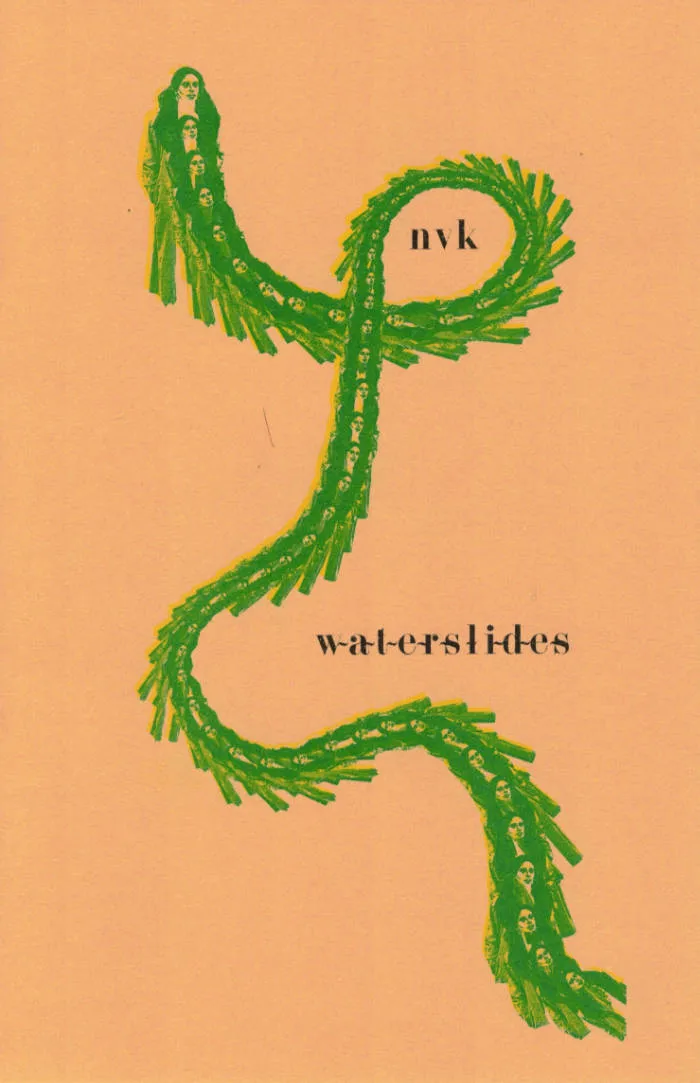
Waterslides
"Waterslides is a falling and plunging, short starts and stops aided by movement, until we splash, climb and plunge again. Each sliding is the same but different—with each descent new expectations and thoughts swirl, shifting focus and gaining new insights or blockages. Waterslides are brief moments of remembering, remembering as a present tense activity, one that happens as we think of it, projected on our now. The waterslide is the moment of past and present working in tandem, a movement of repeating, revisiting and remembering all at once.”
Written by nvk 2021-2023. Dedicated to Judi, MM & TNN.
A version of these poems was published as an audio work through Ignota Press’ The Mountain (2023) and included in a reading with James Loop on Montez Press Radio (2023). nvk would like to thank Jan Matthé, Stine Sampers and Michelangelo Miccolis for their patience & love.
This book was first presented at Kransen in Antwerp, May 6th 2023, with a performance by Sassy (costume by Rosa Schützendorf). Printed and bound at Risiko Press, Borgerhout. Cover image by nvk. Fonts: Adonis, Garamond Pro. Limited to 150 copies.
128x195mm, 16p., stapled, cover: green, yellow and black risoprint on 160gsm caramel paper, inside: black and blue riso on 120gsm Munken Pure paper.

Howdunnit 2 - Panorama
Merle Kröger, Rubaica Jaliwala
Navina Sundaram is sitting in the editing room in Hamburg. She has managed to reduce the complexity of the Kemal Altun case to the required 2 minutes and 40 seconds for the political magazine; a journalistic feat considering the legal terminology and the international political situation, which must be presented in simple terms. She places her interview with the judge at the back. The audience therefore first gets an impression of perhaps the best-known deportation prisoner of the republic on trial here. The phone rings. I imagine she is displeased about the disturbance. It’s the day of the broadcast; the report still needs to be approved. It rings again. She answers. Peter Boultwood is on the phone and says, “Did you hear? Kemal jumped out of the window in the courtroom. He’s dead.”
Merle Kröger lives in Berlin where she works as a novelist, screenwriter and dramaturg. She was a member of the Berlin film collective dog film (1992–1999) and founded pong lm in 2001. Kröger is the co-author of Philip Scheffner’s internationally awarded films Revision (2012), Havarie (2016) and Europe (2022). Kröger has published five novels to date, including Grenzfall (2012), Havarie/ Collision (2015) and Die Experten/ The Experts (2021). Her novels have received numerous awards, including Best Crime Novel of the Year, the Radio Bremen Prize for Crime Fiction and the German Crime Fiction Prize.
Translated by Rubaica Jaliwala

Invisible Oligarchs
Bill Berkson's Invisible Oligarchs is like a book jotted on the back of a poet's hand—a hand that picks up everything that sings to it, from gold-leaf proverb to chopstick sheath, on its quick trip through a few places in urban Russia, 2006. Across faintly ruled Japanese paper, many pages reproduced here in facsimile, snapshots change hands, new poems blink, and poetry politics meet political gossip over lunch in St. Petersburg. Berkson's educated guesswork about that elusive quality once known the Great Russian Soul, is framed here by letters from his friend Kate Sutton and encompassing encounters with poets and cab drivers, Moscow conceptualists and a White Night at the Mariinsky Ballet. As a sharply observant poet and the most soulful art critic alive, Berkson knows how to get us behind the set, and reading this book is as nice as taking a high dive with him into a perfectly mixed White Russian.
Bill Berkson was born in New York in 1939. He moved to Northern California in 1970 and now divides his time between San Francisco and New York. He is a poet, critic, sometime curator, and professor emeritus at the San Francisco Art Institute, where he taught art history and literature for many years. A corresponding editor for Art in America, he has contributed to such other journals as Artforum, Aperture, Modern Painters, and artcritical.com. His recent books include PORTRAIT AND DREAM: NEW & SELECTED POEMS (Coffee House Press, 2009); BILL, a words-and-images collaboration with Colter Jacobsen; Lady Air; Not an Exit with drawings by Léonie Guyer; REPEAT AFTER ME (Gallery Paule Anglim, 2011), with watercolors by John Zurier; and a collection of his art writings, FOR THE ORDINARY ARTIST (BlazeVOX books, 2010), as well as a new collection of his poems, Expect Delays, from Coffee House Press in 2014 and INVISIBLE ORLIGARCHS out from Ugly Duckloing Presse in 2016.

Cadavres
Phœbe Hadjimarkos-Clarke, Rozenn Voyer
Cadavres rassemble 13 poèmes écrits par Phœbe Hadjimarkos - Clarke sur les errances dans les villes âpres, les campagnes humides et les maisons branlantes. Les poèmes sont accompagnés de 15 dessins de Rozenn Voyer.

Lagoon
Part prose poem, part reflection on the relations between writing and place, Lagoon tells the story of the slow undoing of an idyll. In it the narrator walks for hours during long summer nights, gazing through the windows that line the streets. In between, she reflects on how she might write about the shifting space of the lagoon, where she spent summer holidays with her family years ago. In adolescence, the narrator watches quietly as her mother, father and sister go about building their holiday home. But she can sense something is awry, she just does not fully understand what.
Lagoon is the first novella by McCulloch.
Lagoon by Samantha McCulloch is the first title in Kunstverein Amsterdam's new imprint called First Drafts, which, inspired by artist and publisher Anne Turyn, celebrates experimental and commercially unviable work by publishing completed manuscripts that haven’t yet found a home in their first draft form. Importantly, each title is also the first attempt by the author to write in that particular form, or, to write at all.

¶#3: The mental traveller
¶#3 consists of texts and images found on the online collaborative encyclopedia Wikipedia, BIC pen drawings by Kim David Bots and the poem The Mental Traveller by William Blake. ¶#3 is assembled by Kim David Bots, designed by Tjobo Kho, edited by Jan-Pieter ‘t Hart and published in an edition of 150 by OUTLINE in May 2022.

In/Somnia
In/somnia explores fissures within words as places where thought enters. Sleepless sleepers, we dream among ever more complex and hallucinatory realitites: `in/tense/in/season'—Rosmarie Waldrop.
Etel Adnan was born in Beirut, Lebanon in 1925. She is a celebrated writer, essayist, and playwright, and is the author of more than twenty books in all these disciplines. Her work as a whole is a faithful record of the times and places she has lived in Beirut, Paris, and in the San Francisco Bay Area. At least eighteen works by Adnan have been published in English. They include Sitt Marie Rose (Post-Apollo Press, 1982); The Arab Apocalypse (Post-Apollo Press, 1989); Sea and Fog (Nightboat Books, 2012), winner of the Lambda Literary Award for Lesbian Poetry and the California Book Award for Poetry; Premonition (Kelsey Street Press, 2014); Surge (Nightboat Books, 2018); Time (Nightboat Books, 2019), winner of the Griffin Poetry Prize and the Best Translated Book Award; and Shifting the Silence (Nightboat Books, 2020). In 2021, Litmus Press published a second edition of Journey to Mount Tamalpais (originally published by The Post-Apollo Press), which included nine new ink drawings by Adnan. Her paintings, described by New York Times art critic Roberta Smith as "stubbornly radiant abstractions," have been widely exhibited. Spanning media and genres, Adnan's writings have led to numerous collaborations with artists and musicians, including the French part of CIVIL warS, a multi-language opera by American stage director Robert Wilson, performed in Lyon and Bobigny in 1985.

Or, on Being the Other Woman
Throughout this book-length poem, Simone White considers the dynamics of contemporary black feminist life, attesting to the narrative complexities of writing and living as a black woman and artist.
In Or, on being the other woman, Simone White considers the dynamics of contemporary black feminist life. Throughout this book-length poem, White writes through a hybrid of poetry, essay, personal narrative, and critical theory, attesting to the narrative complexities of writing and living as a black woman and artist. She considers black social life—from art and motherhood to trap music and love—as unspeakably troubling and reflects on the degree to which it strands and punishes black women. She also explores what constitutes sexual freedom and the rewards and dangers that come with it. White meditates on trap music and the ways artists such as Future and Meek Mill and the sonic waves of the drum machine convey desire and the black experience. Charting the pressures of ordinary black womanhood, White pushes the limits of language, showing how those limits can be the basis for new modes of expression.

And Then Comes the Chorus
In the high-octane essay And Then Comes the Chorus, Jon Refsdal Moe pursues the imagination of theatre opened up by Alfred Jarry when he slipped an ‘r’ into a profanity as he exclaimed ‘Merdre!’ on stage. ‘What matters is that the words became flesh and that this flesh exploded right in the world’s face. What matters is that literature stood up at the Théâtre de l’Œuvre on December 10, 1896 and cried FUCK! and all hell broke loose and the world has never been the same since.’
Jon Refsdal Moe is a writer and dramaturg from Oslo. He has written two novels, one doctoral dissertation, several essays and a lot of criticism. He was artistic director of Black Box teater in Oslo from 2009 to 2016 and is now professor of dramaturgy at Stockholm University of the Arts.
Published by Varamo Press in the essay series Gestures
First edition November 2022
48 pages, 11.0 x 16.5 cm, sewn perfect binding
ISBN: 978-82-691492-8-9
Graphic design by Michaël Bussaer

Amanda
The artist book Amanda is greatly inspired by “Tradeswomen” quarterly magazine for women in blue-collar work, published in the 1980’s and 1990’s in the United States. Amanda is similarly thought as a periodical dealing with the subjects of technology and industry from a feminist (not solely female) angle. The first issue contains fiction stories of an emancipatory character, citing trade associations, oil industry in Iran and ghosts of the printer feeders.
The publication is made in the framework of The Building Institute, an experimental organisation aiming to strengthen the position of femmes builders in the domain of technical construction work. Amanda brings together literary texts by Maria Toumazou, Samantha McCulloch, Sepideh Karami and Madeleine Morley, combining fiction stories with visual artwork.
Olga Micińska is a visual artist currently living in Amsterdam. Graduated from the MA Art Praxis program at the Dutch Art Institute and holds an MFA in Sculpture from the Academy of Fine Arts in Warsaw. Also trained as a woodworker, collaborates with craft studios of various domains. Recently she has initiated The Building Institute.
The Building Institute (TBI) is an experimental platform aiming to emancipate the undermined knowledges dwelling in the craft domains, and to unpack diverse questions related to technology and the means of production. TBI combines art’s speculative competences with the grounded practice of manual labor, manifesting its objectives through educational activities, exhibitions, and publications.

Afternoon Editions N°4: Certain Things
A day can be a composition not unlike an essay. Full of possibilities, full of limitations, bound by universal structures and marked by idiosyncratic desires. You go on walks. You read. You do your chores. All the while memory and other forms of imagination keep time with you. Books are strange companions; writing is a lonely thing rich with consolations.
Certain Things is a text by Claudia La Rocco, created with and through ideas such as these.
Published September 2022.

Kamer I - Oesters
‘Kamer I - Oesters’ is een kort verhaal geschreven in het kader van het kunstproject Beste Anna,. Hierin fungeert de figuur van de openlijk lesbische Rotterdamse schrijfster Anna Blaman als motor voor vragen, gesprekken en correspondenties rondom feminisme, schrijvende vrouwen en de canon, anders zijn, eenzaamheid en vriendschap.
Ook verkent Katinka met dit onderzoek Anna Blaman als personage voor een toekomstige roman. In ‘Kamer I - Oesters’ betreedt de hoofdpersoon Anna’s met een rolkoffer vol boeken van andere schrijvers, fluistert ze hun woorden in de kieren in Anna’s muren en verleidt ze Anna met een pauwendans.
Anna Blaman (1905-1960) was openlijk lesbisch, in die tijd een groot taboe, maar zag zichzelf niet als voorvechter van een beweging. Een belangrijk thema in haar werk is de vraag of we een ander werkelijk kunnen kennen. De personages in haar romans zijn vaak alleen en verlangen naar een ander, die altijd onbereikbaar blijft. In 1948 publiceerde Blaman de roman Eenzaam Avontuur, die erg veel stof op deed waaien vanwege enkele (homo-)erotische personages die in het boek voorkomen.

Thirty-Odd Functions of Voice in the Poetry of Alice Notley
Alice Notley has consistently peopled her poetry with the voices of those around her: kids, friends, husbands, strangers, and the dead. Thirty-Odd Functions of Voice in the Poetry of Alice Notley offers an array of interpretations of this technique. While not aspiring to completeness, and limiting its attention to one formal aspect of a single author's work, this poem-essay sketches relationships between intimate speech and literary language.

Ante body
An incisive poetic sequence that tracks the relationship between migration and complex traumas in this unsparing critique of the unjust conditions that brought us the global pandemic.
Ante body is a poetics of [un]rest. A project that started as an exploration of how the psychological impacts of migration and complex traumas manifest as autoimmune disease and grew into a critique of the ongoing unjust conditions that brought on the global pandemic. Continuing her use of the invented poetic form, the Arabic, and integrating Fred Moten's concept of "the ANTE," Helal creates an elliptical reading experience in which content and form interrogate the inner workings of patriarchy, capitalism, nationalism, and globalism.
Marwa Helal is the author of Ante body (Nightboat Books, 2022), Invasive species (Nightboat Books, 2019) and the chapbook I AM MADE TO LEAVE I AM MADE TO RETURN (No, Dear, 2017).

Up Your Ass
Valerie Solanas's rarely published, legendary play, Up Your Ass, explodes social and sexual mores and the hypocritical, patriarchal culture that produces them through her signature irreverence and wit, incisiveness and camp.
The play, whose full title is Up Your Ass Or From the Cradle to the Boat Or The Big Suck Or Up from the Slime, marches out a cast of screwy stereotypes: the unknowing john, the frothy career girl, the boring male narcissist, two catty drag queens, the sex-depraved housewife, and a pair of racialized pickup artists, among others. At the center is protagonist Bongi Perez—a thinly veiled Solanas—a sardonic, gender-bending hustler who escorts us through the back alleys of her street life. The fictionalized predecessor to SCUM Manifesto, the play shares the same grand, subversive, implicative language, equally spitting and winking, embracing the margins, the scum, and selling a trick along the way.
Valerie Solanas (1936-1988) is an American radical feminist intellectual, known for her SCUM Manifesto—a pamphlet with which she declares the power of women and imagines a political future through the margin—, and for having tried to assassinate Andy Warhol.
Edited by Leah Whitman-Salkin.
With a contribution by Paul B. Preciado.
Graphic design: Roxanne Maillet.

Eecchhooeess
American poet Norman H. Pritchard's second and final book, EECCHHOOEESS was originally published in 1971 by New York University Press. Pritchard's writing is visually and typographically unconventional. His methodical arrangements of letters and words disrupt optical flows and lexical cohesion, modulating the speeds of reading and looking by splitting, spacing and splicing linguistic objects. His manipulation of text and codex resembles that of concrete poetry and conceptual writing, traditions from which literary history has mostly excluded him. Pritchard also worked with sound, and his dynamic readings—documented, among few other places, on the album New Jazz Poets (Folkways Records, 1967)—make themselves heard on the page.
EECCHHOOEESS exemplifies Pritchard's formal and conceptual sensibilities, and provides an entryway into the work of a poet whose scant writings have only recently achieved wider recognition. DABA's publication of EECCHHOOEESS is unabridged and closely reproduces the design of the original 1971 volume.
Norman H. Pritchard (1939-96) was affiliated with the Umbra group, a predecessor to the Black Arts Movement. He taught writing at the New School for Social Research and published two books: The Matrix: Poems 1960-1970 (Doubleday, 1970) and EECCHHOOEESS (New York University Press, 1971). His work was anthologized in publications including The New Black Poetry (1969), In a Time of Revolution: Poems from Our Third World (1969), Dices or Black Bones: Black Voices of the Seventies (1970), Ishmael Reed's 19 Necromancers from Now (1970), Text-Sound Texts (1980) and others.
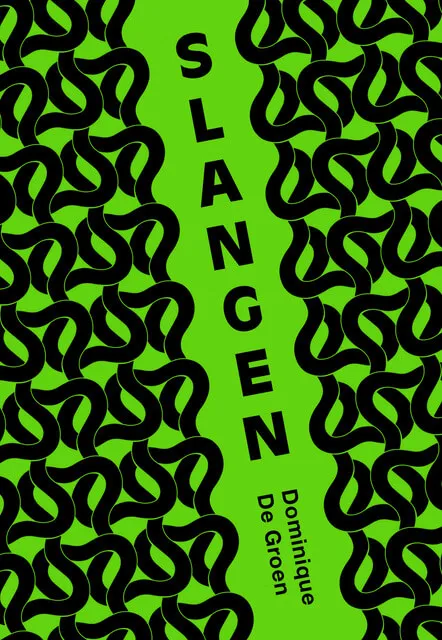
Slangen
Slangen krioelen in de sarcofaag van het heden, in de krochten van de popcultuur, in de mummie van de natuur, in wondes en rot vlees, in artificiële woestijnen en op geoliede dad bods. Ze wentelen zich rond beursgrafieken, raken verstrengeld met wurgende algoritmes, orkestreren een trage ondergrondse revolutie. Een meisje snijdt zich aan een nepdiamanten piramide en werpt haar slangenvel van zich af.
Dominique De Groen is schrijver en beeldend kunstenaar. Ze publiceerde de dichtbundels Shop Girl (2017), Sticky Drama (2019) en offerlam (2020). Ze werd genomineerd voor de Poëziedebuutprijs Aan Zee 2018, de Herman de Coninckprijs 2020 en de Fintroliteratuurprijs 2021 en won de Frans Vogel Poëzieprijs 2019 en de Fintropublieksprijs 2021.