great reads, under 100 pages
great reads, under 100 pages

Biarritz
Written and edited in Biarritz, Borgerhout and Midsommarkransen, 2016—2021. Dedicated to Räffi, with much love. Another version of this text was published in Pfeil Magazin 10 (Montez Press, 2018); editor: Anja Dietmann, copy-editor: Stacy Skulnik. Epigraph from Numéro Deux (1975) by Anne-Marie Miéville and Jean-Luc Godard. Presented on Saturday February 5th 2022 at Kransen, Borgerhout.
128x201mm, 40p, staple bound. Riso-printed on Arcoprint Edizioni Avorio 90g and Clairefontaine Blue 210g. Design by Kaye–Matthé, typefaces: Tribute, Gillies Gothic Light. Printed by Risiko Press at Kransen, covers silkscreened at Afreux, bound by Drukkerijcollectief De Wrikker. Edition of around 200.

Wistlin is did
Chris Mann is an Australian-American composer, poet and performer specializing in compositional linguistics. Mann studied Chinese and linguistics at the University of Melbourne, and his interest in language, systems, and philosophy is evident in his work. Mann founded the New Music Centre in 1972 and taught at the State College of Victoria in the mid-1970s. Mann moved to New York in the 1980s and was an associate of American composers John Cage and Kenneth Gaburo. Mann has recorded with the ensemble Machine For Making Sense with Amanda Stewart and others, Chris Mann and the Impediments, and Chris Mann and The Use. Mann currently teaches in the Media Studies Graduate program at The New School.

Active Reception
A vibrant work of lyric, conceptual, and confessional poetic modes pitched to enact a queer politics of liberation.
Active Reception is a book of bottoming lovers, the world around us, and a history of letters, that thinks through a queer mode of writing from the bottom, a kind of coalition based politics of receptivity and expansion that is open to the world around us, its myriad life forms, its systemic oppressions, its hidden ghosts.
Noah Ross is a bookseller, editor, and poet based in Berkeley, CA. Noah is the author of Swell, and an editor of Baest: a journal of queer forms & affects, and Mo0on/IO with Lindsay Choi.

Translation is a Mode = Translation is an Anti-neocolonial Mode
Don Mee Choi is the author of three books of poetry and hybrid essays, and an award-winning translator of contemporary Korean women’s poetry. In this pamphlet, Translation is a Mode=Translation is an Anti-neocolonial Mode, she explores translation and language in the context of US imperialism—through the eyes of a “foreigner;” a translator; a child in Timoka, the made-up city of Ingmar Bergman’s The Silence; a child from a neocolony.
This pamphlet is part of UDP’s 2020 Pamphlet Series: twenty commissioned essays on collective work, translation, performance, pedagogy, poetics, and small press publishing. Each offers a different approach to the pamphlet as a form of working in the present, an engagement at once sustained and ephemeral.

The Complete Text Would Be Insufferable / Language as Prosthesis
We begin with the image of an idea in ruin. A small field of assumptions disassembled. A question no longer in need of its mark. A thought not sure where it began. It starts from the body and language. The debris of these three words, crumbling already at and, did not break apart but congealed the separations once made. We start from a research (project) undone and just beginning.
Typesetting and design: Will Holder
Produced by: A.pass
Chloe Chignell works across choreography and publication taking the body as the central problem, question and location of the research. She invests in writing as a body building practice, examining the ways in which language makes us up.


one long continuous line or a thought that dissolves into the distance
A short text or a long line written by Mette Edvardsen for Etcetera magazine (June 2018) on an invitation to elaborate on her approach to text, writing and speech from a choreographic point of view. Held by a cardboard cover, the text is here published on its own as a very slim book.

When My Body Was A Clinched Fist
"Back in the day when KRS-One intoned —The Bridge is over!— he did not prefigure a poet from Queens of the fierce attitude and intellectual magnitude of Enzo Silon Surin. WHEN MY BODY WAS A CLINCHED FIST gives the Heisman to such a refrain with lyrical power-packing poetics that settles the score with a succinct— Not! No the Bridge is not over, for Surin's Queens is alive and well and under the gaze of a master observer who eulogizes lives that though at times are battered have always mattered.
Enzo Silon Surin's poems get you caught up in the deeply personal experiences of growing and visceral all-encompassing knowing from an acute witness of every breath and follicle of Black life from palm trees, sand and sea to street corner projects, suburban houses and fistfuls of black water. Surin writes about the confused and disconnected, trigger happy wannabes trapped by outdated notions of masculinity, the cracked head crackheads all held in the clutch of society's clinched fist through which the trauma that comes with being of color, addicted, broke, lost and tossed, is itself a clinched fist of black bodies caught in the Russian nesting doll America's clinched fists make.
WHEN MY BODY WAS A CLINCHED FIST is an elegy for 'the premature exits.' It is a blues for the black-on-black black and blue. Surin yields his pen like a microscopic scalpel whereby an autopsy of possibility is performed to un-clinch the remarkable bone gristle poetry in these unflinching heart-wrenching pages."—Tony Medina
Enzo Silon Surin, Haitian-born poet, educator, speaker, publisher and social advocate, is the author of two chapbooks, A Letter of Resignation: An American Libretto (2017) and Higher Ground. He is the recipient of a Brother Thomas Fellowship from The Boston Foundation and is a PEN New England Celebrated New Voice in Poetry. Surin's work gives voice to experiences that take place in what he calls "broken spaces" and his poems have appeared in numerous publications including Crab Orchard Review, Origins, Transition Magazine/Jalada, Interviewing the Caribbean, jubilat, Soundings East, The BreakBeat Poets: New American Poetry in the Age of Hip-Hop, and sx salon. Surin holds an MFA in Creative Writing from Lesley University and is currently Professor of English at Bunker Hill Community College and founding editor and publisher at Central Square Press. His debut full-length poetry collection is WHEN MY BODY WAS A CLINCHED FIST (Black Lawrence Press, 2020).

Near, At
Near, At follows the inherent strangeness of one’s consciousness as it observes and comes into contact with the physical world. A sustained exploration of language, capitalism, gender, and nature, Near, At traverses and measures the movement of silence against the movement of thought and its pauses. Divided into five parts, each with its own form, and followed by a series of ongoing love poems called MY CHRISTOPHER POEMS, this debut collection is slow to assume but quick to adjust. Rooted in both the traditional and the experimental, it asks just how little of ourselves we can be.
"Jennifer Soong’s collection displays her nuanced understanding of how the philosophical-treatise-as-poem can birth an emotional and embodied intelligence, placing her in a line of affinity with contemporary writers such as Lyn Hejinian, Lisa Robertson and Anne Boyer. Simultaneously, Soong accomplishes something utterly unexpected in 2019: she casts a harpoon into the New England landscape poem – long linked to the genteel, the male, the WASP – and brings it vibrant and expansive into the twenty-first century. Certain poetry collections are written to be 'of the moment,' but a collection such as Near, At is written to give pace to those moments, with each carefully placed word a further step taken by the poet and reader together. Come near, these poems tell us, and we feel we’ll arrive at exactly the time and place we need to be."
—Mia You
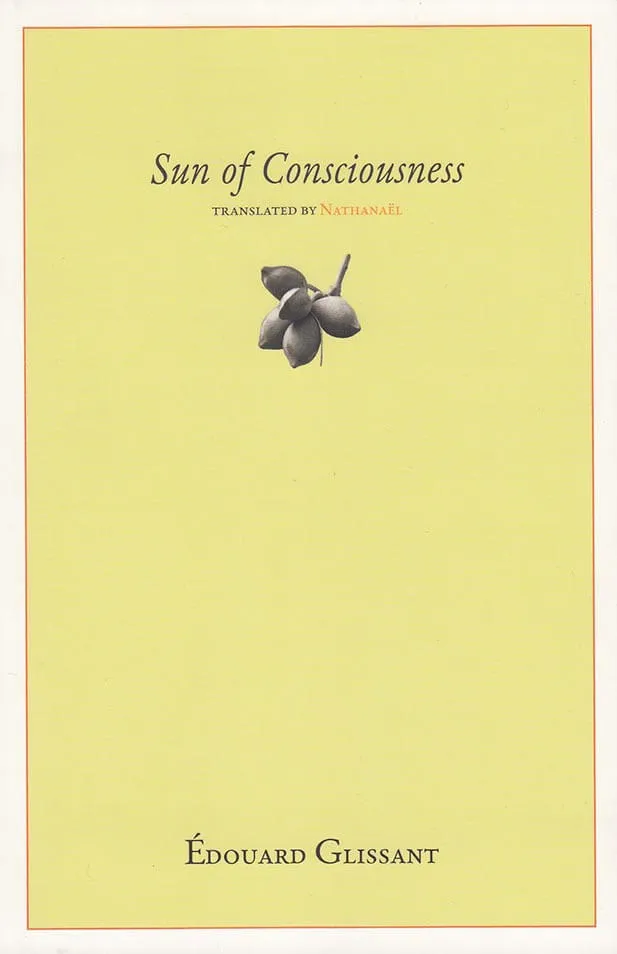
Sun of Consciousness
Soleil de la Conscience (Sun of Consciousness) was Martinican philosopher Édouard Glissant's first published work, and opened the Poétique (Poetics) strain of his oeuvre. This book-length essay, which is characterized by its exploratory, intimate character, announces Glissants concerns with créolisation (creolization), mondialité (worldliness, as against globalization), or opacité (opacity) and inscribes in this work a refusal of colonialism and of inverted exoticism. The sense of estrangement experienced by the author who arrives as a "foreigner" in a country to which he is bound by "the first page of his passport" is the author's principal preoccupation. By positioning himself as both different and same, Glissant opens a space for the writing of a(nother) history: that of the Caribbean.

Artificial Gut Feeling
If winning can only occur in a competition between equal opponents, someone who isn’t equal will need to adopt a different strategy and let go of the promise, or the curse, of victory. Anna Zett takes up the challenge in this collection of personal science fiction, registering the traces systems of power leave in the body, in its locomotory, nervous and digestive systems. Zett’s voice appears in several textual guises, addressing authority, resistance, trauma and the physicality of language. Dedicated to the feminist revolution, the post-socialist subject of Artificial Gut Feeling questions logocentric and capitalist beliefs about the economy of meaning. This book gathers together fists, guts and brains to gain a deeper understanding of the non-verbal roots of dialogue.
"This being is able to transform movement into speech. It winds itself about inside me like a thick snake and I have to use all my strength to let it spin and do what it does. When I wilfully try to stop it, it begins to whisper words to me and that is even more unpleasant. If I were to associate this gut feeling with an emotion, I would say disgust. But this disgust is not directly linked to your name."—Anna Zett
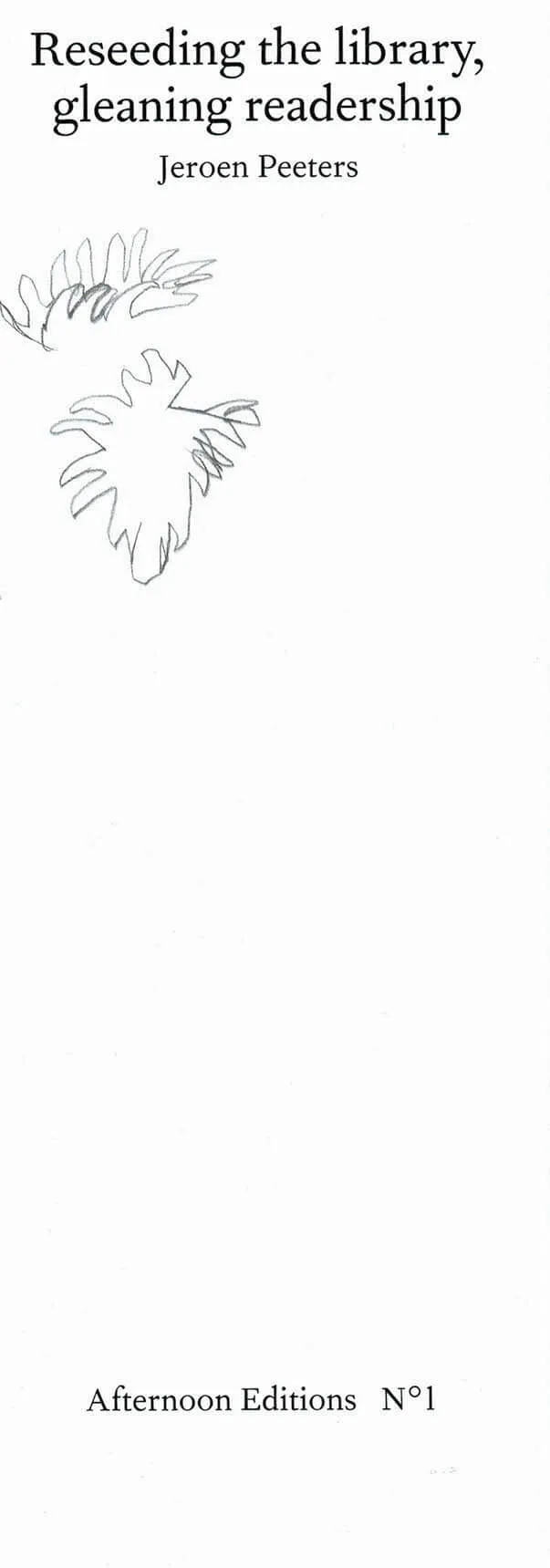
Reseeding the library, gleaning readership
Afternoon Editions no. 1: an essay by Jeroen Peeters titled Reseeding the library, gleaning readership. In May 2017, Time has fallen asleep in the afternoon sunshine settled during three weeks in the Ravenstein Gallery in Brussels as part of the Kunstenfestivaldesarts. Invited as a writer in residence, Jeroen Peeters visited the library of living books on a daily basis and recorded his observations by hand in a notebook, which formed the basis for Afternoon Edition #1. Reseeding the library, gleaning readership is an essay on the seed library, on the dispersion of literature through wind, water and animals, on biodiversity and commoning at the heart of readership. On the cover a drawing by Wouter Krokaert of a Philodendron Xanadu. Published May 2018.

The Men
The Men explores a territory between the poet and a lyric lineage among men. Following a tradition that includes Petrarch's Sonnets, Dante's work on the vernacular, Montaigne, and even Kant, Robertson is compelled towards the construction of the textual subjectivity these authors convey-a subjectivity that honors all the ambivalence, doubt and tenderness of the human. Yet she remains angered by the structure of gender these works advance, and it is this troubled texture of identity that she examines in The Men.

Nilling
NILLING: PROSE is a sequence of five loosely linked prose essays about noise, pornography, the codex, melancholy, Lucretius, folds, cities and related aporias: in short, these are essays on reading.
"I have tried to make a sketch or a model in several dimensions of the potency of Arendt's idea of invisibility, the necessary inconspicuousness of thinking and reading, and the ambivalently joyous and knotted agency to be found there. Just beneath the surface of the phonemes, a gendered name rhythmically explodes into a founding variousness. And then the strictures of the text assert again themselves. I want to claim for this inconspicuousness a transformational agency that runs counter to the teleology of readerly intention. Syllables might call to gods who do and don't exist. That is, they appear in the text's absences and densities as a motile graphic and phonemic force that abnegates its own necessity. Overwhelmingly in my submission to reading's supple snare, I feel love."

Enthusiasm
{ENTHUSIASM} is the 7th poetry collection by poet, artist, curator and vanguardist SJ Fowler. It follows highly-acclaimed collections including The Rottweiler's guide to the Dog Owner and Enemies: the selected collaborations of SJ Fowler. The book's 81 poems are intended as individual pieces in their own right, but are interlinked by subjects including battle and violence, infants and infancy, religion, economy and population, the self, modernity, and the past.