great reads, under 100 pages
great reads, under 100 pages

GOAT FOIL
"Marie’s fragrance, smashed out of the bottle for another breath. We should always doubt that the air is pure. We should always doubt that the air is not."
–Alexandre Curlet
Includes an excerpt from Josh Barber's "Omnipotence".
Published as part of Paraphernalia and Addenda 2.2 of Tabloid Publications.

PARANOID CITI
"Desperate and playful. This iterative poetic series cries through the panic of now to bestill an ecstatic people. Paranoid Citi finds no doubt that if understanding is a matter of form, survival necessitates transformation." - Crystal Odelle, author of Trans Studies
"Who doesn't like to post ethereal lightly? Who isn't a citizenry draped in lilac ethics? Are you a froth? In Shannon Hearn's PARANOID CITI, an interrogative story is shaping up. She's uploading music for grace in crisis. She's writing poems for you, citizen, and kindly so." - Nick Sturm
Includes a bag tag and drawing by Elise Houcek.
Published as part of Paraphernalia and Addenda 2.2 of Tabloid Publications.

UNIVERSAL PRODUCT CODE
"Like the Elizabeth Bishop painting “Interior with Extension Cord,” Kelly Clare’s helical, light-filled Universal Product Code delicately traces a bewildering infrastructure. This incantatory song, “busy in green,” points its reader to the disturbing beauty in stripey checksum barcodes, to arrays of imported figs at the grocer, to words like cloud or lime that now mean too much. Humorous, musical, perspicacious, this chapbook rocks."
- Katherine Gibbel, April 2026
Includes 3 poems by Dre Roelandt.
Published as part of Paraphernalia and Addenda 2.2 of Tabloid Publications.

Open Box (IMPROVISATIONS)
This expanded new edition of Carla Harryman's early-'00s classic, OPEN BOX, features a new introduction by Rachel Levitsky and new afterwords by erica kaufman and Carla Harryman.
GRNN alert just in—Joseph Cornell is doing the can-can over the delicious debris organization in Harryman’s OPEN BOX. This dance of demi-characters—half half, semiquaver, three hooks quarter—places (a State) under an obligation not to maintain armed forces. Next up: removing oneself to another place; migration.
—Tina Darragh
Carla Harryman’s Open Box is a meditation-in-process on the possibility of a poetry available to cultural, social and political critique that does not unwittingly reinscribe the political, social and cultural formations (textual and otherwise) against which it is posed. Because Harryman wants to preserve a ‘place,’ if not ‘places,’ for an aesthetic and procedure resistant to reification, she deploys improvisation as writing, as textual practices open to the future and, more ambitiously, to the past, to the written.
—Tyrone Williams
Carla Harryman is an innovator in interdisciplinary performance, poetry, and prose. She has authored seventeen books including W— /M— (2013), Adorno’s Noise (2008), Gardener of Stars (2001), and the multi-authored work The Grand Piano, an Experiment in Autobiography: San Francisco, 1975-1980. Her Poets Theater, interdisciplinary, and bi-lingual performances have been presented nationally and internationally. She has received many grants and awards including from The Foundation for Contemporary Art, Opera America Next Stage, Fund for Poetry, and The Wallace Alexander Gerbode Foundation.
Carla Harryman is also the author of The Wide Road, a collaborative book with Lyn Hejinian (Belladonna*, 2011, reprinted 2026).

It Was Like Watching
Dear ____,
I happened to look for a while out of “my” window on the 17th floor Palliativstation of the Wiener Allgemeinen Krankenhauses last night, where an enormous orange moon was hanging about, consorting with a lick of dark cloud, near to the tiny gaggle of skyscrapers. I didn’t have much to say for myself and so it just sort of looked back at me.
Every day friends and well-wishers come here and as always I want to run to my room and read a book until they’ve left but for the first time in my life my room is also the room they want to visit, and so I can’t. I wrote down yesterday as best as I could the words of my last long conversation with Marina: there might be more, but the words are running away from her now, which only makes you realise how small and insignificant they are, fleeing from something (from someone) who remains exactly who they were even in their absence: like dust falling from the sun.
*
A voyage in the insight which comes as a kiss and follows as a curse, made after you ran out of things to say.——first halting efforts at mutual understanding——love letters from twelve years ago. journal entries from fifteen years before lick at the edges like flames. Opaque coloured shadows, projected in three dimensions——of a——future that——has. never ceased to exist and which——Doesn’t——.——.——arrive to speak about their fears.—— Beginning with a naked bathroom selfie.
An attempt to live nonjudgmentally and without fear, against the desire to be something other than who you were, as a basic form of class hatred, a fear of the common and of everything that happens there, near speechlessness, trailing off, only sometimes coming back to life again, shame dies so that everything else can be saved, and everything else remains present against the background of this absence, beneath the harsh overhead light, as you pull on the pathetic, unassuming string of the pullcord.
Dedicated to one person, written by one another. “Poems written by / different poets / are my nakedness.”

October
What do we carry from one year to the next? What remains after devastation, and what, despite everything, takes root again?
October in Lebanon is heavy with memory. The euphoria of the 2019 revolution feels far away, its anniversaries marked by crisis, war and the genocide in Gaza.
Across multiple Octobers, Nur Turkmani meditates on rupture, transformation and the quiet undoing and remaking of relationships during collective catastrophe. Part archive, part love letter, her debut poetry collection holds the ordinary and the extraordinary in the same breath, spanning balconies and border towns, fig trees and songs for friends, autumn light and the instinct to flee.
Formally spare and emotionally saturated, October refuses both numbness and spectacle. These poems ask what it means to survive the world and still long for it; and how we hold what’s disappearing, or changing too quickly to make sense of.

Affiliation
Mira Mattar, Judith Abensour and 1 more
Affiliation, de Mira Mattar, autrice londonienne issue de la diaspora palestinienne, explore des thèmes tels que le genre, la famille, la religion, la guerre, l’écologie, le colonialisme et l’amour, en lien avec des lieux comme la Jordanie, le Liban, la Palestine et le Royaume-Uni. Interrogeant nos affiliations personnelles et collectives, et la manière dont les systèmes de pouvoir influencent nos désirs et nos identités, le livre s’ouvre sur quatre Lettres d’Amman qui propulsent le texte poétique dans le mouvement du monde et attestent de la dynamique de l’exil palestinien, où l’éclatement, l’effacement et l’appropriation se mêlent avec les effets contemporains de la mondialisation.
La deuxième partie du livre, intitulée Affiliation (pour mon père) est un long poème rétrospectif qui court sur une trentaine de pages. L’écriture à la première personne de Mira Mattar met en tension des contextes politiques, domestiques, intimes, économiques où se déploient des affiliations coloniales, capitalistes, patriarcales, nationalistes. Elle en restitue les violents processus internes, passant du refus de se soumettre à l’impossible échappée. Dans Affiliation, on fait l’expérience d’être en dehors: en dehors de son corps, en dehors d’un pays, en dehors d’une pièce. Il n’y a aucune position stable, et le sujet se construit dans un éclatement constant. Peu de livres articulent aussi finement expérimentation formelle et nécessité de l’expression verbale. Affiliation est un flux de langage dont on peut sentir l’urgence à chaque vers.

Heights of Macchu Picchu
Pablo Neruda’s Alturas de Macchu Picchu is a poem that distrusts solitary authority even as it passes through a single voice, moving from the lyric “I” toward a collective utterance grounded in labor, history, and shared breath.
Producing the first collaborative translation of Alturas de Macchu Picchu is not incidental but consonant with its deepest claims. Attentive to Neruda’s unique lyric pressure, this new English version resists the tradition of singular, authoritative renderings by allowing meaning, rhythm, and decision to emerge through dialogue and negotiation.
In this way, the translation does not merely transmit Neruda’s poem but enacts its insistence that voice is a collective achievement, not a solitary possession.

Good Looking Pomes
"Joseph Matick is a former poet, now bird. He flies over pastures and eats chemtrails as his karmic sentence for spending so many years without flying. (You still have time, kids). Remarkably, he wrote this book in Paris with Jack before his transformation into Frank 0' Hara for the front cover. This book is dedicated to his father and his son. And to all the gum chewing geniuses of the lower canal. He wrote this in the 9éme and was inspired by baseball, flowers, and getting money so as not to die. These are his simplest and most penetrating words."
KATE FOR AVEC JACK VERA INTL
Joseph Matick is an American poet and filmmaker based in Paris. He grew up on a farm in small-town America, moved to Chicago, and eventually to Paris, where he stayed. He studied at the Jack Kerouac School of Disembodied Poetics at Naropa University — of which he has said: “that place ripped the rug from under my feet” — and has been writing ever since. He is the author of four books: three published by Far West Press — The Baba Books (New American Babble, Post Meridiem Seasick Fuzz, Animal My Soul), Cherry Wagon, and Good Looking Pomes (March 31, 2026). His work appears in King Kong Magazine and is held in the collection of the American Library in Paris.
Translated to English for the first time.
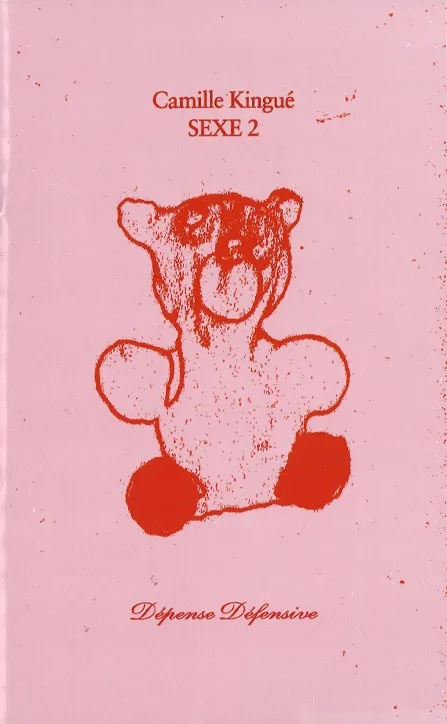
Sexe 2
Confession sur le désir (l’action et l’objet du), les liens de mutualité et de résistance, Sexe 2 alterne prose et versification en 27 fragments numérotés à l’adresse plus ou moins dure, plus ou moins sincère, plus ou moins formulée car plus ou moins éloignée du Toi et du Je. Camille Kingué s’attache à révéler, à voir quelque chose à travers son image réelle et virtuelle, agrandie et rétrécie, droite et renversée, déployant une recherche des principes de l’amour (l’amour comme amour, pourquoi est ce qu’il y a de l’amour) où la métaphysique et la compréhension de soi – donc de l’autre – n’ont jamais été aussi sexy.
Claire Star Finch, dans la magnifique préface qu’iel signe au début de l’ouvrage, écrit : « Après avoir lu tous les livres de Kingué, je ne sais pas si je crois en “l’amour”, que ce soit en tant que substantif absolu ou en tant que proto-résidu de tout ce que “le sexe” peut signifier. Mais je crois définitivement qu’il faut l’écrire. » Définitivement.

CUNY Center for the Humanities
“This Great River”—Translating the Beats into Arabic
Sargon Boulus, Khaled al-Hilli
The Great River—Translating the Beats into Arabic traces the literary encounters of Sargon Boulus (1944-2007), an Iraqi poet who was part of the vibrant literary scene of late 60’s San Francisco. His life was marked by a period of restless traveling, that he would later describe as an attempt to pursue a poetic imaginary. This project continues to map his proximity to the Beat poets, his short-lived Bay Area poetry journal, Tigris, and his other English language publications.
This publication includes a facsimile reproduction of Tigris, featuring a long poem “Jebu” by Boulus’ good friend Etel Adnan.

Red Seed: Poems for Luno
Cruz Alejandra Lucas Juárez, Wendy Call and 1 more
Through a voice at once intimate and collective, Lucas Juárez expands the powerful presence of Tutunakú roots to open up territories and to interweave desirous bodies, dream relationships, and the memories of women ancestors. This beautiful translation by Wendy Call and Whitney DeVos, in a precious handmade edition, affirms the trilingual (Tutunakú, Spanish and English) as an ethical strategy of listening to and translating the world. Red Seed collects twelve poems of women's sexualities and spirits in which body, language and territory are political spaces that Indigenous memory expands within and renews.
—Maricela Guerrero, author of The Dream of Every Cell

touxs mes queers sont des poéte·sses
Car archiver nos écrits et nos paroles n'a jamais été aussi important, car il faut rendre compte de nos existences, de ce moment, pour nous et pour les futurs queers en recherche de repères oui, nous avons écrit, donc oui vous pourrez écrire aussi ! oui, nous avons existé, donc oui, vous existerez aussi ! car oui, nous sommes toustes poéte·sses ! car nos vies sont des poèmes et être queer est de la poésie car touxs mes queers sont des poéte·sses!
Because preserving our writings and our words has never been more important, because we must bear witness to our lives, to this moment, for ourselves and for future queers in search of guidance yes, we have written, so yes, you can write too! yes, we have existed, so yes, you will exist too! because yes, we are all poets! because our lives are poems and being queer is poetry because all my queers are poets!
CUNY Center for the Humanities
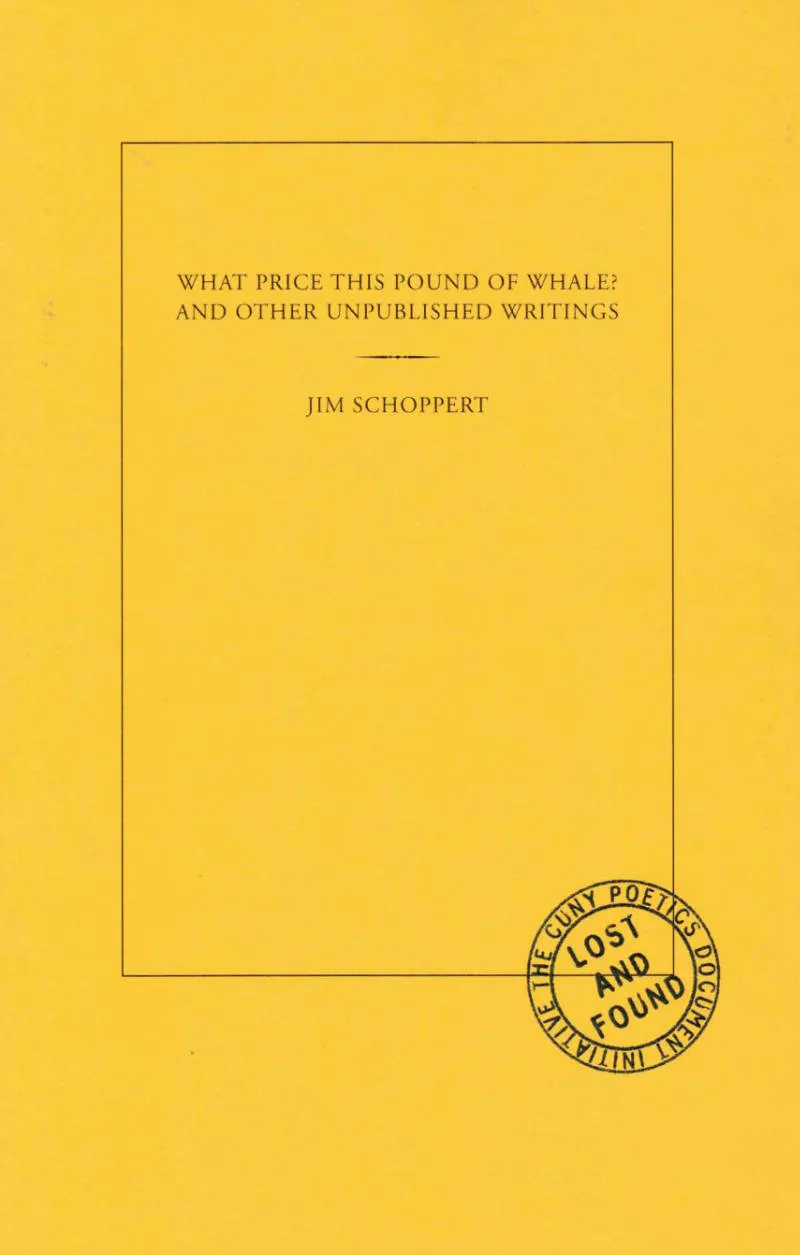
What Price This Pound of Whale? and Other Unpublished Writings
The Tlingit artist Jim Schoppert (1947-1992) was among the most accomplished, innovative, and prolific Alaska Native artists of the twentieth century. His whimsical sculptures and large scale painted wooden carvings reconfigure Tlingit visual motifs, and he challenged the binary categories against which Indigenous artists are so often defined, such as traditional and contemporary, historic and innovative, and artist or craftsperson. While known primarily for his modernist interventions in Tlingit visual traditions, Schoppert was also a prolific writer, an eloquent speaker, and an ardent advocate for Alaska Native artists. This publication brings together a selection of his unpublished poetry and writings from the artist’s personal papers. Presented alongside never before seen sketches and studies, this selection bridges Schoppert’s written and artistic practices in a deeply personal portrait of the artist and Alaska Native life that upsets preconceptions about Native art and unsettles the established narrative of Euro-American and Indigenous aesthetic relations.
Jim Schoppert (1947-1992) was a Tlingit multidisciplinary artist and writer. He was a Taku Tlingit Raven of the Ishkahittaan (Inland Frog) clan from his Tlingit mother and half-German from his father and carried the Łingit name Dom-Yetz. Born in Juneau, Alaska, he earned a BFA in Sculpture and Printmaking from the University of Alaska—Anchorage and an MFA from the University of Washington. In addition to his artistic career, Schoppert was instrumental in promoting Alaska Native arts and organizations. He was Director of Arts and Crafts at the Cook Inlet Native Association, Director of the Alaska Arts in Prisons Program for the University of Alaska Juneau, and organized exhibitions and workshops across Alaska and the Pacific Northwest. He was visiting professor in visual art at the University of Alaska, Fairbanks and directed its Native Art Center. He sat on the Washington State Arts Commission and on the boards of the Alaska State Council on the Arts and the Institute of Alaska Native Arts. His work is held in public and private collections across the United States, including the Smithsonian National Museum of the American Indian, the Anchorage Museum, the Heard Museum, and the Newark Museum, among others. His writing and poetry has appeared in The Greenfield Review and Journal of Alaska Native Arts, among other publications.

Records of a Cassia-Eater
“I had a dream last night in which I was being escorted across the Styx Bridge by a serpent. The bridge, long and thin and seemingly suspended in space, impressed me, and I asked the serpent who it was that had built it. He said something, but I cannot remember what. Upon awakening, I felt terribly lost. It seemed clear to me that my nights were being controlled by mystic forces.”
This 32-page chapbook is an “occult diary” of sorts.
BRENDAN CONNELL was born in Santa Fe, New Mexico, in 1970. He has had fiction published in numerous places, including McSweeney’s, Adbusters, and the World Fantasy Award winning anthologies Leviathan 3 (The Ministry of Whimsy 2002), and Strange Tales (Tartarus Press 2003). His works of fiction include Unpleasant Tales (Eibonvale Press, 2013), The Architect (PS Publishing, 2012), Lives of Notorious Cooks (Chômu Press, 2012), Miss Homicide Plays the Flute (Eibonvale Press, 2013), Cannibals of West Papua (Zagava, 2015), Jottings from a Far Away Place (Snuggly Books, 2015), and Against the Grain Again: The Further Adventures of Des Esseintes (Tartarus Press, 2021). As editor he has worked on various projects, including The Neo-Decadent Cookbook (Eibonvale Press, 2020), which was co-edited by Justin Isis.
Chapbook of 100 hand-numbered copies, lithographically printed on 95 g/m Italian gesso paper with a “hammered” texture. The cover is lithographically printed on 285 g/m recycled birch-colored Italian paper.

Blood On The Tracks
John Joe Kane, Vladimir Nahitchevansky
Blood On The Tracks is an elaboration and cacophony of manic friendship, eroticism and poetic play. Writing into the lyrical text of Bob Dylan's 1975 Album of the same title, the two authors take inspiration from Raymond Roussel's generative mode of translation, and quickly transform the lyrics of Blood On The Tracks into a variety of languages, to then translate these lyrics back into the English text present in the book. The result is a complicated and combative free wheeling text that explores the possibility of co-authorship, and interpretive translation. Featuring a forward by confirmed tramp, filmmaker and photographer Bill Daniel.

God Is a Bitch Too
María Paz Guerrero, Camilo Roldán
God Is a Bitch Too is the accelerated and acidic English-language debut of Colombian poet María Paz Guerrero. In this chapbook, god is needy, Latin American, and an overweight woman. No one asks god to dance. Someone speaks, someone tries: “One is the measure of their body.”
God Is a Bitch Too is #13 in the Señal series for contemporary Latin American poetry in bilingual editions.

Tis of Thee
With figures X, Y, and Z, Fanny Howe constructs "a repressed but emotional history" of encounters and unions between races, classes, genders, and epochs. Considering race as "the most random quality assigned to a soul," Howe has undertaken an (American) history of a racially mixed population. The work bears evidence to many creative unions as well: with Ben Watkins, who provided the photographs; with graphic artist Maceo Senna, who illustrated the text; with Nya Patrinos, set designer, video artist, and director of the original production; as well as with composers Miles Anderson and Erica Sharp, whose score adds another voice to the spoken three. The book includes a link to an audio recording of the work, originally performed at the Porter Troupe gallery in San Diego, 1997, with Paul Miles (X), Stephanie French (Y), and Andre Canty (Z). "So whiteness is what is dependent on a witness. / The moon's opaque and egg-like sheen is the kind of zero / that wants to be more than air and negativity."

Faux Ice
James Goodwin’s Faux Ice contains six poems: ‘Roman Street Sweeper’, ‘Technomarine’, ‘Meridian Walk’, ‘Astroturf’, ‘Star Bright Ice’, and ‘Faux Ice, or The Same as Fantasy?’ Goodwin writes:
“A constrained economy of expression is the formative approach I’ve taken with these poems. I was motivated, in my early attempts, to reproduce, as a crystallised element of black lyric expressivity, the condensed form of the grime lyric, and its invocations of blackness as a poetic description of being immersed in and by indistinction. Or aspects of the black life of poetry which do not derive their origins, causes, or relations from communicative modes of clarification in language. And so the poems in Faux Ice are oblique expressions and articulations of the ways reality is refracted by [the] questions of what is real, informing, say, the experience of seeing without being seen on the one hand and having no others on the other.”
Inheriting from eskibeat and drill and from other sources of experimental Black sociopoetics, these poems, with their dispersed and insistently plural voices, aren’t interested in building up, but in dismantling a stable subject, their icy conditions always displaced and subject to change.
“shot of this glean of jewel with the
force of a technomarine to
connect the more looks around the
pressure-encrusted, iced out skip and
lack of any protection”
JAMES GOODWIN is the author of Fleshed out For All the Corners of the Slip (the87press, 2021), and Aspects Caught in The Headspace We’re In: Composition for Friends (Face Press, 2020). He is currently completing a PhD at Birkbeck College, University of London.

Strange Biology
Strange Biology, Charlotte Strange’s first chapbook, opens with a social media advertisement marketing a probiotic as an alternative to the “nuclear bomb” of antibacterial acne medication. As Strange investigates the treatment of the human body as a landscape submissive to medical intervention, they ruminate on the contemporary relationship between microbes, gut-directed medical technologies, and capitalism’s encroachment on life. Drawing on the vernacular of social media marketing, they deftly oscillate between instructive and personal registers, stretching the private across a nexus of microbial interminglings. Strange Biology reflects on the semiotic science of the gut: how the language of medicine defines the mutating edges of the human body.

SIN BUG
A new book by poet-activist CAConrad combining essay, memoir and (Soma)tic poetry rituals. Documenting the pervasive homophobic violence of the 1980s and the overwhelming losses of AIDS, this work is an unwavering testament to queer resilience. CA’s text forms a resounding incantation to friends and lovers lost. SIN BUG is the first book published as part of the Open Narratives series.
he wrote “I have AIDS
and kissed this wall”
X marked the spot
I wrote “I’m not afraid”
and kissed him back
wherever he is
CAConrad has been writing poems for more than 50 years and working with (Soma)tic poetry rituals for over 20 years. Their latest book is Listen to the Golden Boomerang Return (Wave Books / UK Penguin 2024). The Book of Frank is available in 9 different languages, most recently French and Italian. They also exhibit poems as sculpture with recent shows in London, Melbourne, Porto, Santander, and Tucson. Please visit them online at CAConrad.com.

The Consequences
The Consequences is a hybrid collection of prose and poetry; an autofictional examination of the pain of a transatlantic relocation from New York to the blanketing beige of Paris to rejoin a totemic muse. It also focuses on corgi attacks, Maryland, painful anxiety, the struggle to accept the things one cannot change, the third party and the past as adamantine shackles. The "towering sexual iconography of Mike Immerman" looms over the disorientation of a reluctant resident in “the City of Light.”

Issue № 6 - Winter–Spring 2026 / SENSING BODIES
Coming back to the body is rarely tranquil. Often it is turbulent, interrupting dominant narratives and entrenched meanings. It is the upset of being alive, and awake to it.
The fourteen texts in this new issue do not shy away from that turbulence. There is joy and there is pleasure, there is shame, pain, and liberation... Each text addresses this dense experience from a singular perspective, yet together they explore what emerges and becomes possible when sense-making and making sense(s) are re-anchored in the sensing practices of the body.
With texts by Valérie Hug, Marco Antonini, cassiane c. pfund, Elodie Olson-Coons, Ines Marita Schärer, Bernadette Kolonko, Jo Bahdo, Lotta Beckers, Melanie Jame Wolf, Samuel Brzeski, Madeleine Kaye, Nora Longatti, Rosanna Puyol Boralevi, Larissa Clement-Belhacel
editorial team: Delphine Chapuis Schmitz, Nicole Bachmann, Robert Steinberger, and Shelby Lee Stuart as invited editor

Glove Money
A hymn to perversity, a lyric pledge to desire and risk, Glove Money pages through the canon to “seed its sugar in your dreams.”
In this joyful and irreverent exploration of the role of poet-as lover, Sophia Dahlin plays Sappho, O’Hara, romantics and troubadours, assembling a self seaworthy of romance. With humor and a light touch, Glove Money dismisses bioessentialist gatekeeping and expands the lesbian imaginary.