Kayfa ta
Kayfa ta

How to speak dead
A meditative reflection on language and its loss.
How does one language inherit another? Defeat, erase or live through another? How to speak dead is Walid Sadek's meditative reflection on language, dead or victorious. At heart, beyond defeat and victory, it is a reflection on how one can approach a speaking that is of neither a living language nor a dead one. A speaking that knows loss and knows it is woven into every uttered word, every spoken sentence. A loss that becomes syntax.
"There, where the battle is lost and won and where, after the hurly-burly is done, we may approach a speaking that is of neither a living language nor a dead one. A speaking that knows loss and knows it is woven into every uttered word, every spoken sentence. A loss that becomes syntax."
Walid Sadek
Walid Sadek (born 1966 in Beirut) is a Lebanese artist and writer. He is a professor at the Department of Fine Arts and Art History of the American University of Beirut.

How to live from fire to fire
Olivier Marboeuf takes us on a journey through myths, archives, and fables, where fire symbolizes Caribbean culture, colonial oppression, and ecological disasters, and where the echo of past revolts becomes the spark for future insurrections.
How to Live from Fire to Fire brings together two closely linked texts by Olivier Marboeuf. The volume opens with Marboeuf's latest work, How to Live from Fire to Fire, written as a new commission, and is followed by the first English translation of his earlier text The Night Just Before the Fire, originally published in French in 2025 by Atlantiques déchaînés.
Written as if in the same breath, the two texts follow one another in a fevered, relentless movement. In The Night Just Before the Fire, Marboeuf reworks Bernard-Marie Koltès's play La Nuit juste avant les forêts (Éditions de Minuit, 1977), transforming it into the delirious, unbroken monologue of a man with dark blue skin calling out to another man in the streets of a major European city. Through this act of rewriting, the echo of past revolts becomes the spark for future insurrections. Next time, a riot.
"The French believed that burning the king of the carnival would suffice to erase these old stories and impose a modicum of order in the beautiful Caribbean colony. They thought that everyone would return home and that the streets would take on their usual amnesiac calm after this necessary moment of release. At the end of the celebration, on Ash Wednesday, King Vaval would be burned and along with him, corruption, excess, and bad lives would burn too. But nothing was said about monopolies. Because even when residents returned home, exhausted by the festivities, even when the dark of night cloaked this whole little world and emptied its public squares, water continued to flow dark from taps and poison snaked a path into the land and its gardens. Somewhere, forests and cities continued to burn."
—Olivier Marboeuf
Olivier Marboeuf (born 1971) is an author-storyteller, artist, independent curator, cultural theorist and film producer from Guadeloupe. In the early 1990s, he co-founded éditions Amok (now Frémok) publishing and launched the Parisian literary café Autarcic Comix. He was artistic director of Espace Khiasma (2004–2018) which contributed to introducing postcolonial theories to the French art scene through numerous exhibitions and encounters
Translated from the French by Liz Duff Young.

How to see palace pillars as if they were palm trees
Hussein Nasseraddine, Ben Koerber
For so it happens that when the poets speak, objects appear closer to their own shadows. The poet's mouth fills up with horses and marble, and his verses start to shine like rivers. These rivers then turn back to flow through the very palace he is depicting. The poet's own words begin to weigh down on him, as though he were holding up a palace with his palms. Then he travels, and the palace is obliterated. Countries and nations change, and naught remains but what the poets had seen. Of what the poets had seen, naught remains but its image in anthologies. And when the libraries have been flooded or burned to the ground, nothing but the commentaries on those anthologies are left, and all that one finds in these commentaries is that which was appropriated and wrought a thousand times over.
Hussein Nassereddine is a multidisciplinary artist. His work in installation, writing, video and performance originates from a practice around language that builds fragile monuments - some verbal, some sonic, some tactile - rooted in collective histories and resources of poetry, ruins, construction and image-making.
Translated from Arabic by Ben Koerber.

How to make female action heroes
M was exasperated by her friend's frivolous attitude toward the tragedy of losing a role. She was not trained to read the potential in R's wild imagination. Was it a commitment to realism, trained by the ideological morality of activism, that made her unresposive to the fantasy genre and vigilante characters? R's instinct was to court the unfamiliar, whereas M's training was to engage with criticality. Both these attributes could have interfaced in interesting and colourful ways, with sparks and currents, if and only if the social conditions of the time had been conducive to the arrival of a vigilante.
Madhusree Dutta is a filmmaker, curator and author based in Mumbai and Berlin. She has been the executive director of Majlis Culture, a centre for rights discourse and art initiatives in Mumbai, 1998-2016; and artistic director of Academy of the Arts of the World in Cologne, 2018-2021. Her areas of interest are documentary practices, urban cultures, migration movements, transient identities, and lived-in hybridity.

How to maneuver: Shapeshifting texts and other publishing tactics
The research and series of exhibitions that this publication grew out of, is part of an ongoing project exploring the significant work of individuals, collectives and institutions in the field of alternative art and publishing practices, past and present.
Contributors: Ahmad Makia, Ali Eyal, Ali Hussein Al-Adawy, Ali Yass, Andrew Murphie, Bady Dalloul, Barakunan, Bernhard Cella, Elaine W. HO., Faisal Al Hassan, Farah Khelil & antoine lefebvre editions, Fehras Publishing Practices, Giulia Crispiani & Federico Antonini, Hala Bizri & Jana Traboulsi, Haytham el-Wardany, Huda Smitshuijzen AbiFarès, Hussein Nassereddine, Jabbour Douaihy, Jaffat El Aqlam, Khalid Albudoor & Nujoom Alghanem with Rand Abdul Jabbar & Uns Kattan & Hammad Nasar, Moad Musbahi, Noopur Desai, Raafat Majzoub, Yazan Ashqar.

Howdunnit 2 - Panorama
Merle Kröger, Rubaica Jaliwala
Navina Sundaram is sitting in the editing room in Hamburg. She has managed to reduce the complexity of the Kemal Altun case to the required 2 minutes and 40 seconds for the political magazine; a journalistic feat considering the legal terminology and the international political situation, which must be presented in simple terms. She places her interview with the judge at the back. The audience therefore first gets an impression of perhaps the best-known deportation prisoner of the republic on trial here. The phone rings. I imagine she is displeased about the disturbance. It’s the day of the broadcast; the report still needs to be approved. It rings again. She answers. Peter Boultwood is on the phone and says, “Did you hear? Kemal jumped out of the window in the courtroom. He’s dead.”
Merle Kröger lives in Berlin where she works as a novelist, screenwriter and dramaturg. She was a member of the Berlin film collective dog film (1992–1999) and founded pong lm in 2001. Kröger is the co-author of Philip Scheffner’s internationally awarded films Revision (2012), Havarie (2016) and Europe (2022). Kröger has published five novels to date, including Grenzfall (2012), Havarie/ Collision (2015) and Die Experten/ The Experts (2021). Her novels have received numerous awards, including Best Crime Novel of the Year, the Radio Bremen Prize for Crime Fiction and the German Crime Fiction Prize.
Translated by Rubaica Jaliwala

كيف تلتئم – عن الأمومة وأشباحها - How to Mend: Motherhood and Its Ghosts
A highly personal and sensitive exploration of motherhood.
In How to Mend: On Motherhood and its Ghosts, Iman Mersal navigates a long and winding road, from the only surviving picture of the author has with her mother, to a deep search through what memory, photography, dreams and writing, a search of what is lost between the mainstream and more personal representations of motherhood and its struggles. How to mend the gap between the representation and the real, the photograph and its subject, the self and the other, the mother and her child.
"If I'd been more aware and someone had asked me about 'my mother's picture' I would have shown them the bird she'd stitched onto the canvas herself. It is not aesthetic vision or skill that summons my mother's presence in this canvas, but the slight punctum the bird gives me. I get nothing of this sort from our studio portrait. The bird's eyes are always looking at me, as though they belong to her. The bird: motionless, for whose sake my mother sat and stitched by the window where the light came in, each pinprick a symbolic laceration in the process of its embodiment: cuts by the hundred to make it whole."
Iman Mersal (born 1966 à Mit 'Adlan) is an Egyptian poet, writer, academic and translator. She works as an Associate professor of Arabic literature and Middle Eastern studies at the University of Alberta, Canada. An anthology of her works was translated into more than twenty languages and she has five poetry collections published.

How to Mend: Motherhood and Its Ghosts
In How to Mend: On Motherhood and its Ghosts, Kayfa ta’s 4th monograph, Iman Mersal navigates a long and winding road, from the only surviving picture of the author has with her mother, to a deep search through what memory, photography, dreams and writing, a search of what is lost between the mainstream and more personal representations of motherhood and its struggles. How to mend the gap between the representation and the real, the photograph and its subject, the self and the other, the mother and her child.
Iman Mersal is an Egyptian poet and associate professor of Arabic Literature and Middle Eastern Studies in the University of Alberta, Canada.
Editors: Maha Maamoun and Ala Younis
Co-publishers: Kayfa ta and Sternberg Press
Design: Julie Peeters
Size: 9.6 x 14.8 cm

How to love a homeland
Russian writer and philosopher Oxana Timofeeva was born and grew up in various parts of the USSR. The book explores the difficulty of reducing one’s sense of homeland to one’s country alone, the philosophical interconnectedness of movement and rootedness, our plant and animal souls, and how we need to reimagine our desired, fictional if need be, homelands. The book interweaves vignettes from Timofeeva’s childhood across different parts of the USSR with a philosophical discussion of ideas on homeland in the thought of Brecht, Deleuze and Guattari, and other main figures of literature and philosophy.
Oxana Timofeeva is Sc.D., professor at “Stasis” Center for Philosophy at the European University at St. Petersburg, leading researcher at Tyumen State University, member of the artistic collective “Chto Delat” (“What is to be done”), deputy editor of the journal “Stasis”, and the author of books History of Animals (London: Bloomsbury Academic, 2018; Maastricht: Jan van Eyck, 2012), Introduction to the Erotic Philosophy of Georges Bataille (Moscow: New Literary Observer, 2009), Solar Politics(forthcoming, Polity, 2022).
Commissioned and published by Kayfa ta (2020)
Translation from Russian by Maria Afanasyeva
Design template by Julie Peeters
Cover illustration by Jumana Emil Abboud

How to remember your dreams
The book is a sharp and creative reflection on the interweaving of personal and national/ideological dreams. The chapters are on facts and fictions created in both, how one retraces one’s way through them, and through the numerous philosophers/thinkers/ideas (from Sartre to Zizek, Abdel-Nasser to Ibn Taymiya and others) that appear and shape his life journey, studies and dreams.
Amr Ezzat is an Egyptian writer who studied engineering and philosophy. He worked as an engineer and then a journalist before becoming a human rights researcher and a writer for numerous newspapers and other periodicals. He remembers his dreams very well.
Commissioned and published by Kayfa ta in 2019, printed in Beirut in 2021
Translated from English by Jennifer Peterson
Design template by Julie Peeters
Cover illustration by Hany Rashed

How to spell the fight
James R. Murphy, a math teacher in La Guardia, New York, regarded mathematics as the most powerful and manipulable abstract language available to humans. To acquaint students who don’t “like” math with abstract and systematical thinking, he put a piece of string in their hands and taught them to make string figures.
How to spell the fight follows a thread that has been running through our fingers from centuries past till the present day, morphing from the tangible string figures that join our hands in childhood to the more elusive computational algorithms that engage our fingers today. Following this line of inquiry through various twists and turns, a conversation about collective agency emerges with the aim of rethinking current paradigms of cognition, education, and power.
Natascha Sadr Haghighian is an artist living in Berlin. Her research-based practice encompasses a variety of forms and formats, among them video, performance, installations, text, and sound. She tries to learn how to make string figures.
Text: Natascha Sadr Haghighian
Commissioning editors: Maha Maamoun and Ala Younis
Copyeditor: Ryan Inouye
Co-publishers: Kayfa ta, Sternberg Press, and Tanmia Bookstores
Design template: Julie Peeters
Size: 9.6 x 14.8 cm
Pages: 80 pages, Soft cover
Printed in Cairo.

SSS – How to imitate the sound of the shore using two hands and a carpet
This publication takes up the issue of mimicking nature and demonstrates how to produce the sound of the sea using two hands and a synthetic carpet.
Artist book by Cevdet Erek
Translated by Ala Younis
Copyedited by Hanan Kassab and Maha Maamoun
Commissioning editors: Maha Maamoun and Ala Younis
Design: Julie Peeters
This publication is an adaptation of Cevdet Erek’s artist book SSS – Shore Scene Soundtrack, Theme and Variations for Carpet, originally published in Istanbul in 2007, by BAS (İstanbul Sanat Aras ̧tırmaları Dernegi), in the context of BENT, Artists’ Books from Turkey, edited by Banu Cennetoğlu and Philippine Hoegen, with design adviser Bülent Erkmen and prepress production assistant Oğuz Yaşargil.
These editions are produced in the context of and with support from Durub Al Tawaya (2014 and 2017); a program curated by Tarek Abou El Fetouh within Abu Dhabi Art.

How to disappear
Robin Moger, Haytham El-Wardany and 1 more
This publication proposes a set of aural exercises that show readers how to disappear, reappear, join a group, or leave a group. Its annex is a lexicon of some of the sounds that dwell in or are banished from the middle-class household.
Text: Haytham El-Wardany
Editors: Maha Maamoun and Ala Younis
Translated from Arabic by Jennifer Peterson (Preliminary Exercises) and Robin Moger (Sounds of the Middle Classes)
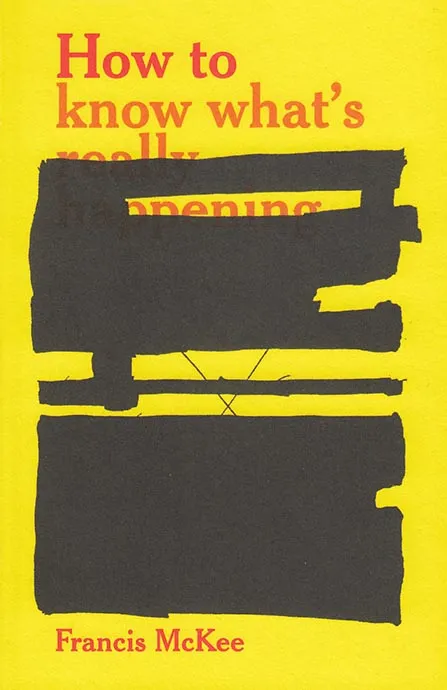
How To Know What's Really Happening
In this post-truth era, how does one navigate the endless information available and choose a viable narrative of reality? In How to Know What’s Really Happening Glasgow-based writer and curator Francis McKee looks at various techniques for determining verity, from those of spy agencies and whistle-blowers to mystics and scientists.
Francis McKee is an Irish writer, medical historian, and curator working in Glasgow where since 2006 he has been the director of the Centre for Contemporary Arts, and is a lecturer and research fellow at Glasgow School of Art. McKee has worked on the development of open-source ideologies and their practical application to art spaces.