great reads, under 100 pages
great reads, under 100 pages

Cunt Norton
In CUNT NORTON, the sequel to her unforgettable CUNT UPS, Dodie Bellamy "cunts" The Norton Anthology of Poetry (1975 edition), setting her text-ravenous cut-ups loose to devour the canonical voices of English literature. The texts that emerge from this sexual-linguistic encounter are monstrous, beautiful, unashamed: 33 erotic love poems ("the greatest fuck poem in the English language," according to Ariana Reines) that lust after the very aesthetic they resist. "These patriarchal voices that threatened to erase me—of course I love them as well," Bellamy writes. Even as CUNT NORTON dismembers the history of English poetry, "cunting" Chaucer and Shakespeare, Emerson and Lowell, it simultaneously allows new sexual members to arise and fill in the gaps, transforming the secret into the explicit, the classically beautiful into the wonderfully grotesque. Bellamy's cunted texts breathe life into literary "masters" with joy, honesty, hilarity, and insatiable passion.
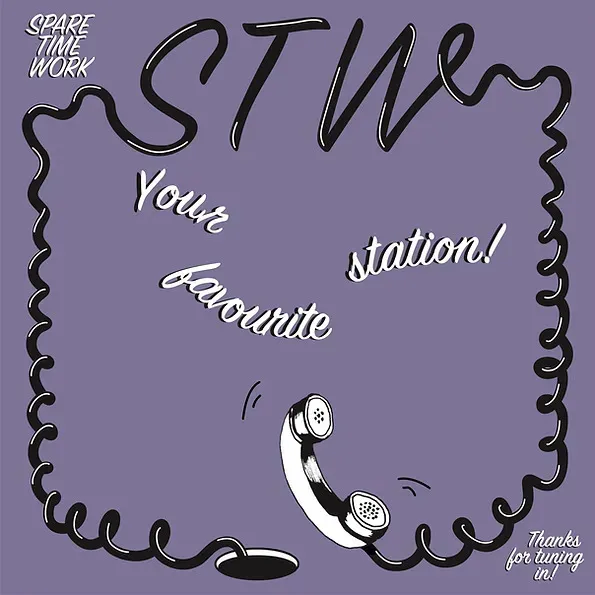
STW, your favourite station!
STW, your favourite station! functioneert als een radioprogramma. Een boek dat lyrisch proza uitzendt van We make stuff up for a living (een CV medley) tot COMPUTER_SONG, een ceremoniële quiz met Adult Hood & Young als protagonisten, een grillige anekdote van iemand die zich ergert aan een Call Service, en meer! Thanks for tuning in!

Ch'ixinakax Utxiwa: On Decolonising Practices and Discourses
The Bolivian scholar and activist Silvia Rivera Cusicanqui is a pre-eminent Latin American intellectual, world renowned for her work in postcolonial and subaltern studies. She has long maintained that we must acknowledge how colonial structures of domination continue to affect indigenous identities and cultures. Even in contexts where diversity and the value of indigenous cultures have been officially recognized, “internal colonialism” operates as a structure that shapes mental categories and social practices.
This book considers this persistent colonial structure by examining artistic and popular practices of apprehending and resisting it, arguing that in Andean cultures there is a sustained practice of insubordinate image production and use. Combining this visual history with other instances of political resistance, the book offers an alternative narrative to the history of Latin American decolonisation. This narrative challenges the common conception that mestizaje (race-mixing) and hybridity are liberatory formations, offering instead a new theorisation of the complex racial configurations produced by colonialism and its afterlives.
Given Rivera Cusicanqui’s vital contribution to critical epistemologies, this book will be of great interest to students and scholars throughout the humanities and social sciences and to everyone concerned with the key questions of critical theory today.

The Slicks: On Sylvia Plath and Taylor Swift
In The Slicks, Maggie Nelson positions culture-dominating pop superstar Taylor Swift and feminist cult icon Sylvia Plath as twin hosts of the female urge toward wanting hard, working hard, and pouring forth—and as twinned targets of patriarchy’s ancient urge to disparage, trivialize, and discipline creative work by women rooted in autobiography and abundance.
A buoyant melding of popular culture and literary criticism, The Slicks is a captivating and unexpected assessment of two iconic female artists by one of the most revered and influential critics of her generation.

49 Venezuelan Novels
Sebastian Castillo, Elisa Díaz Castelo
This new bilingual edition of Sebastian Castillo's long-out-of-print first book reintroduces a classic of American microfiction and features a translation into Spanish by acclaimed Mexican author Elisa Díaz Castelo.
Forty-nine pages of unique and surreal micro-fiction, Sebastian Castillo’s 49 Venezuelan Novels is a magical book with a new story on every page. Full of depth and imagination, Castillo uses imagery in a simple yet intense way. From stories of fish markets to spiteful violins, it almost seems that these novels are snippets of family stories long passed down, just now put to paper. With the nature of a born storyteller, Sebastian Castillo provides the readers of this fantastic read with gorgeous stories that define micro-fiction.

Yellow Songs 1: Voiced-Voiceless
Fifty years after the fall of Saigon, Dao Strom’s Yellow Songs vibrates with the ramifications and ripples of Empire. Each of the four Yellow Songs books reckons with the intimate consequences of the colonial project, reconfiguring them into complex and lucid, literal and figurative songs of selfhood. Embodied, critical, wholehearted, collective, personal, genre-defying—Yellow Songs renders the brute force of history with tender precision. Art book quality printing in full color with felt paper inserts.
Yellow Songs 1: Voiced-Voiceless unearths, unwinds, un-bodies the violence of stigma, reclaiming the ventriloquized voice of David Bowie's "China Girl” through a lyric-critical essaying (assaying) of cultural tropes, racialized and gendered power plays, and memory.

A4 review N°4
Gorge Bataille, Marc Buchy and 2 more
Founded in 2023, A4 is a poetry review which showcases and explores contemporary writings practices. Run by Littérature Supersport collective, the object is seen as the extension of their events. The review takes the form of 4 postcards which, when placed side-by-side, form an A4-sheet. A light (even precarious) format for literature that slips into the back pocket of pants and hangs on fridge doors. Each issue features unpublished texts by 4 authors.
This issue presents texts by: Gorge Bataille, Marc Buchy, Samy Manga, Elke de Rijcke.

Afghanistan
Afghanistan is my father’s homeland. He was born in Kabul in 1945 and later moved first to France, then to Switzerland in the 1970s. In my mind, Afghanistan exists as a geography with blurred edges, something I feel the need to reconcile with. It’s a place I’ve only ever known through stories, a source of memories that, over time, have shifted and become distorted.
Contributors: Luca Cerizza, Farid Rahimi, Said Rahimi, Susanna Ravelli, Francesca Recchia, Zafar Sayan, and Dawood Tawana

Crystal Pantomime
Recognized as a poet, less so as a visual artist […] Mina Loy also wrote in the style of Crystal Pantomime, a text from one hundred years ago [c. 1915] describing a ballet in prose. The writing evokes images with which actual theater effects can only interfere. It projects in the mind as onto a screen. But this restless writing does more than that, shifting registers and unfolded in equal parts fairy tale description, precise impossible stage directions, notes for impossible costumes and sets, guidelines for impossible choreography, and a glancing archeology of personal association, opinion, art historical commentary, and psychoanalysis, all floating in suspension, all shading into poetry, and with this manner of overflowing every frame defining its poetics. — Matthew Goulish
This first standalone edition of Crystal Pantomime opens with a biographical introduction by Mina Loy’s literary executor—poet Roger Conover—originally published in Eliot Weinberger’s journal Montemora in 1981, as well as a dramaturgical introduction by Matthew Goulish of Chicago performance group Every house has a door, originally prepared as opening remarks to Every house’s reading of Loy’s Pantomime at the Arts Club of Chicago in spring of 2024. In tandem these supplementary texts begin to frame what is a rather strange and singular sketch for a work never realized.

THEY LIED TO YOU ABOUT THE EUNUCHS
This book project introduces the history of eunuchism through auto-theory, historiography, historical fiction and poetry, exploring this identity in the ancient world and what kind of echoes can be heard in the present day. By overlapping various histories, and drawing the line between eunuchs in antiquity and contemporary gender discourse, Odete makes a case for a history of gender that hasn’t yet been written, asking what is the relevance of eunuchs to the history of art? And what does the study of the eunuch expose about the current world?
Edited by Jan-Pieter ‘t Hart
Proofread by Callum Dean
Designed by Tjobo Kho & Vlad Omelianenko

Unbidden Tongues #9: Potty Mouth
Unbidden Tongues #9: Potty Mouth is a collection of what could be described as concrete poetry, written over the past two years by our niece Violet Bartley, now aged five. Typed at a computer and sent exclusively via e-mail, the poems stand as clear evidence of a person in the beginnings of grasping (at) language. Throughout, characters are repeated uninterrupted until margins break them, keys pushed down by a finger not yet strong enough to lift itself up.
Over the years, as her written vocabulary grew and these attempts at communication slowly stacked up into the collection printed here, Violet delivered poem after poem within which different mutations of the word ‘poo’ were uttered in type: poo, poobum, bum poo, ipoo, poop. While simple, often illegible and definitely isolated utterances (she never replies when you send a poem back in turn), they are decipherable examples of someone learning defiance through language.

The Obscene Madame D
Nathanaël, Hilda Hilst and 1 more
A wickedly funny work of depraved genius by one of Brazil’s most radical twentieth-century writers; imagine the Marquis de Sade as written by Clarice Lispecter.
An electrifying masterpiece by one of modern Brazilian literature’s most significant and controversial writers, Hilda Hilst takes us into the disorder and beauty of a mind restlessly testing its own limits.
Every month I ingested the body of God, not in the way one swallows green peas or agrostis, or swallows swords, I ingested the body of God the way people do when they know they are swallowing the More, the All, the Incommensurable, for not believing in finitude I would lose myself in absolute infinity…
The Obscene Madame D tells the story of Hillé, a sixty-year-old woman who has decided to abandon conventional life and spend the rest of her days in contemplation in a recess under the stairs. There, she is haunted by the perplexity of her recently deceased lover, Ehud, who cannot understand her rejection of common sense, sex and a simple life in favour of metaphysical speculations that he considers delusional and vain.
In a stream-of-consciousness monologue that’s part James Joyce, part Clarice Lispector, and part de Sade, Hillé speaks of her search for spiritual fulfilment from a space of dereliction, as she searches for answers to great questions of life, death and the relationship between body and soul.
Translated by Nathanaël and Rachel Gontijo Araujo

You Who Suffer, Because You Love, Love Still More
In You Who Suffer, Because You Love, Love Still More, Serubiri Moses offers an intimate and personal study of the lives and loves of pop star Freddy Mercury, combining a detailed epigraphy on the duplicitous nature of Mercury's origins, sexuality, and artistic talent with his own delicate memoir as a poet. Through this series of interlocked poems, yet again Moses lures us into an atmosphere both sensual and scholarly that echoes well past its last verse.
With ardor and grace, Serubiri Moses traverses a catalogue of pop music, visual art, and cultural history to bring his readers to a state of openness — to love, to art, and the freewill of ecstatic experience. Moses’s writing forefronts pleasure as a gateway for deeper critical inquiry, braiding personal memory and epigraphic excursions into sex, stardom, and poetry, reminding us in this journey that "pleasure almost happens without us knowing."
— Tausif Noor
Serubiri Moses, Ugandan curator and author, lives in New York City. He serves as a part-time faculty member at Hunter CUNY, and visiting faculty at the Center for Curatorial Studies, Bard College. He previously held faculty positions at New York University, and the New Centre for Research and Practice, and delivered lectures at Chazen Museum of Art, Art Institute of Chicago, Williams College, Yale University, University of Pittsburgh, The New School, Zeitz Museum of Contemporary Art Africa, and basis voor aktuelle kunst (NL), and University of the Arts Helsinki (FL). As a curator, he has organized exhibitions at museums including MoMA PS1, Long Island City; Kunst-Werke Institute for Contemporary Art, Berlin; the Hessel Museum, Bard College, NY; and the Smithsonian National Museum of African Art. He has curated solo presentations of Carl E. Hazlewood, Reza Aramesh, and is working on a retrospective of Taryn Simon. He previously held a research fellowship at the University of Bayreuth, and received his MA in Curatorial Studies at Bard College, and is an alumni of the Àsìkò International Art Programme. He serves on the editorial team of e-flux journal and his short stories have appeared in print in Ursula, and online in Lolwe. He has published poetry in the online journals Jalada and Badilisha Poetry Exchange, as well as in print journals Kwani? 7, Kwani? 8, and READ: A Journal of Inter-Translation (2022). He is the author of the poetry collection THE MOON IS READING US A BOOK (2023; Pântano Books).

New Ancient Words
New Ancient Words is the first translation of Ellen Lima Wassu's poetry into English. A trilingual edition between her native Tupi indigenous language of the land of Pindorama, now Brazil, Portuguese, and English, this collection offers a wider readership her resistant yet intimate poetry, which flows seamlessly between her relational woes, a decolonial voice, and an animated playfulness with words and imagery. In her poems, history is an unstable landscape, where the personal, the mythical, and the natural are ever entwined and ever shifting in meaning.
Ellen Lima Wassu is a multiartist, freshwater fish, perplexed human, apartment gardener, and more beast than person. Born in Rio de Janeiro, she is Indigenous to the Wassu Cocal people (Alagoas, Brazil) and currently lives in Portugal, where she is pursuing a PhD, developing artistic practices, teaching courses, giving lectures, and working as an activist. In addition to contributing to literary magazines and anthologies, she has published ybykûatiara um livro de terra (Urutau, 2023) and ixé ygara voltando pra ’y’kûá (Urutau, 2021). Her practice weaves together art, poetry, performance, activism, critique, counter-colonial studies, essayistic writing, good encounters, river baths, listening sessions, and conversations with flowers.
Translation by Isadora Neves Marques and Alice dos Reis, revised by Marta Espiridião

Moon Mirrored Indivisible
Multilayered lyric poems that resist systems of power and foster intimacy.
An inheritor of lineages marked by colonial and gendered violence, Farid Matuk approaches the musical capacities of verse not as mere excitation or decoration, but as forms that reclaim pleasure and presence. Entering the sonic constellations of Moon Mirrored Indivisible, the reader finds relief from nesting layers of containment that systems of power impose on our bodies and imaginations. In this hall of historical mirrors, fictions of identity are refracted, reflected, and multiplied into a vast field of possibilities. Matuk’s meditations on place and power offer experiments in self-understanding, moving through expansive conversations between a lyric “I” and others, including poets, the speaker’s partner, ancestors, and the reader, and creating spaces for strange intimacy. Each of the book’s four sections of poems builds on the other to ask how we might form a collective—a people—not founded in orthodoxies of originality but in the mutual work of mirroring one another.

ONE THOUSAND GHOSTS IN THIS FEAST
Sahar Khraibani’s ONE THOUSAND GHOSTS IN THIS FEAST contends with desire, grief, and language as sites of injury and release. Written over a period of three days—amid ongoing genocide, land seizure, and displacement—the long poem counters logics of possession with those of relation. Khraibani’s all-caps, first-person address impels the poem forward, centering intertextuality as a force through which spectral presences shine.
Sahar Khraibani is a writer and artist whose work has been presented with Montez Press, The Brooklyn Rail, Magnum Foundation, the Poetry Foundation, the Poetry Project, and Hyperallergic among others. Sahar is a recipient of the Creative Capital / Arts Writers Grant, a fellowship at The Poetry Project, a MacDowell Fellowship, a 2024 residency at Mass MoCA, and is an alumni of the Whitney Independent Study Program. Sahar teaches at Pratt Institute and is the author of Anatomy of A Refusal (1080PRESS, 2025).
ONE THOUSAND GHOSTS IN THIS FEAST lays bare the “SENSELESS DECAY” potentiated by empire’s relentless categorization, containment, and calculated death delivery. Khraibani’s debut chapbook collapses the imposed and perceived distance written by borders, disrupts anticipated colonial language logics, and bursts “INTO THE MADNESS OF THE ORGY” with queer interference reverberating in all directions. From the soil, from the graveyard, from the dancefloor, from their favorite spot on the eroding waterfront, Sahar broadcasts, IN ALL CAPS, “THE UNNAMEABLE TRUTH.”
— Andrea Abi-Karam

My Earliest Person
Lyrical drifts warped by syntax into blizzarding softness; odes to beauty, meaning, and inexperience splintered by history and grammar. An aqueous surface marbled with the lightest possible touch, lost footings arrested by change’s near-griplessness.
None of this matters. It’s only supposed
to save you from yourself. None of this
matters, when I try to take it out of me into
the world, which to find I can praise
I go out to
Composed across two winters between late 2022 and early 2024. Contains 43 poems.
“This luscious and needle sharp collection is a real feat of the textual imagination, wow.” —Adam Piette, Blackbox Manifold, no. 34

Peach machine
Peach machine comprises nine months of poems, tracing a recurrent cycle of sickness, heartbreak, reparation, and recovery from late summer back into early Spring. The work is roughshod: grieving, oxygen-starved, jetlagged, reflective, and relieved.
Designed and typeset by Phil Baber.

In Abeyance
With this new book of sedimented lyric, John Wilkinson’s poetry enters a terrain of creatures flattened in shale, in flat screen and in digital code. If Silicon Valley would repopulate Jurassic Park and defeat death, Wilkinson’s poetry would make actual what slides past in the disregarded day, whether the flattening of a city or the return of seasonal blossom. This poetry swells dry roots; it breaches the total coverage that flatlines the heart’s response, through its urgent and generous rhythms.
Designed and typeset by Phil Baber.

4 Tales
The power of Sabahattin Ali comes from beyond his words. It is his sense of observation, insight and commitment to fight for a fairer society that have carried his voice into the modern day.
The four tales in this book - Death of the Giants, A Tale of Love, A Tale of Sheep and The Glass Pavilion - were compiled and published in Sırça Köşk [The Glass Pavilion] in 1947. At the time Sabahattin Ali penned these tales, the young Turkish Republic was still struggling to establish a proper democracy with one sole party in parliament. In 1948 the Turkish Council of Ministers decided to ban Sırça Köşk, and all remaining copies were swiftly confiscated. Even after his death, the words of Sabahattin Ali were deemed as a governmental threat and for decades publishers were reluctant to print his work.
Almost eighty years later, these political and social tales remain just as poignant. Does this showcase Sabahattin Ali’s visionary spirit or a general lack of vision within our societies?

5 Prison songs / 5 Hapishane Şarkısı
This booklet is a collection of 5 Prison Songs written by Sabahattin Ali in 1932-1933 whilst imprisoned in Konya and Sinop, Turkey.
Bu kitapçık Sabahattin Ali’nin 1932-1933 senelerinde önce Konya sonra Sinop hapishanesinde kaleme aldığı 5 Hapishane Şarkısı içerir.

Michigan State University Press
Citizens of Beauty: Poems of Jean Sénac
This stunning collection of poems by the Algerian poet Jean Sénac (1926–1973) was originally published when he was forty-one. Sénac represented the hope of the new generation of Algerians who were celebrating their independence from France after 130 years of colonialism, and in the tradition of René Char and the early Albert Camus, he portrayed an Algeria whose land and people would finally sing with their own voice.
Sénac celebrates revolution, love, and the body, beginning with the resonant verses: “And now we’ll sing love / for there’s no Revolution without love.” He sang, as well, of beauty: “No morning without smiling. / Beauty on our lips is one continuous fruit.”
Translated by Jack Hirschman

All Ah We is One: Caribbean Carnival Costume
Caribbean Carnivals have been taking place around the UK since 1959. These joyous celebrations of culture and community began as acts of resistance in the face of enslavement — a defiant stand from communities who refused to lose who they were and where they came from.
Drawing from this rich and radical history, Aisling Serrant explores Carnival through one of its most vibrant and unmissable features: costume. First turned to by former slaves in the Caribbean as an act of reclamation and quiet resistance, with roots in West African and European masquerade alike, the colourful costumes of Carnival weekend remain a vital mode of self-expression, protest, and camaraderie. From Canboulay to Leeds and Notting Hill, the costume makers, wearers, and the communities they attract, embody Carnival in the spirit of an expression used across the Caribbean to signify unity among nations and peoples: all ah we is one.

University of California Press
The Totality for Kids
The Totality for Kids is the second collection of poems by Joshua Clover. This volume takes as its subject the troubled sleep of late modernity, from the grandeur and failure of megacities to the retreats and displacements of the suburbs. The power of crowds and architecture commingles with the alienation and idleness of the observer, caught between “the brutal red dream/Of the collective” and “the parade/Of the ideal citizen.” The book’s action takes place in these gaps, “dead spaces beside the endlessly grieving stream.” The frozen tableau of the spectacle meets its double in the sense that something is always about to happen. Political furies and erotic imaginings coalesce and escape within a welter of unmoored allusions, encounters, citations, and histories, the dreams possible within the modern’s excess of signification—as if to return revolutionary possibility to the regime of information by singing it its own song.