rile*books

Search books

Search books by title, author, publisher, keywords...

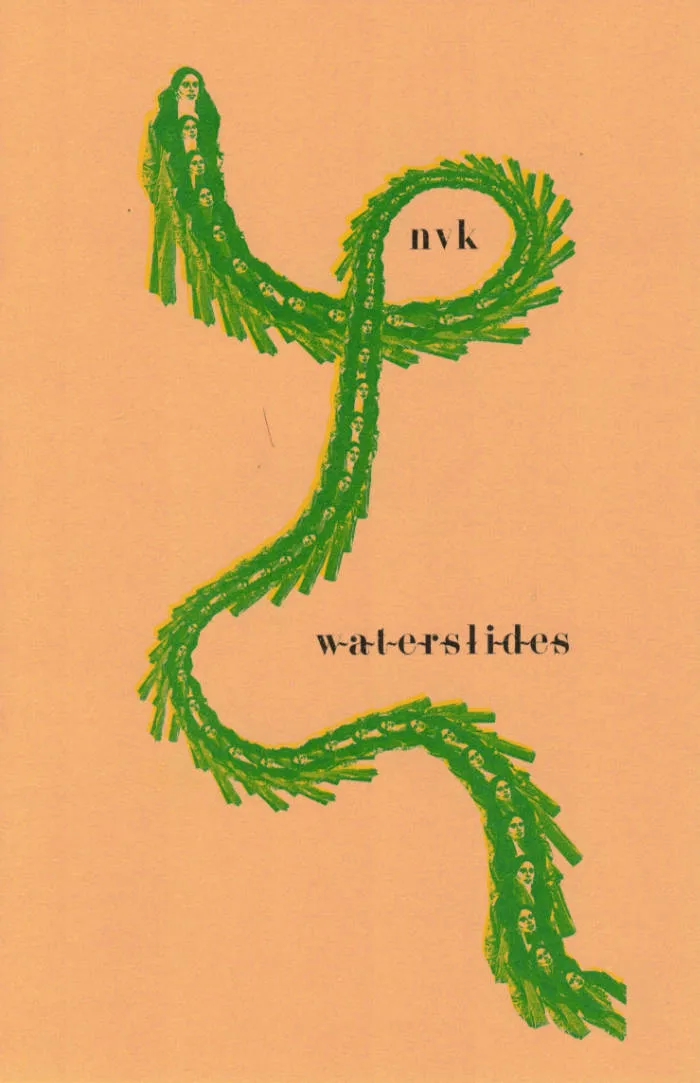
Cover of Waterslides

Risiko Press

Waterslides

nvk

€10.00

"Waterslides is a falling and plunging, short starts and stops aided by movement, until we splash, climb and plunge again. Each sliding is the same but different—with each descent new expectations and thoughts swirl, shifting focus and gaining new insights or blockages. Waterslides are brief moments of remembering, remembering as a present tense activity, one that happens as we think of it, projected on our now. The waterslide is the moment of past and present working in tandem, a movement of repeating, revisiting and remembering all at once.”

Written by nvk 2021-2023. Dedicated to Judi, MM & TNN.

A version of these poems was published as an audio work through Ignota Press’ The Mountain (2023) and included in a reading with James Loop on Montez Press Radio (2023). nvk would like to thank Jan Matthé, Stine Sampers and Michelangelo Miccolis for their patience & love.

This book was first presented at Kransen in Antwerp, May 6th 2023, with a performance by Sassy (costume by Rosa Schützendorf). Printed and bound at Risiko Press, Borgerhout. Cover image by nvk. Fonts: Adonis, Garamond Pro. Limited to 150 copies.

128x195mm, 16p., stapled, cover: green, yellow and black risoprint on 160gsm caramel paper, inside: black and blue riso on 120gsm Munken Pure paper.

Language: English

recommendations

Cover of Biarritz

Risiko Press

Biarritz

Jan Matthé

Poetry €10.00

Written and edited in Biarritz, Borgerhout and Midsommarkransen, 2016—2021. Dedicated to Räffi, with much love. Another version of this text was published in Pfeil Magazin 10 (Montez Press, 2018); editor: Anja Dietmann, copy-editor: Stacy Skulnik. Epigraph from Numéro Deux (1975) by Anne-Marie Miéville and Jean-Luc Godard. Presented on Saturday February 5th 2022 at Kransen, Borgerhout.

128x201mm, 40p, staple bound. Riso-printed on Arcoprint Edizioni Avorio 90g and Clairefontaine Blue 210g. Design by Kaye–Matthé, typefaces: Tribute, Gillies Gothic Light. Printed by Risiko Press at Kransen, covers silkscreened at Afreux, bound by Drukkerijcollectief De Wrikker. Edition of around 200.

Cover of New Infinity

Metatron Press

New Infinity

Bára Hladík

New Infinity is an experimental novella that follows a woman as she lives and dreams her way through the philosophical implications of autoimmune disease. Met by a labyrinth of closing doors, she searches for meaning and connection among fragmented realities and failed relationships, finding infinitude in the healing process of bibliomancy.

Bára Hladík’s New Infinity is a glittering cross-genre debut. Weaving surrealist stories with meditative poetics, Hladík invites you into a dream world of degenerative illness, left disordered by the failures of ableism, medical professionals, and late-stage capitalism. Here, everything runs on sick time. Where physical health and financial resources grow scarce, the restorative possibilities of queer love, divination, and self-reclamation grant a defiant, yet often tenuous, abundance. Alive with Hladík’s boundless insight and wit, New Infinity is a powerful addition to the collective body of disability literature.

“I have been waiting for a book like New Infinity for years: a story of disability that oozes over the edges of ‘personal narrative’ into the surreal logics of bodies that will not be made useful under capitalism. Bára Hladík’s prose delights me with its 21st-century metamorphoses, its waiting-room dream logics, and its mystical invocations of a body in pain. Her poetry is a channel to another dimension, but one that is grounded inside our everyday sensoria—’cracking, pushing, pulsing’ like a spine writhing with snakes. Here, embodiment is never extractable from the institutions and economies whose profits are predicated on the question ‘do I matter if / I am only a pulse’? New Infinity insists upon a different kind of mattering, in which missed connections, improper fusions, and fleeting moments command the careful, caring attention that is too often denied them.” – Liz Bowen, author of Compassion Fountain (Trembling Pillow Press) and Sugarblood (Metatron Press)

“New Infinity is the most incredible fiction. It explodes the boundaries of this form so as to get to the heart of important truths about the phenomenon of physical pain and of human existence itself. While Bára Hladík’s story draws from a personal experience of survival through a struggle unlike any other, it is an entirely universal tale. In taking us into the most intimate spaces of suffering and narrating a story of a woman navigating a true labyrinth, Hladík shows us a way to face life, with the uncertainties it presents to us all. This novel is at once a profoundly moving story, a brilliant act of creativity, and an existential philosophy. It’s a book I will keep close, so as to revisit— for the thrilling inspiration of its liberated uses of form and style, as well as to learn from Hladík’s honest language, her resilient sense of humour, and her ability to capture the surreal beauty of being alive at all. I felt like I was reading Franz Kafka crossed with a fully unconstrained Anne Carson. I haven’t been so impacted by a book in a long time. It has changed my ways of seeing, feeling, and thinking about what it means to be alive.” – Molly Lynch, author of The Forbidden Territory of a Terrifying Woman (Catapult Books, 2023)

“Bára Hladík’s debut book is a blend of poetry and prose that seeks to make sense of a world that is flagrantly hostile and impatient with bodies that neither perform nor conform to the manic impatience of capitalist acceleration. An honest, vibrant, and very real account of a young writer finding a voice.” – Sina Queyras, writer, editor, professor, curator

“Bára Hladík’s New Infinity is a stirring pedagogy, philosophy, and witness. This offering of sick hybridity coils in a long, calm, and exhilarating breath while asking, ‘Do the doctors know how to breathe?’ Yes, Hladík’s prose and poems prompt, pain cosmologies are at once funny and incantatory. Each of New Infinity’s oneiric turns reads the body as an oracle and mirror, reminds us we are atmospheric. I would rather live here in this book, relearn how to breathe, than return to the ‘impossible crank’ of normal.” – Jane Shi, writer, poet, editor, organizer

Bára Hladík is a Czech-Canadian writer, editor and multimedia artist. Born in Ktunaxa Territory, she began her literary studies in the Creative Writing program at Capilano University in 2011. After studying Technical Writing at the British Columbia Institute of Technology, she received her Bachelor of Arts in Literature and Communications from the University of British Columbia in 2016. Her work can be found in Briarpatch Magazine, THIS Magazine, Contemporary Verse 2, Carte Blanche, EVENT Mag, Hamilton Arts and Letters, Bed Zine, Empty Mirror, Cosmonauts Avenue and elsewhere. Bára’s microchapbook Book of Mirrors was selected for the 2019 Ghost City Press Summer Micro-Chap Series and her collaborative artist book Behind the Curtain (Publication Studio, 2018) was an honourable mention for the Scorpion and Felix Prize (2017). New Infinity is Bára’s first book. She is now a guest in Esquimalt, BC.

Cover of The Dogs

Krupskaya Books

The Dogs

Noah Ross

Poetry €21.00

In Noah Ross's new book THE DOGS, Ross opens the question of authority and possession in what he deems an illicit act of translation. THE DOGS may begin with Herve Guibert's Les Chiens, but through multiple reiterations of translation, Guibert's text ultimately meets Ross to celebrate, among other sources, Marie de France, Teen Wolf, Auden, and Dom Orejudos in establishing a unique pack of hungry werewolves. You know what happens when werewolves get together: the play can get a little rough. THE DOGS empowers these snarls and yips, growls and howls, on the level of the sentence in translation as much as the embodied erotogenic zones of the body.

Cover of Alice Notley, Live in Seattle

Fonograf Editions

Alice Notley, Live in Seattle

Alice Notley

Entirely comprised of poems contained in her latest collection, 2016’s Certain Magical Acts, Live in Seattle elucidates why Alice Notley is one of the world’s most revered poets, the recipient of the Los Angeles TimesBook Award, the Griffin Prize, the Shelley Memorial Award, the Lenore Marshall Prize, and the Poetry Foundation’s Ruth Lilly Prize. “I am alive outside written memory” is how one of the speakers of Notley’s poem “Voices” puts it and listening to the poet read her work live, in front of an entranced audience, serves to detail the intangibility of sound vis-à-vis language.

Live in Seattle also includes excerpts of the onstage conversation Notley had with Seattle poets John Marshall, Christine Deavel and Rebecca Hoogs. Among other topics, the talk revolves around concepts of success, what it means to write a female poetry circa 2017, and the importance of always creating from a position of disobedience.

As part of Seattle Arts & Lectures’ Poetry Series, Live in Seattle was recorded at McCaw Hall in Seattle, Washington on Wednesday, April 5th, 2017 and mastered and engineered by Gus Elg at Sky Onion in Portland, Oregon in the Summer of 2017. 

Purchase of Live in Seattle includes a 11×11 insert of Notley’s poem “FOUND WORK (lost lace),” as well as a download card for the entire album. Live in Seattle can also be found digitally on Spotify and Bandcamp. The record itself is not black but clear.

Cover of The Mirror of Simple Souls

Winter Editions

The Mirror of Simple Souls

Leah Flax Barber

Poetry €20.00

In her first book of poems, Leah Flax Barber revives an actress figure of the commedia dell'arte to consider her own destiny as a soon-to-be historical subject. Taking its title from Marguerite Porete's fourteenth-century Beguine classic, The Mirror of Simple Souls embodies the metaphysical thorniness of the book-as-object through sources as wide-ranging as Renaissance theater, Low German and Old French mystical texts, Kate Bush lyrics, and the melancholy dialectics of Walter Benjamin. In Flax Barber's stark, brutally compressed poems, the performance of writing is charged with the eros and anxiety of coming after: "Will it all be destroyed? / Definitely / I will hear it on my radio / In the 22nd century."

The Mirror of Simple Souls, a series of repeated beginnings and endings, is a form of speech act which, through a Freudian Durcharbeiten, or working through, brings about a new beginning. And, in its movement from this Freudian "working through" to a Hegelian Aufhebung, lets us begin, again, at the beginning, at the end. —CYNTHIA CRUZ

The spare poems of The Mirror of Simple Souls evoke and then draw back into shimmer. Herein, a performance that suffuses the horizon with beautiful absurdity: a shirt sewn with mirrors that reflect a strange and evanescing world-at-large, “an I where the nay was.” Drawing from film, mystical texts, commedia dell'arte, the reader finds that there “is paraphernalia of life / all over.” This paraphernalia is a kind of “segue music” for the endlessly indeterminate. The old adage claims that we can’t step into the same river twice, but Leah Flax Barber creates an evocative, provocative current through which each step is at once past, present, and future. —ELIZABETH ROBINSON

Leah Flax Barber is a daring and brilliant new poet. Her voice is restless and coiled and sprung as we discover "The demonic finalist / Of material culture / Is love / There is paraphernalia of life / All over / A woman.” There is also a take-no-prisoners attitude throughout this startling and powerful book. These poems are vital and necessary and perform “The wounded chance / To think in public.” This book will move you, scare you, and blow you away. —PETER GIZZI

Leah Flax Barber's first book reads like a journey, a kind of anabasis, passing back through the myth and history which are its own antecedents. It manifests, in the encounter, a saturnalian world: ludic, dark and sensuous, strange and vibrant with thought. I was delighted to travel with it. —CLAIRE DeVOOGD

Cover of The Saddest Thing Is That I Have Had to Use Words: A Madeline Gins Reader

Siglio Press

The Saddest Thing Is That I Have Had to Use Words: A Madeline Gins Reader

Madeline Gins

Poetry €28.00

Poet, philosopher, speculative architect and transdisciplinary artist, Madeline Gins is well known for her collaborations with her husband, the artist Arakawa, on the experimental architectural project Reversible Destiny, in which they sought to arrest mortality by transforming the built environment. Yet, her own writings — in the form of poetry, essays, experimental prose and philosophical inquiries — represent her most visionary and transformative work. Like Gertrude Stein before her, Gins transfigures grammar and liberates words. Like her contemporaries in conceptual art, her writing is attuned to the energized, collaborative space between reader and page.

The Saddest Thing Is That I Have Had to Use Words: A Madeline Gins Reader is a revelatory anthology, edited and with an introduction by the writer and critic Lucy Ives. It brings never-before-published poems and essays together with a complete facsimile reproduction of Gins' 1969 masterpiece, WORD RAIN (or A Discursive Introduction to the Intimate Philosophical Investigations of G, R, E, T, A, G, A, R, B, O, It Says), along with substantial excerpts from her two later books What the President Will Say and Do!! (1984) and Helen Keller or Arakawa (1994). Long out of print or unpublished, Gins' poems and prose form a powerful corpus of experimental literature, one which is sure to upend existing narratives of American poetics at the close of the 20th century.

Edited by Lucy Ives.