rile*books

Search books

Search books by title, author, publisher, keywords...

Explore

Categories
Visit
Collections
Publishers
Back in stock
Any books
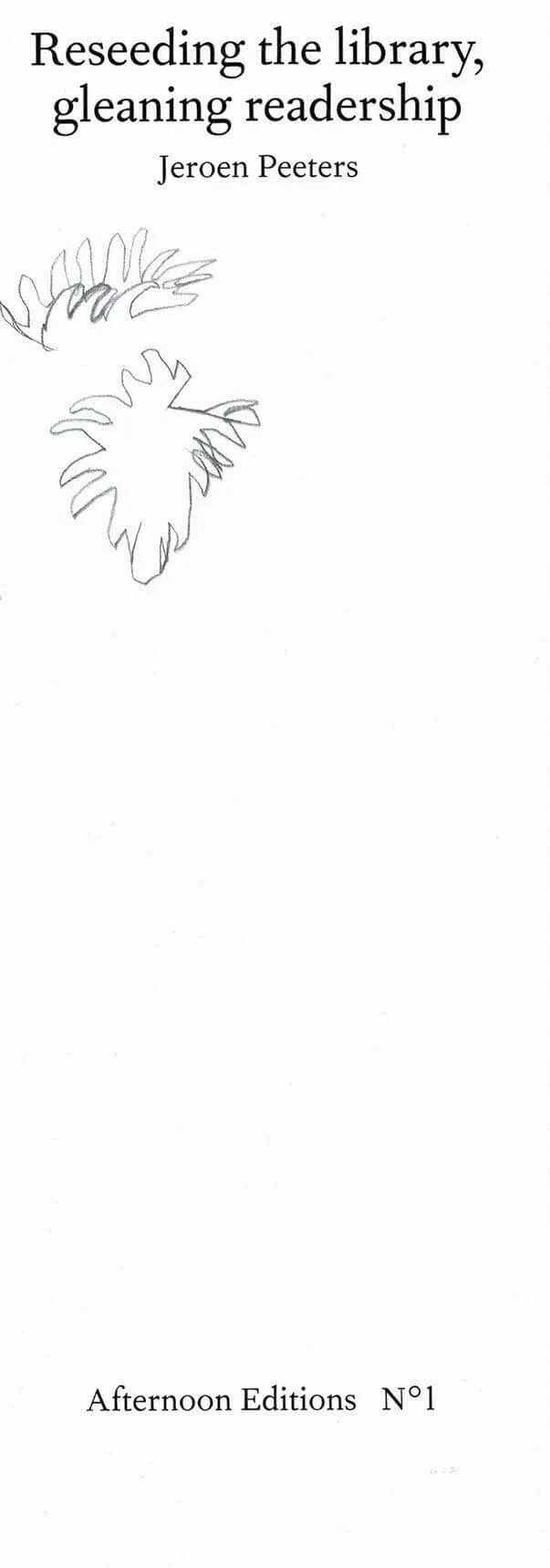
Cover of Reseeding the library, gleaning readership

Afternoon Editions

Reseeding the library, gleaning readership

Jeroen Peeters

€8.00

Afternoon Editions no. 1: an essay by Jeroen Peeters titled Reseeding the library, gleaning readership. In May 2017, Time has fallen asleep in the afternoon sunshine settled during three weeks in the Ravenstein Gallery in Brussels as part of the Kunstenfestivaldesarts. Invited as a writer in residence, Jeroen Peeters visited the library of living books on a daily basis and recorded his observations by hand in a notebook, which formed the basis for Afternoon Edition #1. Reseeding the library, gleaning readership is an essay on the seed library, on the dispersion of literature through wind, water and animals, on biodiversity and commoning at the heart of readership. On the cover a drawing by Wouter Krokaert of a Philodendron Xanadu. Published May 2018.

Published in 2018 ┊ 32 pages ┊ Language: English

recommendations

Cover of Language is a map of failures: Messy thoughts on reading, writing and dressing up

Afternoon Editions

Language is a map of failures: Messy thoughts on reading, writing and dressing up

Runa Borch Skolseg

Afternoon Editions no. 3: Language is a map of failures. Messy thoughts on reading, writing and dressing up by Runa Borch Skolseg.

In May 2019, Time has fallen asleep in the afternoon sunshine relocated its base to the Oslo Biennale headquarters in Myntgata, with a room of its own and ongoing activities. Runa Borch Skolseg visited the space at several occasions before its final closure, in 2021. Her invitation to write for the Afternoon Editions bridges the move from one room to another, and is a reflection on how fashion can be a world of fantasy, and drama, a language we all communicate through. With a personal narrative she makes readings of clothes, literature and writing, and how they merge and enrich each other.

Cover of LIST OF BOOKS in the LIBRARIES of Time has fallen asleep in the afternoon sunshine

Afternoon Editions

LIST OF BOOKS in the LIBRARIES of Time has fallen asleep in the afternoon sunshine

Mette Edvardsen

Afternoon Editions no. 0: List of books in the library of Time has fallen asleep in the afternoon sunshine. The list consists of books that have been leart by heart within the project (by heart library), an incomplete list of books that were considered to be leart by heart, that played an important role in the process of choice, or that have been considered to be learnt by heart in the future (shadow library), a growing collection of literature, publications, essays, films, ephemera relating to interests within the project (reference library).

Edition last updated May 2020.

Cover of Weaknesses

Afternoon Editions

Weaknesses

Chrysa Parkinson

Afternoon Editions no. 2: text and drawings by Chrysa Parkinson titled Weaknesses. Between January and March 2019 Time has fallen asleep in the afternoon sunshine was presented as a solo-exhibition at Index Foundation in Stockholm. During this period Chrysa Parkinson was invited as a guest writer for Afternoon Editions. Weaknesses is a leap in memory.

Cover of Afternoon Editions N°4: Certain Things

Afternoon Editions

Afternoon Editions N°4: Certain Things

Claudia la Rocco

A day can be a composition not unlike an essay. Full of possibilities, full of limitations, bound by universal structures and marked by idiosyncratic desires. You go on walks. You read. You do your chores. All the while memory and other forms of imagination keep time with you. Books are strange companions; writing is a lonely thing rich with consolations.

Certain Things is a text by Claudia La Rocco, created with and through ideas such as these.

Published September 2022.

Cover of And then it got legs: Notes on dance dramaturgy

Varamo Press

And then it got legs: Notes on dance dramaturgy

Jeroen Peeters

Drawing on his experience in the field of contemporary dance, Jeroen Peeters discusses principles, methods and practices that contribute to an understanding of dramaturgy as an experimental, collaborative practice and a material form of thinking.

Written from practice, this book reflects a particular history of collaboration and conversation with dance-makers such as Martin Nachbar, Meg Stuart, Vera Mantero, Sabina Holzer, Lisa Nelson, Jennifer Lacey, Chrysa Parkinson, deufert + plischke, Eleanor Bauer, Philipp Gehmacher and many others.

Phantasmal archaeology, unfolding material, literal and physical reading, crafting method, articulating process, witnessing and performing not-knowing, naming and ritual destruction, conceptual landscapes, symbolic waste, internal fictions and foreign objects – they may all play a role in creation and in exploring the unfamiliar in pursuit of making sense.

And then it got legs is an invitation to think along or against, to discuss those ideas with others or explore them in the studio, and eventually to imagine and devise one’s own methods of research, observation, reflection and creation.

Cover of Bookmarks of sorts

Afternoon Editions

Bookmarks of sorts

Jeroen Peeters

Afternoon Editions no. 5: a collection of found papers annotated by Jeroen Peeters, titled Bookmarks of sorts. During several years Jeroen Peeters collected notes left by readers in library books: faded reader tickets, scraps with notes, a shopping list, train tickets and other little papers used as bookmarks. He noted each time the date and the book in which they were found. Afterwards he wrote commentaries to this collection, an essay on alternative reading practices, marginalia and extra-illustration, on the exchange between readers and the imaginary community lingering in all those library books.

Cover of Ik ben Elias of het gevecht met de nachtegalen, door Maurice Gilliams

Time has fallen asleep in the afternoon sunshine

Ik ben Elias of het gevecht met de nachtegalen, door Maurice Gilliams

Wouter Krokaert

For the project Time has fallen asleep in the afternoon sunshine a group of people/ performers memorize a book of their choice. Together they form a library collection consisting of living books. After years of learning by heart and reciting for readers, some of the books have now been written down from memory to create new editions, versions resulting from this process. This book is one of those books, chosen by one person, learned by heart and recited many times, and now written down again from memory. This edition is not a re-edition of the original text. It is a re-writing of the text after the process of reading, memorizing and reciting, with all the alterations that might have occured in the course of this process.

Cover of Let's Not Get Used to This Place – Works 2008-2023

Damaged Goods

Let's Not Get Used to This Place – Works 2008-2023

Meg Stuart

Performance €45.00

Edited by Astrid Kaminski, Jeroen Versteele, Julie De Meester. A personal and intimate look behind the scenes of Meg Stuart's creative process over more than a decade. 

Since the early nineties, Meg Stuart, and her dance company Damaged Goods, based in Brussels, have produced a remarkable and audacious body of choreographic work. In 2010, Damaged Goods published Are we here yet?, which spans the first twenty years of Meg Stuart's career. In the follow-up book Let's not get used to this place, the choreographer looks back on more than a decade of works through reflections, interviews, scores, and notes on the practice of creating, performing, teaching and living dance. These are mixed with reports, essays and poetry by collaborators and other observers, photos, performance texts and archive material. The book's title, gleaned from one of Stuart's recent video works, ties together these multifarious sources in a desire to discard tried and tested strategies, explore new contexts, and transgress the edge of what we (do not) know. 
Let's not get used to this place gives a sense of the plentitude of motions, inspirations and personalities that energize Meg Stuart's creative cosmos. It offers a personal and intimate look behind the scenes of the creative process, and expands this to include the world around it. As a journey through her more recent career, an inspiring manual and a work of art in its own right, it has a wide appeal to an international base of artists, students and peers, and to anyone who is interested in performance.

Contributions by Jean-Marc Adolphe, Preethi Athreya, Mariana Tengner Barros, Sandra Blatterer, Esther Boldt, Márcio Kerber Canabarro, Varinia Canto Vila, Descha Daemgen, Jorge De Hoyos, Igor Dobricic, Brendan Dougherty, Doris Dziersk, Tim Etchells, Moriah Evans, Thomas F. DeFrantz, Jule Flierl, Alain Franco, Davis Freeman, Ami Garmon, Philipp Gehmacher, Jared Gradinger, Ezra Green, Claudia Hill, Maija Hirvanen, Elise Misao Hunchuck, Astrid Kaminski, Kiraṇ Kumār, Göksu Kunak, André Lepecki & Eleonora Fabiano, Jean-Paul Lespagnard, Marc Lohr, Matthias Mohr, Anne-Françoise Moyson, Anja Müller, Kotomi Nishiwaki, Jeroen Peeters, Alejandro Penagos, Léa Poiré, Leyla Postalcıoğlu, Ana Rocha, Tian Rotteveel, Hahn Rowe, Isabela Fernandes Santana, Maria F. Scaroni, Bernd M. Scherer, Kerstin Schroth, Gerald Siegmund, Charlotte Simon, Mieko Suzuki, Claire Vivianne Sobottke, Poorna Swami, Meg Stuart, Margarita Tsomou, Kristof Van Boven, Elke Van Campenhout, Myriam Van Imschoot, Jeroen Versteele, Doug Weiss, Stefanie Wenner, Jozef Wouters, John Zwaenepoel.

Cover of Moments Before The Wind

Varamo Press

Moments Before The Wind

Jozef Wouters

Moments Before the Wind is a heterogeneous collection of notes on scenography that offers a glimpse into the poetics and artistic practice of Jozef Wouters. These reflections on space, scenography, art making and institutional critique have developed over the years as they were written out loud in various contexts. Now settling on the page among built and unbuilt spaces, they’re an invitation to the reader to think along or against, and think up space for oneself. Edited by Jeroen Peeters; graphic design by Filiep Tacq.

Jozef Wouters is a scenographer and theatre maker based in Brussels, who develops work in collaboration with his Decoratelier. Decoratelier is also a workplace for set designers and artists, and provides room for cross-disciplinary ventures and social experiment.

Cover of The Prime Times Vol.2

cry mimi cry

The Prime Times Vol.2

Sophie T. Lvoff

Sophie T. Lvoff revient avec « The Prime Times, Volume 2 » à l'occasion de la fin de sa résidence aux ateliers de la ville de Marseille, bye, bye! Au travers de poèmes en haïku, de gros titres et de photographies de son atelier traversé par la lumière du jour au milieu de l’après-midi, le journal chronique la torpeur des longues journées de travail mêlées d’attente, de glimpses et de glances. En attendant the prime time, Sophie lit les nouvelles sur son téléphone, parcourt paresseusement sa bibliothèque, écrit des emails à des amix éloigné·es et parfois à elle-même. Elle note des blagues et des poèmes dans son cahier, mange des snacks, doute d’elle-même, fume, jette des regards autour d’elle, jusqu’au moment précis où la photo doit être prise.

Sophie T. Lvoff is back with « The Prime Times, Volume 2 »! Through haiku poems, headlines, doodles and photographs of her studio pierced by mid-afternoon daylight, the journal chronicles the torpor of long workdays mixed with waiting, glimpses, and glances. While waiting for the prime time, Sophie reads the news on her phone and lazily reads her collection of books, writes emails to far-away friends and sometimes to herself. She notes things in notebooks and writes jokes and poems, stretches, eats snacks, doubts herself, smokes, glances around, until the precise moment when the picture has to be taken.

Cover of Salvation

Primary Information

Salvation

Jimmy DeSana

Salvation is a previously-unpublished artist book by Jimmy DeSana that he conceptualized shortly before his death in 1990. The publication contains 44 of the artist’s late photographic abstractions that quietly and poetically meditate on loss, death, and nothingness. Depicted within the works are images of relics, body parts, flowers, and fruits that DeSana altered using collage and darkroom manipulations to create pictures that are both intimate and other-worldly. Salvation provides a nuanced and sophisticated counterpoint to the prevailing work around HIV/AIDS at the time, which tended to favor bold political statements.

Variations of many of the works in this book were first presented at DeSana’s last show with Pat Hearn Gallery in 1988. Shortly thereafter, the artist began assembling a maquette of Salvation, using black and white images as place holders for the color works that he intended to comprise the final layout of the publication. Sadly, he was unable to fully realize Salvation in his lifetime, but on his deathbed, he dictated instructions to his longtime friend Laurie Simmons for completing the work; instructions which she noted on each page of the single-copy maquette. With these notes, Simmons was able to match extant slides  and sequencing. Simmons’ studio chose color gels from DeSana’s archive for each corresponding black and white image in the assembly of the publication. Thankfully, due to this recuperative work, Salvation—long-considered to be DeSana’s last major work—is now available for the first time, with every step taken to honor and embody DeSana’s original vision.

Jimmy DeSana (1949-1990) grew up in Atlanta, GA, and received his bachelor’s degree from the Georgia State University in 1972 before relocating to New York’s East Village in the early 1970s. Recent solo and two-person exhibitions include The Sodomite Invasion: Experimentation, Politics and Sexuality in the work of Jimmy DeSana and Marlon T. Riggs, Griffin Art Projects, Vancouver, Canada, 2020, and Remainders, Pioneer Works, Brooklyn, NY, 2016. DeSana’s work can be found in numerous public collections including the Institute of Contemporary Art, Boston, MA; Metropolitan Museum of Art, New York; Museum of Contemporary Art, Chicago, IL; Museum of Fine Arts, Houston, TX; Museum of Modern Art, New York, NY; and the Whitney Museum of American Art, New York, NY, among others. A major retrospective of DeSana’s work was exhibited at the Brooklyn Museum, New York, in 2022, accompanied by a catalogue co-published by the Brooklyn Museum and DelMonico Books.

Cover of Visit [country]

sismógrafo

Visit [country]

Carlos Azeredo Mesquita

Visit [country] is an artist’s book that brings together texts taken word for word from official government tourism websites and state-produced promotional videos from every UN-recognized country in the world. Stripped of the usual accompanying imagery and inspirational music, what becomes clear is how tourism feeds on — and is fuelled by — nationalism, chauvinism, and the invention of identity.

Much like a “choose your own adventure” book, the reader is guided by a series of questions that connect one country to another through recurring ideas and clichés, and must decide whether to visit the destination with “the best food”, “the most beautiful women”, “the friendliest people”, or “the most authentic history”. The book also includes an extensive concept index that maps the thematic and linguistic patterns linking the nations’ self-descriptions. It is a journey where every country is the best.

The project grows out of The Complete National Anthems of the World, a durational performance first presented in 2023, and stands as a parallel, autonomous, yet complementary work.