rile*books

Search books

Search books by title, author, publisher, keywords...

Explore

Categories
Visit
Collections
Publishers
Back in stock
Any books
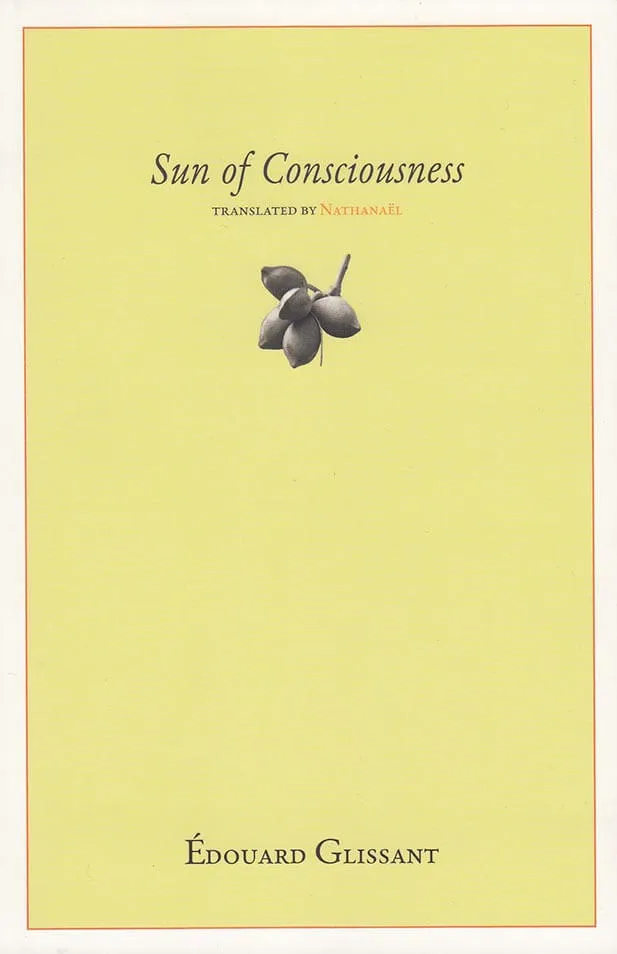
Cover of Sun of Consciousness

Nightboat Books

Sun of Consciousness

Edouard Glissant, Nathanaël trans.

€18.00

Soleil de la Conscience (Sun of Consciousness) was Martinican philosopher Édouard Glissant's first published work, and opened the Poétique (Poetics) strain of his oeuvre. This book-length essay, which is characterized by its exploratory, intimate character, announces Glissants concerns with créolisation (creolization), mondialité (worldliness, as against globalization), or opacité (opacity) and inscribes in this work a refusal of colonialism and of inverted exoticism. The sense of estrangement experienced by the author who arrives as a "foreigner" in a country to which he is bound by "the first page of his passport" is the author's principal preoccupation. By positioning himself as both different and same, Glissant opens a space for the writing of a(nother) history: that of the Caribbean.

Published in 2020 ┊ 96 pages ┊ Paperback ┊ Language: English

recommendations

Cover of Time Also Will Make It Interesting: Selected Journals

Nightboat Books

Time Also Will Make It Interesting: Selected Journals

Red Jordan Arobateau

Biography €23.00

The selected journals of trans, mixed-race artist and dyke erotica writer Red Jordan Arobateau.

Best known for his erotic lesbian fiction, Red Jordan Arobateau was also a prolific painter who maintained and self-published a journal for roughly twenty years, documenting his experiences at the “abject bottom” of life in the US. Edited and introduced by poet and scholar Cameron Awkward-Rich with a foreword by Michelle Tea and paintings by Arobateau, Time Also Will Make It Interesting captures Arobateau’s life as a young dyke in the criminalized cultures of 1950s-60s gay bars of Chicago and New York; his transition from dyke to trans man in late 1990s San Francisco; and his return to painting and an unfolding spirituality within that rapidly gentrifying city. 

Queerly messy, ornery, and stuffed with Arobateau’s wisdom, this volume is what he might have called, “a novel combined with a journal—da novel/journal! Taking all the liberty in the world! A domain where verse can be inserted, dreams recorded, my everyday political rants printed out, combined with my forté—fiction! All under one binding & title!”

Foreword by Michelle Tea.

Cover of Ante body

Nightboat Books

Ante body

Marwa Helal

Poetry €16.50

An incisive poetic sequence that tracks the relationship between migration and complex traumas in this unsparing critique of the unjust conditions that brought us the global pandemic.

Ante body is a poetics of [un]rest. A project that started as an exploration of how the psychological impacts of migration and complex traumas manifest as autoimmune disease and grew into a critique of the ongoing unjust conditions that brought on the global pandemic. Continuing her use of the invented poetic form, the Arabic, and integrating Fred Moten's concept of "the ANTE," Helal creates an elliptical reading experience in which content and form interrogate the inner workings of patriarchy, capitalism, nationalism, and globalism.

Marwa Helal is the author of Ante body (Nightboat Books, 2022), Invasive species (Nightboat Books, 2019) and the chapbook I AM MADE TO LEAVE I AM MADE TO RETURN (No, Dear, 2017).

Cover of Padam Padam: Collected Poems

Nightboat Books

Padam Padam: Collected Poems

Kevin Killian

Poetry €25.00

A posthumous celebration of the poet and provocateur Kevin Killian, Padam Padam pulses with camp, pop culture, and pleasure.

Kevin Killian—the puckish poet, playwright, novelist, scholar, and impresario of the Bay Area arts community—channeled the charisma of the pop stars. Pulled from his legendary corpus, and long out of print, the work collected here is the record of Killian’s life as a radical littérateur. In Argento Series, Killian conjures the horror, suspense, and cinematic imagery of director Dario Argento as he documents the AIDS epidemic in San Francisco. In Action Kylie, he revels in queer identity and the universal love of fandom. In Tweaky Village and Tony Greene Era, Killian elevates artists and friends to legendary status within his personal pantheon. And Elements, Killian’s wink at the periodic table, makes its U.S. debut. 

The collection features an introduction by Kay Gabriel, who writes of Killian’s “fabulous, permissive body of work, charming, filthy and smarmy at turns, with its retchable milk enemas and its devilish twists.”

Edited by Evan Kennedy & Jason Morris

Cover of Don't Leave Me This Way

Nightboat Books

Don't Leave Me This Way

Eric Sneathen

LGBTQI+ €18.00

A textual and historigraphical odyssey imbued with queer intergenerational yearning and loss.

Don't Leave Me This Way blends archival research with sexual fantasy to produce a series of sonnets inspired by Gaétan Dugas, named by Randy Shilts as "Patient Zero" of the AIDS epidemic in North America. Committed to the utopian possibilities of elegy and pornography, Don't Leave Me This Way exploits the absurdist beauty of the cut-up technique to voice a chorus of lost spirits: poignant, vengeful, and ready to ball.

Cover of Acker

Nightboat Books

Acker

Douglas A. Martin

Essays €18.00

A lyric essay written through Kathy Acker's evocative prose, public statements, and private archives.

A cover of Kathy Acker’s career and a study of the development of narrative in her books deftly tracing Acker’s interactions with a diverse palette of avant-gardisms, world letters, cultures, and theory. Martin follows Acker through New York’s downtown St. Mark’s Poetry Project scene, Black Mountain College, and the Beats, as Acker embarks on her own deconstructions of subjects autobiographical and historical, art procedurals, proto-conceptual writing, legacies, and spirits.

Cover of The Obscene Madame D

Pushkin Press

The Obscene Madame D

Nathanaël, Hilda Hilst and 1 more

Fiction €15.00

A wickedly funny work of depraved genius by one of Brazil’s most radical twentieth-century writers; imagine the Marquis de Sade as written by Clarice Lispecter.

An electrifying masterpiece by one of modern Brazilian literature’s most significant and controversial writers, Hilda Hilst takes us into the disorder and beauty of a mind restlessly testing its own limits.

Every month I ingested the body of God, not in the way one swallows green peas or agrostis, or swallows swords, I ingested the body of God the way people do when they know they are swallowing the More, the All, the Incommensurable, for not believing in finitude I would lose myself in absolute infinity…

The Obscene Madame D tells the story of Hillé, a sixty-year-old woman who has decided to abandon conventional life and spend the rest of her days in contemplation in a recess under the stairs. There, she is haunted by the perplexity of her recently deceased lover, Ehud, who cannot understand her rejection of common sense, sex and a simple life in favour of metaphysical speculations that he considers delusional and vain. 

In a stream-of-consciousness monologue that’s part James Joyce, part Clarice Lispector, and part de Sade, Hillé speaks of her search for spiritual fulfilment from a space of dereliction, as she searches for answers to great questions of life, death and the relationship between body and soul.

Translated by Nathanaël and Rachel Gontijo Araujo

Cover of Murder

Litmus Press

Murder

Danielle Collobert, Nathanaël

Fiction €18.00

Murder is Danielle Collobert’s first novel. Originally published in 1964 by Éditions Gallimard while Collobert was living as a political exile in Italy, this prose work was written against the backdrop of the Algerian War. Uncompromising in its exposure of the calculated cruelty of the quotidian, Murder’s accusations have photographic precision, inculpating instants of habitual violence.

Born in Rostrenen in 1940, Danielle Collobert left Bretagne for Paris at the age of eighteen where she worked in an art gallery and self-published her first poems in a book entitled Chants des guerres (1961). Both of Collobert’s parents, and her aunt, who survived deportation to Ravensbrück, were members of the Résistance during World War II. Herself a supporter of Algerian independence, Collobert joined the FLN (the Algerian National Liberation Front), precipitating her exile in Italy, during which time she completed work on Meurtre, first published in 1964 by Éditions Gallimard with the unwavering support of Raymond Queneau. She worked for Révolution africaine, a short-lived journal created at the end of the Algerian war. Collobert’s extensive travels, to Czechoslovakia, Indonesia, Bolivia, Ecuador, Venezuela, Mexico, Spain, Greece, Egypt, etc., did not prevent her from becoming a member of the group formed around Jean-Pierre Faye and the journal, Change. Her other works include Dire I et II (1972), a radio play the following year, Polyphonie, aired by France Culture, Il donc (1976) and Survie (1978). Upon her return from a trip to New York, Danielle Collobert took her own life in a hotel in Paris on her thirty-eighth birthday. Her complete works, in two volumes, edited by Françoise Morvan, augmented by several unpublished texts, were published by P.O.L. in 2005. Collobert’s works available in English include In the Environs of a Film (Litmus Press, 2019), Notebooks, 1956-1978 (Litmus Press, 2003) and It Then (O Books, 1989).

Cover of A Catalogue of Risk

Wendy's Subway

A Catalogue of Risk

Alisha Mascarenhas

Poetry €18.00

Alisha Mascarenhas’s A Catalogue of Risk is a volte-face of the neoliberal market economy’s construction of isolated, individual safety. In her debut book of poems, Mascarenhas lingers in the question of risk as it arises in daily life and intimacy. Through a close study and partial translation of philosopher-psychoanalyst Anne Dufourmantelle’s Éloge du risque (2011), her poems posit risk as a fissure, through which we might imagine yet-unknown futures.

Alisha Mascarenhas’s A Catalogue of Risk is the recipient of the 2022 Carolyn Bush Award.

Alisha Mascarenhas (b. 1989) is a poet and translator and the author, most recently, of the chaplet Contagion Fields (Belladonna* 2021). She has contributed writing to Pamenar Press, The Poetry Project Newsletter, The Recluse, Peripheral Review, and The Felt, among others. Alisha was a 2023 resident at La Baldi Artist’s Residency in Montegiovi, Italy. She holds an MFA in Writing from Pratt Institute in Brooklyn, where she now lives.

There is a body lying across Alisha Mascarenhas’s A Catalogue of Risk. Here is a book of generosity and perdition, that could not anticipate the death of its author, the one these works are addressed to, written for, dreamt by, in a stream of proximities. A strange dismantling of time occurs as a result of quiet reversals in which light is diffracted across belated syntaxes, reaching past life to the living. Though A Catalogue of Risk is “running past the flowers,” it is a slow text that grieves the day’s illuminations. It is a lesson in transmission in which we, readers, are the apprentices of grace, at the edge also of drowning. Here is a book that has been “hungering to be emptied.” So, too, is it a book of promise.
Nathanaël

A Catalogue of Risk is a book of luminous attention. Alisha Mascarenhas gives us the language of a mind tracking both internal and external weathers, tuning and returning herself to beauty, fear, grief and desire. Attending a cascade of emotions, the poet dwells in questions, knowing that to keep open to difficult questions is to keep open to desire. That she risks such openness, thinking always with others, through pain and love, is an astonishment. 
— Madhu Kaza

A Catalogue of Risk poses an evocative challenge, one of prismatic nuance: to pursue multiple angles of intimacy along the life-death continuum of how risk holds, unfolds, and makes one whole. “The definition” of what risk is “is shaded in questions” and runs a gamut of desires and sensations at once libidinal and cerebral. Alisha Mascarenhas risks risk itself with this generous offering of exquisite phenomenology and experiential trace in the form of a full-saturation poetics glowing in amplitude and intensity.
— Brenda Iijima
Cover of The Earth, the Fire, the Water, and the Winds

CARA Center for Art, Research and Alliances

The Earth, the Fire, the Water, and the Winds

Edouard Glissant

Non-fiction €30.00

The first publication dedicated to Glissant's art collection and project for a museum of memory-in-transit. 

Titled after Édouard Glissant's (1928–2011) anthology, La Terre, le feu, l'eau et les vents (2010), this publication offers a polyphonic extension of the writer's foundational thinking on art to museology, philosophy and poetry. The Museum of Errantry reflects Glissant's conception of the museum itself as an archipelago—a space open to ruptures, disappearances, and reinventions without forced synthesis. The Earth, the Fire, the Water, and the Winds features detailed artist entries, archival fragments and visual documents to illuminate the many relational, diasporic, migratory trajectories that inform Glissant's personal art collection and meditations. The volume also features never-before-published excerpts from L'Abécédaire d'Édouard Glissant (2008), a long-form recorded dialogue between the author and acclaimed Martinican writer Patrick Chamoiseau, as well as a facsimile of Notebook of a Journey on the Nile (1988), a poetic-philosophical travelog composed during a felucca trip through Egypt.

Edited with text by Ana Roman, Paulo Miyada. Foreword by Sylvie Séma Glissant, Mathieu Glissant, Isabelle Vestris, Manuela Moscoso, Anne Louyot. Text by Catalina Bergues, Patrick Chamoiseau, Sabrina Fontenele, Édouard Glissant, Cecília Vilela.

Cover of Mahagony

University of Nebraska Press

Mahagony

Edouard Glissant, Betsy Wing

Fiction €20.00

Édouard Glissant’s novels, closely tied to the theories he developed in Poétique de la Relation (Poetics of relation), are rich explorations of a deported and colonized people’s loss of their own history and the ever-evolving social and political effects this sense of groundlessness has caused in Martinique. In Mahagony Glissant identifies both the malaise of and the potential within Martinican society through a powerful collective narrative of geographic identity explored through multiple narrators. These characters’ lives are viewed back and forth over centuries of time and through tales of resistance, linked always by the now-ancient mahogany tree.

Attempting to untangle the collective memory of Martinique, Mathieu, the contemporary narrator, creates a conscious history of these people in that place—a record that unearths the mechanics of misrepresentation to get at the fundamental, enduring truths of that history, perhaps as only the mahogany tree knows it.

Cover of Smoke Drifts

World Poetry Books

Smoke Drifts

Nadia Anjuman, Diana Arterian and 1 more

Poetry €20.00

Afghan poet Nadia Anjuman (1980-2005) drew on the lineage of Persian and Sufi writing and her life under Taliban rule, attending to love, oppression, myth, and devotion through lyrics that both embrace and resist tradition. Anjuman grew up in the Herat, Afghanistan, a city known for centuries for its poetry. While the Taliban was in power, Anjuman met with other women in what appeared to be a needlepoint school, one of the few sanctioned pastimes for women, to secretly discuss literature and poetry. After the fall of the Taliban, Anjuman was finally able to attend university. She wrote and published a celebrated volume of poetry and was set to publish another before her early death due to domestic violence. Selections from both of Anjuman’s collections are presented here for the first time in English.

Cover of Howdunnit 2 - Panorama

Kayfa ta

Howdunnit 2 - Panorama

Merle Kröger, Rubaica Jaliwala

Fiction €12.00

Navina Sundaram is sitting in the editing room in Hamburg. She has managed to reduce the complexity of the Kemal Altun case to the required 2 minutes and 40 seconds for the political magazine; a journalistic feat considering the legal terminology and the international political situation, which must be presented in simple terms. She places her interview with the judge at the back. The audience therefore first gets an impression of perhaps the best-known deportation prisoner of the republic on trial here. The phone rings. I imagine she is displeased about the disturbance. It’s the day of the broadcast; the report still needs to be approved. It rings again. She answers. Peter Boultwood is on the phone and says, “Did you hear? Kemal jumped out of the window in the courtroom. He’s dead.” 

Merle Kröger lives in Berlin where she works as a novelist, screenwriter and dramaturg. She was a member of the Berlin film collective dog film (1992–1999) and founded pong  lm in 2001. Kröger is the co-author of Philip Scheffner’s internationally awarded films Revision (2012), Havarie (2016) and Europe (2022). Kröger has published five novels to date, including Grenzfall (2012), Havarie/ Collision (2015) and Die Experten/ The Experts (2021). Her novels have received numerous awards, including Best Crime Novel of the Year, the Radio Bremen Prize for Crime Fiction and the German Crime Fiction Prize.

Translated by Rubaica Jaliwala