rile*books

Search books

Search books by title, author, publisher, keywords...

Cover of ONE THOUSAND GHOSTS IN THIS FEAST

Wendy's Subway

ONE THOUSAND GHOSTS IN THIS FEAST

Sahar Khraibani

€14.00

Sahar Khraibani’s ONE THOUSAND GHOSTS IN THIS FEAST contends with desire, grief, and language as sites of injury and release. Written over a period of three days—amid ongoing genocide, land seizure, and displacement—the long poem counters logics of possession with those of relation. Khraibani’s all-caps, first-person address impels the poem forward, centering intertextuality as a force through which spectral presences shine.

Sahar Khraibani is a writer and artist whose work has been presented with Montez Press, The Brooklyn Rail, Magnum Foundation, the Poetry Foundation, the Poetry Project, and Hyperallergic among others. Sahar is a recipient of the Creative Capital / Arts Writers Grant, a fellowship at The Poetry Project, a MacDowell Fellowship, a 2024 residency at Mass MoCA, and is an alumni of the Whitney Independent Study Program. Sahar teaches at Pratt Institute and is the author of Anatomy of A Refusal (1080PRESS, 2025). 

ONE THOUSAND GHOSTS IN THIS FEAST lays bare the “SENSELESS DECAY” potentiated by empire’s relentless categorization, containment, and calculated death delivery. Khraibani’s debut chapbook collapses the imposed and perceived distance written by borders, disrupts anticipated colonial language logics, and bursts “INTO THE MADNESS OF THE ORGY” with queer interference reverberating in all directions. From the soil, from the graveyard, from the dancefloor, from their favorite spot on the eroding waterfront, Sahar broadcasts, IN ALL CAPS, “THE UNNAMEABLE TRUTH.”
Andrea Abi-Karam

Published in 2025 ┊ 52 pages ┊ Language: English

recommendations

Cover of The Time of the Novel

Wendy's Subway

The Time of the Novel

Lara Mimosa Montes

Fiction €18.00

A disaffected young woman seeking self-estrangement and withdrawal from the world decides to quit her day job as a bookseller to live out, or live in, an experiment: to become a full-time narrator. She moves through sentences, afternoons, a rented apartment, an artist’s studio, a party, the post office with the flowering focus of a realist novel, transposing physical and social life to the space of fiction. As she chronicles the process of becoming a subject in writing, the narrator confronts her fantasy of uninterrupted interiority—and its limits.

What is “fiction” and how does one “enter” into it? Composed in the tense of Literature, Lara Mimosa Montes’s The Time of the Novel is a book about detours, psychic swerves, and surprising encounters with the Real as it converges with the written.

Cover of An Inherent Tear

Wendy's Subway

An Inherent Tear

Rodrigo Quijano, Judah Rubin

Poetry €18.00

Rodrigo Quijano’s An Inherent Tear assembles a suite of poems first published in Lima in 1998 as Una procesión entera va por dentro and his 2014 essay “A Terrace in Valparaiso,” translated into English for the first time by Judah Rubin. Written during the Fujimori years of the 1990s—a period characterized by the end of the conflict between the Maoist Sendero Luminoso insurgency, the Peruvian army, and the Marxist-Leninist Túpac Amaru Revolutionary Movement—Quijano’s bracingly mournful and incisively wry poems insist that we not turn away from the unburied dead. Shifting between neo-baroque hermeticism and a poetics of the conversational, his work destabilizes lyric subjectivity, testing the limits of the structure of metaphor to relay the impasses of the present. Reflecting almost twenty years later from the “city of wildfires,” Quijano’s essay charts the continued landscape of state violence that carries with it the “payroll of bones” Cesar Vallejo evoked nearly a century earlier. In this new, searing collection, Quijano searches amid the smoke and the ashes for “A place to spend the night, / or a language to speak in, / walking through the desert, or drilling into our / insubstantial dreams.” 

About the author
Rodrigo Quijano is a poet and art researcher. He has worked on contemporary art exhibitions in Lima, São Paulo, Mexico, Buenos Aires, Santiago, Bogotá, and the 57th Venice Biennale.

About the translator
Judah Rubin is the author, most recently, of Antiquarian Historiography (Oxeye Press, 2020). Recent translations can be found in the anthology The Beauty Salons/Salones de la Belleza (Aeromoto/Gato Negro/UNAM, 2021), the journals Firmament and Jacket2, and elsewhere. He is the editor of A Perfect Vacuum and lives in Queens, New York.

Cover of Ad Học

Wendy's Subway

Ad Học

Teline Trần

Poetry €12.00

Teline Trần's Ad Học traverses the improvisational structures that shape social life in order to reflect their valences as both insufficient and abundant. In their first poetry chapbook, Trần locates those junctures with bittersweet pleasure and biting critique and asks how to sustain both at once. This is, Trần shows us, the work of living, against and within the ongoing attrition and amnesia at scales historical and governmental, interpersonal, familial, and social. Ad Học asks the reader to turn inwards, towards a personal politic, to self-revolution, in order to seek horizons dreamier, queerer, and hopefully insurgent.

Teline Trần is a writer from Orange, California or Gabrieleño/Tongva land. They write about home and interstitial faith via several mediums such as fiction, poetry, film, and ultimately, the browser. Teline works as the Membership and Community Engagement Coordinator at Wendy’s Subway, where they were a Fellow in 2020. They also work as the Development Coordinator at Mekong NYC, a Southeast Asian grassroots organization in the Bronx. They hold a degree in Comparative Literature from Reed College.

Cover of She Follows No Progression

Wendy's Subway

She Follows No Progression

Rachel Valinsky, Juwon Jun

Anthology €30.00

She Follows No Progression reflects on the plurality of Theresa Hak Kyung Cha (1951–1982)’s work and legacy, collecting essays, personal narratives, poems, conversations, letters, and the extratextual in a reader that attests to Cha’s genre-bending vision and political imagination. The writers, artists, scholars, organizers, and educators collected here, each unique in their voice and method, multiply approaches to language, colonial history, migration, and time in dialogue with Cha’s unequivocally interdisciplinary practice. Their contributions traverse subjects from Asian American studies to literary history, translation, film theory, and experimental poetics, while attending to the gaps between these fields and the intractable entanglements of race, class, and gender that underlie them. She Follows No Progression echoes Cha’s appeal for a liberatory horizon emergent from all that we are affixed to in the present.

She Follows No Progression is published on the occasion of the 2022 program, The Quick and the Dead: Theresa Hak Kyung Cha Edition. The Quick and the Dead is a yearlong, multiphase project that highlights the life, work, and legacy of a deceased writer by bridging their work to that of contemporary practitioners. In its third year, the program focused on Theresa Hak Kyung Cha.

Contributors:

Sam Cha, Marian Chudnovsky, Jesse Chun, Una Chung, Anton Haugen, Irene Hsu, Valentina Jager, Juwon Jun, Youbin Kang, Eunsong Kim, Youna Kwak, Jennifer Kwon Dobbs, Andrew Yong Hoon Lee, Jennifer Gayoung Lee, Sujin Lee, Florence Li, Serubiri Moses, Jed Munson, Yves Tong Nguyen, Wirunwan Victoria Pitaktong, Brandon Shimoda, Caterina Stamou, Megan Sungyoon, Teline Trần, and Soyoung Yoon.

Cover of The Book of Na

Wendy's Subway

The Book of Na

Na Mira

Fiction €28.00

In The Book of Na, translation acts at the edge of perception. Tracing across projects in film, video, and performance, Na Mira reflects on the violent fragmentation of bodies while refusing the containment of geographic and corporeal borders. In 1977, a name is cut at an immigration office. This gap turns into an intergenerational score for becoming heat, hexagram, hologram. Using oracular and glitching technologies, Mira witnesses what escapes data: doppelgängers, dreams, endangered tigers, tesseracts, A. Turiyasangitananda Coltrane's stairs, Theresa Hak Kyung Cha in a theater, Korean shamanism, frozen ligaments, wildfires, borderlands, subatomic particles, and pink. Syncing to a clock with neither face nor hands, Mira’s hauntological permutations in time, death, and relation travel outside the symbolic order and draw energy from the void.

Na Mira’s autobody rites have been presented at sites including Seoul Museum of Art; Museum of Contemporary Art, Los Angeles; Portland Institute of Contemporary Art; Participant Inc., New York; and Whitney Museum of American Art, New York. She earned an MFA from the University of California, Los Angeles. She grew up between the US and East Asia and teaches outside.

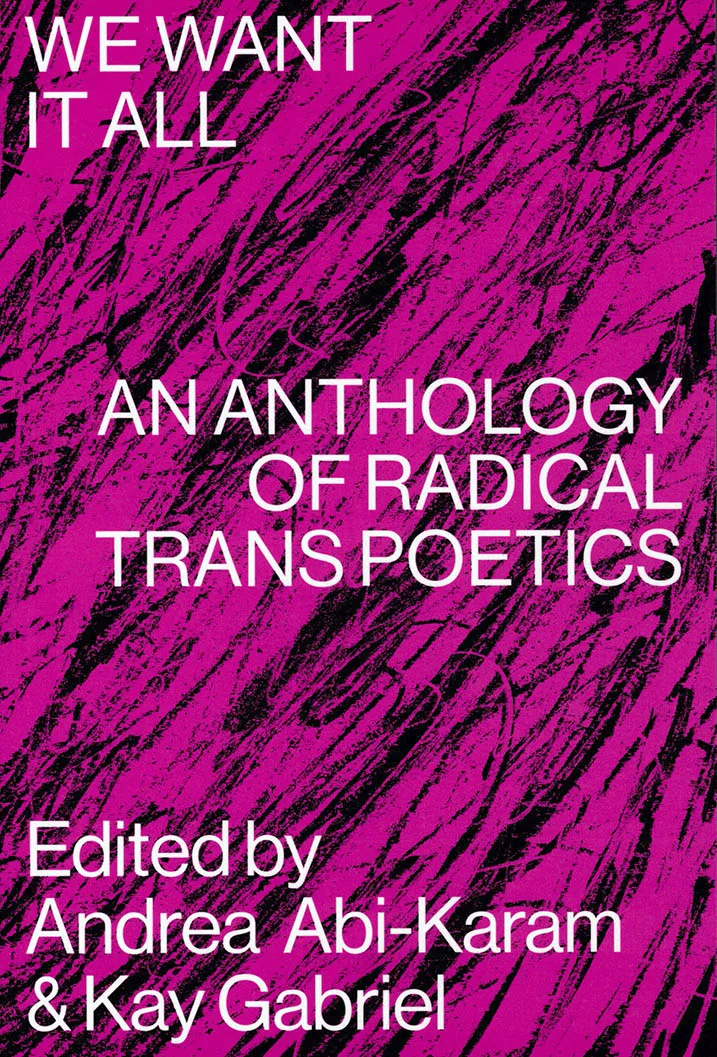
Cover of We Want It All: An Anthology of Radical Transpoetics

Nightboat Books

We Want It All: An Anthology of Radical Transpoetics

Kay Gabriel, Andrea Abi-Karam

Poetry €23.00

An anthology of formally inventive writing by trans poets against capital and empire.

With texts by: Andrea Abi-Karam, New York City Sam Ace, South Hadley, MA Bahaar Ahsan, Berkeley, CA jasper avery, Philadelphia, PA Ari Banias, Berkeley, CA Jo Barchi, Chicago, IL Joss Barton, St. Louis, MO Levi Bentley, Philadelphia, PA Jessica Bet, Baltimore, MA Rocket Caleshu, Los Angeles, CA Ching-in Chen, Seattle, WA listen chen, Vancouver, BC Faye Chevalier, Philadelphia, PA Cody-Rose Clevidence, Arkansas Miles Collins-Sibley, Easthampton, MA Valentine Conaty, New York City CA Conrad, Philadelphia, PA Jimmy Cooper, Rochester, MI Maxe Crandall, Oakland, CA José Díaz, Boston, MA Aaron El Sabrout, New Mexico Ian Khara Ellasante, Lewiston, ME Caelan Ernest, New York City, NY NM Esc, San Diego, CA joshua jennifer espinoza, Los Angeles, CA Logan February, Ibadan, Nigeria Ray Filar, Brighton, UK Nora Collen Fulton, Montreal, Canada Kay Gabriel, New York City Callie Gardner, Cardiff, Wales Jesi Gaston, Chicago, IL Harry Josephine Giles, Edinburgh, Scotland Aeon Ginsberg, Baltimore, MD Caspar Heinemann, Berlin, Germany Kamden Hilliard, Greenville, SC Stephen Ira, New York City Cyrée Jarelle Johnson, New York City Peach Kander, New York City Jayson Keery, Western, MA Evan Kleekamp, Los Angeles, CA Noah LeBien, New York City Ty Little, Richmond, VA Zavé Martohardjono, New York City Amy Marvin, Philadelphia, PA Natalie Mesnard, New York City Bianca Rae Messinger, Iowa City, IA Liam O'Brien, New York City Xandria Phillips, Madison, WI Rowan Powell, Santa Cruz, CA Nat Raha, Edinburgh, Scotland Holly Raymond, Philadelphia, PA Jackie S, New York City Trish Salah, Toronto, Canada Raquel Salas Rivera, Philadelphia, PA Mai Schwartz, New York City Kashif Sharma-Patel, London, UK Julian Talamantez Brolaski, Oakland, CA Charles Theonia, New York City Jamie Townsend, Oakland, CA Nora Treatbaby Laurel Uziell, London, UK Rachel Franklin Wood, Boulder, CO Clara Zornado Akasha-Mitra xtian w. and Anaïs Duplan, NYC.

Kay Gabriel is a poet and essayist. She's the author of Elegy Department Spring / Candy Sonnets 1 (BOAAT Press, 2017), the recipient of fellowships from Lambda Literary and the Poetry Project, and recently completed her PhD at Princeton University.

Andrea Abi-Karam is an arab-american genderqueer punk poet-performer cyborg, writing on the art of killing bros, the intricacies of cyborg bodies, trauma & delayed healing. Their chapbook, THE AFTERMATH (Commune Editions), attempts to queer Fanon's vision of how poetry fails to inspire revolution. Andrea's first book, EXTRATRANSMISSION (Kelsey Street Press, 2019), is a poetic critique of the U.S. military's role in the War on Terror.

Cover of Anatomy of a Refusal

1080 Press

Anatomy of a Refusal

Sahar Khraibani

Poetry €25.00

Written after the Beirut Port Explosion on August 4, 2020, when 2,750 tonnes of ammonium nitrate exploded in the commercial and residential  port of Beirut after years of warning and mismanagement, Anatomy of a Refusal drifts between lineated and prose poetry, creating a transitional space of mourning. Comprised of three sections, “Mutually Assured Destruction” confronts displacement; “Blast” erases and rescribes bureaucratic documents written about the explosion, and “Deterrence” “return[s] to the place of injury.” 

Intertextually poetic, Sahar Khraibani writes in conversation with other writers and philosophers to question, “who owns my language?” and “What does it mean to be in / place?" And yet, between bureaucracy and philosophy, there are moments of intimacy, friendship coexisting in the shared space of the poem—between speaker and addressee, the body and the living world—where belonging carries the weight of grief.

—Blurb written by Clarise Reichley

Cover of What Price This Pound of Whale? and Other Unpublished Writings

CUNY Center for the Humanities

What Price This Pound of Whale? and Other Unpublished Writings

Jim Schoppert

The Tlingit artist Jim Schoppert (1947-1992) was among the most accomplished, innovative, and prolific Alaska Native artists of the twentieth century. His whimsical sculptures and large scale painted wooden carvings reconfigure Tlingit visual motifs, and he challenged the binary categories against which Indigenous artists are so often defined, such as traditional and contemporary, historic and innovative, and artist or craftsperson. While known primarily for his modernist interventions in Tlingit visual traditions, Schoppert was also a prolific writer, an eloquent speaker, and an ardent advocate for Alaska Native artists. This publication brings together a selection of his unpublished poetry and writings from the artist’s personal papers. Presented alongside never before seen sketches and studies, this selection bridges Schoppert’s written and artistic practices in a deeply personal portrait of the artist and Alaska Native life that upsets preconceptions about Native art and unsettles the established narrative of Euro-American and Indigenous aesthetic relations.

Jim Schoppert (1947-1992) was a Tlingit multidisciplinary artist and writer. He was a Taku Tlingit Raven of the Ishkahittaan (Inland Frog) clan from his Tlingit mother and half-German from his father and carried the Łingit name Dom-Yetz. Born in Juneau, Alaska, he earned a BFA in Sculpture and Printmaking from the University of Alaska—Anchorage and an MFA from the University of Washington. In addition to his artistic career, Schoppert was instrumental in promoting Alaska Native arts and organizations. He was Director of Arts and Crafts at the Cook Inlet Native Association, Director of the Alaska Arts in Prisons Program for the University of Alaska Juneau, and organized exhibitions and workshops across Alaska and the Pacific Northwest. He was visiting professor in visual art at the University of Alaska, Fairbanks and directed its Native Art Center. He sat on the Washington State Arts Commission and on the boards of the Alaska State Council on the Arts and the Institute of Alaska Native Arts. His work is held in public and private collections across the United States, including the Smithsonian National Museum of the American Indian, the Anchorage Museum, the Heard Museum, and the Newark Museum, among others. His writing and poetry has appeared in The Greenfield Review and Journal of Alaska Native Arts, among other publications.