rile*books

Search books

Search books by title, author, publisher, keywords...

Cover of UNIVERSAL PRODUCT CODE

Tabloid Publications

UNIVERSAL PRODUCT CODE

Kelly Clare

€12.00

"Like the Elizabeth Bishop painting “Interior with Extension Cord,” Kelly Clare’s helical, light-filled Universal Product Code delicately traces a bewildering infrastructure. This incantatory song, “busy in green,” points its reader to the disturbing beauty in stripey checksum barcodes, to arrays of imported figs at the grocer, to words like cloud or lime that now mean too much. Humorous, musical, perspicacious, this chapbook rocks."

- Katherine Gibbel, April 2026

Includes 3 poems by Dre Roelandt.
Published as part of Paraphernalia and Addenda 2.2 of Tabloid Publications.

Published in 2026 ┊ 20 pages ┊ Language: English

recommendations

Cover of GOAT FOIL

Tabloid Publications

GOAT FOIL

Maxwell Gontarek

Poetry €14.00

"Marie’s fragrance, smashed out of the bottle for another breath. We should always doubt that the air is pure. We should always doubt that the air is not." 
–Alexandre Curlet

Includes an excerpt from Josh Barber's "Omnipotence".
Published as part of Paraphernalia and Addenda 2.2 of Tabloid Publications.

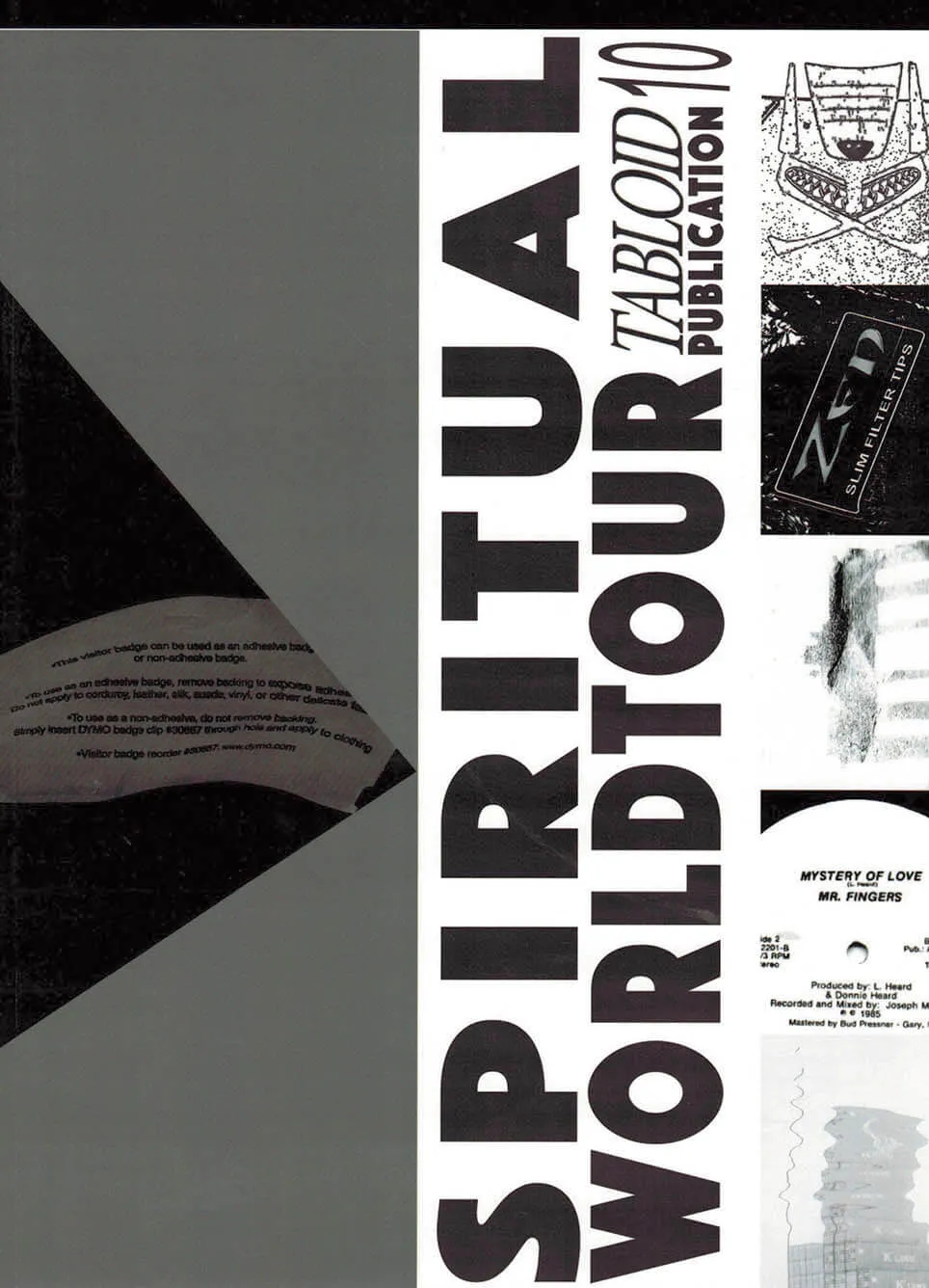
Cover of Spiritual World Tour

Tabloid Publications

Spiritual World Tour

Nat Marcus

Spiritual World Tour by Nat Marcus.
Cover of Juvenilia #2

Tabloid Publications

Juvenilia #2

Willa Smart

Poetry €12.00

Ludi Juvenales (Latin for "juvenile games') is a poetry, art and games series interested in youth, childhood, play, and immaturity. 

Ludi Juvenales is edited by Elise Houcek & Zoe Darsee

www.ludijuvenales.com

Juvenilia #2 by Willa Smart.
Copyright C Willa Smart 2024. All rights reserved.
Cover art by K. Fabricant.
Design by Elise Houcek & Zoe Darsee.
Risograph printed with BearBear in Milwaukee, Wisconsin.
Edition of 50.

Cover of The Flesh

Tabloid Publications

The Flesh

Yves B. Golden

Poetry €18.00

The Flesh is a collection of Yves B. Golden's poems, lyric essays and social criticism – and often these generic distinctions become blurred. Published by Ediciones La Escocesa (Barcelona, ES), TABLOID facilitated this book's production as editors and book designers. A selection of Golden's texts are also translated by Leto Ybarra, rendering the author's work into Spanish for the first time.

“Respectfully! The Flesh feels like a conjuring and a force of nature—unyieldingly raw, full of delectable sensitivity that shapes a world Yves B. Golden deliveries with formidable honesty—where her word is the journey, the body and the bond. Yves writes: ‘not one bird is declined entry into heaven’. The Flesh is succulent in the mouth of the mother— Yves is a steward of time machines, celestial bliss and untethered healing. The Flesh unties the tongue, waters the mouth and the garden. Within Yves’ 5th book she offers us a timeline in recognizing that all birds and angels alike can touch the sky. We are always, already, held and drenched in glory and deserving of love and safety. The Flesh is Black like obsidian. May our love bloom like the flesh in every lifetime.”
- keioui keijaun thomas

“Yves B Golden has given us a protection spell against tyranny; a Blue Guide for the conscious and the daydream; raw free jazz that knows the standards as well. Golden’s linguistically liberated fantasies can transmute into a body of politically imperturbable ethoses in the same sentence. This book offers information for an evolutionary sensitivity, for the next level of sense-making and particularity of the human being. Though the poet urges us to de-realize the flesh, to split our own heads open, we must also accommodate the flesh’s intangibles that interlock, conjoin, negate, and negotiate: such ‘outward and inward facing conundrums’ go on and on. Welcome this ‘bearer of turbulent news.’”
- Losarc Raal

Cover of PARANOID CITI

Tabloid Publications

PARANOID CITI

Shannon Hearn

Zines €12.00

"Desperate and playful. This iterative poetic series cries through the panic of now to bestill an ecstatic people. Paranoid Citi finds no doubt that if understanding is a matter of form, survival necessitates transformation." - Crystal Odelle, author of Trans Studies

"Who doesn't like to post ethereal lightly? Who isn't a citizenry draped in lilac ethics? Are you a froth? In Shannon Hearn's PARANOID CITI, an interrogative story is shaping up. She's uploading music for grace in crisis. She's writing poems for you, citizen, and kindly so." - Nick Sturm

Includes a bag tag and drawing by Elise Houcek.
Published as part of Paraphernalia and Addenda 2.2 of Tabloid Publications.

Cover of SIXFINGERAFTERWARDS

Veer2

SIXFINGERAFTERWARDS

William Rowe

Poetry €13.00

William Rowe, the poet, and eminent translator of Latin American poetry from Vallejo to Raul Zurita & others presents his latest book of poems, Sixfingersafterwards, in six sections. The title word ‘afterwards’, which refers to a large part of the first section of poems takes inspiration from an Ayahuasca session. According to Freud, Afterwardness or Nachtraglichkeit as originally harmless memory can later be re-experienced as traumatic through the lens of new mature understanding. The Marxists view the capitalist state as inherently connected to a ‘death culture’ where the pursuit of profit overrides the human life, turning the system into a form of a vampirism that consumes the living labour. All the sections are written with a deep commitment, elaborating a painful truth in a remarkable open poetic sensitivity. Our language ravaged by ‘vampirism’ where ‘Language itself seemed to form death communiques.’  Other sections are about love, ‘when my daughter says she loves me very much.’  Or a section of Quechua poems translated by Rowe, which shed light on the extensive range of his writing and interconnectedness of his creativity. The poems in this collection leave nothing out of the traumatic pain from capitalism nor its ‘dark dark shine of money.

I dreamt of Rowe, reading these poems to the track called Walking on the ceiling, by the late Chicago blues guitarist, who played with six fingers. I renamed it to Walking the ceiling toward eternity, to honour the Sixfingersafterwards. A must-read!
- Ulli Freer

Cover of Death Industrial Complex

Action Books

Death Industrial Complex

Candice Wuehle

Poetry €18.00

Candice Wuehle’s Death Industrial Complex is a meditation on the cultural obsession with the bodies of dead women and an occult invocation of the artist Francesca Woodman. Like Woodman’s photographs with their long exposures and blurred lenses, this book is haunted and haunting, hazy yet devastatingly precise. These are poems as possessions, gothic ekphrases, dialogues with the dead, biography and anti-biography, a stunning act of “cryptobeauty.”

Cover of Adorno's Noise

Essay Press

Adorno's Noise

Carla Harryman

Poetry €18.00

Adorno’s Noise is a collection of experimental, poetic, and conceptual essays. Adorno’s Noise takes a stunning plunge into a kaleidoscopic world of globalization, female sexuality, the place of art and artist, and the looming power of the state. Phrases from Theodor Adorno’s aphoristic philosophical text, Minima Moralia, serve as catalysts for an explosion of thought and language that quickly breaks Adorno’s orbit.

“This work by Carla Harryman, startlingly astute, once again proves how necessary an encounter with her writing has become for us today. Her grasp of theoretical and poetic exigencies is unbypassable, and she moves lightly, lifting the prose poem into the amplitude of a new articulation.” — AVITAL RONELL

“Adorno’s ‘noise’ may be nothing more than the consonance of late modern capital talking to itself, but Carla Harryman listens to Adorno listening, and what she hears is a very different sort of dissonance, something Adorno himself may have been deaf to. Listening for a noise that can’t be heard, Harryman attends to the disruption of signal the aesthetic artifact called a corpse at the limit of Adorno’s magisterial eloquence, where thought steps over the body. Atonally faithful to his negativity the afterglow of torment passing through figures of speech while refusing the authority of a masterful dialectic, Harryman makes our unthought horizon “normality is death” audible, presencing a body that can’t be redeemed by aesthetics the bosy wants tobe art and fails at it. From Gender the Status of Dogs to works by Sun Ra, Anais Nin, Robert Smithson, and Kenzaburo Oe, this radically asynthetic writing moves thru polyphonic configuration of word, image and concept. Synthesia? Emotional truth? The intersection between abstraction and narration? Practicing a militant ethic of non-mastery as every one of its sentences sounds like a sensory organ in the process of becoming its own theoretician. Adorno’s Noise reinvents the “essay as form,” but it doesn’t stop short of reinventing thinking.” — ROB HALPERN

Carla Harryman is the author of twenty-four books of poetry, prose, plays, and essays. Harryman is widely acknowledged as an innovator in poetry, prose, and inter-disciplinary performance. An active collaborator, she is one of ten co-authors of The Grand Piano, an Experiment in Collective Autobiography: San Francisco, 1975-1980 (2006-2010). Open Box, a CD of music and spoken text performance created with composer and musician Jon Raskin was released on the Tzadik label in 2012. Her Poets Theater plays and music/text collaborations have been performed nationally and internationally, including at dOCUMENTA 13, where she presented the closing keynote performance Occupying Theodor W. Adorno’s “Music and New Music,” a music/text work that folds segments of Adorno’s Noise into her poetic adaptation of Adorno’s lecture. She is the editor of two critical volumes: Non/Narrative, a special issue of the Journal of Narrative Theory ( 2012) and Lust for Life: On the Writings of Kathy Acker (with Avital Ronell and Amy Scholder, Verso, 2006).

Other books by Carla Harryman include the collection of poetry and performance writings published in French and English editions Sue in Berlin and Sue á Berlin (2017); A Voice to Perform (Split/Level 2020); the epistolary essay, Artifact of Hope (2017); the diptych W—/M— (2013), Gardener of Stars: A Novel (2001), and two volumes of selected writing: Animal Instincts: Prose, Plays, Essays (1989) and There Never Was a Rose without a Thorn (1995). Her grants and awards include The Foundation of Contemporary Art, New York, Opera America Next Stage (with Erling Wold), and The Ronald W. Collins Distinguished Faculty in Creative Activity Award from Eastern Michigan University, where she serves on the faculty of an interdisciplinary creative writing program.

Cover of Alice Notley, Live in Seattle

Fonograf Editions

Alice Notley, Live in Seattle

Alice Notley

Poetry €23.00

Entirely comprised of poems contained in her latest collection, 2016’s Certain Magical Acts, Live in Seattle elucidates why Alice Notley is one of the world’s most revered poets, the recipient of the Los Angeles TimesBook Award, the Griffin Prize, the Shelley Memorial Award, the Lenore Marshall Prize, and the Poetry Foundation’s Ruth Lilly Prize. “I am alive outside written memory” is how one of the speakers of Notley’s poem “Voices” puts it and listening to the poet read her work live, in front of an entranced audience, serves to detail the intangibility of sound vis-à-vis language.

Live in Seattle also includes excerpts of the onstage conversation Notley had with Seattle poets John Marshall, Christine Deavel and Rebecca Hoogs. Among other topics, the talk revolves around concepts of success, what it means to write a female poetry circa 2017, and the importance of always creating from a position of disobedience.

As part of Seattle Arts & Lectures’ Poetry Series, Live in Seattle was recorded at McCaw Hall in Seattle, Washington on Wednesday, April 5th, 2017 and mastered and engineered by Gus Elg at Sky Onion in Portland, Oregon in the Summer of 2017. 

Purchase of Live in Seattle includes a 11×11 insert of Notley’s poem “FOUND WORK (lost lace),” as well as a download card for the entire album. Live in Seattle can also be found digitally on Spotify and Bandcamp. The record itself is not black but clear.

Cover of Cyclamen

Tenement Press

Cyclamen

Alix Chauvet

Poetry €25.00

A debut collection from the poet, artist and designer, a suite of unfaithful translations/transversions of works drawn from Baudelaire’s Les Fleurs du mal / Flowers of Evil, a bunch of flowers in decay, pressed and frayed, ‘a flock of pockmarked words.’

Through these creative ‘translations’ of Charles Baudelaire, Alix Chauvet—artist, designer, poet—refuses fidelity in favour of flirtation: her ‘flowers of evil’ line Amsterdam’s canals, drink from the same rainclouds as Rachel Ruysch’s bewitching bouquets, sprout through peat, and are tended by a distinctly feminist and nomadic sensibility. Chauvet—akin to Olive Moore, Sean Bonney and Lisa Robertson—takes the nineteenth-century French decadent as a contemporary accomplice for aesthetic and linguistic misbehaviour. Walter Benjamin once wrote of Baudelaire that he is ‘der geheime Architekt der Moderne,’ and in Chauvet’s hands, those foundations are made porous, unbuilt into cast shadows, into ribbons, into veins streaming across the page. Accompanied by scans of the French poems and Chauvet’s shadow photography, what Cyclamen ultimately offers us is a regenerative rewilding of the English language: a wondrous terrain ringed by vines of unruly syntax and dotted with the fruit of words refusing domestication by any single tongue. Mia You

Alix Chauvet is a Swiss-French poet and graphic designer based in Amsterdam, taking pleasure in the possibilities of translation. She received her BA in Graphic Design from the Gerrit Rietveld Academie (Amsterdam, 2020), and has since been working independently and in collaboration with contemporary artists. Investigating the relationships between language and body, intimacy and collectivity, past and contemporary, her hybrid practice covers a wide range of visual and linguistic experiments from artist’s book design to experimental translation. Her method is rooted in decelerating the creative process through the use of analogue and unprofitable techniques such as cut-outs, letterpress, linocut, handwriting and painting. Chauvet’s poetic approach follows the same logic, prioritising English over her mother tongue as a way to revise language with both critical detachment and a degree of identification. Her poems have appeared in literary magazines such as Blackbox Manifold, and Cyclamen is her debut collection.