rile*books

Search books

Search books by title, author, publisher, keywords...

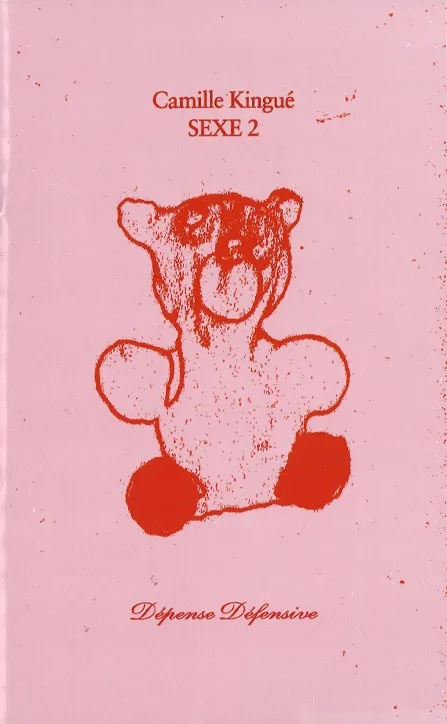
Cover of Sexe 2

Dépense Défensive

Sexe 2

Camille Kingué

€12.00

Confession sur le désir (l’action et l’objet du), les liens de mutualité et de résistance, Sexe 2 alterne prose et versification en 27 fragments numérotés à l’adresse plus ou moins dure, plus ou moins sincère, plus ou moins formulée car plus ou moins éloignée du Toi et du Je. Camille Kingué s’attache à révéler, à voir quelque chose à travers son image réelle et virtuelle, agrandie et rétrécie, droite et renversée, déployant une recherche des principes de l’amour (l’amour comme amour, pourquoi est ce qu’il y a de l’amour) où la métaphysique et la compréhension de soi – donc de l’autre – n’ont jamais été aussi sexy.

Claire Star Finch, dans la magnifique préface qu’iel signe au début de l’ouvrage, écrit : « Après avoir lu tous les livres de Kingué, je ne sais pas si je crois en “l’amour”, que ce soit en tant que substantif absolu ou en tant que proto-résidu de tout ce que “le sexe” peut signifier. Mais je crois définitivement qu’il faut l’écrire. » Définitivement.

Published in 2026 ┊ 56 pages ┊ Language: French

recommendations

Cover of Oraison funèbre pour Zelda1990

Dépense Défensive

Oraison funèbre pour Zelda1990

Romane Constant

Fiction €15.00

D’eux, il ne reste que les mots de celle qui a croisé leur route. Le crissement de pneus qui sifflent avant un malheur qui tarde à se produire. Sanctification plus que célébration, Oraison funèbre pour Zelda1990 est une tentative de communication au-delà de la matière physique de l’énonciation, un dialogue interne qui convoque « par moment le frère, par moment l’ami parti », toujours la ruine, la consommation de la séparation avec le tout. À travers quatre parties qui font écho à la structure des éloges funèbres de la Grèce antique, Romane Constant réouvre la poésie des plaies larges et profondes que les vers lapidaires d’Hélène Bessette – sur qui l’autrice mène un travail de recherche – ont laissé dans l’histoire moderne de la littérature, et signe un texte bouleversant sur la difficulté des choses qui ne (se) passent pas, la force de celles que l’on voit suspendues par le cou au bord d’une paix impossible à trouver. Oraison funèbre pour Zelda1990 est une douleur croissante, avec écoulement et rougeur.

Romane Constant vit et travaille à Paris. Elle explore à travers différents supports les questions relationnelles, d’intimité, du corps et du genre. Attachée aux Ardennes où elle a grandi, elle s’intéresse également à l’héritage de la classe ouvrière et aux traumatismes intergénérationnels.

Cover of Crue

Dépense Défensive

Crue

Théo Robine-Langlois

Poetry €12.00

L’Île-de-France a été engloutie. Submergée par de l’eau liquide. C’est à peu près tout ce que l’on sait. Crue est un long poème construit sur un rythme ternaire, une suite de tercets libres entrecoupés de symboles typographiques étranges dont la signification exacte semble avoir été perdue dans l’inondation. Il y a dans le va-et-vient soutenu du texte comme dans celui de la mer, ses gestes répétés, toujours successifs, quelque chose de l’automation ; l’acceptation sans révolte d’une nouvelle nature sous-marine hybride, plus uniquement humaine, à la langue noyée, gorgée de néologismes, méthodique, néanmoins sentimentale. Car ici la cruauté sinistre de la nature fait écho aux émotions du narrateur. Le paysage-état d’âme est désolé, apocalyptique mais comme résigné, nu. Crue sonde les abysses de la civilisation et des comportements humains. Peut-être un des textes les plus personnels de Théo Robine-Langlois.

Cover of Secrèt

Dépense Défensive

Secrèt

Théo Robine-Langlois

Fiction €12.00

Mystique des rues vides et peu éclatantes des banlieues pavillonnaires, ce court poème en prose interpelle par sa langue sombre. Dans une parodie de messe noire – beigeasse comme le crépis des façades –, Théo Robine-Langlois dépeint le monde mystérieux des maisons individuelles, du repli sur soi démonique, et des vieilles qui marmonnent entre leurs gencives au retour du marché, le panier plein de gros sel et de radis noirs en guise d'hostie. Les mots occitans qui ponctuent le texte comme des conjurations en accroissent l’escur.

Cover of New York Temps

Dépense Défensive

New York Temps

Aurelia Guo, Salomé Burstein

Poetry €15.00

Composé à la fois de récits personnels, de citations et de collages provenant notamment du New York Times, New York Temps suggère une discontinuité des états intérieurs, accentuée par la multiplicité des orateur.ices : les voix se succèdent à elles-mêmes, sont à chaque moment ce qu’elles n’étaient pas celui d’avant, apprenantes et à l’écoute de tout ce qui n’est pas elles. À travers des questions d’intertextualité et de sampling en poésie, le texte porte en lui une violence immanente – rendue plus intérieure, faite sienne –, une gêne, non seulement ressentie, mais aussi imposée, comme une protestation.

Titre original : NYT. Publié pour la première fois chez Gauss PDF en 2018. Traduit de l’anglais par Salomé Burstein.

Aurelia Guo est écrivaine et chercheuse à Londres. Elle est également l’autrice de World of Interiors (Divided Publishing, 2022).

Cover of Tongue Ring: Issue 01

Tongue Ring

Tongue Ring: Issue 01

Aodhan Madden, Claire Star Finch

Periodicals €13.12

Oh oh this is the first issue of Tongue Ring, a journal of experimental writing in English & French, with original contributions and translations of texts* by Ariana Reines*, CAConrad*, Camille Kingué, Kaur Alia Ahmed*, Rafael Moreno, Taos Bertrand, and Théo Robine-Langlois*. 

Vous voyez, c’est ça mon genre. Je ne sais pas ce que c’est. 
Mais c’est mon genre. J’ai cet esprit en moi—qui est très ému
par la féminité. Je pourrais me mettre à pleurer. Je veux poser
mon manteau par terre pour la laisser marcher dessus
—Ariana Reines

Premier numéro de la nouvelle revue fantastique et bilingue (FR + EN) d’écriture expérimentale Tongue Ring, avec des contributions originales ainsi que des traductions* de textes de Ariana Reines*, CAConrad*, Camille Kingué, Kaur Alia Ahmed*, Rafael Moreno, Taos Bertrand, and Théo Robine-Langlois*. 

Cover of Working Museum

Veer2

Working Museum

Ziddy Ibn Sharam

Poetry €13.00

"In Spring and All, William Carlos Williams figures imagination as the springing off point to greater connection with the world and its gentle motions. ‘It is spring,’ he writes: ‘life again begins to assume its normal appearance as of “today.” Only the imagination is undeceived.’ Embracing the haecceity of the everyday and allowing the imagination to make silent and surprising connections are ways to withhold the deceptiveness of relying on old habits of thinking and writing. 

Ziddy Ibn Sharam’s Working Museum begins with another quotation from Spring and All: ‘There is not confusion – only difficulties’, and the sequence offers delicate, poetical examinations how the confusions and frustrations of interpersonal communication are beneficent difficulties to be embraced and considered in gentle depth. This is a gorgeous sequence of poems, offering generous, gracious and graceful glimpses of a family’s birthday pilgrimage to Amberley Museum and Heritage Centre in Sussex. Working Museum is a tour de force of delicate poetry of feelings and feeling through feelings in a world of wordless connections and contacts, navigating the liminal but intimately understood spaces between two brothers and their family. In these poems, 

Sharam is trying to be still in language, as smiles, touches and profound intimacies are exchanged. Observing and being in his brother’s presence during this special time of spring, Sharam re-learns to experience, to become ‘plugged’ in, as he writes, to new ‘switchboards’ of sensation, thought and poetic possibility. The ‘old machines’ of mental expectation and habit are, in the presence of his other-sensing brother, found wanting for the appreciation of his ‘intellect just as it is’. Here, Sharam learns to ‘do things minimally’ and to revel in the ‘seismic proportions’ of the apparently mundane. Sharam and his readers are offered a space to share in a brother’s beautifully vivid world and are privileged to witness a profound, ‘beginning, // again." - Gareth Farmer

Cover of Plastic: A Poem

Soft Skull Press

Plastic: A Poem

Matthew Rice

Poetry €16.00

Set during a single twelve-hour night shift in an injection molding factory, plastic is a book-length poem exploring the life of the industrial worker turned poet.

Bringing together memoir, ekphrasis, and satire, plastic is based on Matthew Rice’s experience working in a plastic molding factory for ten years. Illustrating alienated twenty-first-century Irish labor in poetic form, plastic engages with the inflictions and implications of a “post-industrial,” “post-Troubles” society, all while weaving in depictions of factory work from literature, film, and the visual arts.

Time-stamped to highlight the claustrophobia of the worker’s experience, Rice meditates on masculinity, sectarianism, and intergenerational trauma. But at its core is a poem about feeling a calling while being submerged in the world of menial labor—making plastic airplane parts by night, making poetry by day.

Invoking the brevity of Seamus Heaney, plastic is an expansive and imaginative poem that offers the working class a grace, dignity, and truth not often found in contemporary literature.

MATTHEW RICE was born in Belfast. He holds an MA in poetry from Queen’s University Belfast and is currently undertaking a PhD at the Seamus Heaney Centre at Queen’s. His debut collection, The Last Weather Observer, was published in 2021 to critical acclaim, highly commended for the Forward Prize for Best First Collection, and included in the Arts Council of Northern Ireland’s top ten books of the year.

Cover of Pivot

HELA Press

Pivot

Imani Mason Jordan

Poetry €14.00

Pivot is an experimental, book-length poem exploring the profound act of "turning", with the Haitian Revolution as its cornerstone.

Pivot moves beyond historical narrative, scrutinizing this epochal event through its pivotal moments—critical junctures of rupture and radical reorientation. Mason Jordan masterfully employs repetition, metaphor, and other minimalist abstractions of language to delve into the visceral and conceptual mechanics of turning: a turning away from colonial subjugation, a turning towards new vocabularies of freedom, and the cyclical turning of memory. Through linguistic architectures and etymology, akin to the likes of Fred Moten, N. H. Pritchard, and M. NourbeSe Philip, Pivot examines international revolt, revolutionary fervor, and the development of Black Marxism(s) through a critical reflection on Haitian revolutionary history.

Cover of as the non-world falls away

TEXTS press

as the non-world falls away

E Scourti

Poetry €19.00

as the non-world falls away is set of fragmented poetic compositions, created through iPhone scans of the artists notebook that have then been worked over digitally, testing the boundaries between image and text in a palimpsestic manner

WITHOUT THE E is a series of pamphlets responding to a presence or an absence felt in contemporary digital culture.

Cover of An Inherent Tear

Wendy's Subway

An Inherent Tear

Rodrigo Quijano, Judah Rubin

Poetry €18.00

Rodrigo Quijano’s An Inherent Tear assembles a suite of poems first published in Lima in 1998 as Una procesión entera va por dentro and his 2014 essay “A Terrace in Valparaiso,” translated into English for the first time by Judah Rubin. Written during the Fujimori years of the 1990s—a period characterized by the end of the conflict between the Maoist Sendero Luminoso insurgency, the Peruvian army, and the Marxist-Leninist Túpac Amaru Revolutionary Movement—Quijano’s bracingly mournful and incisively wry poems insist that we not turn away from the unburied dead. Shifting between neo-baroque hermeticism and a poetics of the conversational, his work destabilizes lyric subjectivity, testing the limits of the structure of metaphor to relay the impasses of the present. Reflecting almost twenty years later from the “city of wildfires,” Quijano’s essay charts the continued landscape of state violence that carries with it the “payroll of bones” Cesar Vallejo evoked nearly a century earlier. In this new, searing collection, Quijano searches amid the smoke and the ashes for “A place to spend the night, / or a language to speak in, / walking through the desert, or drilling into our / insubstantial dreams.” 

About the author
Rodrigo Quijano is a poet and art researcher. He has worked on contemporary art exhibitions in Lima, São Paulo, Mexico, Buenos Aires, Santiago, Bogotá, and the 57th Venice Biennale.

About the translator
Judah Rubin is the author, most recently, of Antiquarian Historiography (Oxeye Press, 2020). Recent translations can be found in the anthology The Beauty Salons/Salones de la Belleza (Aeromoto/Gato Negro/UNAM, 2021), the journals Firmament and Jacket2, and elsewhere. He is the editor of A Perfect Vacuum and lives in Queens, New York.