Books
Books
published in 2017

Family Lexicon
Natalia Ginzburg, Jenny McPhee
An Italian family, sizable, with its routines and rituals, crazes, pet phrases, and stories, doubtful, comical, indispensable, comes to life in the pages of Natalia Ginzburg’s Family Lexicon. Giuseppe Levi, the father, is a scientist, consumed by his work and a mania for hiking—when he isn’t provoked into angry remonstration by someone misspeaking or misbehaving or wearing the wrong thing. Giuseppe is Jewish, married to Lidia, a Catholic, though neither is religious; they live in the industrial city of Turin where, as the years pass, their children find ways of their own to medicine, marriage, literature, politics. It is all very ordinary, except that the background to the story is Mussolini’s Italy in its steady downward descent to race law and world war. The Levis are, among other things, unshakeable anti-fascists. That will complicate their lives.
Family Lexicon is about a family and language—and about storytelling not only as a form of survival but also as an instrument of deception and domination. The book takes the shape of a novel, yet everything is true. “Every time that I have found myself inventing something in accordance with my old habits as a novelist, I have felt impelled at once to destroy [it],” Ginzburg tells us at the start. “The places, events, and people are all real.”
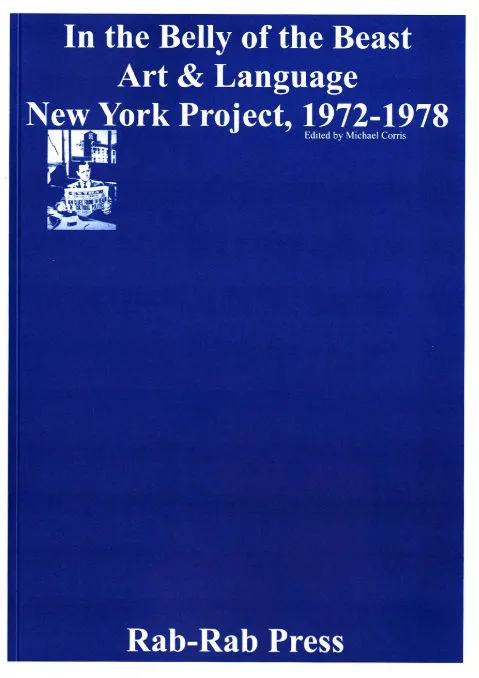
In the Belly of the Beast – Art & Language New York Project 1972-1978
Edited by Michael Corris, the expanded edition of In the Belly of the Beast: Art & Language New York Project 1972-1978 is a survey of the tumultuous years of the political Conceptualism in the mid-seventies New York.
Artists have always experimented with politics, either by organizing themselves or uniting in support of a broader political movement. Today, "activist art" is taught in universities, supported by foundations, and featured in museums and international exhibitions. Is this the only possible way?
In the Belly of the Beast tells a different story, of the work of politically engaged artists and the conflicts they experienced. It is the history of artists wishing to continue working within the boundaries of the artworld and those who were intent on establishing new ideological and class relationships with activists to build a political party.
During the 1970s in New York, the Art & Language collective pioneered institutional critique; published a Marxist-influenced journal; agitated against racism and sexism in museums; challenged the cultural imperialism of international exhibitions; and forged a framework for a socialist organization of artists. This new edition includes previously unpublished documents illuminating the contradictions and disputes that lay at the center of the organization and practices of Art & Language and left-wing groups, such as the Anti-Imperialist Cultural Union and the Artists' Meeting for Cultural Change, mobilizing artists in New York at the time.
The new and expanded edition of In the Belly of the Beast features an extensive interview with Michael Corris, who annotated a collection of previously unavailable documents from the period, including manuscripts, pamphlets, transcripts, and letters.
Art & Language is the name of a group of English artists who choose to work collectively, and the title of a magazine that they founded in 1968. Proposing a critical analysis of the relations between art, society, and politics, Art & Language marks, even in its name, the importance of the “textual turning point” in the 1960s.
Since 1976, Art & Language's project has continued, through Mel Ramsden and Michael Baldwin, with the literary and theoretical collaboration of Charles Harrison. Working with very varied mediums, from painting to rock, these co-founders of Conceptual art remain, even today, attached to observing the consequences of what they themselves call the “depressing collapse of modernism.”

Les Goddesses/Hemlock Forest
This book is based on two related projects that take form as text, photography and film. Les Goddesses (2011) collapses the lives of Davey and her five sisters with those of the daughters of Mary Wollstonecraft, the 18th-century feminist writer and activist. Hemlock Forest (2016) weaves references to Wollstonecraft, Chantal Akerman and Karl Ove Knausgaard with her own family stories. During the making of Hemlock Forest, Akerman took her own life. Her death soon engulfed Davey's awareness, prompting a broader exploration of Akerman's and her own biographies, amid more universal themes of compulsion, artistic production, life and its passing.
Texts by Moyra Davey and an introduction by Aveek Sen
Design by Filiep Tacq

Of · The · Abyss
A sequence of ten poems; in separated continuance, an outcry that ventriloquises and manifests languages of exclusion and yet with dogged persistence protests them.
“Oh strike the light, float the boat, for sake of common peril they are fallen away as gathered up in sight of lamentable in- difference and will go down against us”.

Ghosts
Poems written in Berlin between September 2015 and the Summer of 2017. This pamphlet contains selected work from the pamphlet Cancer: Poems after Katerina Gogou, previously published in a limited edition, and an ongoing sequence entitled Our Death, as well as other pieces from the period. These are poems haunted by catastrophe, light, fires, the sun, violence and love. As Bonney writes: “We were talking about prophecy, about defeat and war, about how nobody knows what those words really mean, and what they will come to mean”. Drawing on writers like Baudelaire, Artaud, Anita Berber and Hölderlin like “marks on a calendar”, “a kind of cacophony”, or “the beginnings of a map”, these poems are vital indices of where we are.

Blood and Guts in High School
A masterpiece of surrealist fiction, steeped in controversy upon its first publication in 1984, Blood and Guts in High School is the book that established Kathy Acker as the preeminent voice of post-punk feminism. With 2017 marking the 70th anniversary of her birth, as well as the 10th year since her death this transgressive work of philosophical, political, and sexual insight—with a new introduction by Chris Kraus—continues to become more relevant than ever before.
In the Mexican city of Merida, ten-year-old Janey lives with Johnny—her "boyfriend, brother, sister, money, amusement, and father"—until he leaves her for another woman. Bereft, Janey travels to New York City, plunging into an underworld of gangs and prostitution. After escaping imprisonment, she flees to Tangiers where she meets Jean Genet, and they begin a torrid affair that will lead Janey to her demise. Fantastical, sensual, and fearlessly radical, this hallucinatory collage is both a comic and tragic portrait of erotic awakening.

Acker
A lyric essay written through Kathy Acker's evocative prose, public statements, and private archives.
A cover of Kathy Acker’s career and a study of the development of narrative in her books deftly tracing Acker’s interactions with a diverse palette of avant-gardisms, world letters, cultures, and theory. Martin follows Acker through New York’s downtown St. Mark’s Poetry Project scene, Black Mountain College, and the Beats, as Acker embarks on her own deconstructions of subjects autobiographical and historical, art procedurals, proto-conceptual writing, legacies, and spirits.

Joyful Militancy
Nick Montgomery, Carla Bergman
"Absolutely what we need in these days of spreading gloom. A very well argued case for joyful militancy, and against the dead hand of puritanical revolution. Read it, live it!” — John Holloway, author of Crack Capitalism
Why do radical movements and spaces sometimes feel laden with fear, anxiety, suspicion, self-righteousness, and competition? Montgomery and bergman call this phenomenon rigid radicalism: congealed and toxic ways of relating that have seeped into social movements, posing as the “correct” way of being radical. In conversation with organizers and intellectuals from a wide variety of political currents, the authors explore how rigid radicalism smuggles itself into radical spaces, and how it is being undone.
Interviewees include Silvia Federici, adrienne maree brown, Marina Sitrin, Gustavo Esteva, Leanne Betasamosake Simpson, Walidah Imarisha, Margaret Killjoy, Glen Coulthard, Richard Day, and more.

The Years
The Years is a personal narrative of the period 1941 to 2006 told through the lens of memory, impressions past and present—even projections into the future—photos, books, songs, radio, television and decades of advertising, headlines, contrasted with intimate conflicts and writing notes from 6 decades of diaries.
Local dialect, words of the times, slogans, brands and names for the ever-proliferating objects, are given voice here. The voice we recognize as the author’s continually dissolves and re-emerges. Ernaux makes the passage of time palpable. Time itself, inexorable, narrates its own course, consigning all other narrators to anonymity. A new kind of autobiography emerges, at once subjective and impersonal, private and collective.
On its 2008 publication in France, The Years came as a surprise. Though Ernaux had for years been hailed as a beloved, bestselling and award-winning author, The Years was in many ways a departure: both an intimate memoir “written” by entire generations, and a story of generations telling a very personal story. Like the generation before hers, the narrator eschews the “I” for the “we” (or “they”, or “one”) as if collective life were inextricably intertwined with a private life that in her parents’ generation ceased to exist. She writes of her parents’ generation (and could be writing of her own book): “From a common fund of hunger and fear, everything was told in the “we” and impersonal pronouns.”

Crazy for Vincent
Diary, memoir, poem, fiction? Autopsy, crime scene, hagiography, hymn? The chronicle of an obsessive love. In the middle of the night between the 25th and 26th of November, Vincent fell from the third floor playing parachute with a bathrobe. He drank a liter of tequila, smoked Congolese grass, snorted cocaine...
Crazy for Vincent begins with the death of the figure it fixates upon: Vincent, a skateboarding, drug-addled, delicate "monster" of a boy in whom the narrator finds a most sublime beauty. By turns tender and violent, Vincent drops in and out of French writer and photographer Hervé Guibert's life over the span of six years (from 1982, when he first met Vincent as a fifteen-year-old teenager, to 1988). After Vincent's senseless death, the narrator embarks on a reconnaissance writing mission to retrieve the Vincent that had entered, elevated, and emotionally eviscerated his life, working chronologically backward from the death that opens the text. Assembling Vincent's fragmentary appearances in his journal, the author seeks to understand what Vincent's presence in his life had been: a passion? a love? an erotic obsession? or an authorial invention? A parallel inquiry could be made into the book that results: Is it diary, memoir, poem, fiction? Autopsy, crime scene, hagiography, hymn? Crazy for Vincent is a text the very nature of which is as untethered as desire itself.
Hervé Guibert (1955-1991) was a writer, a photography critic for Le Monde, a photographer, and a filmmaker. In 1984 he and Patrice Chereau were awarded a César for best screenplay for L'Homme Blessé. Shortly before his death from AIDS, he completed La Pudeur ou L'impudeur, a video work that chronicles the last days of his life.

Adrenalin
Adrenalin is Syrian-born, Stockholm-based Palestinian poet Ghayath Almadhoun’s first collection to be published in English. This sinuous translation by Catherine Cobham comprises poems that span years and continents, that circulate between cities, ideas, lovers, places of refuge, war zones, time zones, histories. Here is a vital, relentless, intertextual voice that refuses arrest by sentimentality, that pursues the poetry coursing underneath the poetry.

Ik hier jij daar
'In de poëzie kunnen twee verschillende werelden elkaar ontmoeten, door gedichten kunnen we zonder ID denkbeeldige grenzen overschrijden en in dezelfde denkbeeldige ruimte verblijven. Maar is die ruimte wel dezelfde? Kunnen we losbreken uit onze rollen van slachtoffer en medeplichtige? Kunnen gedichten ons leren ons te identificeren met ongevoelde pijn? Wat spreekt er uit onze ontmoeting op papier?' - Anne Vegter
'Een dichter moet egoïstisch zijn, moet een eenzame wolf zijn, maar soms ontmoeten eenzame wolven elkaar in de wouden en jagen ze samen. Twee dichters, één boek: niet noodzakelijkerwijs om iets nieuws te bouwen, maar om de muren af te breken die ons tegenhouden wanneer we naar de andere oever willen oversteken. De Steen van Rosetta, die ervoor zorgt dat we het ongelezene lezen.' - Ghayath Almadhoun
Ghayath Almadhoun (1979) werd geboren in het Palestijnse vluchtelingenkamp Yarmouk in Damascus als zoon van een Palestijnse vader en een Syrische moeder. Hij studeerde Arabische literatuur aan de Universiteit van Damascus en werkte als cultureel journalist. Sinds 2008 woont hij in Stockholm. In Nederland verscheen in 2014 zijn lovend besproken dichtbundel 'Weg van Damascus'. Anne Vegter woont en werkt in Rotterdam. Van haar hand verschenen onder andere de verhalenbundels 'Ongekuiste versies' en 'Harries hoofdingang' en de dichtbundels 'Aandelen en obligaties', 'Spamfighter' en 'Eiland berg gletsjer'. Haar werk werd meermaals bekroond. De afgelopen vier jaar was ze Dichter des Vaderlands. De gedichten van Ghayath Almadhoun zijn uit het Arabisch vertaald door Djûke Poppinga.

ECAL (Lausanne University of Art and Design)
Early Video Art and Experimental Films Networks
An international history of video art and experimental cinema networks in the early 1970s: the volume casts a new eye on various exhibitions, broadcasts and production and distribution structures, including a case study on Jonas Mekas' Anthology Film Archives.
Early Video Art and Experimental Films Networks traces the diffuse international networks through which video art and experimental films circulated during the late sixties and early seventies. It explores forgotten exhibitions both in Switzerland and France, the activities of public television channels and alternative art spaces in the US, a production art center dedicated to video in Italy and an Argentinian collective of conceptual artists, aiming to shed new light on the production and diffusion of moving images.
This volume is divided into two parts: the first part, which is longer and more extensively documented, explores the emergence and consolidation of video art networks at international level; the second focuses more specifically on two exhibitions of artists' films (New Forms in Film and Une histoire du cinéma) and one of the main instances of the museification of experimental cinema, Anthology Film Archives. Indeed, this particular story has wider currency insofar as several important works in recent years have focused on artists' films 23 and expanded cinema 24. We have adopted the principle, wherever possible, of providing rare and previously unpublished images and documents alongside the essays specifically commissioned for this volume, the choice of which has been left to the discretion of the author of each particular chapter.
Texts by Kristen Alfaro, François Bovier, Enrico Camporesi, Katarzyna Cytlak, Larisa Dryansky, Tristan Lavoyer, Adeena Mey, Kris Paulsen, Cosetta G. Saba, Andrew V. Uroskie.

Caliban et la Sorcière
Silvia Federici revisite ce moment particulier de l’histoire qu’est la transition entre le féodalisme et le capitalisme, en y introduisant la perspective particulière de l’histoire des femmes.
Elle nous invite à réfléchir aux rapports d’exploitation et de domination, à la lumière des bouleversements introduits à l’issue du Moyen Âge. Un monde nouveau naissait, privatisant les biens autrefois collectifs, transformant les rapports de travail et les relations de genre. Ce nouveau monde, où des millions d’esclaves ont posé les fondations du capitalisme moderne, est aussi le résultat d’un asservissement systématique des femmes. Par la chasse aux sorcières et l’esclavage, la transition vers le capitalisme faisait de la modernité une affaire de discipline. Discipline des corps féminins dévolus à la reproduction, consumés sur les bûchers comme autant de signaux terrifiants, torturés pour laisser voir leur mécanique intime, anéantis socialement. Discipline des corps d’esclaves, servis à la machine sociale dans un formidable mouvement d’accaparement des ressources du Nouveau Monde pour la fortune de l’ancien.
Le capitalisme contemporain présente des similitudes avec son passé le plus violent. Ce qu’on a décrit comme barbarie et dont aurait su triompher le siècle de la raison est constitutif de ce mode de production : l’esclavage et l’anéantissement des femmes n’étaient pas des processus fortuits, mais des nécessités de l’accumulation de richesse. L’auteur nous invite à partager son son regard d’historienne et de féministe sur la situation actuelle et sur ses mécanismes.
Essai, traduction de l’anglais (États-Unis) par le collectif Senonevero, revue et complétée par Julien Guazzini
Silvia Federici (née en 1942 à Parme en Italie) est une universitaire américaine, enseignante et militante féministe révolutionnaire. Elle est professeure émérite et chercheuse à l’Université Hofstra à New York.

Three Month Fever: The Andrew Cunanan Story
A sardonic and artful reconstruction of the brief life of the party boy who became a media sensation for shooting Gianni Versace.
First published in 1999, Gary Indiana's Three Month Fever is the second volume of his famed crime trilogy, now being republished by Semiotext(e). (The first, Resentment, reissued in 2015, was set in a Menendez trial-era L.A.) In this brilliant and gripping hybrid of narrative and reflection, Indiana considers the way the media's hypercoverage transformed Andrew Cunanan's life “from the somewhat poignant and depressing but fairly ordinary thing it was into a narrative overripe with tabloid evil.”
“America loves a successful sociopath,” Indiana explains. This sardonic and artful reconstruction of the brief life of the party boy who became a media sensation for shooting Gianni Versace is a spellbinding fusion of journalism, social commentary, and novelistic projection. By following Cunanan's notorious “trail of death,” Indiana creates a compelling portrait of a brilliant, charismatic young man whose pathological lies made him feel more like other people—and more interesting than he actually was. Born in a working-class exurb of San Diego and educated at an elite private school, Cunanan strove to “blend in” with the upscale gay male scene in La Jolla. He ended up crazed and alone, eventually embarking on a three-month killing spree that took the lives of five men, including that of Versace, before killing himself in a Miami boathouse, leaving behind a range of unanswerable questions and unsolvable mysteries.

Whites, Jews, and Us: Toward a Politics of Revolutionary Love
A scathing critique of the Left from an indigenous anti-colonial perspective.
With Whites, Jews, and Us, Houria Bouteldja launches a scathing critique of the European Left from an indigenous anti-colonial perspective, reflecting on Frantz Fanon's political legacy, the republican pact, the Shoah, the creation of Israel, feminism, and the fate of postcolonial immigration in the West in the age of rising anti-immigrant populism. Drawing upon such prominent voices as James Baldwin, Malcolm X, and Jean Genet, she issues a polemical call for a militant anti-racism grounded in the concept of revolutionary love.
Such love will not come without significant discomfort for whites, and without necessary provocation. Bouteldja challenges widespread assumptions among the Left in the United States and Europe—that anti-Semitism plays any role in Arab-Israeli conflicts, for example, or that philo-Semitism doesn't in itself embody an oppressive position; that feminism or postcolonialist theory is free of colonialism; that integrationalism is a solution rather than a problem; that humanism can be against racism when its very function is to support the political-ideological apparatus that Bouteldja names the "white immune system."
At this transitional moment in the history of the West—which is to say, at the moment of its decline—Bouteldja offers a call for political unity that demands the recognition that whiteness is not a genetic question: it is a matter of power, and it is high time to dismantle it.
"Why am I writing this book? Because I share Gramsci's anxiety: "The old are dying and the new cannot be born; in this interregnum a great variety of morbid symptoms appear." The fascist monster, born in the entrails of Western modernity. Of course, the West is not what it used to be. Hence my question: what can we offer white people in exchange for their decline and for the wars that will ensue? There is only one answer: peace. There is only one way: revolutionary love." — from Whites, Jews, and Us
This Semiotext(e)/Intervention series English-language edition includes a foreword by Cornel West.

A Nice Well-Behaved Fucked-Up Person
In a single seventeen-page paragraph, Jill Johnston describes an odyssey in and out of a not-yet-described identity in this excerpt from her 1973 bestseller, "Lesbian Nation".

In Part: Writings by Julie Ault
Spanning more than three decades, In Part brings together a full spectrum of the New York-based artist, writer and activist Julie Ault's (born 1957) published texts through carefully selected extracts in a single volume.
Reprinted in chronological sequence alongside a selection of full-length texts, this series of excerpts offers a timeline of Ault's continuous artistic growth, longstanding political concerns and dynamic interpersonal affinities.
Beginning in the 1980s with texts written with her collaborators in Group Material, In Part highlights Ault's shift from exhibition making in the mid-1990s to include publishing and writing. Ault's dialogic practice extends to the present day through her sustained engagements and relationships with such artists as Corita Kent, Felix Gonzalez-Torres, Nancy Spero, Martin Beck, David Wojnarowicz, Liberace and Martin Wong.
Lucy R. Lippard contributes an introduction.

Alice Notley, Live in Seattle
Entirely comprised of poems contained in her latest collection, 2016’s Certain Magical Acts, Live in Seattle elucidates why Alice Notley is one of the world’s most revered poets, the recipient of the Los Angeles TimesBook Award, the Griffin Prize, the Shelley Memorial Award, the Lenore Marshall Prize, and the Poetry Foundation’s Ruth Lilly Prize. “I am alive outside written memory” is how one of the speakers of Notley’s poem “Voices” puts it and listening to the poet read her work live, in front of an entranced audience, serves to detail the intangibility of sound vis-à-vis language.
Live in Seattle also includes excerpts of the onstage conversation Notley had with Seattle poets John Marshall, Christine Deavel and Rebecca Hoogs. Among other topics, the talk revolves around concepts of success, what it means to write a female poetry circa 2017, and the importance of always creating from a position of disobedience.
As part of Seattle Arts & Lectures’ Poetry Series, Live in Seattle was recorded at McCaw Hall in Seattle, Washington on Wednesday, April 5th, 2017 and mastered and engineered by Gus Elg at Sky Onion in Portland, Oregon in the Summer of 2017.
Purchase of Live in Seattle includes a 11×11 insert of Notley’s poem “FOUND WORK (lost lace),” as well as a download card for the entire album. Live in Seattle can also be found digitally on Spotify and Bandcamp. The record itself is not black but clear.

Arts of Living on a Damaged Planet: Ghosts and Monsters of the Anthropocene
Nils Bubandt, Elaine Gan and 2 more
As human-induced environmental change threatens multispecies livability, Arts of Living on a Damaged Planet puts forward a bold proposal: entangled histories, situated narratives, and thick descriptions offer urgent “arts of living.” Included are essays by scholars in anthropology, ecology, science studies, art, literature, and bioinformatics who posit critical and creative tools for collaborative survival in a more-than-human Anthropocene.
Anna Lowenhaupt Tsing is professor of anthropology at the University of California, Santa Cruz, and a Niels Bohr Professor at Aarhus University in Denmark, where she codirects Aarhus University Research on the Anthropocene (AURA).
Heather Swanson is assistant professor of anthropology at Aarhus University.
Elaine Gan is art director of AURA and postdoctoral fellow at Aarhus University.
Nils Bubandt is professor of anthropology at Aarhus University, where he codirects AURA.

Catalog Issue 14 — 'Books on Books'
Catalog is a serial publication about cataloging, written by Lieven Lahaye and designed by Ott Metusala. This is Catalog #14, printed by Colorama on the occasion of ‘Books on Books’ — a week-long event on the topic of publishing and collecting, hosted by Anna Bergquist, Johanna Maierski and Kathrin Schömer. Berlin, August 2017.

Emergent Strategy: Shaping Change, Changing Worlds
Inspired by Octavia Butler's explorations of our human relationship to change, Emergent Strategy is radical self-help, society-help, and planet-help designed to shape the futures we want to live. Change is constant. The world is in a continual state of flux. It is a stream of ever-mutating, emergent patterns. Rather than steel ourselves against such change, this book invites us to feel, map, assess, and learn from the swirling patterns around us in order to better understand and influence them as they happen. This is a resolutely materialist "spirituality" based equally on science and science fiction, a visionary incantation to transform that which ultimately transforms us.

Johnny Would You Love Me If My Dick Were Bigger
A dirty cult-classic put out in a small batch by an underground publisher (Rudos and Rubes) in 2015, Johnny Would You Love Me If My Dick Were Bigger recounts the life of an artist and "old school homosexual" who bears a big resemblance to author Brontez Purnell.
Our hero doesn't trust the new breed of fags taking over San Francisco, though. They wear bicycle helmets, seat belts, and condoms. Meanwhile, he sabotages his relationships, hallucinating affection while cruising in late night parks, bath-houses, and other nooks and crannies of a newly-conservative, ruined city.
Furiously original, vital, and messy, this funny "non-memoir" uncovers a revelatory truth for the age: there are things far scarier than HIV.

The complete stories of Leonora Carrington
Surrealist writer and painter Leonora Carrington (1917-2011) was a master of the macabre, of gorgeous tableaus, biting satire, roguish comedy, and brilliant, effortless flights of the imagination. Nowhere are these qualities more ingeniously brought together than in the works of short fiction she wrote throughout her life.
Published to coincide with the centennial of her birth, THE COMPLETE STORIES OF LEONORA CARRINGTON collects for the first time all of her stories, including several never before seen in print. With a startling range of styles, subjects, and even languages (several of the stories are translated from French or Spanish), THE COMPLETE STORIES captures the genius and irrepressible spirit of an amazing artist's life.