Memoir
Memoir

Ten Bridges I’ve Burnt
In Ten Bridges I’ve Burnt, Brontez Purnell—the bard of the underloved and overlooked—turns his gaze inward. A storyteller with a musical eye for the absurdity of his own existence, he is peerless in his ability to find the levity within the stormiest of crises. Here, in his first collection of genre-defying verse, Purnell reflects on his peripatetic life, whose ups and downs have nothing on the turmoil within. “The most high-risk homosexual behavior I engage in,” Purnell writes, “is simply existing.”
The thirty-eight autobiographical pieces pulsing in Ten Bridges I’ve Burnt find Purnell at his no-holds-barred best. He remembers a vicious brawl he participated in at a poetry conference and reckons with packaging his trauma for TV writers’ rooms; wrestles with the curses, and gifts, passed down from generations of family members; and chronicles, with breathless verve, a list of hell-raising misadventures and sexcapades. Through it all, he muses on everything from love and loneliness to capitalism and Blackness to jogging and the ethics of art, always with unpredictable clarity and movement.
With the same balance of wit and wisdom that made 100 Boyfriends a sensation, Purnell unleashes another collection of boundary-pushing writing with Ten Bridges I’ve Burnt, a book as original and thrilling as the author himself.

Twenty Shadows
Twenty Shadows tells of a man’s spiritual change following the suicide of his son after a long addiction. Haunted by this loss and the unknown desire of his only child, thinking and writing with a new emptiness, he finds a form of expression that was previously impossible.
This singular book brings together the reflections of one of our greatest living philosophers with a father’s grief. —Todd McGowan
Taking its title from Shakespeare’s Richard II—“Each substance of grief hath twenty shadows”—this book follows personal tragedy into the murky place where memory and interpretation become indistinguishable. What lies at its heart is a meditation on the unknowability of the other. —Charlotte Northall
Richard Boothby is right that no amount of intellect curbs the impulses of real experience, but that doesn’t mean you have to remain in a state of ignorance. Composed from the leftovers of terrible, unassimilable events, this book gives us bracing indications of ways to live on in a diminished aftermath. —Justin Clemens
Richard Boothby is professor emeritus of philosophy at Loyola University Maryland. Boothby’s books include Death and Desire: Psychoanalytic Theory in Lacan’s Return to Freud (1991), Freud as Philosopher: Metapsychology after Lacan (2001), Sex on the Couch: What Freud Still Has to Teach Us about Sex and Gender (2006), and Embracing the Void: Rethinking the Origin of the Sacred (2023). He lives in Baltimore.

Time Also Will Make It Interesting: Selected Journals
The selected journals of trans, mixed-race artist and dyke erotica writer Red Jordan Arobateau.
Best known for his erotic lesbian fiction, Red Jordan Arobateau was also a prolific painter who maintained and self-published a journal for roughly twenty years, documenting his experiences at the “abject bottom” of life in the US. Edited and introduced by poet and scholar Cameron Awkward-Rich with a foreword by Michelle Tea and paintings by Arobateau, Time Also Will Make It Interesting captures Arobateau’s life as a young dyke in the criminalized cultures of 1950s-60s gay bars of Chicago and New York; his transition from dyke to trans man in late 1990s San Francisco; and his return to painting and an unfolding spirituality within that rapidly gentrifying city.
Queerly messy, ornery, and stuffed with Arobateau’s wisdom, this volume is what he might have called, “a novel combined with a journal—da novel/journal! Taking all the liberty in the world! A domain where verse can be inserted, dreams recorded, my everyday political rants printed out, combined with my forté—fiction! All under one binding & title!”
Foreword by Michelle Tea.

Love's Work
Love’s Work is at once a memoir and a work of philosophy. Written by the English philosopher Gillian Rose as she was dying of cancer, it is a book about both the fallibility and the endurance of love, love that becomes real and lasting through an ongoing reckoning with its own limitations. Rose looks back on her childhood, the complications of her parents’ divorce and her dyslexia, and her deep and divided feelings about what it means to be Jewish. She tells the stories of several friends also laboring under the sentence of death. From the sometimes conflicting vantage points of her own and her friends’ tales, she seeks to work out (seeks, because the work can never be complete—to be alive means to be incomplete) a distinctive outlook on life, one that will do justice to our yearning both for autonomy and for connection to others. With droll self-knowledge (“I am highly qualified in unhappy love affairs,” Rose writes, “My earliest unhappy love affair was with Roy Rogers”) and with unsettling wisdom (“To live, to love, is to be failed”), Rose has written a beautiful, tender, tough, and intricately wrought survival kit packed with necessary but unanswerable questions.
Gillian Rose (1947–1995), who is now recognized as one of the most important and influential critical thinkers of her time, was a British philosopher and writer. For many years she taught at Sussex University, drawing large numbers of research students, before she accepted a chair in social and political thought at Warwick University. Her major works, which ranged from Continental philosophy to Judaism, include The Melancholy Science, Hegel Contra Sociology, Dialectic of Nihilism, The Broken Middle: Out of Our Ancient Society, Judaism and Modernity, Mourning Becomes the Law, and Paradiso.
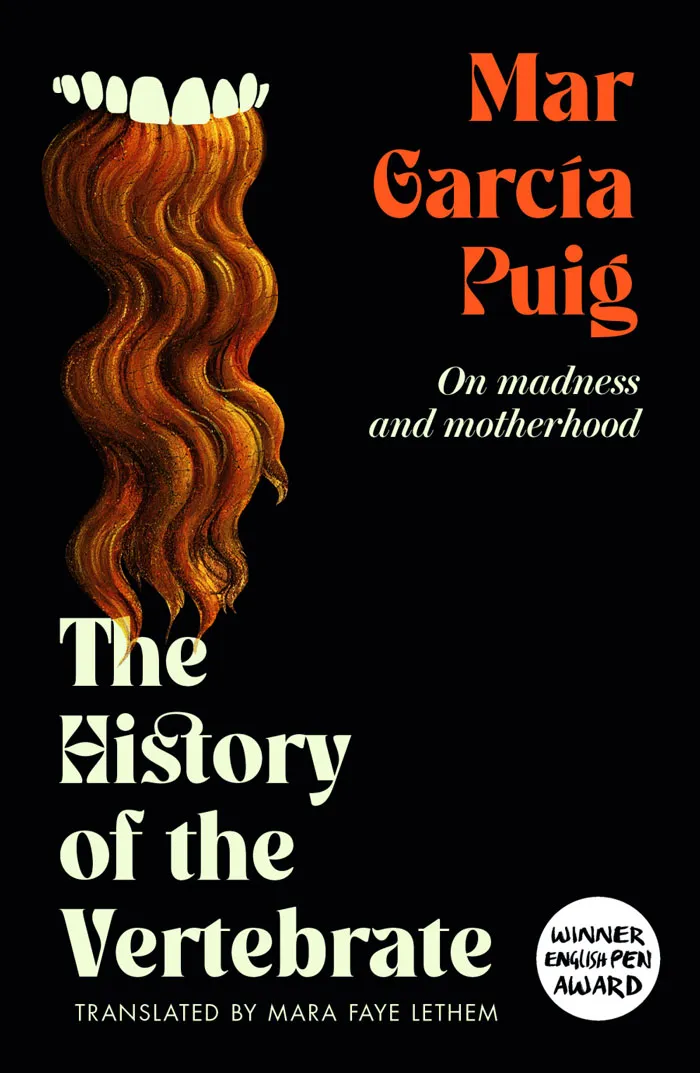
The History of the Vertebrate
Mar García Puig, Mara Faye Lethem
‘On 20 December 2015 I became a mother and I went mad.’
On a single day, Mar García Puig gives birth to twins and becomes elected to the Spanish Parliament as a member of the insurgent left-wing party Podemos. What might have been the best day of her life becomes the start of a terrifying ordeal; García Puig’s grip on reality begins to slip as she grapples with uncertainty, the weight of expectation, and misogyny in both of her new roles.
In defiance of a culture that tells her the problem lies within, García Puig chooses to look outwards, examining the imbrication of madness and motherhood across centuries of science, myth, and politics while dissecting the ways in which women have been pathologized and banished from public life.
At once intimate and epic, The History of the Vertebrate is a searing account of postpartum madness. Moving between memory, culture, and the history of medicine, García Puig transforms her experience into a story about the countless women who have felt that sanity was leaving them, and about the patriarchal forces that have silenced them.
MAR GARCÍA PUIG is an editor and author. From 2015 to 2023 she was a member of the Spanish Congress of Deputies for Podemos, where she served on the Culture Committee and the Equality Committee. Her books include The History of the Vertebrate and This Thing of Darkness.

knot body
Bringing together poetry, essay, and letters to “lovers, friends and in-betweens,” Eli Tareq El Bechelany-Lynch confronts the ways capitalism, fatphobia, ableism, transness, and racializations affect people with chronic pain, illness, and disability. knot body explores what it means to discover the limits of your body, and contends with what those limitations bring up in the world we live in.
knot body was shortlisted for the QWF First Book Prize. Their second collection of poetry, The Good Arabs (Metonymy Press), won the 2022 Grand Prix du Livre de Montréal.
“For me, the power of knot body stems from its courage and unique voice in writing the ache, the ache of chronic pain, the ache of faulty diagnoses and bodily misreadings, and, equally, the ache for honest answers on how to love each other in all our dignity. Eli Tareq El Bechelany-Lynch is an artist and philosopher of talent, generosity, and heart.” – David Chariandy, author of Brother (Penguin Random House)
“In this moment, when trans, racialized and disabled bodies are met with violent and polarizing commentary within the public sphere, Eli Tareq El Bechelany-Lynch offers us the uninterrupted intimacy of knot body. As self-communional as Kiese Laymon’s Heavy and Terese Marie Mailhot’s Heart Berries, they amplify and queer the epistolary memoir genre. Each letter is emotionally and thematically complete and, too, each letter decidedly speaks to the next. Readers may ruminate on the sharp and sensual inquiry offered by each individual letter, or read cover-to-cover and be present to the gorgeously-engaged, call-and-response quality of knot body as a whole.” – Amber Dawn, author of My Art is Killing Me (Arsenal Pulp Press)
“knot body is such a generous tapestry of tenderness—a collection that brilliantly utilizes the direct address in a way that is not universal, but still beautifully communal. I reached the end of this collection and breathed in a newer, better world.” – Hanif Abdurraqib, author of A Fortune for Your Disaster (Tin House)
Eli Tareq El Bechelany-Lynch is a queer Arab poet living in Tio’tia:ke, unceded Kanien’kehá:ka territory (Montreal). Their work has appeared in The Best Canadian Poetry 2018 anthology, GUTS, carte blanche, the Shade Journal, The New Quarterly, Arc Poetry Magazine, Room Magazine, and elsewhere. They participated in the Banff Centre’s ‘Centering Ourselves’ BIPOC residency, and they were longlisted for the CBC Poetry Prize in 2019. Their second collection of poetry, The Good Arabs, was published by Metonymy Press in 2021.

Fair: The Life-Art of Translation
Fair: The Life-Art of Translation, is a satirical, refreshing and brilliantly playful book about learning the art of translation, being a bookworker in the publishing industry, growing up, family, and class.
Loosely set in an imagined book fair/art fair/fun fair, in which every stall or ride imitates a real-world scenario or dilemma which must be observed and negotiated, the book moves between personal memories and larger questions about the role of the literary translator in publishing, about fairness and hard work, about the ways we define success, and what it means – and whether it is possible – to make a living as an artist.
Fair is also interested in questions of upbringing, background, support, how different people function in the workplace, and the ways in which people are excluded or made invisible in different cultural and creative industries. It connects literary translation to its siblings in other creative arts to show how creative and subjective a practice it is while upholding the ethics and politics at play when we translate someone else’s work.
Blurring the lines between memoir, autofiction, satire and polemic, Fair is a singularly inventive and illuminating book by one of the UK’s most original and admired writers and translators.

Praise House
Building on the notion of ‘praise,’ Adama Delphine Fawundu frames this book as a celebration of life. She honors the stories whispered to her by her mother; she adorns her body in her grandmother’s textile work; she elevates the memory of various named and unnamed Black women of the diaspora and documents the iconic small Civil War era styled white wooded praise house on a patch of land off the side of a road in South Carolina not far from Beaufort creating an intimate body of work of color photography of an interconnected history.
This book about female figures—grandmothers, mothers, daughters, artists, caregivers, storytellers, and cooks—explores a range of emotions that consume us about family life and history. It is both an art book
and a memoir. Viewing it brings us face to face with known and unknown cultures and introduces us to various art practices shared, taught, and learned through the African diasporic traditions. Fawundu connects to the self through history, joy, and beauty and offers the reader ways to navigate fear based on migration and loss. It is a gift, too, as it allows us to imagine alongside the artist.
Adama Delphine Fawundu is an artist based in Brooklyn, NY of Mende, Bubi, and Krim descent.
Through photography, video, textile-based sculptural forms, and performance, she creates embodied entities inspired by Indigenous knowledge systems and spiritual retentions across time and space. She co-authored the book MFON: Women Photographers of the African Diaspora. She is an Assistant Professor of Visual Arts at Columbia University.
Edited by Chiara Figone
Contributions by Mistura Allison, Berette S Macaulay, Niama Sandy, Bonaventure Soh Bejeng Ndikung, Deborah Willis

Centrefold 1974. A Memoir
Following the publication of Centrefold in Artforum, November 1974, Benglis says that Penthouse wanted to use the image, but instead she proposed ‘a take-off on a traditional pieta, depicting a beautiful girl as the Madonna with a nude man on her lap’. They refused, ‘we cannot do that, we cannot allow artists to make a centrefold.’
Published to coincide with the fiftieth anniversary of that Centrefold, and shifting between 1970s New York and Los Angeles and the Corbyn years in Tower Hamlets, London, this Centrefold enacts an ambivalent ‘full accounting’ of Lynda Benglis’s Artforum spread, as well as her gender ‘mockeries’ and Secrets series. Taking in nursery privatisation, artworld silencing and censorship, maintenance art, muddled Marxism, performances of motherhood, and masturbation, Louise O’Hare weighs up the various impacts and forms of disciplining at play in both column and dildo inches.

Nowhere Near
Nowhere Near follows the author’s psychogeographic journey from Los Angeles to Pangasinan to Mexico City after his departure from the United States, where he lived undocumented for twenty-six years. Returning to the Philippines with his grandmother to search for lost land and to confront a “family curse,” Revereza surfaces legacies of Spanish colonialism and US imperialism as they bear out in its continued present. Through film stills, photographs, family archives, and a rapt, first-person narrative, Nowhere Near excavates the amnesias and silences that shape personal and historical memory in the exilic, diasporic impasse.
Miko Revereza's Nowhere Near is the 2021 Open Reading Period Book Prize winner, and was selected by guest judge John Keene.
About the author
Miko Revereza (b. 1988, Manila, Philippines) is an award-winning experimental filmmaker raised in California and currently residing in Oaxaca City. His upbringing as an undocumented immigrant and current exile from the United States informs his relationship to moving images. He has made a series of personal documentaries informed by his experiences with migration and exile: DROGA! (2014), Disintegration 93 – 96 (2017), No Data Plan (2018), Distancing (2019), El Lado Quieto (2021), and Nowhere Near (2023). These works have been screened at festivals and institutions such as Locarno, TIFF, NYFF, and MoMA. No Data Plan is recognized with such honors as the Sheffield Doc Fest Art Award, and was listed in BFI’s Sight & Sound Magazine’s 50 Best Films of 2019, Hyperallergic’s Top 12 Documentary and Experimental Films of 2019, and CNN Philippines’ Best Filipino Films of 2019. Nowhere Near (recipient of Hubert Bals Fund) was among Film Comment’s Best Undistributed Films of 2023 and CNN Philippines’ Best Filipino Films of 2023. Revereza was included in Filmmaker Magazine’s New Faces of Independent Cinema, is a Flaherty Seminar featured filmmaker, and is a recipient of the 2021 Vilcek Prize in Filmmaker. He holds an MFA from Bard College, Milton Avery Graduate School of the Arts. His films are distributed by LUX, London.
Praise
In his powerful and entrancing voice, fueled by irony and critique, Miko Revereza explores neoliberal capitalism, the challenges facing undocumented families, the non-existent “American dream,” and internal and external exile, showing how borders of all kinds (geographical, racial, psychic), though regularly traversed, are policed and criminalized. Nowhere Near is a cri de coeur about twenty-first century American society.
—John Keene
Miko Revereza’s captivating book is a companion to his diaristic 2023 feature of the same title, and it is a pleasure to encounter on the page the resonant literary voice he developed while making that film. Befitting its rich entwining of personal and political histories, Nowhere Near contains a wondrous range of modes and moods: raw and revealing one moment, sharply and humorously observant the next, by turns poetic and plainspoken.
—Dennis Lim
Nowhere Near is a document of lives lived undocumented. Here, form matters: text branches out from image, while dialogue counterpoints an easy, self-reflexive poetic. With the acuity necessitated by a status requiring constant vigilance, negotiating the privatized avenues of America’s dream, Revereza’s words carry a weight that belies their simplicity. Here and now, our attention matters, as America’s icy grip chills us all.
—Alia Syed

Prisoner of Love
Starting in 1970, Jean Genet—petty thief, prostitute, modernist master—spent two years in the Palestinian refugee camps in Jordan. Always an outcast himself, Genet was drawn to this displaced people, an attraction that was to prove as complicated for him as it was enduring. Prisoner of Love, written some ten years later, when many of the men Genet had known had been killed, and he himself was dying, is a beautifully observed description of that time and those men as well as a reaffirmation of the author’s commitment not only to the Palestinian revolution but to rebellion itself. For Genet’s most overtly political book is also his most personal—the last step in the unrepentantly sacrilegious pilgrimage first recorded in The Thief’s Journal, and a searching meditation, packed with visions, ruses, and contradictions, on such life-and-death issues as the politics of the image and the seductive and treacherous character of identity. Genet’s final masterpiece is a lyrical and philosophical voyage to the bloody intersection of oppression, terror, and desire at the heart of the contemporary world.

Faltas: Letters to Everyone in My Hometown Who Isn't My Rapist
A rich and moving epistolary memoir about transgender childhood, sexual trauma, motherhood, and a young queer life in 1970s Argentina.
In these hilarious and heartbreaking letters, Cecilia Gentili reinvents the trans memoir, putting the confession squarely between the writer and her enemies, paramours and friends.
Writing to childhood figures such as her rapist’s daughter, her father’s mistress, her best friend, and her mother, Gentili probes deeply into the bitter cruelty, buried secrets, and delicious gossip of a small town.
Is she here for revenge, or forgiveness? Both! And more! A story of sex, theft, murder, motherhood, and outrageous fashion choices, Faltas is a beautiful, messy meditation on what it takes to heal, and even grow.

Practicing Dying
Practicing Dying is a literary anti-memoir documenting life in a Zen Buddhist monastery in rural France where the protagonist, a woman in her late twenties, attempts to overcome chronic drug addiction and mental illness.
Broken and severely unwell, our protagonist arrives at the monastery from London: starving, drug-addicted and disillusioned, having exhausted every conventional treatment route available to her. The book examines how, habituated to a life of benefits assessments, petty-crime and sex work, she struggles to adjust to the rules, discipline and religious life of the monastery—at times to devastating and comedic effect.
As the story unfolds, she reflects on her addictions and past experiences, raising critical questions about what it means to be "an addict" and why there may be vested corporate and societal interests in maintaining a narrow, individualistic understanding of addiction.
Anarchic and provocative, tender and self-deprecating, Practicing Dying differs from other contemporary memoirs in the genre of addiction-recovery by simultaneously challenging the dominant narratives surrounding mental health while proposing an alternative approach to treating the “sickness of self” from which we all increasingly suffer.
‘Practicing Dying is brilliant, rewarding and difficult. Northall offers the most brazen and shocking account of addiction I’ve ever read. Committing herself to the practice of Mahayana Buddhism, she eventually finds a way out, but only on the most rambling, circuitious path. Her account of addiction and loss, displacement and grief is profound and it proves that nothing is ever one thing.’ — Chris Kraus, author of The Four Spent The Day Together
Charlotte Northall is a London-based writer. Her debut, Practicing Dying, blends autobiography and cultural criticism to explore addiction, capitalism, and spiritual practice. She works with rough sleepers, supporting those living with addiction and complex mental health needs.

Blackout
Spring 2020. During lockdown in a mountain village with his partner and young child, Yann Chateigné Tytelman becomes haunted by the presence of his dead father. Provoked by memories of him, of their laconic relationship and of the class antagonisms that emerged between them – the father was a manual labourer while his son ‘turned his back’ and entered the art world – Chateigné Tytelman starts writing letters, piles of them, which have as their subject that most mystical, most incomprehensible of phenomena: silence.
Condensed into a series of short fragments, Blackout interweaves the letter to the father with the observations of an art theorist who surveys with precision the occurrences and experiences of silence in painting, music, literature and philosophy.

Better Do It Now before You Die Later: Sonny Simmons with Marc Chaloin
Though his years in the New York free-jazz scene of the sixties cemented his reputation as "one of the most forceful and convincing composers and soloists in his field," saxophonist Sonny Simmons (1933–2021) was nearly forgotten by the '80s, which found him broke, heavily dependent on drugs and alcohol, and separated from his wife and kids. "I played on the streets from 1980 to 1994, 365 days a year," Simmons tells jazz historian and biographer Marc Chaloin. "I would go to North Beach, and I'd sleep in the park. The word got around town that Sonny is a junkie, really strung out."
The resurrection of Simmons' career―upon the release of his critically acclaimed Ancient Ritual (Qwest Records) in 1994―has become a modern legend of the genre. In the last two decades of his musical career, Simmons broke through to a new echelon of recognition, joining the pantheon of great innovators and masters of the music. But to this day he remains an undersung figure. Here, in the first ever book dedicated to his life, Simmons recounts his childhood in the backwoods of Louisiana, his adolescence in the burgeoning Bay Area jazz scene and his star-studded life in New York playing alongside the greats.

CEC (Centre d'édition contemporaine)
Blackout
Un texte très personnel de Yann Chateigné Tytelman, commissaire d'exposition et critique, qui établit un lien entre son passé, son enfance et son parcours de curateur, ses choix artistiques, ses expositions, souvent en lien avec la thématique du silence.
« Tout a commencé par une lettre à mon père. Cela faisait une dizaine d'années qu'il était mort, et j'ai tout à coup eu envie de lui écrire au sujet du silence, de son silence, du silence entre nous. Cela a commencé en 2020, comme une nécessité. Le silence, alors, était frappant. Il résonnait avec d'autres voix effacées, d'autres vides, d'autres émotions. J'ai cru que je n'arriverai pas à m'arrêter. Ni journal, ni essai, ni nouvelle, Blackout est un tissage, une tresse faite de ces lignes de silence, et raconte, par fragments, l'histoire d'une dépossession, d'une entrée dans l'obscurité. »
Cette publication s'inscrit dans la collection Before publication qui réunit textes d'auteurs ou inserts d'artistes.

Why I Failed in Porn
This book follows my journey of launching, growing, and ultimately failing in the adult entertainment industry. It explores society’s complex relationship with porn and sex education, the challenges of entrepreneurship, and the struggles of working in a deeply stigmatized space. Sometimes funny, often dramatic, and always surprising, it offers an unfiltered look at the business side of porn and what it really takes to challenge the status quo.

Memories That Smell Like Gasoline
David Wojnarowicz, one of the most provocative artists of his generation, explores memory, violence, and the erotism of public space—all under the specter of AIDS.
Here are David Wojnarowicz’s most intimate stories and sketches, from the full spectrum of his life as an artist and AIDS activist. Four sections—”Into the Drift and Sway,” “Doing Time in a Disposable Body,” “Spiral,” and “Memories that Smell like Gasoline”—are made of images and indictments of a precocious adolescence, and his later adventures in the streets of New York. Combining text and image, tenderness and rage, Wojnarowicz’s Memories That Smell Like Gasoline is a disavowal of the world that wanted him dead, and a radical insistence on life.
The new and revised edition features a foreword by Ocean Vuong and a note from the editor, Amy Scholder.

Immemory: Gutenberg Version
Filmmaker, photographer, writer and traveler Chris Marker (1921-2012) never respected boundaries between genres. His landmark 1962 film La Jetée is almost entirely stills, its one moving image as thrilling as the Lumières’ films must have been for their original audiences. Each of Marker’s films (including the widely celebrated Sans Soleil) stretched the definition of the art, merging at times with the essay, political manifesto, personal letter, even computer game.
In Immemory, Chris Marker originally used the format of a CD-ROM to create a multi-layered, multimedia memoir. The reader investigates “zones” of travel, war, cinema, and poetry, navigating through image and text as if physically exploring Marker’s memory itself. The result is a veritable 21st-century Remembrance of Things Past, an exploration of the state of memory in our era. With it, Marker both invented a literary form and perfected it. And yet the digital format he chose for his experiment was quickly rendered obsolete.
Immemory: Gutenberg Version reinvents this unique work for the printed page, a project the author dreamed up, titled, and developed with Exact Change before his death. Now finally realized, Immemory: Gutenberg Version brings this seminal work by Chris Marker into the present and future via a time-tested, durable format of the past — the book.
Edited & with an Introduction by Isabel Ochoa Gold

Seeing for Ourselves
Why do we yearn to be seen when we are already far too visible? How do we want to be perceived, and how are we exposed? Could we ever really see for ourselves?
In memoir, vignettes, poetry and essays, Suhaiymah Manzoor-Khan records her observations from the stands at the dizzying circus of being seen and unseen. She surveys the criminalising stadium of civic life, the open-air arenas of family, friendship and grief, the performative pageantry of the public eye and the unclad secrets of the self in solitude, paying attention to what’s on show and what goes undetected.
Perhaps the strangest, most exciting possibilities are opened when we surrender to another kind of sight. Submitting to the gaze of the Unseen and the All-Seeing, Manzoor-Khan invites us to close our eyes and discover what it would mean to look with our souls instead.
Suhaiymah Manzoor-Khan is a poet and writer whose work disrupts assumptions about history, race, violence and knowledge. She is the author of Tangled in Terror and the poetry collection Postcolonial Banter; a co-author of A FLY Girl’s Guide to University; and a contributor to the anthologies Cut from the Same Cloth? and I Refuse to Condemn. She is based in Leeds and is currently writing for theatre.

Sambac Beneath Unlikely Skies
Tender yet brutal vignettes on a girlhood in Gaza, Palestine, filled with honey and warmth.
Winner of the Creative Award in the 2022 Palestine Book Awards.
Chosen as a 2021 Book of the Year by The White Review, Middle East Eye & The New Arab.
Sambac Beneath Unlikely Skies is written for those who had to leave—collected remembrances of a childhood in Gaza by a woman far from Palestine’s sun and sea. Overindulgent, chaotic and sentimental, Heba Hayek’s narrator struggles to navigate life in colder, unfamiliar worlds. She holds tightly to memories of home, hoping they will lead back to her sisters and mothers.
With brilliance and grace, Hayek’s vignettes explore the methods of survival nurtured by Palestinian women in the face of colonial occupation and patriarchy—the power of community care, and of loving what’s not meant to be loved. Her reflections reveal the intimate magnificence and quiet devastation of everyday life: a family drive on the shore, waxing for the first time with aunties, or peeling figs while waiting at a checkpoint.
Heba Hayek is a London-based, Gaza-raised Palestinian author, creative and facilitator. She completed an MFA in Creative Writing at Miami University, Ohio, and studied for an MA in Social Anthropology at SOAS University of London.
Heba’s first book, Sambac Beneath Unlikely Skies, won the Creative Award in the 2022 Palestine Book Awards and was chosen as a 2021 Book of the Year by The White Review, Middle East Eye and The New Arab.

Pathemata, Or, the Story of My Mouth
Pathemata, Or, The Story of My Mouth is an experiment in interiority written in the pandemic studio. Something of a companion piece to 2009's Bluets, Pathemata merges a pain diary chronicling a decade of jaw pain with dreams and dailies, eventually blurring the lines between embodied, unconscious, and everyday life.
In scrupulously distilled prose, Pathemata offers a tragicomic portrait of a particularly unnerving and isolating moment in recent history, as well as an abiding account of how it feels to inhabit a mortal body in struggle to connect with others. Formally inspired by Hervé Guibert's The Mausoleum of Lovers, and conceptually guided by Gilles Deleuze's notion of artist as symptomologist, Pathemata is yet another urgent innovation from Maggie Nelson in the art of life-writing.

Black Body Index
Andrew E. Colarusso’s Black Body Index takes the concept of the ‘ideal black body’ as its guiding object. In thermodynamics and physics, the ideal black body is a theoretical object that absorbs and emits all incident radiation. No such object exists, though a few come close…
Told in a mercurial constellation of fragments that move between memoir, poetry and thermodynamic theory, Andrew E. Colarusso’s Black Body Index inspects the ‘thingification’ of an ideal black life and refutes it—insisting on the freedom to live beyond the demands of an enforced objecthood.
Black Body Index is published as part of Arrhythmia, a series curated for Book Works by Katrina Palmer.
Andrew E. Colarusso was born and raised in Brooklyn, New York City. He occasionally writes things when not tending to his bookstore, Taylor & Co. Books, in the Ditmas Park neighbourhood of Brooklyn.

Hardly War
Hardly War, first published in the USA in 2016 and finally published in the UK in 2025, splices the personal and political to dizzying effect in a poetry fluid with forms and genres including reportage, memoir, opera libretto, archival photos and drawings. Using artefacts from Choi’s father, a professional documentary photographer during the Korean and Vietnam wars, she explores her paternal relationship and heritage. Here poetry and geopolitics are inseparable twin sisters, conjoined to the belly of a warring empire.
Choi’s KOR-US Trilogy (Hardly War and the subsequent DMZ Colony and Mirror Nation) brings us a new poetic language to learn. Suggestive and subtle in its connections and allusions, there is an exhilarating freedom in its playful form, all while looking straight at the brutality of colonialism and dictatorship.