rile*books

Search books

Search books by title, author, publisher, keywords...

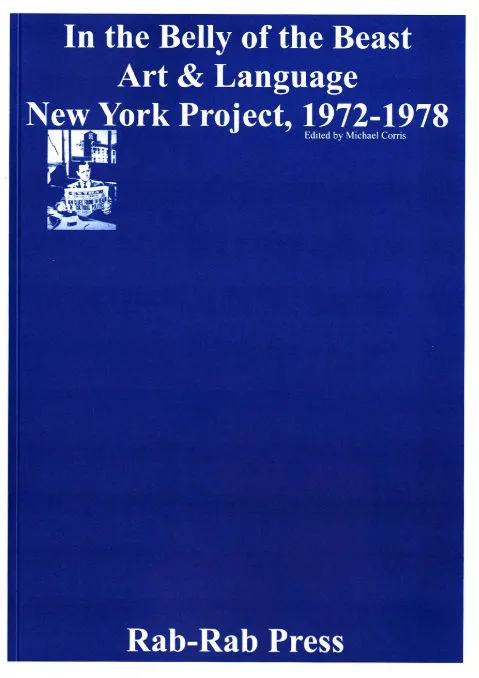
Cover of In the Belly of the Beast – Art & Language New York Project 1972-1978

Rab-Rab Press

In the Belly of the Beast – Art & Language New York Project 1972-1978

Art & Language

€16.00

Edited by Michael Corris, the expanded edition of In the Belly of the Beast: Art & Language New York Project 1972-1978 is a survey of the tumultuous years of the political Conceptualism in the mid-seventies New York.

Artists have always experimented with politics, either by organizing themselves or uniting in support of a broader political movement. Today, "activist art" is taught in universities, supported by foundations, and featured in museums and international exhibitions. Is this the only possible way?

In the Belly of the Beast tells a different story, of the work of politically engaged artists and the conflicts they experienced. It is the history of artists wishing to continue working within the boundaries of the artworld and those who were intent on establishing new ideological and class relationships with activists to build a political party.

During the 1970s in New York, the Art & Language collective pioneered institutional critique; published a Marxist-influenced journal; agitated against racism and sexism in museums; challenged the cultural imperialism of international exhibitions; and forged a framework for a socialist organization of artists. This new edition includes previously unpublished documents illuminating the contradictions and disputes that lay at the center of the organization and practices of Art & Language and left-wing groups, such as the Anti-Imperialist Cultural Union and the Artists' Meeting for Cultural Change, mobilizing artists in New York at the time.

The new and expanded edition of In the Belly of the Beast features an extensive interview with Michael Corris, who annotated a collection of previously unavailable documents from the period, including manuscripts, pamphlets, transcripts, and letters.

Art & Language is the name of a group of English artists who choose to work collectively, and the title of a magazine that they founded in 1968. Proposing a critical analysis of the relations between art, society, and politics, Art & Language marks, even in its name, the importance of the “textual turning point” in the 1960s.

Since 1976, Art & Language's project has continued, through Mel Ramsden and Michael Baldwin, with the literary and theoretical collaboration of Charles Harrison. Working with very varied mediums, from painting to rock, these co-founders of Conceptual art remain, even today, attached to observing the consequences of what they themselves call the “depressing collapse of modernism.”

Published in 2026 ┊ 196 pages ┊ Language: English

recommendations

Cover of Rab-Rab, Issue 5

Rab-Rab Press

Rab-Rab, Issue 5

Rab-Rab

Periodicals €27.00

The fifth issue of Rab-Rab: Journal of Political and Formal Inquiries in Art includes stories about nation traitors, fierce masses, socialist women struggles, love-forms, psychedelic counter-revolutionaries, workers unions, Brecht fiddlers, jazz surrealism, Soviet trains, and anti-fascism.

Among the contributors to the fifth issue are Anna Thew, Yehuda Safran, Peter Gidal, Cana Bilir-Meier, David Black, Marjo Liukkonen, Alejandro Pedregal, Peter Hallward, Minna Henriksson, and Jyrki Siukonen.

It has also two extensive dossiers. One dedicated to Franklin Rosemont is presented by Joe Feinberg and is introducing some unpublished and difficult to find texts parallel with writings of T-Bone Slim and Joe Hill. The other dossier on Robert Linhart is presented by Tevfik Rada, and it includes a translation of a chapter from Linhart's book on productivism, an article against Western bourgeois dissidents, and an interview with him.

Cover of Iliazda at the Birthday Party – Autobiographical Lecture, 1922

Rab-Rab Press

Iliazda at the Birthday Party – Autobiographical Lecture, 1922

Iliazda

The English translation of Zdanevich's Dadaist autobiographical lecture in Paris in 1922, where he adopts the name Iliazda. In this entertaining lecture, the achievements of the avant-garde is presented as a combination of zaum, polymorphous sexuality, aleatory forms and scatological interpretation of culture.

The second volume of the bie bao series presents a eulogy entitled Iliazda at the Birthday Party, a pseudo-autobiographical lecture delivered by Ilya Zdanevich in Paris in 1922. It reports on Zdanevich's artistic and political adventures up until then. Along with an autobiography full of self-admiration, in this lecture Zdanevich gives an interpretation of his zaum dramas inspired by Freudianism, and humorously describes a colourful image of the Russian microcosm in Montparnasse. 

Additionally, this second volume also includes Iliazd's letter to Ardengo Soffici from 1964, where one can read, in the most unambiguous terms, about Zdanevich's positions against war, imperialism, and all forms of nationalism. Subtitled 50 Years of Russian Futurism, the letter to Soffici presents us with an altogether new Zdanevich—a "fellow traveller" in both leftist and avant-garde circles. As well as the extended introduction and extensive annotations, the texts are further contextualised with Johanna Drucker's visual presentation of the birth of the Iliazd cult.

The bie bao series will include eight publications, covering many layers of Zdanevich's rich theoretical and artistic output. Each volume consists of a bio-bibliographical introduction, a commentary, a translation with annotations, and artistic intervention.

Iliazd (Ilya Zdanevich, 1894-1975) was a Russian poet, designer, typographer, theoretician, art critic, and publisher, close to the avant-garde circles and one of the promoters of Futurism in Russia, author of a poetic work, drama written in zaum abstract poetic trans-sense or "transrational" language, and novels.

Cover of About Narration – Materials, Comments, Interventions

Rab-Rab Press

About Narration – Materials, Comments, Interventions

Ingemo Engström, Harun Farocki

Published in collaboration with Harun Farocki Institut, this book unpacks About Narration [Erzählen], a 1975 essay film directed by Ingemo Engström and Harun Farocki.

Edited and introduced by Sezgin Boynik and Tom Holert, this book focuses on About Narration [Erzählen] directed by Ingemo Engström and Harun Farocki.
It includes the film's script alongside the historical documents related to its making and Farocki's previously unpublished theoretical and programmatic essay on the film. The publication also includes a retrospective essay by Ingemo Engström on the film's political and artistic background.

Volker Pantenburg's detailed elaboration of the conditions of its making, alongside Boynik and Holert's concluding remarks, further contextualizes the film. The interview with Cathy Porter on Larisa Reisner, a heroine of About Narration, gives an overview of the life of a militant writer who inspired Engström and Farocki.

Edited and introduced by Sezgin Boynik and Tom Holert.

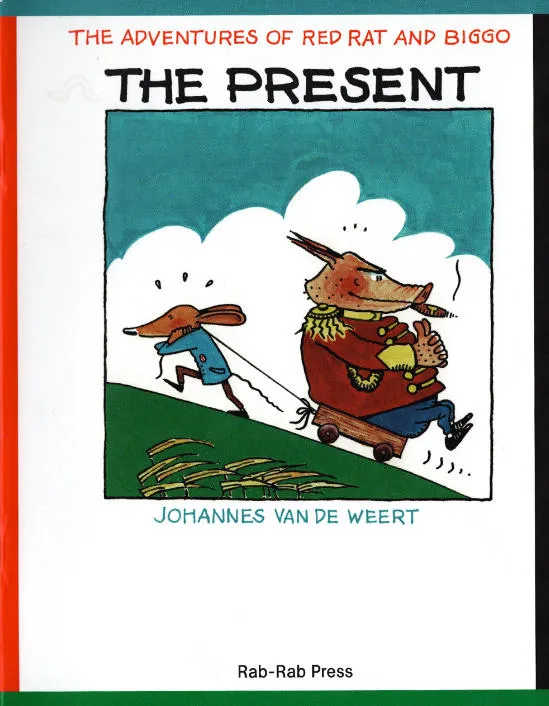
Cover of The Adventures of Red Rat and BIGGO – The Present

Rab-Rab Press

The Adventures of Red Rat and BIGGO – The Present

Johannes van de Weert

A children's book by Johannes van de Weert, a veteran of the punk underground (Rondos, The Ex, Red Rat, Raket).

The Adventures of Red Rat and BIGGO – The Present is a remake of Bram konijn en Piet de muis [Bram the Rabbit and Piet the Mouse], a 1982 children's book by Johannes van de Weert, a veteran of the Dutch punk underground who played with Rondos and The Ex, and who was the force behind Red Rat and Raket editions.
The Present is a 2010 remake telling the story of a bully pig who terrifies a poor rat on a daily basis. After a while, the rat falls ill with fear and has to stay in bed. The lonely, evil pig has no one to play with and becomes depressed. The pig gives the rat a present—a bunch of beautiful flowers—and all is well. Now the two can play together.
The 2010 remake, featuring different characters and intended for a North Korean audience, was never published. The 2025 English version opens with an introduction by Van de Weert, telling a bizarre story of a failed political career and an absurd vaudeville class struggle behind the seemingly harmless educational children's book.

Johannes van de Weert was a cartoonist active in the Rotterdam punk and squatter's movements of the 1980s. He was a singer with the punk band De Rondos and he started self-publishing small comic booklets in the late 1970s. He created his character "Redrat" for the fanzine Raket in 1980. The character soon became an icon for the squatter's movement.

Cover of Biting the Hand – Traces of Resistance in the Art & Language diaspora

Rab-Rab Press

Biting the Hand – Traces of Resistance in the Art & Language diaspora

Paul Wood

€30.00

Extensive survey of the politically outward-looking Conceptualism emerging from Art & Language in the UK. Especially considering its critique of the norms of Modernist art practices in contemporary art, particularly practices of art education.

Edited, compiled and introduced by Paul Wood, Biting the Hand: Traces of Resistance in the Art & Language diaspora is about a dissident formation of artists active in the UK in the 1970s and 80s.

The book tells the story of artists engaging with a critique of then-contemporary modernist art education, who have embarked on a series of theoretical investigations which became increasingly politicised under the pressures of an evolving social crisis. Increased racism, unemployment and attacks on the organised working class all raised questions about how a critical art might respond.

By the late 1970s, these radical artists, mostly in the orbit of the Art & Language group, were producing posters and leaflets for a wide range of left-wing causes, as well as analyses of the politics of art and design education and the role of cultural ideology in maintaining consensus. In the 1980s, as Thatcherism tightened its grip, those involved went their separate ways into areas as diverse as media work, trade unionism, health and education.

Biting the Hand has three parts: a retrospective introduction setting the formation in its historical context, and two annotated documentary sections presenting examples of the work as both text and image, written and edited by Paul Wood.

It also includes a foreword by Sezgin Boynik, publisher, and an afterword by Ann Stephen, curator and art historian, further expanding on the book's subject.

For many years Paul Wood worked for the Art History Department of the Open University. His publications from that period include Conceptual Art (2000), Western Art and the Wider World (2013), and the four-volume anthology Art in Theory (1990-2020), co-edited with Charles Harrison and others.

Edited, compiled and introduced by Paul Wood.
Foreword by Sezgin Boynik; afterword by Ann Stephen.

Cover of Reality (Dark) Fragments (Light)

Château de Montsoreau

Reality (Dark) Fragments (Light)

Art & Language

This monograph covers more than fifty years of creation by Art & Language, whose artists are at the origin of conceptual art. Through unpublished texts by Matthew Jesse Jackson and Art & Language, a transcript of their opera libretto Victorine, and an interview with the artist collective, this publication questions their journey, and more broadly, the relationship between contemporary art and conceptual art.

The permanent collection of the Château de Montsoreau – Museum of Contemporary Art has grown to include 800 works from Art & Language. To celebrate this event, the museum produced a major exhibition and a publication titled Reality (Dark) Fragments (Light). The monograph and exhibition look back at 50 years of creation by these critical, provocative, subversive, punk art collective. They question the main issues involved in Art & Language's work: conversation as an artwork, description, transdiciplinarity, crisis in the relationship between the artist, the museum and the art gallery.

Edited by Marie-Caroline Chaudruc.
Foreword by Marie-Caroline Chaudruc.
Text by Matthew Jesse Jackson, interview with Art & Language by Victorine Meurent.

Cover of A Psalm for the Third Wind

Self-Published

A Psalm for the Third Wind

Damien Troadec

Book: 11.7 × 18 cm
Book and Glove: 13.5 × 31.5 cm

Presented in a monster glove

Three broken halves of one god walk a city that wants them dead
Their bodies speak in static hunger and rust
Something follows breathing through their mouths
Read it Bleed from it


In A Psalm for the Third Wind, a film script written from 3 perspectives, Damien Troadec is aiming to address in parallel narrative the struggle of having multiples inner voices and the danger of following their distinct desires. One question is raised without any light at the end of the tunnel, confronting the reader to a conflict : THE COMFORT OF MISERY OR THE PAIN OF CHANGE ?

Cover of ztscript 33 : Lisa Fittko

ztscript

ztscript 33 : Lisa Fittko

ztscript

Typeface by Bea Schlingelhoff, from the Project "Women against Hitler"

Eric Bell & Kristoffer Frick: Rainbow Rope, 2017 1, Crystal Table (II), 2017 2, 63, Platonic Solid, 2018 64, Kolumne 3, Sara MacKillop: WC2N 4, 10, 15, 24, California Cannabis Legalization 9, Letzte Ausgabe der Spartakusbriefe, Oktober 1918 11, Delia Gonzales 16-21, Cordula Daus 22, Christina Irrgang 25, Eric Ellingsen 26, Hugo Canoilas: L’ô 29, 30, 35-38, Sadie Plant 31, Markus Krottendorfer: aus der Serie TERMINAL, 2017 32, Kate Rich: Feral Trade 39, Julia Knass 44, Walter Hetzer: World Trade Center 1972 46, Lidl, Wiedner Hauptstraße 15, Wien (ehemals Generali Foundation, gebaut 1993-95, Architektur Jabornegg & Pálffy) 50, One Hour and a Half in the Life of Ztscrpt 62-52

Cover of Oriental Cyborg

Essay Press

Oriental Cyborg

Aditi Kini

Essays €15.00

Who is the Oriental Cyborg? asks Aditi Kini in this collection of notes, jokes, and queries into the provenance of a creature designed for labor, 3-D printed in the technoscientific post-colonies, modeled on old automata. Race is a technology, that we know, and technology can be raced — so why inquire into this at all? Perhaps this, the Oriental Cyborg, is a fantasy more than a memory, or an echo more than a form — or just an essayist’s extraction of personal anguish and humor from globalist decay.

Taking on the form of historical analysis / lyrical essay / documentary poem / experimental buzzword / positionality statement, this chapbook and its titular character might still be an elusive mystery even after reading.

“’What is a ghost but a person removed from corporeality?’ This is one among layers of questions Aditi Kini poses in Oriental Cyborg, a lyrical excavation into survival in the era of techno racial capitalism, and its “deleting touch” that so easily voids—reduces to faceless services—the exploited individuals performing various acts of techno-labor. A grieved searching drives this hybrid essay, which feels urgent and necessary as threats from AI grab headlines. This work compels us to see our culture’s love affair with technological progress as a means for continued colonization and domination. It also reminds us, and celebrates, that those erased don’t stay silent forever. We privileged may not be able to hear them yet, but those who are listening know. They roar.” — Allison Cobb

“In the mirror of Aditi Kini’s Oriental Cyborg, I become the monster—a hopeless automaton, an intelligence stripped of roar. With titanium-threaded theory, Kini radiantly stitches together the ideal Asian working machine. Get your own Oriental cyborg today: super dazzling and sexy, historically embroidered, an oracular truth who never tires, never complains, forever mute, what perfection!” — Lily Hoàng

Aditi Kini is an undisciplined writer. They’ve done both NYC and the MFA (at UC San Diego). They were a finalist/alternate for the 2020-22 Jerome Award for Literature. They edit Lumpenpockets, “a nonquarterly sick rag.” Read their words in Hayden’s Ferry Review, The Rumpus, Denver Quarterly, The New York Times, and elsewhere. They’re at work on multiple projects, all at once. They are blessed with two dogs, Lucy the Happy and Charly Kong, who make life worth living.

Cover of Le Chauffage — Issue #2

Le Chauffage

Le Chauffage — Issue #2

Francesca Percival, Felix Rapp and 1 more

Le Chauffage (french for “The Heater”) is an artist-run publication based in Brussels and Vancouver. It is conceived as a cross-continental, community oriented platform. Le Chauffage brings together the work and writing of artists / friends from different cities with the  intent to spark discussion and fuel casual forms of critical discourse.

The second issue of Le Chauffage contains photographs and texts, photographs of text, photographs as text and vice versa. Loosely thinking through the format of The Photo Essay celebrated by John Szarkowski in an eponymously titled exhibition at MoMA in 1965, this issue considers some of the artistic possibilities that can be found in such an archaic and historically male-dominated form. 

Many of the contributions that make up this second issue are not photo essays per se. But each one of them considers the printed page as a space in its own right. The magazine becomes an interior where words and images entertain a malleable and distinctly porous relationship. At times, it is also a space where artists and writers from different cities were invited to meet and collaborate. And since interest in other people is also an interest in yourself, it is always unclear who is really transforming who?

Contributions by: Bob Cain & Linda Miller, Moyra Davey, Laurie Kang, Niklas Taleb, Madeleine Paré & Diane Severin Nguyen, Josephine Pryde, Slow Reading Club, Ken Lum, Isaac Thomas, Vijai Maia Patchineelam, Artun Alaska Arasli & Graeme Wahn, Stephen Waddell, Maya Beaudry & Chloe Chignell, Lisa Robertson, groana melendez, Victoria Antoinette Megens and Will Holder.

Editors: Emile Rubino and Felix Rapp
Co-Editor: Francesca Percival
Design: Francesca Percival and Felix Rapp
Cover Design: Francesca Percival
Printed by: Cassochrome, Belgium
Edition of 350

Cover of The Twofold Commitment

Primary Information

The Twofold Commitment

Trinh T. Minh-ha

At once an artist's book and an interview collection by Vietnamese filmmaker, writer and feminist and postcolonial theorist Trinh T. Minh-ha (born 1952), The Twofold Commitment centers on Trinh's 2015 feature film Forgetting Vietnam, which takes up one of the myths surrounding the creation of Vietnam: a fight between two dragons whose intertwined bodies fell into the South China Sea and formed Vietnam's curving, S-shaped coastline. Commemorating the 40th anniversary of the end of the war, the film draws inspiration from ancient legend to stage an ongoing contemporary conversation between land and water, creating a third space, another way, for historical and cultural re-memory.

This book features the film's lyrical, essayistic script, along with rhythmically distributed movie stills. Expanding on this central focus is a series of conversations between the filmmaker and critics and film and sound studies scholars dating from 2016 to 2022, amplified by an index identifying key concepts and ideas in the artist's work.