rile*books

Search books

Search books by title, author, publisher, keywords...

Cover of Johnny Would You Love Me If My Dick Were Bigger

Feminist Press

Johnny Would You Love Me If My Dick Were Bigger

Brontez Purnell

€18.00

A dirty cult-classic put out in a small batch by an underground publisher (Rudos and Rubes) in 2015, Johnny Would You Love Me If My Dick Were Bigger recounts the life of an artist and "old school homosexual" who bears a big resemblance to author Brontez Purnell.

Our hero doesn't trust the new breed of fags taking over San Francisco, though. They wear bicycle helmets, seat belts, and condoms. Meanwhile, he sabotages his relationships, hallucinating affection while cruising in late night parks, bath-houses, and other nooks and crannies of a newly-conservative, ruined city.

Furiously original, vital, and messy, this funny "non-memoir" uncovers a revelatory truth for the age: there are things far scarier than HIV.

Published in 2017 ┊ 200 pages ┊ Language: English

recommendations

Cover of Little F

Feminist Press

Little F

Michelle Tea

A new epic novel about a teenage queer runaway from cult classic author of Black Wave and Valencia Michelle Tea. A Literary Hub Notable Small Press Book of 2025.

In Spencer's fantasies, the breezy, queer streets of Provincetown, MA, are utopia, a place where he can be free. Yet when a violent attack in his suburban Arizona schoolyard sends him to the hospital, he decides queer utopia can't wait. And one night, with the help of his best friend, the teenage witch Joy, he hitches a ride to find it.

The cross-country road odyssey that follows brings Spencer from new moon rituals in Arizona canyons to Texas bus stations, from the luxe drag stages of Houston's Montrose district to the jazz-soaked streets of the French Quarter and beyond. This new novel from Michelle Tea tells the story, by turns raw, romantic, and sweet, of a sheltered boy taking his first leap into queer life, among all the complicated queers who live it.

"Tea's conversational tone and her way of writing deeply personal experience . . . presents a very necessary counter-narrative to mainstream histories of American punk, feminism, and sexual identity." – The Brooklyn Rail

Michelle Tea is the author of over twenty books of fiction, memoir, poetry and children's literature. Her autofiction Valencia, a cult classic, won the Lambda Literary Award for Best Fiction. Her essay collection Against Memoir was awarded the PEN/Diamonstein-Spielvogel Award for The Art of the Essay. Tea is also the recipient of awards from the Rona Jaffe Foundation and the Guggenheim Foundation. The founder of Drag Queen Story Hour, she has received honors from the American Library Association and Logo Television. Tea curated the Sister Spit Books series at City Lights Publishers and founded the ongoing imprint Amethyst Edition at the Feminist Press.

Cover of Cockfight

Feminist Press

Cockfight

María Fernanda Ampuero

Fiction €16.00

Thirteen stories explore domestic horrors and everyday violence, providing an intimate and unflinching portrait of twenty-first-century Latin America.

Named one of the ten best fiction books of 2018 by the New York Times en Español, Cockfight is the debut work by Ecuadorian writer and journalist María Fernanda Ampuero.

In lucid and compelling prose, Ampuero sheds light on the hidden aspects of the home: the grotesque realities of family, coming of age, religion, and class struggle. A family’s maids witness a horrible cycle of abuse, a girl is auctioned off by a gang of criminals, and two sisters find themselves at the mercy of their spiteful brother. With violence masquerading as love, characters spend their lives trapped reenacting their past traumas.

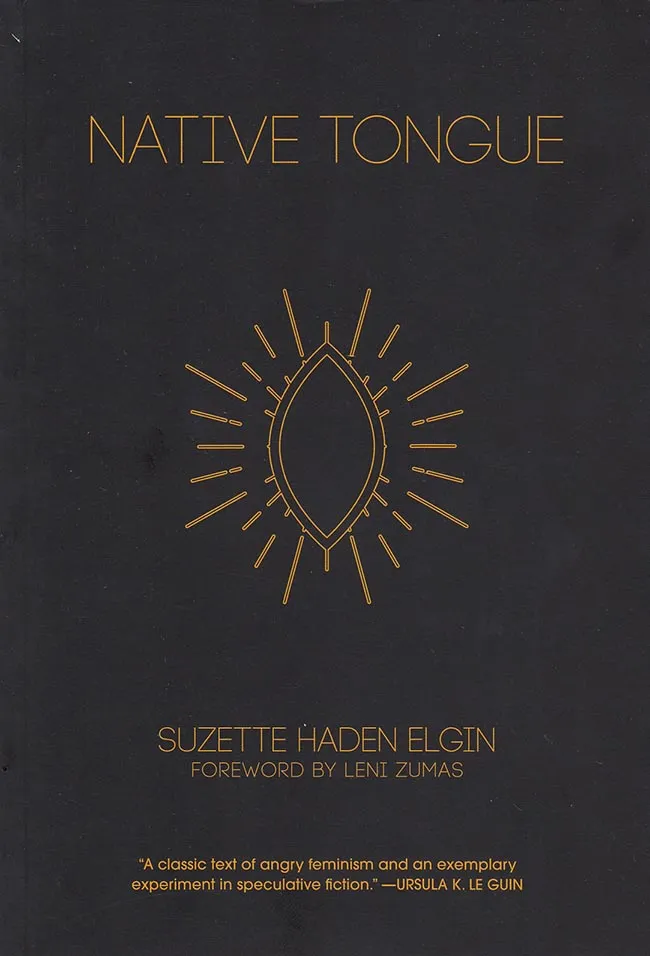
Cover of Native Tongue

Feminist Press

Native Tongue

Suzette Haden Elgin

Originally published in 1984, this classic dystopian trilogy is a testament to the power of language and women's collective action. 

In 2205, the Nineteenth Amendment has long been repealed and women are only valued for their utility. The Earth's economy depends on an insular group of linguists who "breed" women to be perfect interstellar translators until they are sent to the Barren House to await death. But instead, these women are slowly creating a language of their own to make resistance possible. Ignorant to this brewing revolution, Nazareth, a brilliant linguist, and Michaela, a servant, both seek emancipation in their own ways. But their personal rebellions risk exposing the secret language, and threaten the possibility of freedom for all.

Cover of Don't Leave Me This Way

Nightboat Books

Don't Leave Me This Way

Eric Sneathen

Poetry €18.00

A textual and historigraphical odyssey imbued with queer intergenerational yearning and loss.

Don't Leave Me This Way blends archival research with sexual fantasy to produce a series of sonnets inspired by Gaétan Dugas, named by Randy Shilts as "Patient Zero" of the AIDS epidemic in North America. Committed to the utopian possibilities of elegy and pornography, Don't Leave Me This Way exploits the absurdist beauty of the cut-up technique to voice a chorus of lost spirits: poignant, vengeful, and ready to ball.

Cover of Tar Hollow Trans: Essays

University Press of Kentucky

Tar Hollow Trans: Essays

Stacy Jane Grover

Essays €22.00

"I've lived a completely ordinary life, so much that I don't know how to write a transgender or queer or Appalachian story, because I don't feel like I've lived one.... Though, in searching for ways to write myself in my stories, maybe I can find power in this ordinariness."

Raised in southeast Ohio, Stacy Jane Grover would not describe her upbringing as "Appalachian." Appalachia existed farther afield—more rural, more country than the landscape of her hometown.

Grover returned to the places of her childhood to reconcile her identity and experience with the culture and the people who had raised her. She began to reflect on her memories and discovered that group identities like Appalachian and transgender are linked by more than just the stinging brand of social otherness.

In Tar Hollow Trans, Grover explores her transgender experience through common Appalachian cultural traditions. In "Dead Furrows," a death vigil and funeral leads to an investigation of Appalachian funerary rituals and their failure to help Grover cope with the grief of being denied her transness. "Homeplace" threads family interactions with farm animals and Grover's coming out journey, illuminating the disturbing parallels between the American Veterinary Association's guidelines for ethical euthanasia and the World Professional Association for Transgender Health's guidelines for transgender care.

Together, her essays write transgender experience into broader cultural narratives beyond transition and interrogate the failures of concepts such as memory, metaphor, heritage, and tradition. Tar Hollow Trans investigates the ways the labels of transgender and Appalachian have been created and understood and reckons with the ways the ever-becoming transgender self, like a stigmatized region, can find new spaces of growth.

Cover of BRICKS FROM THE KILN #7

Bricks from the Kiln

BRICKS FROM THE KILN #7

Matthew Stuart, Harriet Moore and 1 more

Fiction €20.00

Guest edited by artist Helen Marten and literary agent Harriet Moore with Matthew Stuart, this volume of the journal considers what it means for a publication to be an allegorical container. A simple box in which to gather multiple things, an economical set of permutations — rational in one sense, yet defiantly flexible to move. Contributors were approached with an open invitation; some explored the multiplicities of containing or containers, while others filled the printed vessel with their own ongoing preoccupations. The following pages perform as envelope, bag, shell, net, fold, alarm, letter and instruction. There are holes to disappear within; smoke to knot and wind; shadows to unfold — a context that takes in and binds, finding new kinships from unforeseen proximities.

THE FIRE FLOWERS AND THE FLOWER LIGHTS UP –
Lucy Mercer
(spine)

WE SHALL GREET THE MOON AGAIN
Walter Price
(front cover)

BACK PAGES OF ALGIERS DIARIES 2018
Lydia Ourahmane
(inside front & inside back cover)

AN INTRODUCTION TO / NOTES ON / INSTRUCTION FOR THE FRONT NOVEL
Eliza Barry Callahan
(pp.1–16)

SATURDAY MORNING
Kathryn Scanlan
(pp.25–29)

KILLDEER
Jason Schwartz
(pp.33–38)

ALARMS AND EXCURSIONS
Rosmarie Waldrop
(pp.45–61)

"THE BATHROOM"
Najwa Barakat
(pp.67–76)

ARMY ROLLS, A CIRCUMSCRIPTION
Roy Claire Potter
(pp.81–91)

CONCHOMANIA
Felix Bernstein
(pp.95–109)

O-POEM
Line-Gry Hørup
(pp.113–129)

THIS MUSCLE
Cally Spooner
(pp.133–153)

STERLING PARK IN THE DARK
Susan Howe
(pp.159–179)

COCONUTTERY
Mathelinda Nabugodi
(pp.183–193)

YOUR SELF CONFIDENT BABY
Aurelia Guo
(pp.197–206)

BIOGRAPHY OF A NET: HOLDING A VOLUME
Daisy Hildyard
(pp.211–225)

A GUIDE TO THE POETRY OF LI HO
Eliot Weinberger
(pp.229–235)

WOMEN SMOKING
Charline von Heyl
(throughout & p.239)

INFRATHIN
Marcel Duchamp
(throughout & p.239)

THE MAZED WORLD
Rachael Allen
(bookmark insert)

UNTITLED
Helen Marten
(back cover)

Cover of Bad Girls

Other Press

Bad Girls

Camila Sosa Villada

Fiction €17.00

Gritty and unflinching, yet also tender, fantastical, and funny, a trans woman’s coming-of-age tale about finding a community among fellow outcasts.

Born in the small Argentine town of Mina Clavero, Camila is designated male but begins to identify from an early age as a girl. She is well aware that she’s different from other children and reacts to her oppressive, poverty-stricken home life, with a cowed mother and abusive, alcoholic father, by acting out—with swift consequences. Deeply intelligent, she eventually leaves for the city to attend university, slipping into prostitution to make ends meet. And in Sarmiento Park, in the heart of Córdoba, she discovers the strange, wonderful world of the trans sex workers who dwell there.

Taken under the wing of Auntie Encarna, the 178-year-old eternal whose house shelters this unconventional extended family, Camila becomes a part of their stories—of a Headless Man who fled his country’s wars, a mute young woman who transforms into a bird, an abandoned baby boy who brings a twinkle to your eye.

Camila Sosa Villada’s extraordinary first novel is a rich, nuanced portrait of a marginalized community: their romantic relationships, friendships and squabbles, difficulties at work, aspirations and disappointments. It bears witness to these lives constantly haunted by the specter of death—by disease or more violent means at the hands of customers, boyfriends, or the police—yet full of passion, empathy, and insight.

Cover of T (poem)

Materials

T (poem)

Laurel Uziell

Poetry €13.00

T is a long poem in multiple parts and its author's second book. “The two genders are YES and NO, so you stutter or else shut up forever”. 

From the Afterword: "Between 2017-2018 I was involved in a trial with a group of TERFs after a scuffle emerged during a counter protest against a ‘debate’ about sex-based rights in light of proposed reforms to the Gender Recognition Act which would have made trans people’s lives marginally easier. Luckily I wasn’t actually in the dock, but I appeared to give evidence, and for everyone involved it was a humiliating ordeal as we were doxxed, harrassed online and in real life, while the relentless media campaign which ensued took a toll on the entire trans community. The caricaturesque reduction of a complex interrelation of political positions, epistemologies, traumas and personal grievances into two ‘sides’ ultimately worked to further the persecution of trans people, but nevertheless highlighted a social logic on whose terms the so called debate was forced to appear: sex was pitted against gender (or more revealingly ‘gender identity’), objective biology against subjective ‘self-identification’, nature against culture, or perhaps, first nature against second nature."

What does a poet say (what does anyone say), when placed on the stand, how answer the binary logics forced like a cage in the legally-grounded violence which splittingly interrogates solidarity, the splitting invocation of law? In answer, T spreads across the page as if desperately finding a form for speech acts forced into a garrotted tick-box, a witness stand, video evidence, Nature’s originary disguise as history or vice versa, wrapped inside ‘common sense’ as a pronominal shroud, in the policing of body, speech, and every fungible fibre of being. The author writes: “I want the whole text to be a kind of horrific inorganic body with awkward parts, both to replay at the level of form some of the critiques of organicist thinking with reference to nature that the poem tries to articulate, and also, more glibly, to be somewhat like a trans body, awkwardly fitting together with some parts undercutting others”. An extended enquiry into Materialism and its material (fleshed) stakes, driven through the heart and to the heart of things, T sees lyric poem shudder to line-broken essay to fragment of play to citational drop; in tight compression sprawling, a poem whose argument is necessary and necessarily incomplete, poetry can do thinking, this thinking we do outside and within it, sprung trap, open and closing door.