rile*books

Search books

Search books by title, author, publisher, keywords...

Cover of Alice Notley, Live in Seattle

Fonograf Editions

Alice Notley, Live in Seattle

Alice Notley

€23.00

Entirely comprised of poems contained in her latest collection, 2016’s Certain Magical Acts, Live in Seattle elucidates why Alice Notley is one of the world’s most revered poets, the recipient of the Los Angeles TimesBook Award, the Griffin Prize, the Shelley Memorial Award, the Lenore Marshall Prize, and the Poetry Foundation’s Ruth Lilly Prize. “I am alive outside written memory” is how one of the speakers of Notley’s poem “Voices” puts it and listening to the poet read her work live, in front of an entranced audience, serves to detail the intangibility of sound vis-à-vis language.

Live in Seattle also includes excerpts of the onstage conversation Notley had with Seattle poets John Marshall, Christine Deavel and Rebecca Hoogs. Among other topics, the talk revolves around concepts of success, what it means to write a female poetry circa 2017, and the importance of always creating from a position of disobedience.

As part of Seattle Arts & Lectures’ Poetry Series, Live in Seattle was recorded at McCaw Hall in Seattle, Washington on Wednesday, April 5th, 2017 and mastered and engineered by Gus Elg at Sky Onion in Portland, Oregon in the Summer of 2017. 

Purchase of Live in Seattle includes a 11×11 insert of Notley’s poem “FOUND WORK (lost lace),” as well as a download card for the entire album. Live in Seattle can also be found digitally on Spotify and Bandcamp. The record itself is not black but clear.

Published in 2017 ┊ Language: English

recommendations

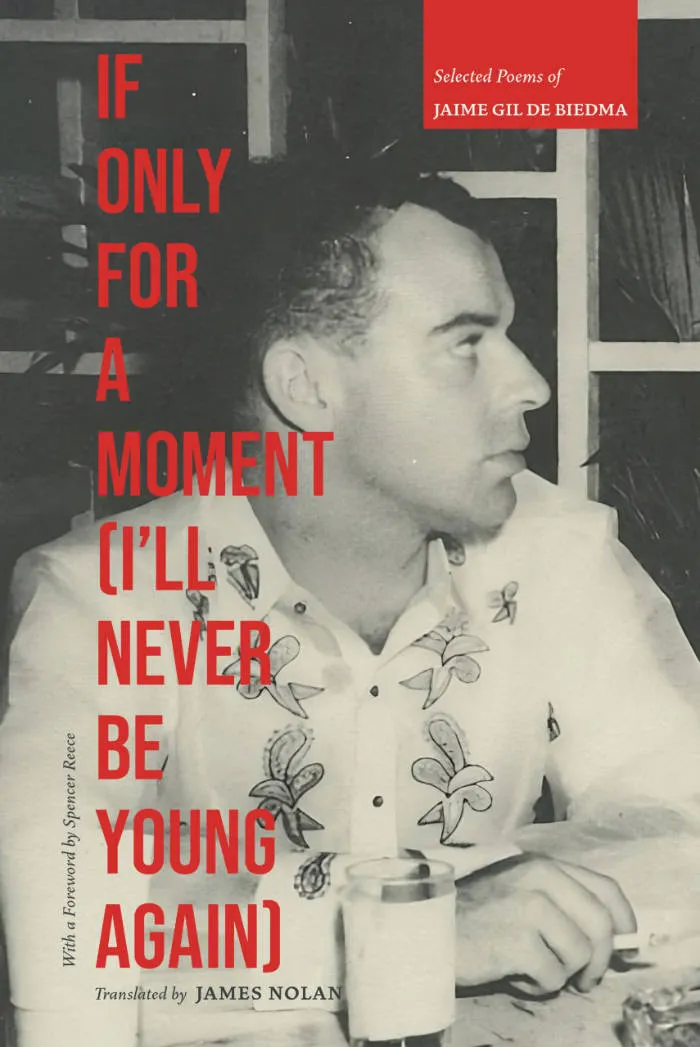
Cover of If Only For a Moment (I’ll Never Be Young Again)

Fonograf Editions

If Only For a Moment (I’ll Never Be Young Again)

Jaime Gil de Biedma, James Nolan

Poetry €19.00

Jaime Gil de Biedma is the most original and influential among the poets known as the ‘50’s Generation in Spain, and is considered the greatest Spanish poet to emerge in the second half of the 20th century. His life and literary career were bracketed almost entirely by the rise and fall of Generalissimo Francisco Franco, notorious for the suppression of literature. Born in 1929, Gil de Biedma was six years old when García Lorca was murdered in Granada at the outbreak of the Civil War, and his collected poems, Las personas del verbo, first appeared in 1975, the year Franco died. What is surprising is that Gil de Biedma was a leftist, homosexual poet from the Catalan capitol, Barcelona – all of Franco’s favorite things – who not only published books of autobiographical poetry in Spain but was known as a poet of social conscience as well as erotic lyricism. Like other Spanish poets of his time, he chose his words carefully. Gil de Biedma died of AIDS in 1990.

If Only For a Moment (I’ll Never Be Young Again) consists of an extensive bilingual selection of Gil de Biedma’s poetry, including all of his most well-known work. The book additionally consists of a Foreword by Spencer Reece, Jaime Gil de Biedma’s short essay “I wanted to be the poem,” and two different essays on Gil de Biedma and the art of translation by James Nolan, the volume’s translator.

Cover of The Grimace of Eden, Now

Fonograf Editions

The Grimace of Eden, Now

Cody-Rose Clevidence

Poetry €19.00

The playful, inventive, and lyrically quick poems comprising The Grimace of Eden, Now orbit the strange space halfway between Tennyson and the Metaverse, veering between the natural world and a sci-fi universe, between inner feelings and outward observations, with questions of divinity alongside domestic life, spiders, dishes, and spaceships. The roving eye of these poems wanders through spacetime carrying irreverent theologies and exploring what it could mean to be living, sensate, and awake in this weird moment in time, exposing a mixture half of awe and half of madness. 

Cody-Rose Clevidence is the author of Aux Arc / Trypt Ich (Nightboat Books, 2021), Listen My Friend, This is the Dream I Dreamed Last Night (The Song Cave, 2021), Flung/Throne (Ahsahta, 2018), and BEAST FEAST (Ahsahta Press, 2014), as well as several chapbooks (Fonograf Editions, flowers and cream, NION, garden door press, Auric). Occasionally a visiting poetry professor at the Iowa Writers Workshop, they live in the Arkansas Ozarks alongside three loyal, sentient pets, and the continuous void.

Cover of Early Works

Fonograf Editions

Early Works

Alice Notley

Poetry €26.00

Early Works collects Alice Notley’s first four out of print poetry collections, along with 80 pages of previously uncollected material. A must have for any Notley fan. Includes original collection cover artwork by Philip Guston, Philip Whalen and George Schneeman, among others.

From editor Nick Sturm’s “Introduction” to Early Works:

In the author’s note that begins Grave of Light: New and Selected Poems 1970-2005, Alice Notley writes, “My publishing history is awkward and untidy, though colorful and even beautiful.” I have always been enamored of this sentence, which reminds us that an array of dispersed and varying publishing contexts are the original sites that give shape to such a book’s form. It is also something of an invitation into that color and untidiness, a prompt to become more curious about the awkwardness and beauty of Notley’s publishing history. This book, Early Works, accounts for a significant portion of that history by bringing back into print the complete versions of her first four books, a little-known 22-poem sonnet sequence, and a large selection of early uncollected poems gathered from little magazines. In doing so, Early Works joins an important set of recent volumes that put Notley’s earlier poetry back into circulation, including Manhattan Luck (Hearts Desire, 2014), which collects four long poems written between 1978 and 1984, and Songs for the Unborn Second Baby, originally published by United Artists in 1979 and reissued in a facsimile edition by London-based Distance No Object in 2021. Each in their own way, and especially taken together, these books continue to confirm that, as Ted Berrigan writes in The Poetry Project Newsletter in 1981, “Alice Notley is even better than anyone has yet said she is.”

Cover of Bird Watching and Their First Three Books of Poetry

Fonograf Editions

Bird Watching and Their First Three Books of Poetry

Eileen Myles

Poetry €24.00

Any future film director planning to make a movie of Myles's iconic novel Chelsea Girls (it's always just about to happen) would be wise to read Bird Watching first. Written in 1978 and unpublished until now, the central character of the book is a twenty-something that is already filled with memories. Living in New York City, resplendent, full of both grandeur and awkwardness, they are about to embark on a life fully invested in art. Bliss happens, as does uncertainty. Everything is here and now.

The Irony of the Leash, A Fresh Young Voice from the Plains, and Sappho's Boat, the other collections contained in the volume, comprise the first three books that Myles published, when their promise as one of the most important writers of their generation was just coming into view. Immensely readable, raw, and slightly unhinged, the poetry that comprises these three texts is post young. Slight creaky but fully functional, all of these poems are beautiful and funky.Bird Watching and Their First Three Books of Poetry contains a critical foreword by poet and scholar Rosa Campbell, along with a preface by Eileen Myles contextualizing the book within our contemporary moment.

Eileen Myles (them/them, b. 1949) is a poet, novelist and art journalist whose practice of vernacular first-person writing has made them one of the most recognized writers around town (globally). They live in New York & in Marfa, TX.

Cover of The Speak Angel Series

Fonograf Editions

The Speak Angel Series

Alice Notley

Poetry €28.00

The Speak Angel Series is composed of six full-length books in various forms but towards the achievement of a unifying epic narrative in which the poet, as character, leads all the souls of all the living and dead to a point zero where the remaking of the cosmos can be performed. As this is being done, the official public world takes place in Paris, France and the United States, and new “characters” are incorporated from the news and from the poet’s life.

The forms include a long-line narrative broken by lyric stand-alones, an operatic form designed to make the reader chant if reading aloud, two spiritual sequels to the author’s book The Descent of Alette, written in the same stanzaic form, a book that is simply a collection of different kinds of poems, a book formed by literary collaging, and a final, long book that is the volume’s ultimate culmination.

The Speak Angel Series took years to accomplish but is finally ready; it is meant to be read for plot, pleasure, musical experience, wisdom and truth. Why not? The books present something like a cosmology in the philosophical sense, a reading of existence and of death. The dead are very close-by and available in the series, which is a work of stunning ambition.

Cover of Ezio Gribaudo - The Weight of the Concrete

Grazer Kunstverein

Ezio Gribaudo - The Weight of the Concrete

Lilou Vidal, Tom Engels and 1 more

The Weight of the Concrete explores the legacy of the Turinese artist and publisher Ezio Gribaudo (1929–2022), examining his multifaceted oeuvre at the confluence of image and language. This publication, named after Il Peso del Concreto (1968)—a seminal work that featured Gribaudo’s early graphic creations alongside an anthology of concrete poetry edited by the poet Adriano Spatola (1941–88)—places Gribaudo’s work in conversation with approximately forty artists and poets from different generations, all of whom similarly engage with explorations of text, form, and visual expression.

Reflecting the editorial premise of Il Peso del Concreto, The Weight of the Concrete revisits the influential anthology, including archive material that documents its production, and reimagines it, pairing Gribaudo’s graphic work with a new selection of historical and contemporary concrete and experimental poetry.

At the heart of the volume is Gribaudo’s emblematic Logogrifi series, developed from the 1960s onward. The Logogrifi reveal his deep engagement with the art of bookmaking and fascination with industrial printing processes, relief matrices, typefaces, and language games.

In this new edition, the editors take the opportunity to revisit Gribaudo’s pioneering work, examining previously overlooked dimensions—gendered, geographical, and technological—and exploring contemporary associations beyond the original context. The book also includes essays that elucidate the poetic and political interplay between image, language, and materiality.

This publication is released following Ezio Gribaudo – The Weight of the Concrete, an exhibition held at the Grazer Kunstverein in Graz, Austria (2023–24), and at the Museion—Museum of Modern and Contemporary Art in Bolzano-Bozen, Italy (2024).

Edited by Tom Engels and Lilou Vidal
Published by Axis Axis and Grazer Kunstverein

Contributions by Anni Albers, Mirella Bentivoglio, Tomaso Binga, Irma Blank, Al Cartio, Paula Claire, CAConrad, Natalie Czech, Betty Danon, Constance DeJong, Mirtha Dermisache, Johanna Drucker, Bryana Fritz, Ilse Garnier, Liliane Giraudon, Susan Howe, Alison Knowles, Katalin Ladik, Liliane Lijn, Hanne Lippard, Sara Magenheimer, Françoise Mairey, Nadia Marcus, Giulia Niccolai, Alice Notley, Ewa Partum, sadé powell, N. H. Pritchard, Cia Rinne, Neide Dias de Sá, Giovanna Sandri, Mary Ellen Solt, Alice Theobald, Colleen Thibaudeau, Patrizia Vicinelli, Pascal Vonlanthen, Hannah Weiner, and Ruth Wolf-Rehfeldt

Essays by Alex Balgiu, Tom Engels, Nadia Marcus, Luca Lo Pinto, Mónica de la Torre, and Lilou Vidal

Cover of Help

Tenement Press

Help

Steven Zultanski

Poetry €25.00

Death-obsessed, disengaged and overinvested—the four long poems assembled in Steven Zultanski’s Help theatricalise morbid fascinations, self-protective impulses, and unfocused desire. Help is, at its core, a set of conversations; the result of games played between friends that were then transcribed, edited, and embellished. Participants were asked to talk about loss, the death of acquaintances, secret hiding places, mislaid time, and unmet demands. The resulting poems read like meandering scripts for unrealised plays; incidental excavations of persona and place.

Somewhat reminiscent of Linda Rosenkrantz’s Talk (1968) or Alice Notley’s transcription poems of the 1970s, in Help the poet pretends to be a recording device, and the poem an act of remembering. Zultanski’s writing is at once skeletal and overstuffed, dryly unsentimental and yet dripping with melodrama. Help foregrounds its own contradictions in a collection that is at once both extremely personal and distinctly artificial.

Help brilliantly extends Steven Zultanski’s current phase of writing—looser, more documentary, more situational. In setting up explicit objects of inquiry and conversation—love, death, childhood—the book shows that to know these things is to also know our friends and ourselves. Sustained by an orchestration of relation and memory (and thus reality), affect here is modular, the product of what happens when we transform things by talking about them. A careful and astute experiment in writing and living.
 — Jennifer Soong

Cover of Midwinter Day

New Directions Publishing

Midwinter Day

Bernadette Mayer

Poetry €17.00

Midwinter Day, as Alice Notley noted, is an epic poem about a daily routine. A poem in six parts, Midwinter Day takes us from awakening and emerging from dreams through the whole day-morning, afternoon, evening, night-to dreams again:...

a plain introduction to modes of love and reason/ Then to end I guess with love, a method to this winter season/ Now I've said this love it's all I can remember/ Of Midwinter Day the twenty-second of December// Welcome sun, at last with thy softer light/ That takes the bite from winter weather/ And weaves the random cloth of life together/ And drives away the long black night!