Mothering
Mothering

Foam
I am still transitioning, but I am unsure into what.
Who are all these Evas? They puncture and disrupt the domestic space and equilibrium of the narrator, who alternately relies upon them or administers their care. Foam is the latest boundary-blurring, genre-resistant, strange and speculative new fiction from Kate Zambreno, the inimitable and relentless literary stylist and conceptualist. Inspired by the absurdities of Eva Hesse and other soft sculpture, these are speculative art essays and textures, a document of precarity and slippery time—mischievous, moody, estranged—a masterwork of tone and atmosphere.

Comment réparer : La maternité et ses fantômes
Iman Mersal, Richard Jacquemond
Publié en 2018 par Kayfa-ta (Égypte), Comment réparer : la maternité et ses fantômes propose une réflexion sur la maternité et ses représentations. Plusieurs fois réimprimé, ce livre jouit d’une très grande réputation dans le monde arabophone, notamment auprès des jeunes générations.Mobilisant différentes formes d’écriture (essai, récit, poème, journal) et des images photographiques tirées de sources diverses (archives personnelles, presse, portraits vernaculaires, etc.), la trame du livre s’articule autour des relations de l’autrice avec sa mère, sa grand-mère et ses deux fils. Déjouant les clichés et les formes narratives établies, Iman Mersal décèle les complexes réseaux symboliques dans lesquels s’inscrivent la filiation et la maternité, depuis la grossesse jusqu’à l’éducation des enfants, et ce de génération en génération.À l’écoute des silences de la mémoire, explorant ses labyrinthes, le livre porte un regard critique sur la violence et le sentiment de culpabilité qui traversent le corps maternel, notamment dans ses rapports au langage, au travail ou aux institutions. Iman Mersal élabore ainsi une sorte d’art poétique : la réparation dont parle le titre passe par l’écriture, elle est donc d’ordre créatif ; mais l’écriture s’insère dans un quotidien qui lui fait obstacle, qui met au défi la possibilité même d’écrire dès qu’on devient mère. Comment réparer : la maternité et ses fantômes est en ce sens un formidable texte de résistance, un geste d’émancipation.
Née en 1966 en Égypte, Iman Mersal est poète et professeur associé de littérature arabe à l’université d’Alberta, au Canada. Ses récents livres sont des écrits très originaux qui mêlent recherche académique et réflexions intimes sur une grande variété de sujets, dont la plupart ont trait à son identité de femme et d’artiste. Une anthologie de ses poèmes – Des choses m’ont échappé (2018) – et un récit – Sur les traces d’Enayat Zayyat (2021) – ont été traduits en français par Richard Jacquemond pour les éditions Actes Sud

Mother
Dorothea Lasky’s stunning new collection of poems presents an unfurling, terrifying, and fiercely loving embodiment of motherhood as a force of creation. Inspired by Bernadette Mayer’s The Desires of Mothers to Please Others in Letters, Lasky writes from the inner realm of a third pregnancy and guides us through a suspended timeline taut with anticipation. Mother documents caring for small children, the death of the mother, and the simultaneous anxiety and darkness of impending birth, as Lasky transmits from a deep mythic and biologically immediate space: “And even though I’ve spent / Eight months now / Dreading the sight / Of anything red / Now I long to bleed all over.” Invoking the eternal symbol of the mother, Lasky asks us to consider an expansive understanding of the horror and devotion inherent in the daily practices of existence.

Mother Media: Hot and Cool Parenting in the Twentieth Century
An essential history for understanding how we mother now, and how motherhood itself became a medium—winner of the Brooke Hindle Award from the Society for the History of Technology.
From the nursery to the prison, from the clinic to the commune, Mother Media tells the story of how we arrived at our contemporary understanding of what a mother is and how understandings of “bad” mothering formed our contemporary panics about “bad” media. In this book, leading historian of psychology Hannah Zeavin examines twentieth-century pediatric, psychological, educational, industrial, and economic norms around mediated mothering and technologized parenting. The book charts the crisis of the family across the twentieth century and the many ingenious attempts to remediate nursemaid and mother via speculative technologies and screen media.
Growing out of her previous award-winning book The Distance Cure, which considered technologized care, the book lays bare the contradictions of techno-parenting and how it relates to conceptions of “maternal fitness,” medical redlining, and surveillance of children, parents, and other caregivers. The author offers narratives of parenting in its extremity (for example, Shaken Baby Syndrome) and its ostensible banality (for example, the Nanny Cam) and how the two are often intertwined. Ultimately, Zeavin grapples with a simple contradiction: technology is seen and judged as harmful in domestic and educational spaces, even as it is a saving grace in the unending labor of raising a family.
Hannah Zeavin is Associate Professor of the History of Science in the Department of History and the Berkeley Center for New Media at UC Berkeley. She is the author of The Distance Cure and Mother Media (MIT Press) and Founding Editor of Parapraxis. In 2021, she cofounded The Psychosocial Foundation.

Art Monsters: Unruly Bodies in Feminist Art
In this dazzlingly original reassessment of women’s stories, bodies, and art, Lauren Elkin—the celebrated author of Flâneuse—explores the ways in which feminist artists have taken up the challenge of their work and how they not only react against the patriarchy but redefine their own aesthetic aims. How do we tell the truth about our experiences as bodies? What is the language, what are the materials, that we need to transcribe them? And what are the unique questions facing those engaged with female bodies, queer bodies, sick bodies, racialized bodies?
Encompassing a rich genealogy of work across the literary and artistic landscape, Elkin makes daring links between disparate points of reference—among them Julia Margaret Cameron’s photography, Kara Walker’s silhouettes, Vanessa Bell’s portraits, Eva Hesse’s rope sculptures, Carolee Schneemann’s body art, Theresa Hak Kyung Cha’s trilingual masterpiece DICTEE—and steps into the tradition of cultural criticism established by Susan Sontag, Hélène Cixous, and Maggie Nelson.
An erudite, potent examination of beauty and excess, sentiment and touch, the personal and the political, the ambiguous and the opaque, Art Monsters is a radical intervention that forces us to consider how the idea of the art monster might transform the way we imagine—and enact—our lives.
Destined to become a new classic . . . Elkin shatters the truisms that have evolved around feminist thought.
—Chris Kraus
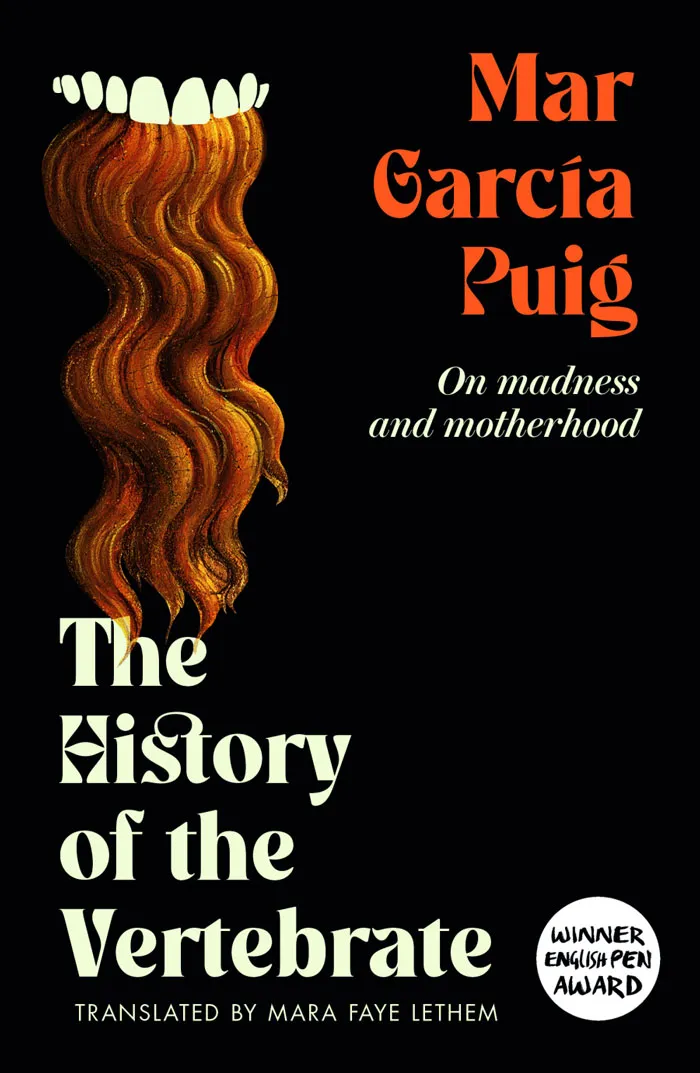
The History of the Vertebrate
Mar García Puig, Mara Faye Lethem
‘On 20 December 2015 I became a mother and I went mad.’
On a single day, Mar García Puig gives birth to twins and becomes elected to the Spanish Parliament as a member of the insurgent left-wing party Podemos. What might have been the best day of her life becomes the start of a terrifying ordeal; García Puig’s grip on reality begins to slip as she grapples with uncertainty, the weight of expectation, and misogyny in both of her new roles.
In defiance of a culture that tells her the problem lies within, García Puig chooses to look outwards, examining the imbrication of madness and motherhood across centuries of science, myth, and politics while dissecting the ways in which women have been pathologized and banished from public life.
At once intimate and epic, The History of the Vertebrate is a searing account of postpartum madness. Moving between memory, culture, and the history of medicine, García Puig transforms her experience into a story about the countless women who have felt that sanity was leaving them, and about the patriarchal forces that have silenced them.
MAR GARCÍA PUIG is an editor and author. From 2015 to 2023 she was a member of the Spanish Congress of Deputies for Podemos, where she served on the Culture Committee and the Equality Committee. Her books include The History of the Vertebrate and This Thing of Darkness.

Night Night Fawn
From the author of Confessions of the Fox comes a novel in which a yenta on her deathbed gives an unrepentant account of all her failures—including her child.
“Jordy Rosenberg might be one of our most fearless living novelists. There are no half-measures in his work, just big ideas and living characters and gorgeous sentences and metafictional panache and surprise after heart-stopping surprise. Night Night Fawn is extraordinary.”—Carmen Maria Machado, author of In the Dream House
In a cluttered rent-controlled apartment in the middle of Manhattan, Barbara Rosenberg is terminally ill, high on opioids, and writing the story of her life. She has opinions about her smutty late husband, her career as the receptionist for a disreputable plastic surgeon, her glory days as an accomplished jazzerciser, and her failed aspirations to be a film noir actress. But what she really wants to talk about are unhinged thoughts on gender, Karl Marx, Zionism, and her two great disappointing loves: an estranged trans son and a long-lost best friend whose betrayal haunts Barbara still. As she descends further into delirium and illness, Barbara finds herself in a nightmare from which she cannot escape, and her circumstances put her on a crash course with these intimates—or are they avenging nemeses?—once again.
Part novel, part someone’s mother’s unauthorized memoir—all diatribe, gutter schtick, and deranged manifesto, Night Night Fawn is a ferociously candid account of intergenerational conflict.

Day Book
Looking at pictures, she was reminded of the lack of time. And anyway, where did all the time go?
In Day Book a woman artist looks at time in an address to quotidian events and their unfolding. Exploring motherhood, unpaid labour, childcare, and the time of the artist, she reads the work of contemporary women filmmakers through the earlier works of filmmakers, writers, and photographers, including Chantal Akerman and Marguerite Duras, Natalia Ginzburg and Christa Wolf, Bertien van Manen and Bernadette Mayer. The inability to capture the accumulation of days emerges—a form without form, day after day after day.

Unfit
Ariana Harwicz, Jessie Mendez Sayer
A bracing novel that asks how far we would go for the ones we love—and what we would do to destroy the ones we hate.
Lisa has lost custody of her young twin boys. Caught between the French legal system’s sluggish bureaucracy and her sinister, scheming in-laws, she’s alone and lost, an Argentine migrant in rural France picking grapes for a pittance, only allowed to see her children in supervised visits once a month. Scapegoated and outcast, destitute and desperate, Lisa decides to take radical action: early one morning, she sneaks into her in-laws’ farmhouse, takes back her children, sets the barn ablaze, and makes her escape.
What follows is a white-knuckled road trip that explores human beings pushed to the edge. Clearly, Lisa is not in her right mind, and as Harwicz deftly mingles a chorus of contradictory voices into her very unreliable narration, the reader comes to regard the protagonist with an unsettling mixture of sympathy and suspicion. Written in savage, chiseled prose, Unfit shoots off, a gripping chase that questions all our assumptions—and points out our hypocrisies— about motherhood, custody rights, love, violence, anti-semitism, and migration. The latest novel by the acclaimed author of Die, My Love (soon to be adapted to a film starring Jennifer Lawrence), Unfit is addictively terrifying, savagely sophisticated, and shockingly brilliant.
Translated from Spanish by Jessie Mendez Sayer

Baby
Mangled diction from the cusp of childhood.
Carla Harryman is the author of 11 books of poetry, prose plays and essays. Her two experimental novels, Gardener of Stars (2001) and The Words: after Carl Sandburg’s Rootabaga Stories and Jean-Paul Sartre (1999) are “explorations of the paradise and wastelands of utopian desire.” Baby continues this exploration through the convolutions of Baby, who enters the book as “fire in the womb with a skirt."
Carla Harryman is a poet, experimental prose writer, essayist, and performance writer who has collaborated with multiple visual artists and composers on bodies of work. Her work has been translated into several languages, including French, with her writing represented in more than 30 national and international anthologies. She has received the Foundation for Contemporary Arts Grants to Artists award (2004), the Opera America Next Stage Grant (with composer Erling Wold), the Alexander Gerbode Foundation, and the NEA Consortium Playwrights Commission, among additional grants and awards from the Fund for Poetry.
Harryman was a founding figure of the Bay Area language writing and a co-founder of The San Francisco Bay Area Poets Theater (1979-1986). She currently teaches Creative Writing at Eastern Michigan University and serves on the MFA summer faculty of the Milton Avery School of the Arts at Bard College.

My Work
From the acclaimed author of The Employees, a radical, funny, and mercilessly honest novel about motherhood
After giving birth, Anna is utterly lost. She and her family move to the unfamiliar, snowy city of Stockholm. Anxiety threatens to completely engulf the new mother, who obsessively devours online news and compulsively buys clothes she can’t afford. To avoid sinking deeper into her depression, Anna forces herself to read and write.
My Work is a novel about the unique and fundamental experience of giving birth, mixing different literary forms – fiction, essay, poetry, memoir, and letters – to explore the relationship between motherhood, work, individuality, and literature.

The Long Form
The Long Form is the story of two people composing a day together. It is a day of movements and improvisations, common and uncommon rhythms, stopping and starting again. As the morning progresses, a book – The History of Tom Jones by Henry Fielding – gets delivered, and the scope of the day widens further. Matters of care-work share ground with matters of friendship, housing, translation, aesthetics and creativity. Small incidents of the day revive some of the oldest preoccupations of the novel: the force of social circumstance, the power of names, the meaning of duration and the work of love. With lightness and precision, Kate Briggs renews Henry Fielding’s proposition for what a novel can be, combining fiction and essay to write an extraordinary domestic novel of far-reaching ideas.
Kate Briggs grew up in Somerset, UK, and lives and works in Rotterdam, NL, where she founded and co-runs the writing and publishing project ‘Short Pieces That Move’. She is the translator of two volumes of Roland Barthes’s lecture and seminar notes at the Collège de France: The Preparation of the Novel and How to Live Together, both published by Columbia University Press. The Long Form follows This Little Art, a narrative essay on the practice of translation. In 2021, Kate Briggs was awarded a Windham-Campbell Prize.

Feebleminded
The unraveling of a mother/daughter relationship that is at once chaotic, loving, and mercilessly destructive.
Following the international success of Die, My Love (longlisted for the Man Booker International Prize 2018), Ariana Harwicz again takes us into the darkest recesses of the imagination with this delirious, furious account of a mother and daughter bound by chaos as much as love. Driven to the edge by the men in their lives, they oscillate between erratic bursts of housework, lazing in the garden, and drunken escapades. But is the constant undercurrent of violence all in the daughter's mind or will they actually go through with their plan for revenge? With a shocking, edge-of-the-seat finale worthy of Thelma & Louise if it were remade by David Lynch, Feebleminded is a wild ride of a novel with echoes of Ágota Kristóf, Elfriede Jelinek and Alan Warner, and will leave you both shaken and begging for more.
Compared to Nathalie Sarraute and Virginia Woolf, Ariana Harwicz is one of the most radical figures in contemporary Argentinian literature. Her prose is characterised by its violence, eroticism, irony and criticism of the clichés surrounding the notions of the family and conventional relationships. Born in Buenos Aires in 1977, Harwicz studied screenwriting and drama in Argentina, and earned a degree in Performing Arts from the University of Paris VII as well as a Master's in comparative literature from the Sorbonne. She has taught screenwriting and written plays, which have been staged in Buenos Aires. Feebleminded (which has also been adapted for the stage in Argentina and Spain) is her second novel and a sequel in an 'involuntary' trilogy, preceded by Die, My Love (Charco Press, 2017) and followed by Precocious. Her fourth novel, Degenerate comes out in June 2019. Die, My Love was longlisted for the Man Booker International Prize (2018) and shortlisted for the Republic of Consciousness Prize (2018). It has been translated into more than ten languages.

Mothercare: On Obligation, Love, Death, and Ambivalence
When a mother’s unusual health condition, normal pressure hydrocephalus, renders her entirely dependent on you, your sisters, caregivers, and companions, the unthinkable becomes daily life. In MOTHERCARE, Tillman describes doing what seems impossible: handling her mother as if she were a child and coping with a longtime ambivalence toward her.
In Tillman’s celebrated style and as a “rich noticer of strange things” (Colm Tóibín), she describes, without flinching, the unexpected, heartbreaking, and anxious eleven years of caring for a sick parent.
MOTHERCARE is both a cautionary tale and sympathetic guidance for anyone who suddenly becomes a caregiver. This story may be helpful, informative, consoling, or upsetting, but it never fails to underscore how impossible it is to get the job done completely right.

كيف تلتئم – عن الأمومة وأشباحها - How to Mend: Motherhood and Its Ghosts
A highly personal and sensitive exploration of motherhood.
In How to Mend: On Motherhood and its Ghosts, Iman Mersal navigates a long and winding road, from the only surviving picture of the author has with her mother, to a deep search through what memory, photography, dreams and writing, a search of what is lost between the mainstream and more personal representations of motherhood and its struggles. How to mend the gap between the representation and the real, the photograph and its subject, the self and the other, the mother and her child.
"If I'd been more aware and someone had asked me about 'my mother's picture' I would have shown them the bird she'd stitched onto the canvas herself. It is not aesthetic vision or skill that summons my mother's presence in this canvas, but the slight punctum the bird gives me. I get nothing of this sort from our studio portrait. The bird's eyes are always looking at me, as though they belong to her. The bird: motionless, for whose sake my mother sat and stitched by the window where the light came in, each pinprick a symbolic laceration in the process of its embodiment: cuts by the hundred to make it whole."
Iman Mersal (born 1966 à Mit 'Adlan) is an Egyptian poet, writer, academic and translator. She works as an Associate professor of Arabic literature and Middle Eastern studies at the University of Alberta, Canada. An anthology of her works was translated into more than twenty languages and she has five poetry collections published.

How to Mend: Motherhood and Its Ghosts
In How to Mend: On Motherhood and its Ghosts, Kayfa ta’s 4th monograph, Iman Mersal navigates a long and winding road, from the only surviving picture of the author has with her mother, to a deep search through what memory, photography, dreams and writing, a search of what is lost between the mainstream and more personal representations of motherhood and its struggles. How to mend the gap between the representation and the real, the photograph and its subject, the self and the other, the mother and her child.
Iman Mersal is an Egyptian poet and associate professor of Arabic Literature and Middle Eastern Studies in the University of Alberta, Canada.
Editors: Maha Maamoun and Ala Younis
Co-publishers: Kayfa ta and Sternberg Press
Design: Julie Peeters
Size: 9.6 x 14.8 cm

Detransition, Baby (paperback)
A whipsmart debut about three women — transgender and cisgender — whose lives collide after an unexpected pregnancy forces them to confront their deepest desires around gender, motherhood, and sex.
Torrey Peters is the author of the novellas Infect Your Friends and Loved Ones and The Masker, which are available for free on her website. She holds an MFA from the University of Iowa and an MA in Comparative Literature from Dartmouth. She grew up in Chicago and now lives in Brooklyn.

On Immunity: An Inoculation
Upon becoming a new mother, Eula Biss addresses a chronic condition of fear: fear of the government, the medical establishment, and what is in children's food, mattresses, medicines, and vaccines. Biss investigates the metaphors and myths surrounding the conception of immunity and its implications for the individual and the social body. As she hears more and more fears about vaccines, Biss researches what they mean for her own child, her immediate community, America, and the world.

Why Call it Labor? On Motherhood and Art Work
This publication comprises four essays and one conversation with contemporary artists and curators discussing their experience of becoming mothers as professionals in the arts, its reality and effects. While their reflections represent a similar strata of art worker in terms of background, class, and career trajectory, the impact of instruments of patriarchy on rendering maternity invisible that they describe is recognizable and insidious.
Contributions by Mai Abu ElDahab, Basma Alsharif, Lara Khaldi, Mary Jirmanus Saba, and Mirene Arsanios with Nikki Columbus.
Edited by Mai Abu ElDahab
Published by Mophradat and Archive Books
Text design layout by Valerie Arif
Arabic and English

Book of Mutter
A fragmented, lyrical essay on memory, identity, mourning, and the mother.
"Writing is how I attempt to repair myself, stitching back former selves, sentences. When I am brave enough I am never brave enough I unravel the tapestry of my life, my childhood." - from Book of Mutter
Composed over thirteen years, Kate Zambreno's Book of Mutter is a tender and disquieting meditation on the ability of writing, photography, and memory to embrace shadows while in the throes, and dead calm, of grief. Book of Mutter is both primal and sculpted, shaped by the author's searching, indexical impulse to inventory family apocrypha in the wake of her mother's death. The text spirals out into a fractured anatomy of melancholy that includes critical reflections on the likes of Roland Barthes, Louise Bourgeois, Henry Darger, Theresa Hak Kyung Cha, Peter Handke, and others. Zambreno has modeled the book's formless form on Bourgeois's Cells sculptures—at once channeling the volatility of autobiography, pain, and childhood, yet hemmed by a solemn sense of entering ritualistic or sacred space.
Neither memoir, essay, nor poetry, Book of Mutter is an uncategorizable text that draws upon a repertoire of genres to write into and against silence. It is a haunted text, an accumulative archive of myth and memory that seeks its own undoing, driven by crossed desires to resurrect and exorcise the past. Zambreno weaves a complex web of associations, relics, and references, elevating the prosaic scrapbook into a strange and intimate postmortem/postmodern theater.

Pfeil Magazine #13 – Mother
The notion of a mother seems simple enough. But just one shy cut beneath the surface lies a multitude of facets, problems, questions, contradictions and wonders all connected to the idea of maternity. Biologically speaking, every person has a mother; perhaps it is the one fact we all have in common. Nevertheless this issue, dedicated to Mother, raises more questions than it is able to answer. Precisely because everyone appears to understand what a mother is, many crucial aspects of the topic are never questioned and are instead taken as a given. Is a mother defined by just having a child, or is it a child that defines the mother? Can we look at the mother without assuming womanhood? Can we untie the gendered attributes bound to the role of a mother? And what exactly are the notions of gender and sex that are connected to the common idea of motherhood? Where do they stem from? What kind of social, biological and economic pressure do mothers and potential mothers face?
In this issue, we explore alternative family structures and how responsibilities of parenting might be shared; prevailing working conditions for mothers in the arts; difficulties, challenges and prejudices mothers face in their professional lives, and what an ideal work environment might look like. Simultaneously, this issue deals with disappointments and unfulfilled expectations in the mother-child relationship, and again at that relationship in the social context. We picture the past and the present in the process of envisioning what maternity could look like in the future
Contributors
Adrian Williams, A.L. Steiner, Alexander Rischer, A.M. Bang, Andrew Stone, Anne Döring, Axel Loytved, Burk Koller, Ceyenne Doroshow, Eva Ďurovec, Flaka Haliti, Hanne Lippard, Henrik Olesen, Johannes Sturm, Julie Béna, Katharina Bosse, Lauren Strom-Berg, Lena Greene, Lila de Magalhaes, Lili Reynaud Dewar, Matheus Rocha Pitta, Nadine Droste, Nicola Gördes, Nicolaas Schmidt, Patricia Gray, Penny Goring, Peter Piller, Raphaela Vogel, Stella Rossié, Ulla von Brandenburg, Vincent Ramos.

Revolutionary Mothering: Love on the Front Lines
Mai'a Williams, China Martens and 1 more
Revolutionary Mothering: Love on the Frontlines is an anthology that centers mothers of color and marginalized mothers' voices, women who are in a world of necessary transformation. The challenges faced by movements working for antiviolence, anti-imperialist, and queer liberation, as well as racial, economic, reproductive, gender, and food justice are the same challenges that marginalized mothers face every day.
Motivated to create spaces for this discourse because of the authors' passionate belief in the power of a radical conversation about mothering, they have become the go-to people for cutting-edge inspired work on this topic for an overlapping committed audience of activists, scholars, and writers. Revolutionary Mothering is a movement-shifting anthology committed to birthing new worlds, full of faith and hope for what we can raise up together.
Contributors include alba onofrio, Alexis Pauline Gumbs, Ariel Gore, Arielle Julia Brown, Autumn Brown, Cheryl Boyce-Taylor, China Martens, Christy NaMee Eriksen, Claire Barrera, Cynthia Dewi Oka, Esteli Juarez Boyd, Fabielle Georges, Fabiola Sandoval, Gabriela Sandoval, H. Bindy K. Kang, Irene Lara, June Jordan, Karen Su, Katie Kaput, Layne Russell, Lindsey Campbell, Lisa Factora-Borchers, Loretta J. Ross, Mai'a Williams, Malkia A. Cyril, Mamas of Color Rising, Micaela Cadena, Noemi Martinez, Norma A. Marrun, Panquetzani, Rachel Broadwater, Sumayyah Talibah, Tara CC Villaba, Terri Nilliasca, tk karakashian tunchez, Victoria Law, and Vivian Chin.

Detransition, Baby
A whipsmart debut about three women—transgender and cisgender—whose lives collide after an unexpected pregnancy forces them to confront their deepest desires around gender, motherhood, and sex.
Torrey Peters is the author of the novellas Infect Your Friends and Loved Ones and The Masker, which are available for free on her website. She holds an MFA from the University of Iowa and an MA in Comparative Literature from Dartmouth. She grew up in Chicago and now lives in Brooklyn.

Mother Reader
'My aim for Mother Reader has been to bring together examples of the best writing on motherhood of the last sixty years, writing that tells firsthand of the mother's experience.
Many of the writings in Mother Reader comment on and interpolate one another, in citations, in footnotes, in direct homage. As I was assembling this collection one text would lead to one another, treasure-hunt fashion, the clue provided by an acknowledgement or bibliography. And just as often the writing circles back.
In Mother Reader chapters are excerpted from autobiographies, memoirs, and novels; entries are lifted from diaries; essays and stories are culled from collections, anthologies, and periodicals. My project has been to assemble a compendium or sampler of these ''kindred spirit'' works on motherhood, so that readers, and especially mothers with limited time on their hands, can access in one volume the best literature on the subject and know where turn to continue reading." [Moyra Davey in the introduction]
Writings by Margaret Atwood, Susan Bee, Rosellen Brown, Myrel Chernick, Lydia Davis, Buchi Emeta, Annie Ernaux, Mary Gaitskill, Susan Griffin, Nancy Hutson, Mary Kelly, Jane Lazarre, Ursula K. Le Guin, Doris Lessing, Ellen McMahon, Margaret Mead, Vivian Montgomery, Toni Morrison, Tillie Olsen, Alicia Ostrker, Grace Paley, Sylvia Plath, Adrienne Rich, Sara Ruddick, Lynda Schor, Mira Schor, Dena Schottenkirk, Mona Simpson, Elizabeth Smart, Joan Snyder, Elke Solomon, Susan Rubin Suleiman, Alice Walker, Joy Williams, Martha Wilson, Barbara Zucker.