rile*books

Search books

Search books by title, author, publisher, keywords...

Explore

Categories
Visit
Collections
Publishers
Back in stock
Any books
Cover of Foam

Semiotext(e)

Foam

Kate Zambreno

€18.00

I am still transitioning, but I am unsure into what.

Who are all these Evas? They puncture and disrupt the domestic space and equilibrium of the narrator, who alternately relies upon them or administers their care. Foam is the latest boundary-blurring, genre-resistant, strange and speculative new fiction from Kate Zambreno, the inimitable and relentless literary stylist and conceptualist. Inspired by the absurdities of Eva Hesse and other soft sculpture, these are speculative art essays and textures, a document of precarity and slippery time—mischievous, moody, estranged—a masterwork of tone and atmosphere. 

Published in 2026 ┊ 216 pages ┊ Paperback ┊ Language: English

recommendations

Cover of Leash

Semiotext(e)

Leash

Jane Delynn

Leash extends the logic of S&M to its inexorable and startling conclusion, darkly and hilariously revealing the masochistic impulse as the urge to disappear from the chores, obligations, and emotional vacuity of daily life.

No more jobs, no more taxes, no more checkbook, no more bills, no more credit cards, no more credit, no more money, no more mortgages, no more rent, no more savings, no more junk mail, no more junk, no more mail, no more phones, no more faxes, no more busy signals, no more computers, no more cars, no more drivers' licenses, no more traffic lights, no more airports, no more flying, no more tickets, no more packing, no more luggage, no more supermarkets, no more health clubs... While her current spends the summer researching public housing in Stockholm, a moderately wealthy, object-oppressed, and terminally hip New York female of a certain age seeks adventure in the sedate dyke bars of lower Manhattan. Finding none, she answers a personal ad. She is ordered to put on a blindfold before the first meeting with the woman she knows only as Sir. Not knowing what someone looks like turns out to be freeing, as do the escalating constraints that alienate her not just from her former life, but from her very conception of who she is. Part Georges Bataille, part Fran Leibowitz, this is the Story of O told with a self-referentially perverse sense of humor.

Cover of Grand Rapids

Semiotext(e)

Grand Rapids

Natasha Stagg

Fiction €18.00

Installed alongside the Grand River in downtown Grand Rapids, Michigan, Alexander Calder’s public sculpture La Grande Vitesse has come to symbolize the city. Tess moves there from Ypsilanti, Michigan in 2001—the same year that her mother dies, when everything begins to move, for her, in slow motion. Thrust into adolescence nearly rudderless, fifteen-year-old Tess is intoxicated, angsty, and sexually awake. A decade later, inspired by diary entries and TV reruns, she remembers this summer in the suburbs as the one that redefined her. Its echoes of death are frozen in time like the waves represented in the Calder sculpture or the concrete steps leading down to the churning river. She comes to see Grand Rapids as a collection of architecture and emblems, another home to which she cannot return.

Natasha Stagg is the author of Sleeveless: Fashion, Image, Media, New York 2011–2019 and Surveys: A Novel, both published by Semiotext(e). Her work has appeared in Artforum, Bookforum, Texte Zur Kunst, n+1, Spike Art, Flash Art, Dazed, V, Vice, 032c, and other publications.

Cover of hello, world?

Semiotext(e)

hello, world?

Anna Poletti

Erotica €18.00

Abandoned by their Dutch partner after giving up their home and their job to follow him to the Netherlands, humanities scholar Seasonal finds themself single in a strange place for the first time in a decade. 

Dipping into the rabbit hole of digital eroticism, Seasonal soon meets László, a male sub who volleys back their cerebral sexts and is seeking a  dominant guide. His dating-app profile—a photo of Foucault and the  ingenuous greeting “Hello, World?”—thinly veils his desire to be annihilated. It's a desire that Seasonal senses they can fulfill. But to do this means crossing the frightening gap between their desires and capacities.  

Seasonal and László embark on an experiment in remaking intimacy outside the Republic of Gender. But as it continues, the two realize they are staging separate confrontations with domination: Seasonal finds they must confront their own relation to the violence and anger that marked their upbringing in working-class, small-town Australia, while László stages his own confrontation with his  decision to leave Viktor Orbán’s Hungary. As they attempt to improvise a  theater of domination that opens up possibilities of reciprocity, the energies of their sexuality stalk this collaboration, threatening to give them exactly what they bargained or begged for. 

A feminist paean to perversity in the tradition of Pauline Réage’s Story of O and Anaïs Nin's Delta of Venus, Anna Poletti's hello, world? dares to fully inhabit female power, and to fully face the violence, beauty, and uncharted territories of human sexuality.

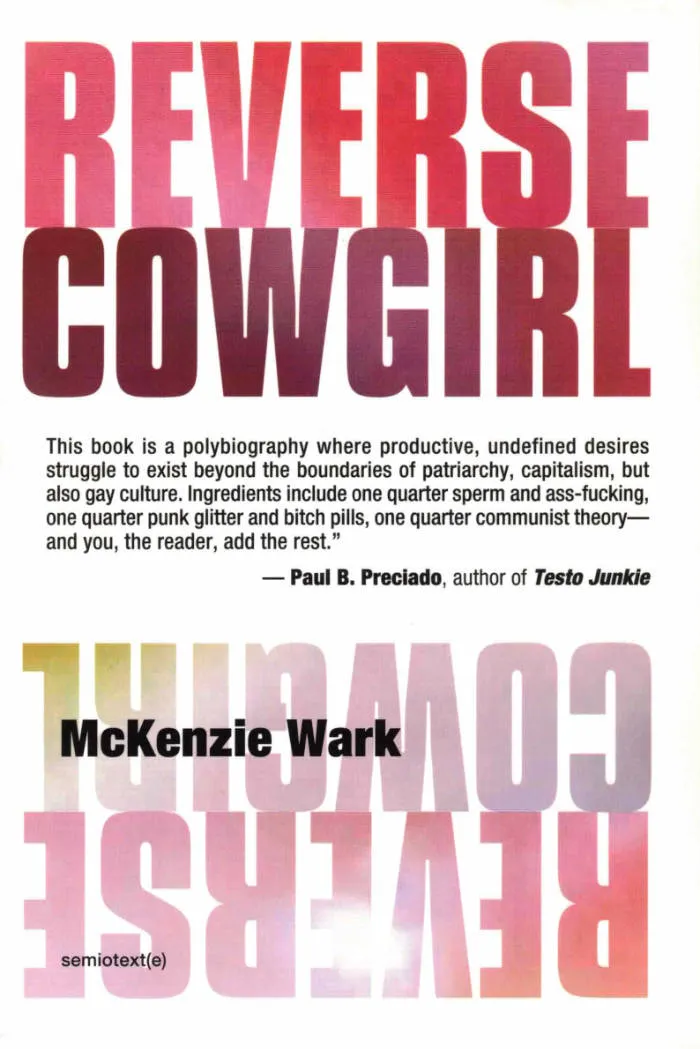
Cover of Reverse Cowgirl

Semiotext(e)

Reverse Cowgirl

McKenzie Wark

Fiction €16.00

McKenzie Wark invents a new genre for another gender: not a memoir but an auto-ethnography of the opacity of the self.

Another genre for another gender.

What if you were trans and didn't know it? What if there were some hole in your life and you didn't even know it was there? What if you went through life not knowing why you only felt at home in your body at peak moments of drugs and sex? What if you expended your days avoiding an absence, a hole in being? Reverse Cowgirl is not exactly a memoir. The author doesn't, in the end, have any answers as to who she really is or was, although maybe she figures out what she could become.

Traveling from Sydney in the 1980s to New York today, Reverse Cowgirl is a comedy of errors, chronicling the author's failed attempts at being gay and at being straight across the shifting political and media landscapes of the late twentieth century. Finding that the established narratives of being transgender don't seem to apply to her, Wark borrows from the genres of autofiction, fictocriticism, and new narrative to create a writing practice that can discover the form of a life outside existing accounts of trans experience: an auto-ethnography of the opacity of the self.

Cover of Love Me Tender

Semiotext(e)

Love Me Tender

Constance Debré

LGBTQI+ €18.00

A novel of lesbian identity and motherhood, and the societal pressures that place them in opposition. 

The daughter of an illustrious French family whose members include a former Prime Minister, a model, and a journalist, Constance Debré abandoned her marriage and legal career in 2015 to write full-time and begin a relationship with a woman. Her transformation from affluent career woman to broke single lesbian was chronicled in her 2018 novel Play boy, praised by Virginie Despentes for its writing that is at once "flippant and consumed by anxiety."  

In Love Me Tender, Debré goes on to further describe the consequences of that life-changing decision. Her husband, Laurent, seeks to permanently separate her from their eight-year old child. Vilified in divorce court by her ex, she loses custody of her son and is allowed to see him only once every two weeks for a supervised hour. Deprived of her child, Debré gives up her two-bedroom apartment and bounces between borrowed apartments, hotel rooms, and a studio the size of a cell. She involves herself in brief affairs with numerous women who vary in age, body type, language, and lifestyle. But the closer she gets to them, the more distant she feels. Apart from cigarettes and sex, her life is completely ascetic: a regime of intense reading and writing, interrupted only by sleep and athletic swimming. She shuns any place where she might observe children, avoiding playgrounds and parks "as if they were cluster bombs ready to explode, riddling her body with pieces of shrapnel."  

Writing graphically about sex, rupture, longing, and despair in the first person, Debré's work is often compared with the punk-era writings of Guillaume Dustan and Herve Guibert, whose work she has championed. As she says of Guibert: "I love him because he says I and he's a pornographer. That seems to be essential when you write. Otherwise you don't say anything." But in Love Me Tender, Debré speaks courageously of love in its many forms, reframing what it means to be a mother beyond conventional expectations.

Cover of Book of Mutter

Prototype Publishing

Book of Mutter

Kate Zambreno

Non-fiction €16.00

Book of Mutter is a tender and disquieting meditation on the ability of writing, photography, and memory to embrace shadows while in the throes — and dead calm — of grief. It is both primal and sculpted, shaped by the author’s searching, indexical impulse to inventory family apocrypha in the wake of a mother’s death. The text spirals out into a fractured anatomy of melancholy that includes critical reflections on the likes of Roland Barthes, Louise Bourgeois, Henry Darger, Theresa Hak Kyung Cha, Peter Handke, and others. Zambreno has modelled the book’s formless form on Bourgeois’s Cells sculptures – at once channelling the volatility of autobiography, pain, and childhood, yet hemmed by a solemn sense of entering ritualistic or sacred space.

Neither memoir, essay, nor poetry, Book of Mutter is an uncategorisable text that draws upon a repertoire of genres to write into and against silence. It is a haunted text, an accumulative archive of myth and memory that seeks its own undoing, driven by crossed desires to resurrect and exorcise the past.

Cover of Appendix Project

Prototype Publishing

Appendix Project

Kate Zambreno

Essays €16.00

Written in the course of the year following the publication of Book of Mutter, and inspired by the lectures of Roland Barthes, Anne Carson, and Jorge Luis Borges, Appendix Project collects eleven talks and essays. These surprising and moving performances, underscored by the sleeplessness of the first year of their child’s life, contain their dazzling thinking through the work of On Kawara, Roland Barthes, W.G. Sebald, Bhanu Kapil, Walter Benjamin, Theresa Hak Kyung Cha, Marguerite Duras, Marlene Dumas, Louise Bourgeois, Doris Salcedo, Jenny Holzer, and more.

Cover of The Hearing Trumpet

New York Review of Books

The Hearing Trumpet

Leonora Carrington

Fiction €17.00

An old woman enters into a fantastical world of dreams and nightmares in this surrealist classic admired by Björk and Luis Buñuel.

Leonora Carrington, painter, playwright, and novelist, was a surrealist trickster par excellence, and The Hearing Trumpet is the witty, celebratory key to her anarchic and allusive body of work. The novel begins in the bourgeois comfort of a residential corner of a Mexican city and ends with a man-made apocalypse that promises to usher in the earth's rebirth. In between we are swept off to a most curious old-age home run by a self-improvement cult and drawn several centuries back in time with a cross-dressing Abbess who is on a quest to restore the Holy Grail to its rightful owner, the Goddess Venus. Guiding us is one of the most unexpected heroines in twentieth-century literature, a nonagenarian vegetarian named Marian Leatherby, who, as Olga Tokarczuk writes in her afterword, is "hard of hearing" but "full of life."

Cover of Mammoth

And Other Stories

Mammoth

Eva Baltasar, Julia Sanches

Fiction €16.00

Mammoth’s protagonist is a disenchanted young lesbian. She’s inexperienced, irritated by life, eager to gestate, and determined to strip everything else down to essentials. She seduces men at random, swaps her urban habitat for an isolated farmhouse, befriends a shepherd, nurses lambs, battles stray cats, waits tables, cleans house, and dabbles in sex work – all in pursuit of life in the raw.  This small bomb of a novel, not remotely pastoral, builds to a howling crescendo of social despair, leaving us at the mercy of Eva Baltasar’s wild voice.

Cover of Amalgamemnon

Dalkey Archive Press

Amalgamemnon

Christine Brooke-Rose

Fiction €15.00

History and literature seem to be losing ground to the brave new world of electronic media and technology, and battle lines are being drawn between the humanities and technology, the first world and the third world, women and men. Narrator Mira Enketei erases those boundaries in her punning monologue, blurring the texts of Herodotus with the callers to a talk-radio program, and blending contemporary history with ancient: fairy-tale and literal/invented people (the kidnappers of capitalism, a girl-warrior from Somalia, a pop singer, a political writer), connected by an elaborate mock-genealogy stretching back to the Greek gods, move in and out of each other's stories. The narrator sometimes sees herself as Cassandra, condemned by Apollo to prophesy but never to be believed, enslaved by Agamemnon after the fall of Troy. Brooke-Rose amalgamates ancient literature with modern crises to produce a powerful novel about the future of culture.

Christine Frances Evelyn Brooke-Rose was a British writer and literary critic, known principally for her later, experimental novels. 

Cover of COOP. A Novelette

Hajar Press

COOP. A Novelette

Nida Sajid

Fiction €16.00

On work and words, and how they contort the world.

Lena is a part-time bookseller in a bougie design studio in Oxford Circus. In between minimum-wage work under a politically hostile boss and strained communications with her parents, her days are shaped by a fraught relationship with food, ambiguous experiments in creative writing, and mounting pressure to find a ‘proper’ postgraduate job.

In taut, pocket-sized vignettes, COOP reveals a suffocating lattice of language that makes up a precarious London life. But as each word of her story unravels, Lena discovers interstices between them—to find autonomy and escape.

Cover of Prieta Is Dreaming: A cuentos-novela

SUNY Press

Prieta Is Dreaming: A cuentos-novela

Gloria Anzaldua

Fiction €25.00

A generative, genre-bending collection of nineteen intertwined stories by legendary writer, theorist, and activist Gloria E. Anzaldúa.

Best known for Borderlands/La Frontera: The New Mestiza (1987), Gloria E. Anzaldúa was also a prolific fiction writer. Prieta Is Dreaming, a speculative novel-in-stories, follows the precocious Prieta from her childhood in South Texas to college and beyond as she tries to find her way in the world. Imbued with supernatural powers, Prieta traverses time, changes form, explores her desires, and defies convention. Started in the 1970s and revised up until Anzaldúa's death in 2004, Prieta Is Dreaming comes as a revelation, affirming Anzaldúa's place at the forefront of contemporary feminist, queer, and border theory, while transforming what we think about both her writing and ourselves. In these nineteen intertwined stories, we find some of Anzaldúa's most adventurous, inspired ideas about gender, sexuality, and the very nature of existence—as well as a character, la Prieta, as bold and memorable as the book itself.

Gloria E. Anzaldúa (1942–2004) was a poet, metaphysical philosopher, and scholar of Chicana cultural theory, feminist theory, and queer theory. Her books include Borderlands/La Frontera: The New Mestiza and Light in the Dark/Luz en lo oscuro: Rewriting Identity, Spirituality, Reality. She was coeditor, with Cherríe Moraga, of This Bridge Called My Back: Writings by Radical Women of Color, the 40th anniversary edition of which was also published by SUNY Press. Kelli D. Zaytoun is Professor of English Language and Literatures at Wright State University. She is the author of Shapeshifting Subjects: Gloria Anzaldúa's Naguala and Border Arte. AnaLouise Keating is Professor of Multicultural Women's and Gender Studies at Texas Woman's University. She is the author, editor, or coeditor of many books, including most recently The Anzaldúan Theory Handbook. Suzanne Bost is Professor and Chair of the Department of English at Loyola University, Chicago. She is the author of four monographs, the most recent being Quiet Methodologies: Humility in the Humanities.