rile*books

Search books

Search books by title, author, publisher, keywords...

Explore

Categories
Visit
Collections
Publishers
Back in stock
Any books
Cover of Mother Media: Hot and Cool Parenting in the Twentieth Century

The MIT Press

Mother Media: Hot and Cool Parenting in the Twentieth Century

Hannah Zeavin

€35.00

An essential history for understanding how we mother now, and how motherhood itself became a medium—winner of the Brooke Hindle Award from the Society for the History of Technology.

From the nursery to the prison, from the clinic to the commune, Mother Media tells the story of how we arrived at our contemporary understanding of what a mother is and how understandings of “bad” mothering formed our contemporary panics about “bad” media. In this book, leading historian of psychology Hannah Zeavin examines twentieth-century pediatric, psychological, educational, industrial, and economic norms around mediated mothering and technologized parenting. The book charts the crisis of the family across the twentieth century and the many ingenious attempts to remediate nursemaid and mother via speculative technologies and screen media. 

Growing out of her previous award-winning book The Distance Cure, which considered technologized care, the book lays bare the contradictions of techno-parenting and how it relates to conceptions of “maternal fitness,” medical redlining, and surveillance of children, parents, and other caregivers. The author offers narratives of parenting in its extremity (for example, Shaken Baby Syndrome) and its ostensible banality (for example, the Nanny Cam) and how the two are often intertwined. Ultimately, Zeavin grapples with a simple contradiction: technology is seen and judged as harmful in domestic and educational spaces, even as it is a saving grace in the unending labor of raising a family.

Hannah Zeavin is Associate Professor of the History of Science in the Department of History and the Berkeley Center for New Media at UC Berkeley. She is the author of The Distance Cure and Mother Media (MIT Press) and Founding Editor of Parapraxis. In 2021, she cofounded The Psychosocial Foundation.

Published in 2025 ┊ 320 pages ┊ Hardcover ┊ Language: English

recommendations

Cover of What Is Sex?

The MIT Press

What Is Sex?

Alenka Zupančič

Why sexuality is at the point of a "short circuit" between ontology and epistemology.

Consider sublimation, conventionally understood as a substitute satisfaction for missing sexual satisfaction. But what if, as Lacan claims, we can get exactly the same satisfaction that we get from sex from talking (or writing, painting, praying, or other activities)? The point is not to explain the satisfaction from talking by pointing to its sexual origin, but that the satisfaction from talking is itself sexual. The satisfaction from talking contains a key to sexual satisfaction (and not the other way around), even a key to sexuality itself and its inherent contradictions. The Lacanian perspective would make the answer to the simple-seeming question, "What is sex?" rather more complex. In this volume in the Short Circuits series, Alenka Zupančič approaches the question from just this perspective, considering sexuality a properly philosophical problem for psychoanalysis; and by psychoanalysis, she means that of Freud and Lacan, not that of the kind of clinician practitioners called by Lacan "orthopedists of the unconscious."

Zupančič argues that sexuality is at the point of a "short circuit" between ontology and epistemology. Sexuality and knowledge are structured around a fundamental negativity, which unites them at the point of the unconscious. The unconscious (as linked to sexuality) is the concept of an inherent link between being and knowledge in their very negativity.

Cover of Discomania

The MIT Press

Discomania

Jennifer Gibbons

Fiction €22.00

A young woman discovers that dancers at a local discotheque are being driven to acts of insane violence.

“The place was full of swarming, pugnacious, dangerous missellneous reptile's… Teenager's everywhere pounded their way on top of each other crazily strangling, biting and slashing each other's with broken glass, smashed records or sharpened blades… ”

16-year-old Jennifer Gibbons (1963–1993) wrote Discomania in 1980, alongside her twin sister June-Alison, who was also writing her own novel, The Pepsi Cola Addict, in the bedroom that they shared.

Jennifer offered Discomania to the same English vanity press who would publish June-Alison's book, but Discomania was turned down for being “too violent, too sexual, and too futuristic.”

Long thought to have been lost or destroyed, June-Alison had in fact preserved the typescript of this unique, furious, funny, and strange novel, which we present with her blessing, alongside additional texts from June-Alison, and editors David Tibet and Ania Goszczyńska.

Cover of Anarchitecture After Everything: A Trans Manifesto

The MIT Press

Anarchitecture After Everything: A Trans Manifesto

Jack Halberstam

LGBTQI+ €35.00

A revolutionary way of seeing bodies and built environment that unites radical politics and trans aesthetics. 

From a leading author and queer theorist known for reframing many of the most pressing questions about counter-intuitive ways of being. 

Anarchitecture, a radical aesthetic practice of unmaking the built environment, staged a vigorous confrontation with urban renewal and gentrification projects in the 1970s. In Anarchitecture After Everything, Jack Halberstam identifies a powerful lexicon of transformation within anarchitecture, joining the movement’s practices of cutting and splitting with the destabilizing power of transness to detonate acts of formal violence in our time. 

Anarchitecture describes the aesthetic practice of splitting and cutting, dismantling and undoing, unmaking, unbuilding, and ultimately unworlding. The trans body splits bodily coherence, dismantles the gender binary, and unbuilds bodily meaning. In these chapters, Gordon Matta-Clark’s cuts, along with Alvin Baltrop’s 1970s images of collapsing warehouses and Beverly Buchanan’s post-demolition fragmentary sculptures, return with a vengeance through the contemporary aesthetic gestures of Yve Laris Cohen, Jesse Darling, Nicole Eisenman, Kiyan Williams, Cassils, boychild, and Every Ocean Hughes. Anarchitecture unmakes space and offers a new rhetoric for emptiness. In its conclusion, the book explores this rhetoric through Renee Gladman’s anarchitectural experiments with language. 

By reading anarchitecture through transness and transness through anarchitecture, Halberstam helps us see the trans body as a space of radical unmaking and as a portal to new lexicons for transformation.

Cover of The Lesbian Body

Winter Editions

The Lesbian Body

Monique Wittig

Fiction €22.00

In this genre- and gender-breaking work of theory-fiction, legendary writer and cofounder of the 1970s French feminist movement Monique Wittig celebrates the body—lesbian, literary and defiantly political—and challenges the order of heterosexuality in literature. 

First published in French in 1973, The Lesbian Body mines the relationship between a lover and a beloved—also a writer and a text—to explore the ideological and historical constructions of the female subject. Organized according to the principle of montage, poetic passages are juxtaposed with anatomic lists that mark lesbian eros. Through expressions of joy, violence, and tenderness, the site of pleasure is celebrated. In her transfiguration of gender and its paradigms, Wittig transformed French vocabulary, feminizing grammar and lesbianizing myths. This edition brings the English translation of Wittig’s groundbreaking work back into circulation for the first time since the mid-1980s, revised according to the author's notes, and with an introduction by Paul B. Preciado.

The Lesbian Body is a fundamental work of lesbian existence. Wittig's applied vision is a state of natural delirium, a revolutionary excess of utopianism, refusal, and mutual self-creation. Revisiting it reveals how much passionate free thought has been lost, and simultaneously, how many of her tropes and discoveries have integrated into our collective consciousness.” — Sarah Schulman

“In this stunning new rendering of The Lesbian Body by the French author, theorist, activist and teacher, the late Monique Wittig, we are plunged into an imagined world of passionate violence and erotic lesbian mayhem intertwined in strikingly bold poetic images. Wittig, in the reach and volatility of her imagination, stands alongside such important American writers as Audre Lorde, Adrienne Rich, and Valerie Solanas, all of whose work deserves to be read again, or for the first time.” — Esther Newton

“To read the book is to be forced by Wittig into another grammar and happily contaminated by its strange forms. You will never think straight again.” — Jack Halberstam

“For me, Wittig opened up a sense of the world that had been, quite literally, unimaginable. She tore us apart.” — Judith Butler

“Together with Ursula Le Guin and Samuel R. Delany, Wittig is the first to design a nonbinary utopia, a world in which the binary categorization of sexes and genders will have ceased to exist.” — Paul B. Preciado

Introduction by Paul B. Preciado
Translated by David Le Vay

Cover of L'Écriture de Monique Wittig À La Couleur De Sappho

Éditions de Ixe

L'Écriture de Monique Wittig À La Couleur De Sappho

Catherine Écarnot

Invitation au voyage à travers l’œuvre littéraire de Monique Wittig, ce livre nous embarque dans une passionnante exploration de ses textes de fiction, de L’opponax à Virgile, non. Il rend compte de la lutte amoureuse qu’elle livre au langage – matériau brut qu’elle travaille au corps pour faire advenir dans la réalité ce qui n’y a pas (encore) droit de cité. La convocation malicieuse et grave des grands récits du passé, les nombreux emprunts aux auteurs anciens, la pratique de la citation font des Guérillères une formidable épopée féministe, du Corps lesbien un Évangile selon Sappho, du Voyage sans fin le combat drôle et tragique d’une Quichotte féministe et lesbienne.

En soulignant la cohérence des textes et leur fragmentation, Catherine Écarnot met en évidence la passion poétique qui habite ces livres que Wittig concevait comme des « chevaux de Troie » : des machines de guerre destinées à fissurer la réalité pour y inscrire une subjectivité mouvante, échappée du continent noir de la féminité, rétive aux assignations de genre. Uniques et radicalement disruptives, les fictions ainsi créées ouvrent grands les chemins qui relient littérature et lesbianisme.

Publié pour la première fois en 2002, cet ouvrage, le premier consacré en Europe à l’œuvre witigienne, reparaît dans une nouvelle édition remaniée, actualisée et enrichie de nombreuses références aux études publiées depuis sa parution.

Cover of  The Book of Sleep

Seagull Books

The Book of Sleep

Haytham El-Wardany, Robin Moger

Philosophy €17.00

What is sleep? How can this most unproductive of human states—metaphorically called death's shadow or considered the very pinnacle of indolence—be envisioned as action and agency? And what do we become in sleep? What happens to the waking selves we understand ourselves to be?

Written in the spring of 2013, as the Egyptian government of President Mohammed Morsi was unraveling in the face of widespread protests, The Book of Sleep is a landmark in contemporary Arabic literature. Drawing on the devices and forms of poetry, philosophical reflection, political analysis, and storytelling, this genre-defying work presents us with an assemblage of fragments that combine and recombine, circling around their central theme but refusing to fall into its gravity.  

"My concern was not to create a literary product in the conventional sense, but to try and use literature as a methodology for thinking," El Wardany explains. In this volume, sleep shapes sentences and distorts conventions. Its protean instability throws out memoir and memory, dreams and hallucinatory reverie, Sufi fables and capitalist parables, in the quest to shape a question. The Book of Sleep is a generous and generative attempt to reimagine possibility and hope in a world of stifling dualities and constrictions.

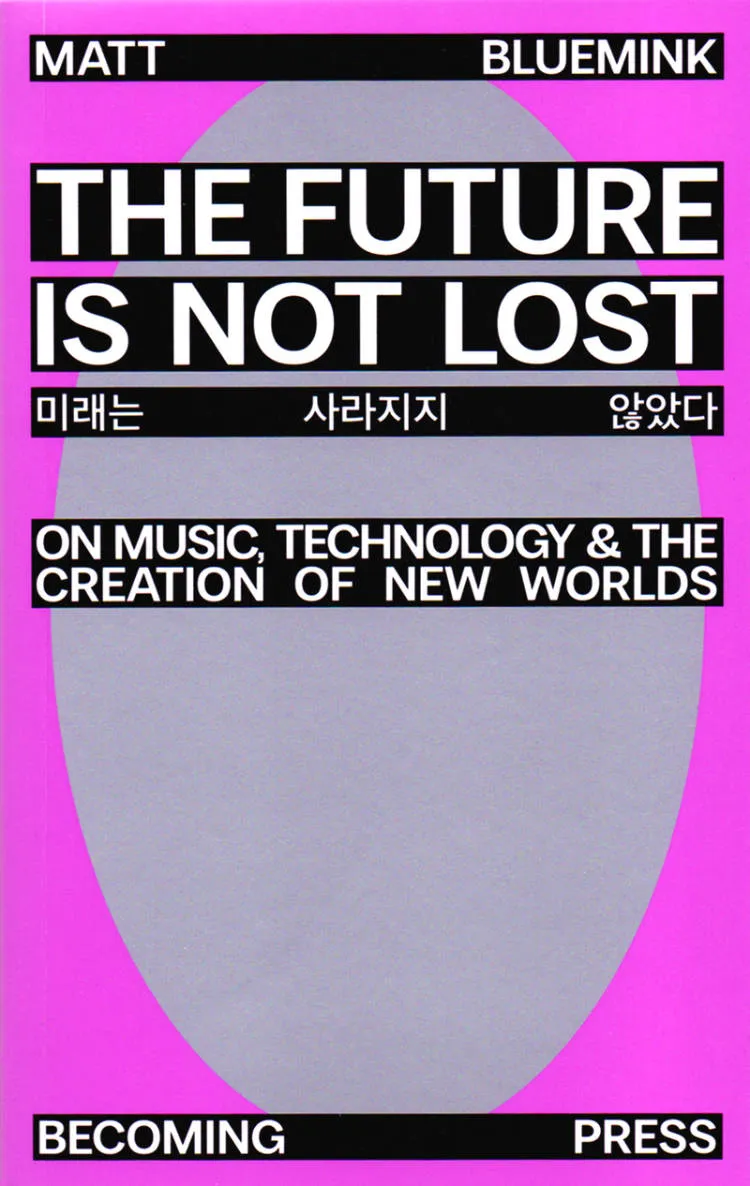
Cover of The Future is not Lost: On Music, Technology, and the Creation of New Worlds

becoming press

The Future is not Lost: On Music, Technology, and the Creation of New Worlds

Matt Bluemink, Alessandro Sbordoni

Mark Fisher taught a generation to hear the future's disappearance in contemporary music, as if the rhythm of the world was synchronised to the periodic flowering of new creative forms. His diagnosis was devastating: stagnation in music was akin to a venous insufficiency, or worse, some kind of nuclear winter that would ward off the spring for endless generations to come. 

Drawing on musicians like SOPHIE, Arca and Iglooghost, Matt Bluemink declares that the future is not lost; it still speaks to us through music. If Fisher’s Hauntology — dwelling on ghosts of the past — is the logic of depression, then Bluemink’s Anti-Hauntology posits a logic of hope where voices from the future continue to guide the development of the present. 

Island-hopping through Stiegler's philosophy of technics, Simondon's theory of individuation, and the spatial imaginaries of cyberpunk and solarpunk, Bluemink builds a theoretical framework equal to the times — one that takes seriously our capacity to, not only diagnose the world, but remake it. In order to create a new future we must re-imagine our relationship with music, with technology, and with culture. The world of tomorrow is a blank canvas; an open book. New beginnings are always possible. 

Matt Bluemink is the founder and editor-in-chief of Blue Labyrinths online magazine. His research is focused on the relationship between the philosophy of technology, media theory and urbanism. He also writes on contemporary music, literature, and digital culture. 

Cover of The Literary Workshop

Verso Books

The Literary Workshop

Monique Wittig, Ann Jefferson

Non-fiction €20.00

A bold, revelatory argument for the power of language by leading radical lesbian feminist and author of The Straight Mind. 

The Literary Workshop takes readers inside Monique Wittig’s creative process, unlocking the practice of writing both in material and political terms. Wittig provides her most com­plete account of how literature and politics work together. Part of the generation that revolutionized French literature, Wittig reveals the secret of her craft: that the work a writer does with language is itself a form of resistance. 

Born and raised in France, Monique Wittig (1935–2003) was a driving force in second-wave feminism and one of the most brilliant authors of her generation. A provocative thinker, she famously declared that lesbians are not women and in­troduced women into a materialist framework by treating them as a class. Wittig is the author of, among other titles, The Straight Mind, Les Guérillères, and The Lesbian Body. Her debut novel, The Opoponax, won Le Prix Medicis.