Books
Books
in random order
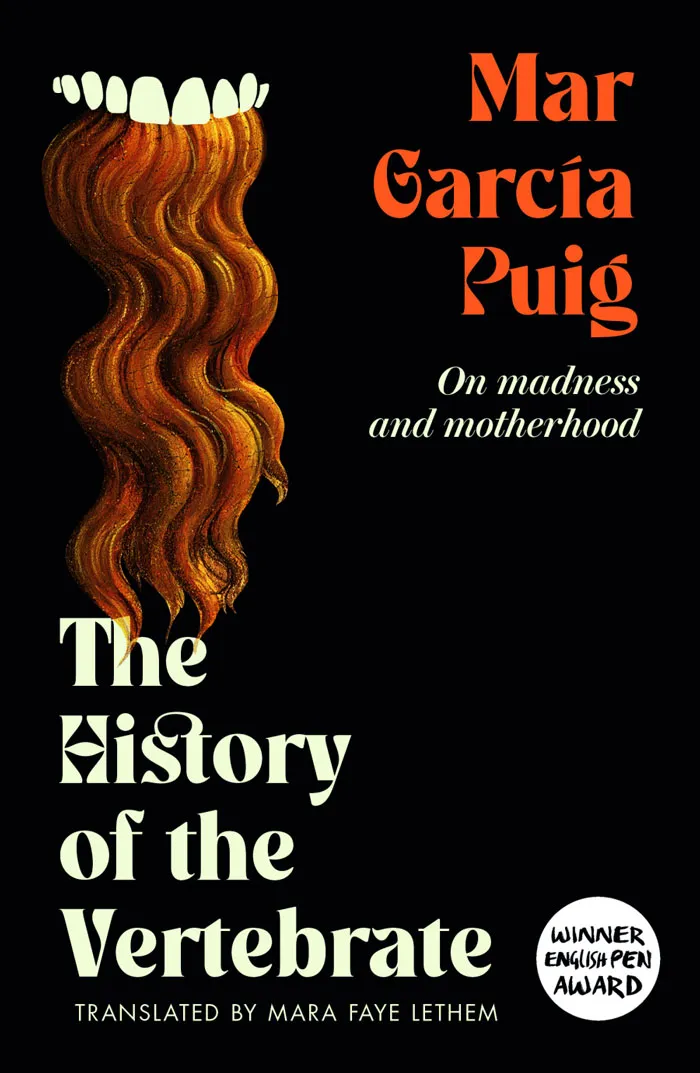
The History of the Vertebrate
Mar García Puig, Mara Faye Lethem
‘On 20 December 2015 I became a mother and I went mad.’
On a single day, Mar García Puig gives birth to twins and becomes elected to the Spanish Parliament as a member of the insurgent left-wing party Podemos. What might have been the best day of her life becomes the start of a terrifying ordeal; García Puig’s grip on reality begins to slip as she grapples with uncertainty, the weight of expectation, and misogyny in both of her new roles.
In defiance of a culture that tells her the problem lies within, García Puig chooses to look outwards, examining the imbrication of madness and motherhood across centuries of science, myth, and politics while dissecting the ways in which women have been pathologized and banished from public life.
At once intimate and epic, The History of the Vertebrate is a searing account of postpartum madness. Moving between memory, culture, and the history of medicine, García Puig transforms her experience into a story about the countless women who have felt that sanity was leaving them, and about the patriarchal forces that have silenced them.
MAR GARCÍA PUIG is an editor and author. From 2015 to 2023 she was a member of the Spanish Congress of Deputies for Podemos, where she served on the Culture Committee and the Equality Committee. Her books include The History of the Vertebrate and This Thing of Darkness.

I Am the Century
This publication aims to provide a critical and profound reading of Alice Neel's humanism, constructing a journey through her artistic and personal life. The book includes texts by academics and artists, enriched by an extensive number of illustrations, archival photographs and documents.
Alice Neel: I Am the Century accompanies the first major retrospective in Italy dedicated to the US artist Alice Neel (1900–1984), presented by Pinacoteca Agnelli, Turin. Conceived as both a critical and a narrative journey, this publication offers an in-depth exploration of Neel's artistic and personal life, expanding on the exhibition through a rich selection of essays and visual material. It brings together sixty works reproduced in dialogue with archival documents, highlighting Neel's role as a pioneer and one of the most important painters of the twentieth century. Contributions by curators, scholars, and artists—including Kelly Richman-Abdou, Jennifer Higgie, Mira Schor, and Annie Sprinkle—provide multiple perspectives on Neel's practice, situating her radical approach to portraiture within broader artistic, social, and political contexts.
Merging realism with surrealism and empathy with unflinching clarity, Neel captured the psychological and emotional depth of her sitters. The publication emphasizes her capacity to chronicle life's stages and relationships—childhood and adulthood, sexuality and intimacy, community and political consciousness—through works that continue to resonate with contemporary audiences. Positioning Neel as both artist and witness, I Am the Century underscores her enduring humanism and her singular vision of the "human comedy," offering readers a comprehensive entry point into a body of work that is still influencing new generations of artists.
Born in 1900 in Merion Square, Pennsylvania, Alice Neel lived in Philadelphia and Havana before settling in New York (where she lived until her death in 1984), becoming part of the social milieu of the Harlem neighbourhood. She painted figuratively throughout her life, often using the people "around her" as subjects, models and muses. For Neel, this meant portraying both the residents of Harlem as well as strangers, friends and intellectuals who often shared her proximity to the Communist Party. A figurative painter in an era dominated by Abstract Expressionism, Neel developed remarkable and radical new ways of representing the human body in painting, such as with her celebrated nudes of pregnant women.. The introspective aspect of Neel's work, her ability to capture the essence of her subjects and their souls, has made her today one of the most appreciated and respected artists of the twentieth century.
Neel's work has been the subject of retrospectives at the Metropolitan Museum of Art in New York, the Guggenheim Museum Bilbao and the Centre Pompidou in Paris. It forms part of the permanent collections of institutions such as the Art Institute of Chicago; the Hirshhorn Museum and Sculpture Garden in Washington, D.C.; the Metropolitan Museum of Art; Moderna Museet in Stockholm; the Museum of Contemporary Art in Los Angeles; the Museum of Fine Arts in Houston; the Museum of Modern Art in New York; the National Gallery of Art in Washington, D.C.; the Philadelphia Museum of Art; Tate Modern in London; the Walker Art Center in Minneapolis, Minnesota; and the Whitney Museum of American Art in New York.
Edited by Sarah Cosulich and Pietro Rigolo.
Texts by Sarah Cosulich, Jennifer Higgie, Kelly Richman-Abdou, Pietro Rigolo, Mira Schor, Annie Sprinkle.

OEI #86/87 Publishing Practices, Publishing Poetics
Tobi Maier, Cecilia Grönberg and 1 more
Once more, an astonishing issue of OEI – a thrilling, compelling, stimulating feast of ideas regarding publishing and the book: the perfect big companion to read and hug in bed while the virus spreads outside.
Bringing together contributions from circa 130 publishing structures, publishing communities, magazines, small press endeavors, artists, poets, writers, editors, theoreticians, curators, scholars, and art bookstores, OEI # 86–87 reflects upon the challenges, pressures and possibilities of publishing and creating publics in different contexts and places in a time of far-reaching – economical, medial, political, social, technological – transformations.
The potential and the versatility of publishing open it to a diversity of practices and approaches in the arts, but as an eminently social form of art, a collective or micro-collective work with shared responsibilities, it is also a never-ending process of “crafting a variegated approach to how you create, publish, distribute, and build a social ecosystem around your efforts”, of trying to “build up and strengthen the community around these printed forms” (Temporary Services).
It is the conviction of OEI #86–87 that print has the power to play an important part in the construction of social spaces, of a social world. As Benjamin Thorel puts it in one of the essays in the issue, “conceiving of the dynamics of publishing as making publics as well as making things public is not a pun – insofar as the artists/publishers encompass, beyond the book itself, its possible ‘lives’, imagining the different spaces, and the different people, amongst whom a publication will circulate.” This is what Michael Warner has called “a public [as] poetic worldmaking”, implying “that all discourse or performance addressed to a public must characterize the world in which it attempts to circulate, projecting for that world a concrete and livable shape, and attempting to realize that world through address.”
This is also, as stressed by Annette Gilbert and others, what can make publishing such an active force, a force co-constituting texts and publications and publics. Indeed, with Michalis Pichler, it is tempting to say that in publishing as practice – perhaps more than in any other art field – “artists have been able to assert the aesthetic value of their own socio-politically informed concerns and to engage, often under precarious conditions, in cultural activities fully aligned with their political values.”
OEI #86–87 also includes sections on and with contemporary poetry from Canada; Fluxus publishing; Krister Brandt/Astrid Gogglesworth; Kalas på BORD (Öyvind Fahlström); Lars Fredrikson; Claude Royet-Journoud’s poetry magazines; Carl Einstein; Gail Scott; Ållebergshändelser; OEI #79: edit/publish/distribute!; “det offentligas försvinnande” and many many other things. [publisher’s note]
Design by Konst & Teknik

Iliazda at the Birthday Party – Autobiographical Lecture, 1922
The English translation of Zdanevich's Dadaist autobiographical lecture in Paris in 1922, where he adopts the name Iliazda. In this entertaining lecture, the achievements of the avant-garde is presented as a combination of zaum, polymorphous sexuality, aleatory forms and scatological interpretation of culture.
The second volume of the bie bao series presents a eulogy entitled Iliazda at the Birthday Party, a pseudo-autobiographical lecture delivered by Ilya Zdanevich in Paris in 1922. It reports on Zdanevich's artistic and political adventures up until then. Along with an autobiography full of self-admiration, in this lecture Zdanevich gives an interpretation of his zaum dramas inspired by Freudianism, and humorously describes a colourful image of the Russian microcosm in Montparnasse.
Additionally, this second volume also includes Iliazd's letter to Ardengo Soffici from 1964, where one can read, in the most unambiguous terms, about Zdanevich's positions against war, imperialism, and all forms of nationalism. Subtitled 50 Years of Russian Futurism, the letter to Soffici presents us with an altogether new Zdanevich—a "fellow traveller" in both leftist and avant-garde circles. As well as the extended introduction and extensive annotations, the texts are further contextualised with Johanna Drucker's visual presentation of the birth of the Iliazd cult.
The bie bao series will include eight publications, covering many layers of Zdanevich's rich theoretical and artistic output. Each volume consists of a bio-bibliographical introduction, a commentary, a translation with annotations, and artistic intervention.
Iliazd (Ilya Zdanevich, 1894-1975) was a Russian poet, designer, typographer, theoretician, art critic, and publisher, close to the avant-garde circles and one of the promoters of Futurism in Russia, author of a poetic work, drama written in zaum abstract poetic trans-sense or "transrational" language, and novels.

Chile Chico et le quartier Versailles
Chile Chico et le quartier Versailles, c'est une exploration qui inventorie, interroge et révèle les mémoires invisibles en listes et en collections. Une mémoire qui ne soffre pas en bloc, qui résiste, se fragmente, se transforme. A travers cette archive collaborative, nous avons voulu capter ces va-et-vient ď'un passé qui dialogue avec le présent, des images qui oscillent entre Vintime et le collectif.
Le point de départ de cette fabrique visuelle, c'est lexil des Chilien.nes, débarqué.es dans les années 70, qui se tissent une nouvelle vie sur le sol de Neder-Over-Heembeek, dans le quartier Versailles à Bruxelles. Ces trajectoires, arrachées à un ailleurs, s'ancrent dans des espaces rêvés comme de transit pour devenir des lieux d 'appartenance, où lexil se mue et les racines finissent par se déployer. A ces récits se greffent d'autres histoires, d'autres trajectoires. Un quartier comme un carrefour, ou les individualités se rencontrent, où les vies se croisent et s'allient.

The Illusion of a Crowd
Publication including the films Transformation Scenario, 70.001, and Faux Terrain, as well as a visual essay, a glossary and texts by Heike Geißler, Fanni Fetzer, and Franciska Zólyom.
“When I visited the Elias Canetti archive at the Zentralbibliothek Zurich, I was looking for manuscripts and sketches for his major work Crowds and Power (1960). I imagined that Canetti must have made drawings, as the behaviour of the various crowd types he identified was described in such detail. I hoped that these drawings would help me transfer the group behaviour he describes to virtual figures in an animated film.
The archive of manuscripts, arranged by Elias Canetti himself, was handed over to the Zurich library and contains the notes and sketches he completed during the development of Crowds and Power, a period of almost forty years. However, in this context I found no drawings—Canetti had only made graphic lists on various themes. So where did Canetti's precise descriptions of the scenes come from?”
Clemens von Wedemeyer (born 1974 in Göttingen, lives and works in Berlin) creates films, videos and media installations poised between reality and fiction, reflecting power structures in social relations, history and architecture.
Edited by Fanni Fetzer and Franciska Zólyom.
Texts by Heike Geißler, Fanni Fetzer, Franciska Zólyom.

Publi Fluor, Letter Business in Brussels
A self-taught typographic letterer, Chrystel Crickx used to cut out letters by hand and sell them by the piece in her Publi Fluor shop in Schaerbeek, Belgium. Commercialized between 1975 and 2000 for local advertising and signage purposes, these letters have since been digitized and made more widely available to users outside of the Belgian borders and in other contexts. At the margins of standard means of communication, they have contributed to shape (and still do) the urban visual landscape, in Brussels and elsewhere.
This non-standard, collective essay attempts both to recount the life of a type model — as well as of its successive authors and their tools — while expanding the field of investigation to examine the cracks between the different stories summoned up by Chrystel Crickx's practice summons up.

Répondeur
Slow Reading Club (SRC) is a semi-fictional reading group initiated and run by Bryana Fritz and Henry Andersen. Since 2016, in numerous contexts, they have rehearsed alternatives to the kinds of reading they were taught in school, actively suppressing semantic content through strobe lights, strange postures, sociality, and toxins. Operating at the contact zones between reader and text, text and text, reader and reader, they attempt to build a practice from within the unstable space of reading itself.
Répondeur is an extensive account of SRC’s practice in collective reading sessions, exhibitions, and textual bootlegging. Imagined as a scroll, with a rhyme structure and typesetting by Will Holder, the book brings together facsimiles of SRC readers, a wide-ranging interview by Alicja Melzacka, new texts by Joyelle McSweeney and Bill Dietz, and visual work and translations by SRC. These discrete elements are interwoven into a complex, shimmering whole, delighting in the ruptures and elisions of one text’s move into the next.

Civilization #7
Richard Turley, Lucas Mascatello
The occasionally-published broadsheet Civilization was founded in New York in 2018 by Richard Turley, Lucas Mascatello, and Mia Kerin. Its origin was as a response to New York City life, but has now transformed into an art project that gathers language, overheard conversations, secret recordings transcribed by rapid-capture software to produce a dense, rhythmic assemblage of texts from both public and private spaces alike. As a result, Civilization’s design texture has found fans in the fashion world, leading to collaborations with Calvin Klein and Junya Watanabe.
The publication has also enjoyed contributions from a wide array of artists, writers and personalities including: Aaron Maine, Alis Atwell, Amos Poe, Amalia Ulman, Aria Dean, Alicia Novella Vasquez, Bill Drummond, Biz Sherbert, Babak Radboy, Carly Busta, Darcie Wilder, Echo Wu, Ella Plevin, Eric Johnson, Honor Levy, Iris Luz, Mel Ottenberg, Isabelle Rea, Joey LaBeija, Jordan Barse, Lovefoxx, Maddie Quinn, Patrick McMullan, Rachel Rabbit White, Sybil Prentice, Thom Bettridge, and Zans Brady Krohn.

Pasts, Futures, and Aftermaths: Revisiting the Black Dada Reader
The sequel to Pendleton's acclaimed Black Dada Reader, compiling an anti-canon of radical experimentation and thought.
In 2011, artist Adam Pendleton (born 1984) assembled Black Dada Reader, a compendium of texts, documents and positions that elucidated a practice and ethos of Black Dada. Resembling a school course reader, the book was a spiral-bound series of photocopies and collages, originally intended only for personal reference, and eventually distributed informally to friends and colleagues. The contents - an unlikely mix of Hugo Ball, W.E.B. Du Bois, Adrian Piper, Gertrude Stein, Sun Ra, Stokely Carmichael, Gilles Deleuze -formed a kind of experimental canon, realized through what Pendleton calls radical juxtaposition. In 2017, Koenig Books published the Reader in a hardcover edition, with newly commissioned essays and additional writings by the artist. A decade later, Pendleton has composed another reader, building upon the constellation of writers, artists, filmmakers, philosophers and critics that emerged in the first volume.
Source texts by Sara Ahmed, Mikhail Bakhtin, Toni Cade Bambara, Amiri Baraka, Augusto de Campos, Hardoldo de Campos, and Décio Pignatari, Angela Davis, Gilles Deleuze, Julius Eastman, Adrienne Edwards, Clarice Lispector, Achille Mbembe, Philippe-Alain Michaud, Charles Mingus, Piet Mondrian, Leslie Scalapino, Leonard Schwartz and Michael Hardt, Juliana Spahr, Cecil Taylor and Malcolm X.

BFTK — Issue 4: On Translation, Transmission & Transposition
Andrew Walsh‐Lister, Matthew Stuart and 2 more
Bricks from the Kiln is an irregular journal edited by Andrew Lister and Matthew Stuart, sometimes with guest editors, that presents graphic design and typography as disciplines activated by and through other disciplines and lenses such as language, archives, collage, and more. It borrows its title from the glossary notes of Ret Marut’s "Der Ziegelbrenner," which was the ‘size, shape and colour of a brick’, and ran for 13 issues between 1917 and 1921.
The latest installment, "#4: On Translation, Transmission & Transposition," was published as an event (and now) a publication, with events at London College of Communication, Burley Fisher Books & Pig Rock bothy, Socttish National Gallery of Modern Art, and Inga (in November, 2019).
GREENING
Helen Marten
(front / back flaps)
JOY & HAPPINESS, FIDELITY
& INTIMACY IN TRANSLATION
Sophie Collins
(pp.4–13)
PLANETARY TRANSLATION
Don Mee Choi
(pp.15–19)
TRANSLATION AND A LIPOGRAM:
OR, ON FORMS OF AGAIN-WRITING
AND NO- (OR NOT THAT-) WRITING
Kate Briggs
(pp.23–33)
UNHOMING (1 of 4):
FOLLOWING HÖLDERLIN’S ‘HEIMAT’
Phil Baber
(pp.35–47)
SNOW WHITE AND THE WHITE
OF THE HUMAN EYEBALLS
Joyce Dixon
(pp.51–62)
ALTAMIRALTAMIRALTAMIRA
Florian Roithmayr
(pp.65–116)
LEVEL UP, LEVEL DOWN
Jen Calleja
(pp.119–124)
TRANS.MISSION [A.DIALOGUE]:
A JAVASCRIPT FOR THREE VOICES
J.R. Carpenter
(pp.127–134)
THE MECHANISATION OF ART
Edgar Wind
(glosses / annotations / insertions by
Natalie Ferris & Bryony Quinn)
(pp.137–144)
UNHOMING (2 of 4)
Phil Baber
(p.147)
COMMISSION FOR A NOIR MOVIE
B IN THE BAY OF BISCAY
Rebecca Collins
(pp.151–157)
UNHOMING (3 of 4)
Phil Baber
(pp.150–162)
EVERY CONTACT LEAVES A TRACE;
TRANSCRIBING OSTEON
Naomi Pearce
(pp.165–170)
HOW DOES A WORK END?
Karen Di Franco
(pp.173–193)
METONYMY Op.1 & Op.2
James Bulley
(pp.197–201)
AFRIKAN ALPHABETS EXTENDED
Saki Mafundikwa
(pp.204–207)
SUSAN HILLER: 1983
Natalie Ferris
(pp.209–217)
EVERY TELLING HAS A TALING /
EVERY STORY HAS AN ENDING
Matthew Stuart
(pp.220–233)
GRAPHIC PROPRIOCEPTION
James Langdon
(pp.235–254)
UNHOMING (4 of 4)
Phil Baber
(pp.257–263)
TUNNELLING AND AGGREGATING
FOR DESIGN RESEARCH
Bryony Quinn (text) &
Peter Nencini (images)
(pp.265–272)
LET IT PERCOLATE:
A MANIFESTO FOR READING
Sophie Seita
(pp.275–280)
288 pgs, 22.4 × 17 cm, Softcover, 2020

Impossible Dreams
Pati Hill's cult novel, available for the first time since 1976.
Impossible Dreams was Pati Hill's last published novel, released in 1976 after it was partially published two years earlier in the Carolina Quarterly under the title "An Angry French Housewife." Hill tells the story of Geneviève, a middle-aged woman whose life is turned upside down when she unexpectedly falls in love with her neighbor, Dolly. Mixing anecdotes with existential thoughts, the novel describes the gradual disruption of the heroine's daily life. Almost every chapter (the length of which varies from a single sentence to no more than three pages) is accompanied by a xerograph of a photograph, selected by Hill with permission from its maker. The resulting combination of text and image constitutes her most ambitious attempt to produce a work in which "the two elements fuse to become something other than either."
This novel is also one of the most incisive examples of Hill's writing—dry and impartial, yet managing to capture the contradictory feelings of her characters. In a letter addressed to the photographer Eva Rubinstein asking for reproduction rights, she writes: "My book is about a woman with a little girl and a husband who falls in love with a woman and a little girl and a husband and loses them all, just like in your mirror. It doesn't sound very cheerful but it is mainly funny."
Daisy, an independent publishing house, releases a facsimile of the out-of-print work that, after almost 50 years since its initial publication, has become a coveted collector's item.
"Impossible Dreams charmed me with its droll and irreverent tone when it was first published. Hill's use of embedded photographs was unexpected and transgressive for its me. Brilliant!"
Anne Turyn, photographer, educator and founding editor, Top Stories
Pati Hill (1921, Ashland, Kentucky – 2014, Sens, France) left behind a litterary and artistic output spanning roughly 60 years . After a short but dazzling career as a model, between 1951 and 1962 she wrote a dozen short stories—several of which were published in George Plimpton's prestigious literary journal, The Paris Review—and five books which earned her real critical recognition. Hill published One Thing I Know in 1962 after giving birth to her first and only daughter. She was then forty-one years old, and would later claim to have decided at that time to "stop writing in favour of housekeeping.''
Edited by Ana Baliza and Baptiste Pinteaux.

Variations
Variations is the debut short story collection from one of Britain’s most compelling voices, Juliet Jacques. Using fiction inspired by found material and real-life events, Variations explores the history of transgender Britain with lyrical, acerbic wit.
Variations travels from Oscar Wilde’s London to austerity-era Belfast via inter-war Cardiff, a drag bar in Liverpool just after the decriminalisation of homosexuality, Manchester’s protests against Clause 28, and Brighton in the 2000s. Through diary entries of an illicit love affair, an oral history of a contemporary political collective; a 1920s academic paper to a 1990s film script; a 1950s memoir to a series of 2014 blog posts, Jacques rewrites and reinvigorates a history so often relegated to stale police records and sensationalist news headlines.
Innovative and fresh, Variations is a bold and beautiful book of stories unheard; until now.

The Mirror of Simple Souls
In her first book of poems, Leah Flax Barber revives an actress figure of the commedia dell'arte to consider her own destiny as a soon-to-be historical subject. Taking its title from Marguerite Porete's fourteenth-century Beguine classic, The Mirror of Simple Souls embodies the metaphysical thorniness of the book-as-object through sources as wide-ranging as Renaissance theater, Low German and Old French mystical texts, Kate Bush lyrics, and the melancholy dialectics of Walter Benjamin. In Flax Barber's stark, brutally compressed poems, the performance of writing is charged with the eros and anxiety of coming after: "Will it all be destroyed? / Definitely / I will hear it on my radio / In the 22nd century."
The Mirror of Simple Souls, a series of repeated beginnings and endings, is a form of speech act which, through a Freudian Durcharbeiten, or working through, brings about a new beginning. And, in its movement from this Freudian "working through" to a Hegelian Aufhebung, lets us begin, again, at the beginning, at the end. —CYNTHIA CRUZ
The spare poems of The Mirror of Simple Souls evoke and then draw back into shimmer. Herein, a performance that suffuses the horizon with beautiful absurdity: a shirt sewn with mirrors that reflect a strange and evanescing world-at-large, “an I where the nay was.” Drawing from film, mystical texts, commedia dell'arte, the reader finds that there “is paraphernalia of life / all over.” This paraphernalia is a kind of “segue music” for the endlessly indeterminate. The old adage claims that we can’t step into the same river twice, but Leah Flax Barber creates an evocative, provocative current through which each step is at once past, present, and future. —ELIZABETH ROBINSON
Leah Flax Barber is a daring and brilliant new poet. Her voice is restless and coiled and sprung as we discover "The demonic finalist / Of material culture / Is love / There is paraphernalia of life / All over / A woman.” There is also a take-no-prisoners attitude throughout this startling and powerful book. These poems are vital and necessary and perform “The wounded chance / To think in public.” This book will move you, scare you, and blow you away. —PETER GIZZI
Leah Flax Barber's first book reads like a journey, a kind of anabasis, passing back through the myth and history which are its own antecedents. It manifests, in the encounter, a saturnalian world: ludic, dark and sensuous, strange and vibrant with thought. I was delighted to travel with it. —CLAIRE DeVOOGD

Hardscapes / Here
Hardscapes / Here documents and brings together two exhibition projects by artists Nina Canell and Maria Hassabi. Produced on the occasion of the exhibitions of the same name curated by Samuele Piazza at the OGR Torino, the publication consists of two graphically specular books that merge into a single volume. Essays, unpublished materials and a rich set of photographic materials form the driving force behind two visual narratives that offer new keys to understanding the research of the two artists.
Hassabi's live installation Here calls on visitors to share space and spend time with six performers portrayed in a decelerated rhythmic choreography within a sculptural environment. In constant motion, the dancers contribute to a situation of shifting presence, demonstrating the contestable nature of the "here and now." Immobility and slowing down are thus used both as techniques and as subjects of representation: the performing bodies oscillate between dance and sculpture, subject and object, living body and static image.
Canell's Hardscapes combines two works that focus on the concepts of circulation and transformation as well as on unexpected forms of coexistence. Energy Budget (2017–18), a video that alternates between two subjects: a basement in which a leopard snail crawls over an electrical panel, and the gradual shifting of the frame away from "dragon gates"—portal-like openings in huge buildings on the Hong Kong waterfront. Muscle Memory (16 Tonnes) (2020–21) is a floor sculpture, decomposed and transformed by the density of moving bodies, which literally crumbles under the soles of passing visitors.
In addition to texts by the curator, the publication includes essays by Felicia Leu and Laura Preston, along with a conversation by Maria Hassabi and Nina Canell with Lorenzo Giusti.
Published on the occasion of the epoymous exhibitions at OGR Torino in 2022.
Edited by Samuele Piazza.
Texts by Lorenzo Giusti, Felicia F. Leu, Samuele Piazza, Laura Preston.

Foundlings
Foundlings, a video film, was shot near Wexford, in the south east of Ireland where she grew up. This visual poem without a particular narrative and full of autobiographical elements is set at a very slowed down pace. Floating images and heavy voices are central to the associative strategy that is at work here. The images allow one to listen to a hypnotic voice, while at the same time allowing the eyes to wander... to daydream... to travel over drawn out time. The images are country images, images of repetitive calm, the kind of calm one finds between awake and asleep. The speed of the sea sets the pace, regular yet irregular. The images are inhabited by people who cannot speak. Who are busy doing nothing, except passing time. Silent brothers and sisters of the sea.
The soundsculpture Unsaid, a joint work by Orla Barry and Portuguese artist Rui Chafes (1964), is very opposite to the film. The film is full of open spaces and bright colours. The sculpture is black, closed and claustrophobic and on top of that it is housed in a narrow tower five meters tall. The visitor has to take place on a rather unconventional chair and put his head in a closed off sphere, surrounding himself by darkness and leaving him with his own heartbeat. A voice addresses the visitor directly on highly intimate terms. The seating is hard and uncomfortable. One has to be strong to experience this piece that is a perpetual struggle between body and mind.
At the occassion of Barry’s show argos editions published Foundlings, a combined artist book and catalogue that can be ordered through argos. The book includes a DVD.
Orla Barry (1969) is an artist who centres her practice on language, written and spoken. Her work is strongly poetic and lyrical, crossing a wide variety of media. Barry was born in Ireland, and the rhythm of her phraseology, the pictorial and narrative vernacular on which she draws, somehow evokes her homeland’s topography, climate and literary heritage. At argos the artist presented two new works.

Theory & Practice
With echoes of Shirley Hazzard and Virginia Woolf, a new novel of startling intelligence from prize–winning author Michelle de Kretser, following a woman looking back on her young adulthood, and grappling with the collision of her emotions and her values.
In the late 1980s, the narrator of Theory & Practice—a first generation immigrant from Sri Lanka who moved to Sydney in her childhood—sets up a life in Melbourne for graduate school. Jilted by a lover who cheats on her with another self-described "feminist," she is thrown into deeper confusion about her identity and the people around her.
The narrator begins to fall for a man named Kit, who is in a “deconstructed relationship” with a woman named Olivia. She struggles to square her feminism against her jealousy toward Olivia—and her anti-colonialism against her feelings about Virginia Woolf, whose work she is called to despite her racism.
What happens when our desires run contrary to our beliefs? What should we do when the failings of revered figures come to light? Who is shamed when the truth is told? In Theory & Practice, Michelle de Kretser offers a spellbinding meditation on the moral complexities that arise in this gap. Peopled with brilliantly drawn characters, the novel also stitches together fiction and essay, taking up Woolf’s quest for adventurous literary form.

COOP. A Novelette
On work and words, and how they contort the world.
Lena is a part-time bookseller in a bougie design studio in Oxford Circus. In between minimum-wage work under a politically hostile boss and strained communications with her parents, her days are shaped by a fraught relationship with food, ambiguous experiments in creative writing, and mounting pressure to find a ‘proper’ postgraduate job.
In taut, pocket-sized vignettes, COOP reveals a suffocating lattice of language that makes up a precarious London life. But as each word of her story unravels, Lena discovers interstices between them—to find autonomy and escape.

Writing Wounds to Heal

Baby
Mangled diction from the cusp of childhood.
Carla Harryman is the author of 11 books of poetry, prose plays and essays. Her two experimental novels, Gardener of Stars (2001) and The Words: after Carl Sandburg’s Rootabaga Stories and Jean-Paul Sartre (1999) are “explorations of the paradise and wastelands of utopian desire.” Baby continues this exploration through the convolutions of Baby, who enters the book as “fire in the womb with a skirt."
Carla Harryman is a poet, experimental prose writer, essayist, and performance writer who has collaborated with multiple visual artists and composers on bodies of work. Her work has been translated into several languages, including French, with her writing represented in more than 30 national and international anthologies. She has received the Foundation for Contemporary Arts Grants to Artists award (2004), the Opera America Next Stage Grant (with composer Erling Wold), the Alexander Gerbode Foundation, and the NEA Consortium Playwrights Commission, among additional grants and awards from the Fund for Poetry.
Harryman was a founding figure of the Bay Area language writing and a co-founder of The San Francisco Bay Area Poets Theater (1979-1986). She currently teaches Creative Writing at Eastern Michigan University and serves on the MFA summer faculty of the Milton Avery School of the Arts at Bard College.

We Both Laughed in Pleasure
Drawn from Lou Sullivan’s meticulously kept journals, this landmark book records the life of arguably the first publicly gay trans man to medically transition.
We Both Laughed In Pleasure: The Selected Diaries of Lou Sullivan narrates the inner life of a gay trans man moving through the shifting social, political, and medical mores of the second half of the 20th century. Sullivan kept comprehensive journals from age eleven until his AIDS-related death at thirty-nine. Sensual, lascivious, challenging, quotidian and poetic, the diaries complicate and disrupt normative trans narratives. Entries from twenty-four diaries reveal Sullivan’s self-articulation and the complexity of a fascinating and courageous figure.
Edited by: Ellis Martin and Zach Ozma
Introduction by: Susan Stryker

Silence: Lectures and Writings
Silence: Lectures and Writings is a book by American experimental composer John Cage (1912–1992), first published in 1961 by Wesleyan University Press. Silence is a collection of essays and lectures Cage wrote during the period from 1939 to 1961.
Most of the works are preceded by a short commentary on their origins, some have an afterword provided. Several works feature unorthodox methods of presentation and/or composition. "The Future of Music: Credo" juxtaposes paragraphs of two different texts. The text of the first part of "Composition as Process" is presented in four columns, the text of "Erik Satie" in two. "45' for a Speaker" is similar to Cage's "time length" compositions: it provides detailed instructions for the speaker as to exactly when a particular sentence or a phrase should be said. "Where Are We Going? and What Are We Doing?" is presented in several types of typeface to better reflect the concept of the lecture, which was originally presented as four tapes running simultaneously. "Indeterminacy" is a collection of various anecdotes and short stories taken from life or books Cage read: the concept is to tell one story per minute, and to achieve the speaker has to either speed up or slow down, depending on the length of the story.

Mouvement #129
The new “left-wing Catholics”; education under Trump and the American brain drain; theater, porn, and bullfighting with Lorraine de Sagazan; an X-ray journey with the nuclear nomads; soccer, Gen Z, and algorithmic governance in Morocco; Pedro Rhino, cinema at the end of the neocolonial mirage...
Founded in 1995, Mouvement is a French “indisciplinary cultural magazine”, published quaterly.

Salvage: Readings from the Wreck
Dionne Brand explores English and American literature, and the colonial aesthetic that shaped her sense of self and the world, of what was possible and what was not.
In Salvage: Readings from the Wreck, Dionne Brand’s first major book of nonfiction since her classic A Map to the Door of No Return, the acclaimed poet and novelist offers a bracing look at the intersections of reading and life, and what remains in the wreck of empire. Blending literary criticism and autobiography-as-artifact, Brand reads Aphra Behn’s Oroonoko, Daniel Defoe’s Robinson Crusoe, and Jane Austen’s Mansfield Park, among other still widely studied works, to explore encounters with colonial, imperialist, and racist tropes from the seventeenth to the nineteenth centuries—tropes that continue in new forms today. Brand vividly shows how contemporary practices of reading and writing are shaped by the narrative structures of these and related works, and explores how, in the face of this, one writes a narrative of Black life that attends to its own consciousness and expression.
With the power and eloquence of a great poet coupled with the rigor of a deep and subtle thinker, Brand reveals how she learned to read the literature of two empires, British and American, in an anticolonial light—in order to survive, and in order to live.
This is the library, the wreck, and the potential for salvage she offers us now, in a brilliant, groundbreaking, and essential work.