rile*books

Search books

Search books by title, author, publisher, keywords...

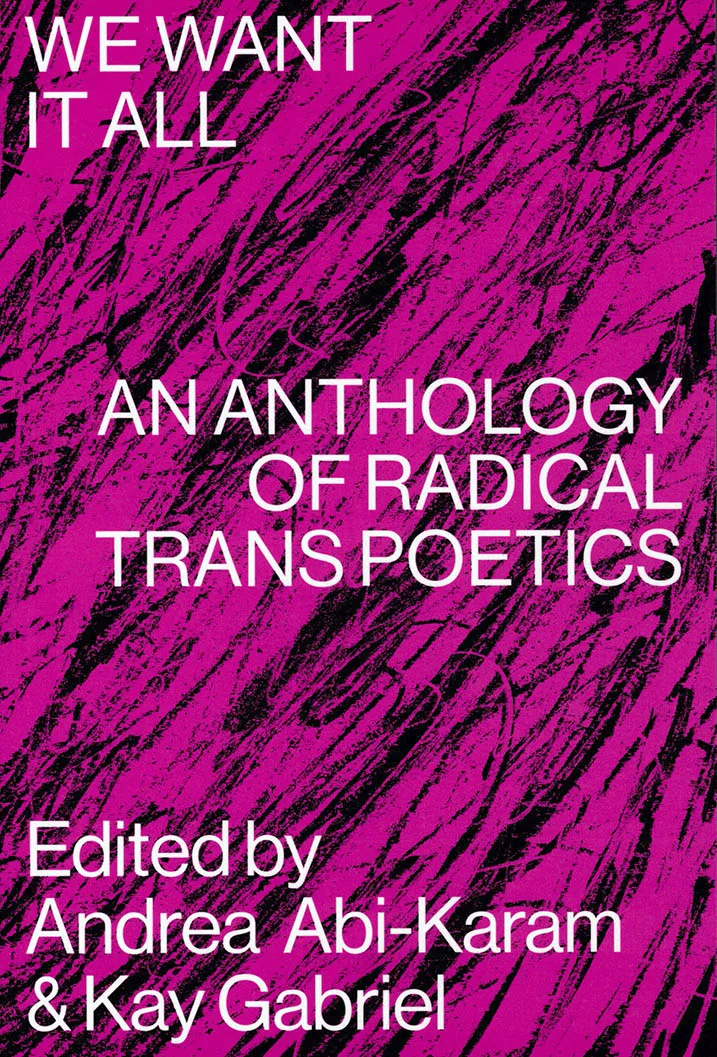
Cover of We Want It All: An Anthology of Radical Transpoetics

Nightboat Books

We Want It All: An Anthology of Radical Transpoetics

Kay Gabriel ed., Andrea Abi-Karam ed.

€23.00

An anthology of formally inventive writing by trans poets against capital and empire.

With texts by: Andrea Abi-Karam, New York City Sam Ace, South Hadley, MA Bahaar Ahsan, Berkeley, CA jasper avery, Philadelphia, PA Ari Banias, Berkeley, CA Jo Barchi, Chicago, IL Joss Barton, St. Louis, MO Levi Bentley, Philadelphia, PA Jessica Bet, Baltimore, MA Rocket Caleshu, Los Angeles, CA Ching-in Chen, Seattle, WA listen chen, Vancouver, BC Faye Chevalier, Philadelphia, PA Cody-Rose Clevidence, Arkansas Miles Collins-Sibley, Easthampton, MA Valentine Conaty, New York City CA Conrad, Philadelphia, PA Jimmy Cooper, Rochester, MI Maxe Crandall, Oakland, CA José Díaz, Boston, MA Aaron El Sabrout, New Mexico Ian Khara Ellasante, Lewiston, ME Caelan Ernest, New York City, NY NM Esc, San Diego, CA joshua jennifer espinoza, Los Angeles, CA Logan February, Ibadan, Nigeria Ray Filar, Brighton, UK Nora Collen Fulton, Montreal, Canada Kay Gabriel, New York City Callie Gardner, Cardiff, Wales Jesi Gaston, Chicago, IL Harry Josephine Giles, Edinburgh, Scotland Aeon Ginsberg, Baltimore, MD Caspar Heinemann, Berlin, Germany Kamden Hilliard, Greenville, SC Stephen Ira, New York City Cyrée Jarelle Johnson, New York City Peach Kander, New York City Jayson Keery, Western, MA Evan Kleekamp, Los Angeles, CA Noah LeBien, New York City Ty Little, Richmond, VA Zavé Martohardjono, New York City Amy Marvin, Philadelphia, PA Natalie Mesnard, New York City Bianca Rae Messinger, Iowa City, IA Liam O'Brien, New York City Xandria Phillips, Madison, WI Rowan Powell, Santa Cruz, CA Nat Raha, Edinburgh, Scotland Holly Raymond, Philadelphia, PA Jackie S, New York City Trish Salah, Toronto, Canada Raquel Salas Rivera, Philadelphia, PA Mai Schwartz, New York City Kashif Sharma-Patel, London, UK Julian Talamantez Brolaski, Oakland, CA Charles Theonia, New York City Jamie Townsend, Oakland, CA Nora Treatbaby Laurel Uziell, London, UK Rachel Franklin Wood, Boulder, CO Clara Zornado Akasha-Mitra xtian w. and Anaïs Duplan, NYC.

Kay Gabriel is a poet and essayist. She's the author of Elegy Department Spring / Candy Sonnets 1 (BOAAT Press, 2017), the recipient of fellowships from Lambda Literary and the Poetry Project, and recently completed her PhD at Princeton University.

Andrea Abi-Karam is an arab-american genderqueer punk poet-performer cyborg, writing on the art of killing bros, the intricacies of cyborg bodies, trauma & delayed healing. Their chapbook, THE AFTERMATH (Commune Editions), attempts to queer Fanon's vision of how poetry fails to inspire revolution. Andrea's first book, EXTRATRANSMISSION (Kelsey Street Press, 2019), is a poetic critique of the U.S. military's role in the War on Terror.

Language: English

recommendations

Cover of We Both Laughed in Pleasure

Nightboat Books

We Both Laughed in Pleasure

Lou Sullivan

Fiction €22.00

Drawn from Lou Sullivan’s meticulously kept journals, this landmark book records the life of arguably the first publicly gay trans man to medically transition.

We Both Laughed In Pleasure: The Selected Diaries of Lou Sullivan narrates the inner life of a gay trans man moving through the shifting social, political, and medical mores of the second half of the 20th century. Sullivan kept comprehensive journals from age eleven until his AIDS-related death at thirty-nine. Sensual, lascivious, challenging, quotidian and poetic, the diaries complicate and disrupt normative trans narratives. Entries from twenty-four diaries reveal Sullivan’s self-articulation and the complexity of a fascinating and courageous figure.

Edited by: Ellis Martin and Zach Ozma
Introduction by: Susan Stryker

Cover of Ponk!

Nightboat Books

Ponk!

Marcus Clayton

Fiction €20.00

A punk rock anti-memoir told through the eyes of a biracial Afrolatino punk academic. 

¡PÓNK! follows Moose, an alienated academic and lead guitarist for Pipebomb!, as he navigates through spaces in and out of South East Los Angeles: punk clubs, college classrooms, family gatherings, street protests, and euphoric backyard shows.Oscillating between autofiction, memoir, and lyric, Clayton blurs genres while articulating the layered effects of racism, trauma, immigration, policing, Black hair, performance, and toxic academic language to uncover how one truly becomes an "ally." Borrowing from the spatial lyricism of Claudia Rankine, the genre-bending storytelling of Alexander Chee, and the racial musings of James Baldwin, ¡PÓNK!'s narrative takes back punk rock and finds safe space in the mosh pit.

Cover of Sacred Spells: Collected Works

Nightboat Books

Sacred Spells: Collected Works

Assotto Saint

Poetry €23.00

The collected life-work of an interdisciplinary writer, performer, and central figure in the Black Gay cultural arts and AIDS movements.

In this timely collection of poetry, plays, fiction, and performance texts, Assotto Saint draws upon music and incantation, his Haitian heritage, and a politics of liberation to weaves together a tapestry of literature that celebrates life in the face of death. Influential to contemporary writers such as Essex Hemphill, Marlon Riggs, and Melvin Dixon, Sacred Spells is Saint’s crucial legacy–five hundred incandescent pages of painful, lyric writing that exemplifies the visceral, spiritual dimensions of an artistic practice that’s integral to Black and LGBTQ activist movements worldwide, both historic and present.

Cover of Permanent Record

Nightboat Books

Permanent Record

Naima Yael Tokunow

Poetry €20.00

A visionary anthology that examines and reimagines the archive as a form of collective record-keeping, featuring work by Alexis Pauline Gumbs, Douglas Kearney, Brenda Shaughnessy, Mahogany L. Brown, and many new and emerging voices. 

Inspired by Naima Yael Tokunow's research into the Black American record (and its purposeful scarceness), Permanent Record asks, what do we gain when we engage with our flawed cultural systems of remembrance? How does questioning and creating a deep relationship to the archive, and in some cases, spinning thread from air where there is none, allow us to prefigure the world that we want? Including reflections on identity and language, diasporic and first generation lived experiences, and responses to the ways the record upholds harm and provides incomplete understandings, Permanent Record hopes to reframe what gets to be a part of collective remembrance, exploring "possibilities for speculating beyond recorded multiplicity."

Cover of Radical Love

Nightboat Books

Radical Love

Fanny Howe

Fiction €24.00

Radical Love gathers five of Fanny Howe's novels: Nod, The Deep North, Famous Questions, Saving History, and Indivisible, previously out-of-print and hard to find classics whose characters wrestle with serious political and metaphysical questions against the backdrop of urban, suburban, and rural America.

Cover of [45-120]

Caniche Editorial

[45-120]

Bea Ortega Botas, Leto Ybarra

Poetry €20.00

Personal space is understood as the distance between 45 and 120 cm that surrounds a person. This bilingual anthology brings together the work of eighteen contemporary poets who take this intimate measurement as a starting point to challenge its apparent rigidity and explore how political, social, sexual, racial, class, and accessibility factors shape it. Beyond a simple physical distance, personal space also becomes a stage where desire draws and negotiates the boundaries between the inside and the outside.

The publication contains contributions by Samuel Ace, Justin Chin, Kyle Dacuyan, Rhea Dillon, Tracy Faud, Elijah Jackson, Taylor Johnson, Nadia Marcus, Park McArthur, Nat Raha, Joan Retallack, Trish Salah, Juan de Salas, María Salgado, Assotto Saint, Cedar Sigo, S*an D.Henry-Smith, Nayare Soledad, Perla Zúñiga.

Bilingual edition, edited by Juf.

JUF (Bea Ortega Botas and Leto Ybarra) explores the relationship between poetry, contemporary art, and theatricality through the organization of performances, readings, and exhibitions. They also publish online texts and a PDF series as an extension of their curatorial and research practice. Currently based between Madrid and New York.

Cover of Issue #60 - Gender Disarray

Movement Research Performance Journal

Issue #60 - Gender Disarray

Kay Gabriel, Amalle Dublon and 2 more

Under the direction of four contributing editors—Amalle Dublon, Kay Gabriel, Keioui Keijaun Thomas, and Anh Vo— we’ve assembled a new body of work by mostly trans and queer artists reflecting on the keyword “gender” and its relation to contemporary performance. Their work moves across multiple genres of writing, from analytic essays to poetry to performance scripts. 

“Read My Lips” is a phrase that will be familiar to longtime readers of the Movement Research Performance Journal—so familiar that the mere reference will bring to mind an image posted by the artist collective GANG, an image that lies at the heart of one of the journal’s most spectacular moments. Issue #3, with its focus “Gender Performance,” was published in 1991 amid that era’s Culture Wars, receiving almost immediately negative reception from government officials (the NEA threatened to withdraw funding from Movement Research) and many members of the dance community (who considered Issue #3 to be deliberately provoking the so-called “war,” intentionally taking a political position that some worried might comprise future funding of the field). In the thirty-three years since its publication, Issue #3 has developed a patina familiar to many artist-activist histories that are looked upon with romance and nostalgia, often by those for whom that history is only a fantasy (rather than a lived experience). 

Cover of T (poem)

Materials

T (poem)

Laurel Uziell

Poetry €13.00

T is a long poem in multiple parts and its author's second book. “The two genders are YES and NO, so you stutter or else shut up forever”. 

From the Afterword: "Between 2017-2018 I was involved in a trial with a group of TERFs after a scuffle emerged during a counter protest against a ‘debate’ about sex-based rights in light of proposed reforms to the Gender Recognition Act which would have made trans people’s lives marginally easier. Luckily I wasn’t actually in the dock, but I appeared to give evidence, and for everyone involved it was a humiliating ordeal as we were doxxed, harrassed online and in real life, while the relentless media campaign which ensued took a toll on the entire trans community. The caricaturesque reduction of a complex interrelation of political positions, epistemologies, traumas and personal grievances into two ‘sides’ ultimately worked to further the persecution of trans people, but nevertheless highlighted a social logic on whose terms the so called debate was forced to appear: sex was pitted against gender (or more revealingly ‘gender identity’), objective biology against subjective ‘self-identification’, nature against culture, or perhaps, first nature against second nature."

What does a poet say (what does anyone say), when placed on the stand, how answer the binary logics forced like a cage in the legally-grounded violence which splittingly interrogates solidarity, the splitting invocation of law? In answer, T spreads across the page as if desperately finding a form for speech acts forced into a garrotted tick-box, a witness stand, video evidence, Nature’s originary disguise as history or vice versa, wrapped inside ‘common sense’ as a pronominal shroud, in the policing of body, speech, and every fungible fibre of being. The author writes: “I want the whole text to be a kind of horrific inorganic body with awkward parts, both to replay at the level of form some of the critiques of organicist thinking with reference to nature that the poem tries to articulate, and also, more glibly, to be somewhat like a trans body, awkwardly fitting together with some parts undercutting others”. An extended enquiry into Materialism and its material (fleshed) stakes, driven through the heart and to the heart of things, T sees lyric poem shudder to line-broken essay to fragment of play to citational drop; in tight compression sprawling, a poem whose argument is necessary and necessarily incomplete, poetry can do thinking, this thinking we do outside and within it, sprung trap, open and closing door.