Books
Books
published in 2018

KW Institute for Contemporary Art
Germaine Kruip: Works 1999-2017
Over the past two decades, artist Germaine Kruip has steadily developed a practice, which merges time, space and perception. Like an anthropological stage director, she investigates, simplifies and presents her observations in a subtle manner often through architectural interventions. In each of these interventions, she changes a location into a stage, with the audience as actors in a play of substantive absence. By doing so, she activates both physical and mental awareness.
This publication presents an overview of the Kruip’s practice since 1999, two years prior to her engagement with the art context. Presenting over 40 works, the publication reflects on three periods in the artist’s practice, each accompanied by an essay contributed by Anna Gritz, Eva Wittocx and Stephanie Bailey. The idea of a catalogue raisonné came out of a conversation that followed Kruip’s ambitious project Geometry of the Scattering, which was presented at de Oude Kerk in Amsterdam in 2015 – 2016.

Fanzine Grrrls
Making a fanzine is an act of rebellion, even more so if it is published and produced by a woman. The grrrls of today use them to inspire countless young people around the world, to take control of their lives and to create their own culture. These homemade publications are a quick and cheap way to spread their ideas and dismantle the usual stereotypes. Traditionally hand-drawn, photocopied, and stapled together, the format of fanzines are now as diverse as their subject matter, with online platforms and social networks fast becoming the norm. The fanzine is more alive than ever!
Gemma Villegas runs her graphic design studio based from Barcelona. She works in close dialog with commissioners and collaborators on a broad range of projects, including visual identities, exhibitions, publications, and digital platforms, overseeing the creative process during all the phases of a project. Her work is characterized by a fresh and powerful visual language focused on detail with special attention to typography.

Reading Like a Computer
The contents of Reading Like a Computer. A Sematic Guide to Facebook's Content Moderation Policies are from leaked PowerPoint slides used to train Facebook content moderators. The contents have not been embellished or editorialized. By organizing and graphically presenting the subtle discrepancies between what Facebook allows and doesn’t allow in a post, the book highlights the contradictions and challenging logic of Facebook's community standards.

The Alphabet Book
In 1971, Michael Morris and Vincent Tarsov—founders of the Vancouver-based artist network Image Bank—invited Eric Metcalfe, Gary Lee Nova, Glenn Lewis and Paul Oberst to create their own, unique alphabet. NowForty years later, with the permission of the participating artists and the help of Image Bank, these historic silk-screened alphabets have finally been published together. The Alphabet Book is designed by Marc Hollenstein, who was inspired to reinitiate the alphabet publication project after having a conversation with Glenn Lewis during the opening of Lewis’ retrospective exhibition at Kunstverein back in 2014.

Reality (Dark) Fragments (Light)
This monograph covers more than fifty years of creation by Art & Language, whose artists are at the origin of conceptual art. Through unpublished texts by Matthew Jesse Jackson and Art & Language, a transcript of their opera libretto Victorine, and an interview with the artist collective, this publication questions their journey, and more broadly, the relationship between contemporary art and conceptual art.
The permanent collection of the Château de Montsoreau – Museum of Contemporary Art has grown to include 800 works from Art & Language. To celebrate this event, the museum produced a major exhibition and a publication titled Reality (Dark) Fragments (Light). The monograph and exhibition look back at 50 years of creation by these critical, provocative, subversive, punk art collective. They question the main issues involved in Art & Language's work: conversation as an artwork, description, transdiciplinarity, crisis in the relationship between the artist, the museum and the art gallery.
Edited by Marie-Caroline Chaudruc.
Foreword by Marie-Caroline Chaudruc.
Text by Matthew Jesse Jackson, interview with Art & Language by Victorine Meurent.

كيف تلتئم – عن الأمومة وأشباحها - How to Mend: Motherhood and Its Ghosts
A highly personal and sensitive exploration of motherhood.
In How to Mend: On Motherhood and its Ghosts, Iman Mersal navigates a long and winding road, from the only surviving picture of the author has with her mother, to a deep search through what memory, photography, dreams and writing, a search of what is lost between the mainstream and more personal representations of motherhood and its struggles. How to mend the gap between the representation and the real, the photograph and its subject, the self and the other, the mother and her child.
"If I'd been more aware and someone had asked me about 'my mother's picture' I would have shown them the bird she'd stitched onto the canvas herself. It is not aesthetic vision or skill that summons my mother's presence in this canvas, but the slight punctum the bird gives me. I get nothing of this sort from our studio portrait. The bird's eyes are always looking at me, as though they belong to her. The bird: motionless, for whose sake my mother sat and stitched by the window where the light came in, each pinprick a symbolic laceration in the process of its embodiment: cuts by the hundred to make it whole."
Iman Mersal (born 1966 à Mit 'Adlan) is an Egyptian poet, writer, academic and translator. She works as an Associate professor of Arabic literature and Middle Eastern studies at the University of Alberta, Canada. An anthology of her works was translated into more than twenty languages and she has five poetry collections published.

The Rambling Figures of Mani Kaul
Arindam Sen, Stoffel Debuysere
Published on the occasion of the program Soft Notes on A Sharp Scale — The Rambling Figures of Mani Kaul, produced as part of the Courtisane festival 2018, as well as the associated Mani Kaul programme organized by the Essay Film Festival 2018, in collaboration with the Otolith Group.

How to Mend: Motherhood and Its Ghosts
In How to Mend: On Motherhood and its Ghosts, Kayfa ta’s 4th monograph, Iman Mersal navigates a long and winding road, from the only surviving picture of the author has with her mother, to a deep search through what memory, photography, dreams and writing, a search of what is lost between the mainstream and more personal representations of motherhood and its struggles. How to mend the gap between the representation and the real, the photograph and its subject, the self and the other, the mother and her child.
Iman Mersal is an Egyptian poet and associate professor of Arabic Literature and Middle Eastern Studies in the University of Alberta, Canada.
Editors: Maha Maamoun and Ala Younis
Co-publishers: Kayfa ta and Sternberg Press
Design: Julie Peeters
Size: 9.6 x 14.8 cm

How to disappear
Robin Moger, Haytham El-Wardany and 1 more
This publication proposes a set of aural exercises that show readers how to disappear, reappear, join a group, or leave a group. Its annex is a lexicon of some of the sounds that dwell in or are banished from the middle-class household.
Text: Haytham El-Wardany
Editors: Maha Maamoun and Ala Younis
Translated from Arabic by Jennifer Peterson (Preliminary Exercises) and Robin Moger (Sounds of the Middle Classes)

La Gentrification des Esprits
La Gentrification des esprits est un retour captivant sur la crise du sida et l’activisme d’ACT UP dans le New York des années 1980 et 1990. Sarah Schulman, elle-même new-yorkaise et militante de la cause LGBT, se souvient de la disparition du centre-ville, pratiquement du jour au lendemain, de la culture rebelle queer, des loyers à bas coût et du prolifique mouvement artistique qui se développait au coeur de Manhattan, remplacés par des porte-parole gays conservateurs, ainsi que par le consumérisme de masse.
Elle décrit avec précision et engagement le « remplacement d’une communauté par une autre » et le processus de gentrification qui toucha ces quartiers concomitamment à la crise du sida. Sarah Schulman fait revivre pour nous le Lower East Side qu’elle a connu. Elle ravive autant le souvenir de ses ami•e•s de l’avant-garde queer que celui de l’ombre inquiétante des premières années de la crise du sida, telles que vécues par une militante. Les souvenirs personnels s’entremêlent à une analyse percutante des deux phénomènes, et du poids invisible qu’ils font aujourd’hui peser sur la société américaine.
L’auteure rend compte de son expérience en tant que témoin de la « perte de l’imagination » de toute une génération, et des conséquences entraînées par cette perte.

Mon musée de la Cocaïne
L’or et la cocaïne sont les deux matériaux bruts de Mon musée de la Cocaïne. C’est au cours de leur transformation et raffinement que ces deux substances ramènent avec elles une histoire de l’oppression et de l’esclavage.
Dans ce livre, l’anthropologue australien Michael Taussig prend comme point de départ la proposition de bâtir un musée de la Cocaïne (qui serait l’image reflétée du musée de l’Or de la Banque de la République à Bogotá) et dresse un portrait sans concession de la vie des mineurs afro-colombiens aspirés dans le monde dangereux de la production de cocaïne au fin fond de la forêt tropicale, sur la côte pacifique de la Colombie. Il décrit la violence, la pauvreté, mais aussi les croyances qui surgissent des marais envahis de mangroves et des rivières tropicales qui, pendant plus de cinq cent ans, ont attiré, ruiné et décontenancé Amérindiens, orpailleurs, conquistadors et pirates, esclaves africains, ingénieurs russes et guérilleros marxistes.
Mon musée de la Cocaïne se présente comme un assemblage éclectique d’histoires et d’anecdotes, présenté comme autant de salles d’un hypothétique musée de la Cocaïne, au sein desquelles le lecteur est invité à déambuler, en croisant des références qui vont de Charles Dickens à Franz Kafka en passant par la poésie de Seamus Heaney.

Care Work
Leah Lakshmi Piepzna-Samarasinha
Lambda Literary Award winning poet and essayist and long-time disability justice advocate Leah Piepzna-Samarasinha writes passionately and personally about disability justice in her latest book of essays. Discussing subjects such as the creation of care webs, collective access, and radically accessible spaces, she also imparts her own survivor skills and wisdom based on her years of activist work, empowering the disabled - in particular, those in queer and/or BIPOC communities - and granting them the necessary tools by which they can imagine a future where no one is left behind.

The Weight of the Earth
Audio journals that document Wojnarowicz's turbulent attempts to understand his anxieties and passions, and tracking his thoughts as they develop in real time.
"In these moments I hate language. I hate what words are like, I hate the idea of putting these preformed gestures on the tip of my tongue, or through my lips, or through the inside of my mouth, forming sounds to approximate something that's like a cyclone, or something that's like a flood, or something that's like a weather system that's out of control, that's dangerous, or alarming.... It just seems like sounds that have been uttered back and forth maybe now over centuries. And it always boils down to the same meaning within those sounds, unless you're more intense uttering them, or you precede them or accompany them with certain forms of violence."
—from The Weight of the Earth
Artist, writer, and activist David Wojnarowicz (1954-1992) was an important figure in the downtown New York art scene. His art was preoccupied with sex, death, violence, and the limitations of language. At the height of the AIDS epidemic, Wojnarowicz began keeping audio journals, returning to a practice he'd begun in his youth.The Weight of the Earth presents transcripts of these tapes, documenting Wojnarowicz's turbulent attempts to understand his anxieties and passions, and tracking his thoughts as they develop in real time.
In these taped diaries, Wojnarowicz talks about his frustrations with the art world, recounts his dreams, and describes his rage, fear, and confusion about his HIV diagnosis. Primarily spanning the years 1987 and 1989, recorded as Wojnarowicz took solitary road trips around the United States or ruminated in his New York loft, the audio journals are an intimate and affecting record of an artist facing death. By turns despairing, funny, exalted, and angry, this volume covers a period largely missing from Wojnarowicz's written journals, providing us with an essential new record of a singular American voice.

Oslo National Academy of the Arts
Segunda Vez: How Masotta Was Repeated
Publication documenting the research made by Dora García for a video project on Oscar Masotta, pioneer of Lacanian psychoanalysis in Latin America and influential art critic.
It features a selection of Masotta's writings as well as contextual essays on his work.Segunda Vez is an art research project centered on the figure of Oscar Masotta (Buenos Aires, 1930, Barcelona, 1979), an author of groundbreaking texts about the Happening, art, and dematerialization, a pioneer of Lacanian psychoanalysis in the Spanish-speaking world, and a happenista. The project has yielded a full-length and four medium-length films by Dora García, two Cahiers documenting the research, and this book. Segunda Vez: How Masotta Was Repeated offers a selection of Masotta's writings, including his early study of Argentinean author Roberto Arlt, as well as texts that contextualize Masotta's thought and broaden the reach of his reflections on the intersections between performance and psychoanalysis, art and politics.
Edited by Emiliano Battista.
Texts by Dora García, Oscar Masotta, Roberto Bolaño, Jorge Jinkis, Inés Katzenstein, Ana Longoni, Emiliano Battista, Aaron Schuster, Julio Cortázar.
English edition
13,5 x 21 cm (hardcover)
320 pages (color & b/w ill.)

of sirens, body & faultlines
of sirens, body & faultlines is a book of prophecy against this Brexit era, rising from a post-2008 London, where crisis and austerity meet the vanity projects of the super-rich. Committed to the immediacy of a present that is precarious and under surveillance, of sirens... attends to queer, transfeminist and people of colour counter-memories and histories. It seeks new expressions of desire and modes of breath, pushing against the gravities that would rather these lives and worlds disappear.
While arguing with the radio may seem futile, syntax, punctuation, grammar and the page must still all be mobilised to help create new conditions of possibility – for collectivity, for poetry to speak. Raha’s exceptional, experimental, queer lyric mobilises all aspects of language to reveal contradictions of capitalism and defuse populist rhetoric. This is a writing of city life against the flows to capital; labouring bodies speaking back to the demands of work and the fictions of xenophobic politicians. It concerns herstory, transfeminism, collectivity; the everyday of South East London, transformation and decolonisation, through counter-memories, anti-memoir, and a trans poetics.
"Nat Raha has written some of the most exciting poetry of the last decade. Transfeminist, communist, revolutionary – with great quickness and nimble intensity, her syllables and survival codes dash through police-lines as high-level transmissions signalling absolute solidarity, insisting that other lives are still possible. Originally published as a series of home-made pamphlets that seemed to come as much from post-punk zine culture as from avant-garde poetics, it's good to see them gathered here in one place for the first time and as a body of evidence of a culture of struggle. These poems do not merely comment on that struggle, but emerge from within it. They are poems that break open a space in which to think through what has happened, who we have been, and what has been done to us. These are fearsome times. Raha writes poetry that acknowledges that fear and refuses to flinch in the face of it, which is in itself an act of the fiercest solidarity." – Sean Bonney

F.R. David - what I mean is—
F.R.DAVID is a typographical journal, dealing with the organisation of reading and writing in contemporary art practises. “what I mean is—” the 16th issue, edited by Will Holder.

F.R. David - Flurry
F.R.DAVID is a typographical journal, dealing with the organisation of reading and writing in contemporary art practises. “Flurry” is the 15th issue (a best-of, of sorts) edited by Will Holder. “I realized very slowly over a period of time that the activity of framing a performance and the intentions that accumulate around that activity produce a certain anxious kind of mode, and I became bothered by the flurry of activity and how it tends to mask so many things.”

Re-Enchanting the World
In this edited collection of work spanning more than 20 years, Silvia Federici provides a detailed history and critique of the politics of the commons from a feminist perspective. In her clear and combative voice, Federici provides readers with an analysis of some of the key issues in contemporary thinking on this subject. Drawing on rich historical research, she maps the connections between the previous forms of enclosure that occurred with the birth of capitalism and the destruction of the commons and the "new enclosures" at the heart of the present phase of global capitalist accumulation.
Considering the commons from a feminist perspective, this collection argues that women and reproductive work are crucial to both our economic survival and the construction of a world free from the capitalist hierarchies. Federici is clear that the commons should not be understood as happy islands in a sea of exploitative relations—but rather autonomous spaces from which to challenge the existing organization of life and labor.
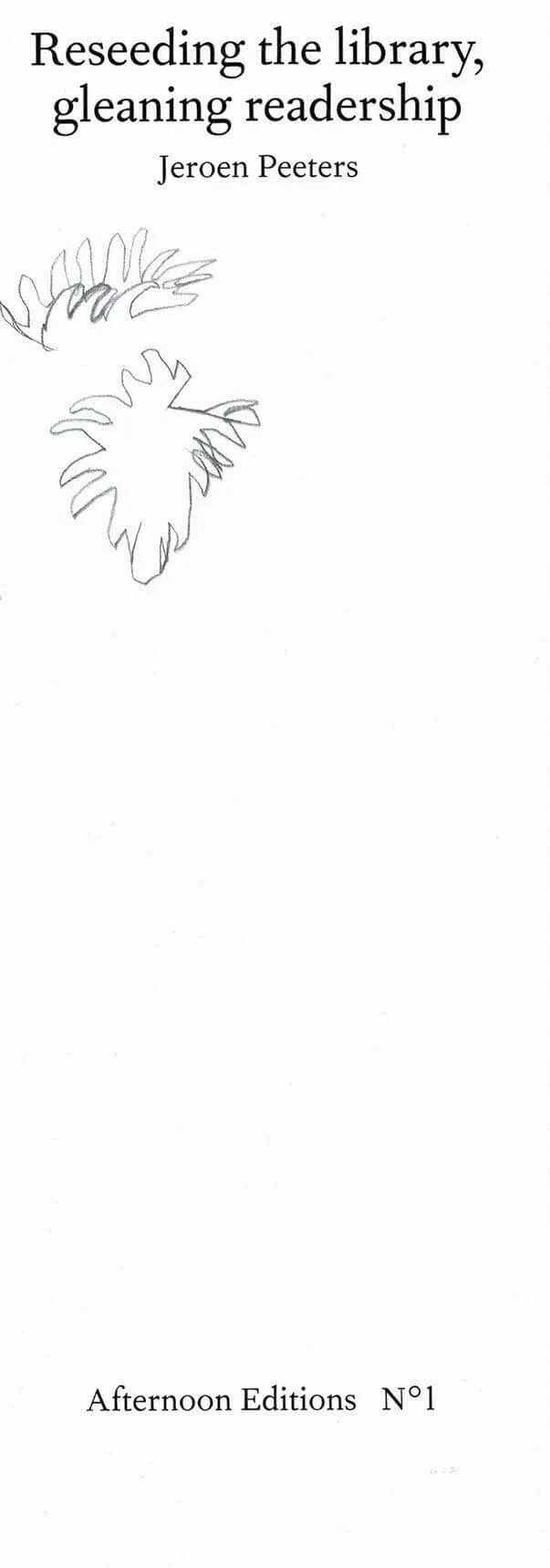
Reseeding the library, gleaning readership
Afternoon Editions no. 1: an essay by Jeroen Peeters titled Reseeding the library, gleaning readership. In May 2017, Time has fallen asleep in the afternoon sunshine settled during three weeks in the Ravenstein Gallery in Brussels as part of the Kunstenfestivaldesarts. Invited as a writer in residence, Jeroen Peeters visited the library of living books on a daily basis and recorded his observations by hand in a notebook, which formed the basis for Afternoon Edition #1. Reseeding the library, gleaning readership is an essay on the seed library, on the dispersion of literature through wind, water and animals, on biodiversity and commoning at the heart of readership. On the cover a drawing by Wouter Krokaert of a Philodendron Xanadu. Published May 2018.

Positions of the Sun
The second work in Belladonna* Collaborative’s Germinal Texts series, Lyn Hejinian’s Positions of the Sun is a book of twenty-six interlocking “essays with characters” that explores the mid-2000s financial “crisis” through the movements and daily lives of a wide-ranging cast of characters located in the Bay Area.
In Positions, Hejinian plays the bricoleur, bringing together whatever’s needed in her to approach to the subject—whether the paratactic tactics of poetry, scholarship’s critical patchwork, or dramatis personae set in time that evokes but frustrates narrative.
Earlier iterations of essays 4, 14, and 17 appeared in Belladonna*’s Elders Series #5, edited by Jennifer Scappettone with work by Etel Adnan, Lyn Hejinian, and Jennifer Scappettone.