Books
Books
published in 2023

Livre d'images sans images (LP)
Iben Edvardsen, Mette Edvardsen
Livre d’images sans images by Mette Edvardsen & Iben Edvardsen borrows its title from a book by H.C. Andersen, also referred to as The Moon Chronicler. The book follows a conversation between a painter and the Moon, where the Moon describes to the painter what she sees on her journey around the world every evening, telling the painter to paint what she describes. “This conversation, as in the now obsolete meaning of the word (‘a place where one lives or dwells’), was the starting point for our work. Using the weather report as dramaturgy, (‘the moon did not show up every evening, sometimes a cloud came in between’), we have created and collected materials from our conversations in the form of recordings, text, voice, drawings, references, found images, loose connections, inspirations and imaginations, in the order they came to us. They are at the same time sources and traces, material and support for new imaginations or events to come.” The work consists of three different media: vinyl, paper and live performance.
Mette Edvardsen is a choreographer and performer eager to explore the performing arts as a practice and situation, also in relation to other media such as books and writing. This work is in collaboration with her daughter, Iben Edvardsen.
Published by Xing & Varamo Press
XONG collection – artist records XX10 (2023)
First edition, September 2023
Recorded and edited by Mette Edvardsen & Iben Edvardsen
Format white 12’ vinyl LP in cardboard sleeve
Released in a numbered edition of 300 copies, including collector’s edition of 25 copies, each accompanied by a unique poster hand drawn with black marker by Mette Edvardsen & Iben Edvardsen, 59,4 x 84 cm, folded, signed by the artists

Don't Leave Me This Way
A textual and historigraphical odyssey imbued with queer intergenerational yearning and loss.
Don't Leave Me This Way blends archival research with sexual fantasy to produce a series of sonnets inspired by Gaétan Dugas, named by Randy Shilts as "Patient Zero" of the AIDS epidemic in North America. Committed to the utopian possibilities of elegy and pornography, Don't Leave Me This Way exploits the absurdist beauty of the cut-up technique to voice a chorus of lost spirits: poignant, vengeful, and ready to ball.

Salamander's Wool
The involuntary whispering of the dew-harvest.
A grimoire carved in scarlet, SALAMANDER'S WOOL is the inaugural full-length collection of writing by V Manuscript, amalgamating a vast array of arcane rituals into an ensorcelling poetic corpus. To read SALAMANDER'S WOOL is to consort with spirits and scry with dæmons, a linguistic alchemy which transmutes both language and reader.
V Manuscript is a poet and scriptomancer living in New York City.

Elika Hedayat
First monograph of the Franco-Iranian artist.
This monographic catalogue looks back over the first 15 years of work by Iranian artist Elika Hedayat through more than 110 reproductions. Two of these are on a 1:1 scale, and a detailed set offers a comparison of the dimensions of the works in relation to each other.
Françoise Docquiert introduces the issues at stake in her practice with an essay, complemented by an interview with Joana P.R. Neves.
"Elika is a Parisian-Iranian artist. This cultural blend is slightly ironic though very significant, as it nourishes her artistic work and practice. Inspired by her childhood, her life, and the violence in her native country, she makes films, videos, and drawings always filled with beauty, scathing humour and cruelty." - Annette Messager
Born 1979 in Tehran, Elika Hedayat lives and works between Paris and Tehran. Arriving in France in 2004, she was admitted to the École Nationale Supérieure des Beaux-Arts in Paris in Annette Messager's studio, from wich she graduated with the Jury's congratulations in 2008.
For her works, Elika Hedyat often uses testimonies and experimental documentaries stage in a dreamlike and imaginary universe. Her stories are contemporary and her characters are real. All of her works revisits historical references, transferring them to the field of personnal experience, mainly using the various possibilities of her repertoire as a narrative document and memory retrieval tool. Reality, memory and imagination come together in a personal story under different forms : drawing, video, documentary, painting and performance.
Text by Françoise Docquiert.
Interview with Elika Hedayat by Joana P. R. Neves.

Sacred Spells: Collected Works
The collected life-work of an interdisciplinary writer, performer, and central figure in the Black Gay cultural arts and AIDS movements.
In this timely collection of poetry, plays, fiction, and performance texts, Assotto Saint draws upon music and incantation, his Haitian heritage, and a politics of liberation to weaves together a tapestry of literature that celebrates life in the face of death. Influential to contemporary writers such as Essex Hemphill, Marlon Riggs, and Melvin Dixon, Sacred Spells is Saint’s crucial legacy–five hundred incandescent pages of painful, lyric writing that exemplifies the visceral, spiritual dimensions of an artistic practice that’s integral to Black and LGBTQ activist movements worldwide, both historic and present.

À perte de mère – Sur les routes atlantiques de l'esclavage
Saidiya Hartman traces the history of the Atlantic slave trade by recounting a journey she took along a slave route in Ghana. Following the trail of captives from the hinterland to the Atlantic coast, she reckons with the blank slate of her own genealogy and vividly dramatizes the effects of slavery on three centuries of African and African American history.
Saidiya Hartman, professor of English and comparative literature at Columbia University, is a scholar of African American literature and cultural history.
Preface by Maboula Soumahoro.
Translated from the English (American) by Maboula Soumahoro (original title: Lose Your Mother. A Journey Along The Atlantic Slave Route, Farrar, Straus and Giroux, 2007).

Pommes Girl / أحتفل بالحياة التي تحتفل بي
Rim Battal, Abdelilah Khattabi
The story of a meeting between a woman and a man linked by music for one night, in a nuptial dance of bodies and words doomed to failure: an ode to desire by the Franco-Moroccan poetess.
Rim Battal (born 1987 in Casablanca, lives and works between Paris and Rabat since 2012) is a French artist and poet.
Edited by Yasmina Naji.
Translated into Arabic by Abdelilah Khattabi.

Forlaget Emancipa(t/ss)ionsfrugten
Great is the Power of the Name
Signe Frederiksen, Anne-Mette Schultz
Great is the Power of the Name considers the works of authors Elena Ferrante, Pauline Reáge, Karl Ove Knausgård, Colette and artist Lee Lozano.
In 2016, when Anne-Mette had invited Signe to take on the role as editor of her text The Institute of Applied Speech, they both began reading Elena Ferrante's The Neapolitan Novels. They were specifically fascinated by the author’s use of pseudonym. Anne-Mette's Institute of Applied Speech was a tale of a fictive place, a pseudo-topos, and Elena Ferrante’s ideas about the pseudonym as a space for the writing itself was useful in thinking about fictive authorship. In a number of written interviews, Elena Ferrante unfolds the feminist perspective of her use of pseudonym. They were attracted by the idea that the author could avoid the biographical question; that she could disappear behind her own writing.
To them, the artist Lee Lozano is the ghostly presence of hard-core moralist and humorous fuck-off art from another decade. During the course of her life, Lozano continuously reconfigured and gradually dissolved her own name, starting from Leonore Knaster ending up with E. Her work Boycott Women, in which she decides not to have any contact with women, expands the notion of feminist critique.
Great is the Power of the Name publishes a readership interested in the position of the artist, and how it conditions the way we make art.

17 Movements
17 Mouvements collects traces of a project that Decoratelier - the workspace and arts platform of Jozef Wouters - did in the fall of 2022 around the ‘5 blocs’ area in Brussels (Rempart Des Moines/Papenvest).
When Nuit Blanche invited them to build a gym, Camille Thiry and other Decoratelier associates did not want to design another generic muscle cage. Together with the neighbourhoods inhabitants, they built 17 distinct movement spaces, each tailor-made to an individual’s size, needs, dreams and aches. The gym equipment has meanwhile been removed from public space, but this eponymous book (ed. by Jozef Wouters) combines notes and reflections (language: French) by Camille with beautiful photography by Enzo Smits, documenting the ingenious and unique negotiations that were a part of this collaboration.

Better Living Catalog
Pippa Garner’s Better Living Catalog, originally published in 1982, takes the form of a mail order catalog featuring clever and whimsical inventions that parody consumer goods while simultaneously critiquing America’s obsession with ingenuity, efficiency, leisure, and comfort. These works, which were made as prototypes and photographed for the publication, take the form of improbable accessories, clothing, footwear, home appliances, and office gadgets.
For example, the “Reactiononometer,” a portable wristband, instantly measures social success, while the “Digital Diet Loafers” display the wearer’s weight with every step. If the “Munch-o-Matic” reduces deskwork interruptions by flinging a snack right into the user’s mouth, other items promise financial solvency (the controlled cash flow “Autowallet”), sustainable waste management, or mess-free companionship (the “Pet-a-Vision” TV console). The artist asserts that all of the products in the book are “absolute necessities for contemporary survival.”
The Better Living Catalog was a pop hit when it was published, earning Garner spots on nighttime TV talk shows and attention from magazines like Vogue and Rolling Stone. In a meme-filled culture, the works still resonate today, finding their analog in widely-circulating consumer products, and—in the case of the “High Heel Skates”—even appearing unattributed in the runway collection of a major luxury fashion brand.
A few years after the Better Living Catalog was published, Garner began her gender transition, which she has characterized as an artistic project that draws conceptual parallels to the altered consumer goods she has continued to create since the 1970s. The artist’s practice has always been about hacking—gender hacking, she stated, was “an excellent premise for maverick conceptual art and diametrically opposed to anything I’d ever done.”
Many of the prototypes Garner created for the publication were repurposed or recycled, making this previously rare gem of an artist book one of the artist’s few works to now be widely available.
Born in 1942 in Evanston, Illinois, Pippa Garner (formerly known as Philip Garner) began her practice in the late sixties as a member of the highly regarded Transportation Design department at ArtCenter, California, with plans to become a car stylist, and was drafted to Vietnam to serve as a combat illustrator. In the mid-80s, Garner began her gender transition, which she considers a conceptual artwork, marking an extension of her practice from twenty years of altering cars, garments, and consumer products to using her own body as raw material. Garner appeared on the Tonight Show Starring Johnny Carson and other talk shows, showcasing her satirical consumer product inventions, and her artwork has been featured in Car & Driver, Rolling Stone, Arts & Architecture, and Vogue, among other publications. In the 1980s, her performance, design, and video work was exhibited in institutions including the Los Angeles Institute of Contemporary Art; Whitney Museum of American Art; and Museum of Contemporary Art, Los Angeles; since 2015, she has had exhibitions at STARS, O-Town House, Redling Fine Art, and Parker gallery in Los Angeles; Jeffrey Stark in New York; JOAN, Los Angeles; Kunstverein München; 49 Nord 6 Est – Frac Lorraine, Metz; Kunsthalle Zurich; and Art Omi, Ghent, New York. She is the author of three other books: Utopia… or Bust! Products for the Perfect World (1984), Garner’s Gizmos & Gadgets (1987), and the zine Beauty 2000 (1992/2021).

Paradis catalogue
Contributions by: Nicole-Antonia Spagnola, Georgia Sagri, John Kelsey, Matthew Pang, Cathy Wilkes, Sarah Rapson, Nick Irvin, Gene Beery, Anne Dressen, Anne Pontégnie, Jacqueline Mesmaeker, Sara Deraedt, Anne Rorimer, Kari Rittenbach, Olga Balema, Maria Nordman, Louise Lawler, Julie Ault, Martin Beck, Adrian Morris, Matt Browning, John Miller, Envers Hadzijaj, Enzo Shalom, Bedros Yeretzian, Morag Keil, Helmut Draxler, Gianna Surangkanjanajai, Steve Cannon, Rae Armentrout, Zoe Hitzig, Pierre Guyotat, Lola Sinreich, Fanny Howe, Hélène Fauquet, Marie Angeletti, Richard Hawkins, Andy Robert, Alexander García Düttmann, Daniel Horn, El Hadji Sy, Henrik Olesen, Aurélien Potier, Richard John Jones, Stéphane Barbier Bouvet, Nora Schultz, Peter Fend, Megan Francis Sullivan, Jill Johnston, Sturtevant, Tonio Kröner, Bernard Bazile, Pierre Bal-Blanc, Jérome Pantalacci, Gérard Traquandi, Gladys Clover, Maria Wutz, Jimmie Durham, Richard Sides, Camilla Wills, Michael Callies, Steven Warwick, Matthew Langan-Peck, Dan Graham, Nina Könnemann, Hans Christian Dany, Valérie Knoll, Win McCarthy, Eleanor Ivory Weber, Anna Rubin, Heji Shin, Michèle Graf & Selina Grüter, Inka Meißner, Simone Forti, Morgan O’Hara, Angharad Williams, Ye Xe, Lily van der Stokker, Yuki Kimura, Peter Wächtler, Eva Steinmetz, Michael Van den Abeele, Marc Kokopeli, Bradley Kronz, Robert Grosvenor, Samuel Jeffery, Charlotte Houette, Adam Martin, Wade Guyton, Chloe Truong-Jones.
Edited by Marie Angeletti with Gianmaria Andreetta and Camilla Wills.

Alia Syed: Imprints, Documents, Fictions
Published by Courtisane festival in collaboration with Open City Documentary Festival, Alia Syed: Imprints, Documents, Fictions (ed. María Palacios Cruz) is the first monograph to be devoted to Syed’s work and features new essays by Jemma Desai, Inga Fraser, Peter Gidal, Rahila Haque, Salima Hashmi, Anjana Janardhan, Ruth Noack and Henrietta Williams, as well as writing by Syed herself.

The Moon is Reading us a Book
THE MOON IS READING US A BOOK is the debut collection of poetry from a writer who displays a wide-ranging palette for storytelling and folklore in a suite of narrative poems. The collection is built around an ensemble of characters that range from known to unknown, through which Serubiri crafts visually-inspired poems that combine the photographic, the intensely personal, and the scholarly. In his book, he manages to domesticate larger-than-life figures, including Zanzibari-born singer-songwriter Freddie Mercury and Nigerian-born photographer Rotimi Fani Kayode. Simultaneously pondered and elastic, Serubiri’s poetry lures these figures – and the reader – into an atmosphere that is only as expansive as the interior landscapes he delineates with each succeeding poem. With this he expresses his own doubts and path, from memories of his native Uganda to New York City, through a psychology of decisions and life choices.
Serubiri Moses is a Ugandan curator and author based in New York City. He currently serves as faculty in Art History at Hunter College and visiting faculty at the Center for Curatorial Studies, Bard College. He previously held positions at New York University and the New Centre for Research and Practice, and delivered lectures at Williams College, Yale University, University of Pittsburgh, The New School, basis voor aktuelle kunst, and University of the Arts Helsinki. As a curator, he has organized exhibitions at museums including MoMA PS1, New York; Kunst-Werke Institute for Contemporary Art, Berlin; and the Hessel Museum, Bard College, NY. He previously held a research fellowship at the University of Bayreuth; received his MA in Curatorial Studies at Bard College; and is an alumni of the Àsìkò International Art Programme. He serves on the editorial team of e-flux journal. He has published poetry in the online journals Jalada and Badilisha Poetry Exchange, as well as in print in journals Kwani? 7, Kwani? 8, and READ: A Journal of Inter-Translation (2022). His poetry has been reviewed online in The New Inquiry. THE MOON IS READING US A BOOK is his first book of poetry.

bruit
Edition of 265 copies. A deluxe edition, accompanied by an original work numbered n/508 (oil pastel on paper A3), has been produced in 35 copies signed and numbered by the artist.
Hardcover, offset printing, 508 p., 31.8 x 25 cm. Printed by Cultura, Gent.

Pages 11 - Stage So Near So Far
Nasrin Tabatabai, Babak Afrassiabi
The new issue consists of 8 plays and performance texts by Iranian women writers living in or outside Iran. Whether based on actual experience, fictional, or drawn from archives, these texts deal in one way or another with the question of the stage. They produce a contested space of performance that is inevitably linked to the performer's body, whose thresholds are stretched and contracted into potentially new forms of staging. The authors in this issue place their writing in performative relation to the specific historical and sociopolitical conditions in which they live and work. In many ways, the writings interrogate the politics that delineate the stage itself.
The authors in this special issue are: Nasim Ahmadpour, Nil (Alista) Aghaee, Naghmeh Manavi, Athena Farrokhzad, Nazanin Sanatkar, Azade Shahmiri, Zahra Mohseni and Naghmeh Samini.

Remembering a Dance – Part of Some Sextets 1965/2019
A re-examination of Yvonne Rainer's Parts of Some Sextets, a radical performance and pivotal piece in the American choreographer's career, which led her to theorize her conception of dance in the 1960s, before being revived in 2019.
Parts of Some Sextets, Yvonne Rainer's 1965 performance for ten people and twelve mattresses, represents a turning point in the American choreographer's oeuvre. "My mattress monster," as Rainer calls it, was built in her formative years with the experimental downtown New York group Judson Dance Theater. In this work, she asserted her exploration of "ordinary" actions as well as her disregard for narrative constructions to create an intricate choreography that unfolded with a new scene every thirty seconds.
More than half a century after its premiere, Rainer, in collaboration with choreographer and dancer Emily Coates, directed the 2019 revival of the piece for the Performa 19 Biennial in New York, grappling with the changing contexts of a new presentation of her radical performance. Remembering a Dance: Parts of Some Sextets, 1965/2019 delves into every aspect of this dance, from its original manifestation to its reconstitution.
This book, designed by visual artist Nick Mauss, includes previously unpublished archival images and documents from the 1965 stagings at the Judson Memorial Church in New York and the Wadsworth Atheneum in Hartford, Connecticut. Texts by Emily Coates, RoseLee Goldberg, Jill Johnston, Kathy Noble, Yvonne Rainer, David Thomson, Lynne Tillman, and Soyoung Yoon, as well as a new interview with Rainer, pose questions about the trajectories of artworks, performers, and audiences, all while tracing the life—and afterlife—of a dance.
Edited by Emily Coates.
Texts and contributions by Emily Coates, RoseLee Goldberg, Jill Johnston, Kathy Noble, Yvonne Rainer, David Thomson, Lynne Tillman and Soyoung Yoon; conversation between Yvonne Rainer, Emily Coates and Nick Mauss.

The Films of Laura Mulvey and Peter Wollen
This collection of Laura Mulvey and Peter Wollen's film scripts vividly evokes the close connection between their influential work as theorists and their work as filmmakers. It includes scripts for all six of Mulvey and Wollen's collaborative films, Wollen's solo feature film, Friendship's Death (1987), and Mulvey's later collaborations.
Each text is followed by a new essay by a leading writer, offering a critical interpretation of the corresponding film. The collection also includes Wollen's short story Friendship's Death (1976), the outlines for two unrealised Mulvey and Wollen collaborations, and a selection of scanned working documents. The scripts and essays collected in this volume trace the historical significance of a complex cinematic project that brought feminist, semiotic and psychoanalytic concerns together with formal devices and strategies.
The book includes original contributions from Nora M. Alter, Kodwo Eshun, Nicolas Helm-Grovas, Esther Leslie, Laura Mulvey, Volker Pantenburg, Griselda Pollock, B. Ruby Rich and Sukhdev Sandhu.

BFTK #6: Tentative — Incomplete — Inconsistent
Andrew Walsh‐Lister, Matthew Stuart
This instalment of Bricks from the Kiln doubles as issue #6 of the journal and as an exhibition catalogue for the thematic show ‘BFTK#6: Tentative — Incomplete — Inconsistent: A Catalogue of the Disappeared, Destroyed, Lost or Otherwise Inaccessible’. Presenting objects, artworks, artefacts, models, events and animals that no-longer — or never did — exist in physical form, the exhibition explores themes of death, destruction and reincarnation, examining persisting interests in notions of ephemerality and permanence, memory and record, preservation and erasure, creation and reconstruction.
How do we remember and memorialise? How is space given to the unrecorded? How do we experience the out of reach, concealed, unseen, undiscovered? How can the dematerialised be materialised again, through the mediation of writing, image and sound?
THE ALMOST HORSE
Helen Marten
(inside front / back cover)
‘STILL IN ALL HEARTS, IN ALL BELLIES, IN ALL TOES’:
A BELATED REVIEW OF FESTIVAL DE FORT BOYARD
Matthew Stuart & Andrew Walsh-Lister
(pp.6–8)
EDDYSTONE
Rachael Allen
(pp.11–18)
TO MAKE THE STONE STONY
Emily LaBarge
(pp.21–26)
WHEREFORE AM I NOW?
Lucy Mercer
(pp.29–40)
WESTON: THE TOWN THAT WAS, AND THEN WASN’T
Crystal Bennes
(pp.43–52)
NOTES TO ACCOMPANY VIOLENT INNOCENCE (2019)
Will Harris
(pp.55–64)
GHOST, POCKETS, TRACES, NECESSARY CLOUDS
Matthew Stuart
(pp.66–69)
CONNECTIVITY OF TOUCHING
Ali Na & Mindy Seu in conversation
(pp.71–76)
PEARL
Rose Higham-Stainton
(pp.79–84)
NOTES FROM NEW MEXICO
Jennifer Hodgson
(pp.87–98)
THE MOOG OF AHMEDABAD
Paul Purgas
(pp.101–108)
IN WHICH DECIBELLA ESCAPES AUDITION
Sarah Hayden
(pp.111–122)
D.C.B.: A PARTIAL RETROSPECTIVE
Juliet Jacques
(pp.125–136)
PINBALL REMAINS: ON THE PINBALL ISSUE OF THE SITUATIONIST TIMES
Ellef Prestsæter
(pp.139–150)
TOMB III – CADMIUM (2021)
Gilbert Again
(pp.152–154)
NON-DESCRIPT ANIMAL
David Hering
(pp.157–161)
Cover & Bookmark artwork by Helen Marten

L'Empire Noir
Après une campagne militaire fulgurante, l’organisation secrète du redoutable Dr Belsidus a chassé les puissances occupantes du sol africain et s’est rendue maitre de l’ensemble du continent, unifié pour la première fois en un gigantesque empire. L’expansion a démarré et l’édification d’une civilisation d’un genre inédit est en marche. Mais les nations européennes, après s’être fait la guerre, s’apprêtent à revenir. Une course s’engage entre l’Internationale noire et les appétits impérialistes : sabotages, espionnage, guerre technologique ou bactériologique, les héros et héroïnes de L’Internationale noire né reculeront devant rien pour sauvegarder cette indépendance acquise de haute lutte.
Dans ce second volet du roman-feuilleton qui fit la réputation de G. Schuyler, retrouvez les nouvelles aventures de nos personnages, dorénavant contraints à une lutte géopolitique d’une ampleur inégalée, pour garantir à leur Empire noir un avenir radieux !
George Samuel Schuyler, 1895–1977, fut un essayiste, journaliste et romancier de première importance dans le monde culturel africain-américain de l’entre-deux-guerres. Il reste connu pour la férocité de ses critiques. Il est l’auteur d’un seul roman, Black No More, traduit en France en 2016 et d’un essai romancé dénonçant la traite au Liberia, produit de son enquête de terrain dans le pays. Proche des courants socialistes jusqu’à la Seconde Guerre mondiale, il prendra un virage nettement réactionnaire par la suite, tout en demeurant dans les mémoires de toute une génération d’écrivains, tels qu’Ishmael Reed ou Samuel Delany.

The Formation of Calcium
A horror story of one woman's awful reinvention, M. S. Coe's The Formation of Calcium is disturbingly funny and completely unexpected.
Middle-aged Mary Ellen Washie has finally freed herself of her stultified past life in western New York state and moved to Florida. With the husband she's grown to hate firmly in her rearview mirror, and all ties to her family cut off, she changes her name, bleaches her hair, and befriends Natalie, a seemingly kind, martini-loving woman whom she promptly begins to manipulate. As her machinations propel her beyond the brink of who she used to be, Mary Ellen seeks to unburden herself—but not one to sit down with pen and paper, she narrates the events of her new life into a cassette tape recorder, giving each tape an innocuous name to keep the curious away. A riveting account of one woman's awful reinvention, M. S. Coe's new novel is disturbingly funny and completely unexpected. With elements of pulp noir and confessional literature, The Formation of Calcium depicts the bland misery of modern American life as one woman seeks her own ill-fated transformation.
Born in Las Vegas, Nevada, M. S. Coe is an American writer living in Guadalajara, Mexico. After she graduated with an MFA in creative writing from Cornell University, Clash Books published her first novel, New Veronia, in 2019. Coe's stories have appeared in The Antioch Review, Cosmonauts Avenue, Electric Literature, Nashville Review, Waxwing, and elsewhere. She has held residencies from the Herbert Hoover National Historic Site, Petrified Forest National Park, and Ora Lerman Trust.

DEARS No. 5 ever:over
Robert Steinberger, Delphine Chapuis Schmitz and 1 more
DEARS is a print magazine for transversal writing practices at the crossroads of art, poetry and experimental writing. It brings together authors and writers from different backgrounds and constitutes a dedicated platform for texts escaping the usual genres and disciplinary boundaries.
DEARS promotes the exploration of new forms of language as a way to foster new forms of living together, and emphasizes the growing relevance of trans- versal writing practices in this respect.
DEARS no. 5 / Summer 2023 / ever.over
With texts by Diaty Diallo, Douglas Keaney, Dzifa Benson, Sevinç Çalhanoğlu, Jana Vanecek, and an epigraph by Trinh T. Minh-ha.

New Forms of Art and Contagious Mental Illness
Carl Julius Salomonsen, Andrew Hodgson
Over the years 1919–20, the celebrated medical scientist and doctor Carl Julius Salomonsen began giving public lectures and publishing pamphlets regarding a new “epidemic” that had begun to affect the European populace: the increasing ubiquity of modernist art.
In a 1919 pamphlet titled New Forms of Art and Contagious Mental Illness, he wrote: “We stand, at this moment, before a movement in art which is psychopathic in character, and whose victorious journey through all countries is probably caused by the same spiritual disease that gave the older, religious spiritual epidemic such a powerful spread.” This pamphlet and the accompanying talks were countered by a retaliatory pamphlet published by members of Grønningen, a Copenhagen modernist painters group, to which Salomonsen responded with a further pamphlet.
Translated into English for the first time by literary theorist Andrew Hodgson, the entire altercation is gathered in this book, documenting one of the earliest rejections of modernist art.
Edited & Translated by Andrew Hodgson.

Being a Chair. Essays on Choreographic Poetry
Imagine words approaching a dance eyes closed or sleepwalking, words adrift beyond what can be envisioned beforehand, prompting writer and reader alike into a zone where time multiplies, where bodies grow footnotes and paper skin, savour the taste of language, attune their ears to the wavelength of blue. In a string of brief essays on her practice of writing choreographic poetry and scores, Janne-Camilla Lyster offers reflections on time, memory and the senses, on translation, punctuation and rhythm, on mistakes and crevasses, on the impossible and yet other things. What does it take to enter another form of existence, say, a chair?
Janne-Camilla Lyster is a writer, dancer and choreographer. She has published poetry, novels, essays and plays.
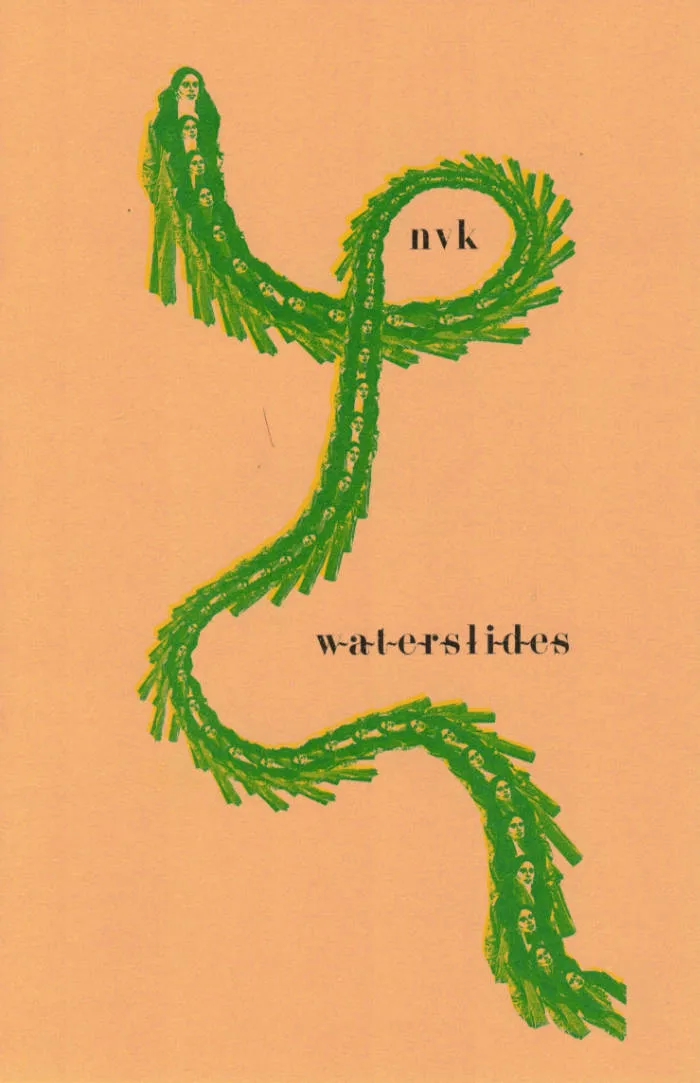
Waterslides
"Waterslides is a falling and plunging, short starts and stops aided by movement, until we splash, climb and plunge again. Each sliding is the same but different—with each descent new expectations and thoughts swirl, shifting focus and gaining new insights or blockages. Waterslides are brief moments of remembering, remembering as a present tense activity, one that happens as we think of it, projected on our now. The waterslide is the moment of past and present working in tandem, a movement of repeating, revisiting and remembering all at once.”
Written by nvk 2021-2023. Dedicated to Judi, MM & TNN.
A version of these poems was published as an audio work through Ignota Press’ The Mountain (2023) and included in a reading with James Loop on Montez Press Radio (2023). nvk would like to thank Jan Matthé, Stine Sampers and Michelangelo Miccolis for their patience & love.
This book was first presented at Kransen in Antwerp, May 6th 2023, with a performance by Sassy (costume by Rosa Schützendorf). Printed and bound at Risiko Press, Borgerhout. Cover image by nvk. Fonts: Adonis, Garamond Pro. Limited to 150 copies.
128x195mm, 16p., stapled, cover: green, yellow and black risoprint on 160gsm caramel paper, inside: black and blue riso on 120gsm Munken Pure paper.