Books
Books
published in 2023

La Maison des Maladies
Unica Zürn, Ruth Henry and 1 more
Unica Zürn dans La maison des maladies raconte, par un ensemble de textes et dessins, un séjour en hôpital où elle est soignée d’une jaunisse. Elle y écrit et compose ce carnet où le regard qu’elle pose sur son propre corps, les lieux qu’elle habite et les personnages qu’elle rencontre, témoigne d’une sensibilité hors-norme qui tire à la fantaisie, voire au délire.
Pour la première fois en France, La maison des maladies est publié intégralement.
Le texte est traduit de l’allemand par Ruth Henry & Robert Valençay. Un après-propos de Mathilde Girard clôture le livre.

a slight cast down at the edges of the lips
“a slight cast down at the edges of the lips brings together work from the last decade of Katherine Hubbard’s prolific practice, which intertwines analogue photography, writing, and live performance. Reproductions of exhibited prints, a selection of new photographs, and images created from within her performances are gathered here, along with four of the artist’s original written works. This publication marks the first occasion for Hubbard’s photographs and writings-for-performance to exist on the same scale, that of the book.”
— co-editor, Corrine Fitzpatrick
The book is accompanied by a poster with a full-scale detail reproduction of Katherine Hubbard's rip stop weave artwork, printed on glossy tissue paper.
Additional contributions by Zoe Leonard, Mónica de la Torre, Elisabeth Sherman, and Lynne Tillman. Edited by Corrine Fitzpatrick and Lara Mimosa Montes.

Lákíríboto
A twisty thriller about the fate of a sprawling family in Lagos, Lakiriboto is a queer, feminist revenge thriller like no other, in which murder, betrayal, and witchcraft collide – with explosive results.
When her grandmother dies in the night, Moremi’s fate falls to her uncle, the grasping family chief who sends her off to work as a housemaid in Lagos. On arriving there, Moremi finds that the big city is not all she thought it would be. But she’s not alone. After another family death, Kudirat, accused of bringing misfortune to her close family, has also been sent to live as a maid in the same house, scrubbing floors and folding laundry for long-suffering Tola, whose abusive doctor husband refuses to treat. Together, with the help of her queer aunt Morieba, the four women must wrestle back control of their lives as the patriarchal traditions that govern the family push back against their freedoms. When Tola’s condition worsens, someone new emerges, someone with revenge and redemption in mind.
Mixing family saga, mobster pulp, and queer coming-of age, Lakiriboto is a staggeringly original and surprising novel about Nigeria’s queer and feminist communities, the struggles they face, and the lengths they will go to to overcome them.

Strangers in Light Coats
Strangers in Light Coats is the third collection of Zaqtan's poetry to appear in English. It brings together poems written between 2014 and 2020 drawn from six volumes of poetry. Catching and holding the smallest particles of observation and experience in their gravity, the poems sprout and grow as though compelled, a trance of process in which fable, myth, and elegy take form only to fall apart and reconfigure, each line picked apart by the next and brought into the new body.
Ghassan Zaqtan is not only one of the most significant Palestinian poets at work today, but one of the most important poets writing in Arabic. Since the publication of his first collection in 1980, Zaqtan's presence as a poet has evolved with the same branching and cumulative complexity as his poems—an invisible system of roots insistently pushing through the impacted soil of political and national narratives.

Nest
Gregory Carlock, Christina Atik
“Ishtar said goodbye to the elephants, goodbye to the clowns, waved to a group of admirers who had gathered on East 43rd Street, and was ushered into a shiny new Escalade, which the NYPD reserved for such occasions. ‘I am the earth,’ she said, as the cops forced her head through the doorframe. The motorcade, fit for heads of state, went 40 down the West Side Highway, past rollerblading homosexuals and New School undergraduates, who held signs with slogans like ‘ISHTAR WE LOVE YOU!’ ‘ARREST ERESHKIGAL AND GILGAMESH,’ and ‘DOWN WITH CAPITALISM.’”
Nest is Gregory Carlock’s vision of Manhattan razed to the ground by Ishtar—Akkadian goddess of love, sex & war—following her liberation from NYPD arrest.
This poem, in 31 sections, combines the 4000-year-old Gilgamesh epic, pre-Islamic poetry, Sufi snippets & Carlock’s own Emily-Dickinsonesque rhymes to vent sulphurous @ New York/Washington’s rape’n plunder of Planetary Mind. Illustrated by the Lebanese artist, Christina Atik.

Thinking What We Are Doing #1: Sewing Books by Hand
Thinking What We Are Doing is a new essay series reflecting on making and contemporary publishing practice, co-published by Impractical Labor and Alder & Frankia. This small book is not a how-to about bookbinding, but rather about the observations, thoughts, and feelings that arise in the process of this patient and meditative labor. A reflective essay by ILSSA Co-Operator Local 917 Shop RC Emily Larned written while binding a large hand-sewn edition of her Alder & Frankia book Our daily lives have to be a satisfaction in themselves.

Traces of Enayat
Cairo, 1963: Enayat al-Zayyat’s suicide becomes a byword for talent tragically cut down, even as Love and Silence, her only novel, languishes unpublished. Four years after al-Zayyat’s death, the novel will be brought out, adapted for film and radio, praised, and then, cursorily, forgotten. For the next three decades it’s as if al-Zayyat never existed.
Yet when poet Iman Mersal stumbles across Love and Silence in the nineties, she is immediately hooked. Who was Enayat? Did the thought of her novel’s rejection really lead to her suicide? Where did this startling voice come from? And why did Love and Silence disappear from literary history? To answer these questions, Mersal traces Enayat’s life, interviews family members and friends, reconstructs the afterlife of Enayat in the media, and tracks down the flats, schools, archaeological institutes, and sanatoriums among which Enayat divided her days. Touching on everything from dubious antidepressants to domestic abuse and divorce law, from rubbish-strewn squats in the City of the Dead to the glamour of golden-age Egyptian cinema, this wide-ranging, unclassifiable masterpiece gives us a remarkable portrait of a woman artist striving to live on her own terms.
Winner of the 2024 James Tait Black Prize – Biography
Longlisted for the 2024 Jan Michalski Prize

Small Prints
This artist’s publication contains a sequence of unique letterpress monoprints, made by Dutch graphic designer Karel Martens between 2014 and 2022. The prints, which are both highly geometric and brightly coloured, are reproduced in the book at their actual size. Textual elements accent the various abstract shapes and repetitions on almost every page. ‘Small Prints’ is available in two different cover versions, which itself is the result of a printing experiment. By printing the contents of the book in three layers on a single print sheet, which was then cut and folded, variations in the cover emerged.
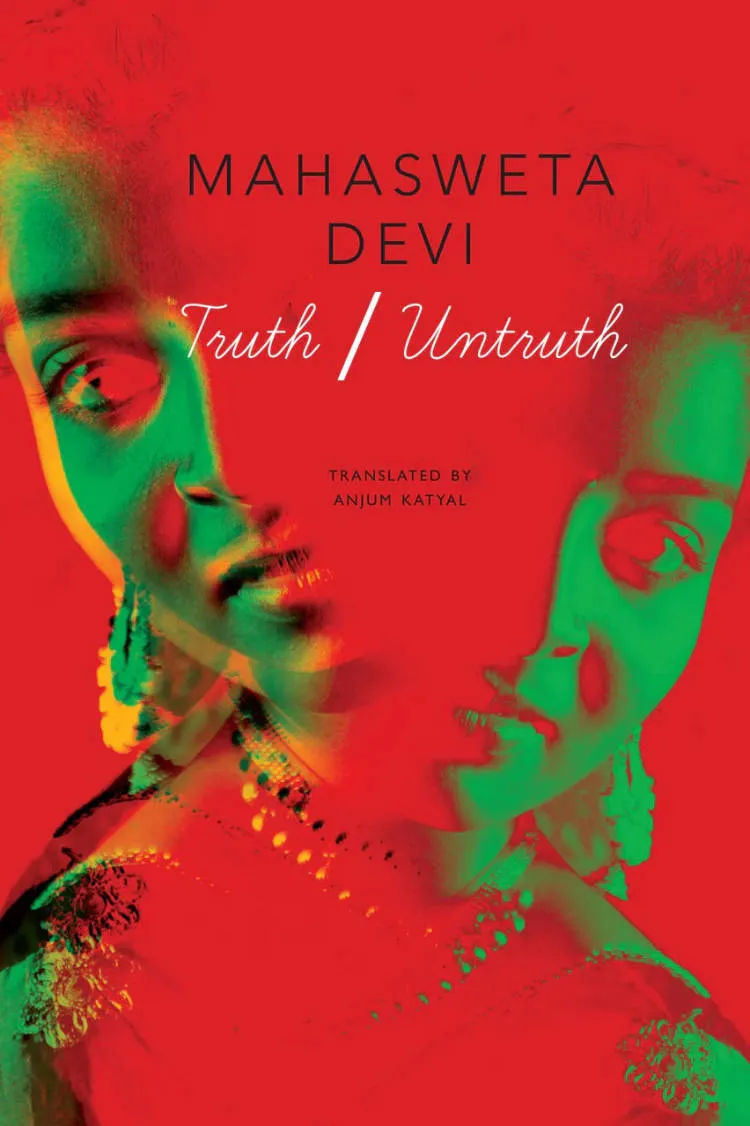
Truth / Untruth
A trenchant, darkly humorous, and unsentimental look at Calcutta society.
Set in Calcutta in the mid-1980s, Truth/Untruth is a fast-paced thriller built around the death of the pregnant Jamuna—a maid in a newly affluent residential apartment complex—and Arjun, the upwardly mobile businessman who seduced her. Packed with a cast of colourful characters, this novel is a trenchant, darkly humorous, and unsentimental look at the different segments of Calcutta society: from the middle-class culture vultures to the unscrupulous ‘promoter’ class and the domestic helpers and slum goons who form an intrinsic part of the city’s life. All are implicated in a complex web of guilt and bizarre twists and turns. Sex, lies, death—the great modernist themes—run like a thread through this book, exposing societal greed, lust, corruption, and moral hypocrisy with a sardonic tone that spares none. An unusual novel by an author who is otherwise known for her hard-hitting activist-feminist stories, Truth/Untruth underlines the exploitative vicious cycle that defines urban relations between the haves and have-nots.
‘Although not of the margins herself, Devi was accomplished in writing from the margins [ . . . ] However, it is indeed worth it if you are looking for an exhilarating social commentary and biting satire that remains relevant today. Devi also reflects the jargon and dialects of the lower classes as deftly as the peculiarities of upper-class speech patterns. A feat of this work is Katyal’s ability to mediate these multiple registers, rewarding the reader with sharp writing that is at once funny, sardonic, and darkly pleasurable to read.‘—Jack Greenbert, Cha: An Asian Literary Journal.

University of California Press
Novel Palestine
Palestinian writing imagines the nation, not as a nation-in-waiting but as a living, changing structure that joins people, place, and time into a distinct set of formations. Novel Palestine examines these imaginative structures so that we might move beyond the idea of an incomplete or fragmented reality and speak frankly about the nation that exists and the freedom it seeks. Engaging the writings of Ibrahim Nasrallah, Nora E. H. Parr traces a vocabulary through which Palestine can be discussed as a changing and flexible national network linking people across and within space, time, and community. Through an exploration of the Palestinian literary scene subsequent to its canonical writers, Parr makes the life and work of Nasrallah available to an English-language audience for the first time, offering an intervention in geography while bringing literary theory into conversation with politics and history.
NORA E. H. PARR is a Research Fellow at the University of Birmingham and at the Center for Lebanese Studies. She coedits Middle Eastern Literatures.

University of California Press
Ovid's Metamorphoses
This fresh translation revives the politics and power at play in classical mythology’s foremost source
Centuries of conservative translators have robbed the Metamorphoses of its subversive force. In this boldly lyrical translation, C. Luke Soucy revives the magnum opus of Rome’s most clever and creative poet, faithfully matching the epic’s wit and style while confronting the sexuality, violence, and politics so many previous translations have glossed over.
Soucy’s powerful version breathes new life into Ovid's mythic world, where canonical power dynamics are challenged from below to drain heroes of their heroism, give victims their say, and reveal an earth holier than heaven. Incorporating the latest scholarship alongside annotations, illustrations, and glossary, this edition brings fresh insights to both returning and new readers.

The Twofold Commitment
At once an artist's book and an interview collection by Vietnamese filmmaker, writer and feminist and postcolonial theorist Trinh T. Minh-ha (born 1952), The Twofold Commitment centers on Trinh's 2015 feature film Forgetting Vietnam, which takes up one of the myths surrounding the creation of Vietnam: a fight between two dragons whose intertwined bodies fell into the South China Sea and formed Vietnam's curving, S-shaped coastline. Commemorating the 40th anniversary of the end of the war, the film draws inspiration from ancient legend to stage an ongoing contemporary conversation between land and water, creating a third space, another way, for historical and cultural re-memory.
This book features the film's lyrical, essayistic script, along with rhythmically distributed movie stills. Expanding on this central focus is a series of conversations between the filmmaker and critics and film and sound studies scholars dating from 2016 to 2022, amplified by an index identifying key concepts and ideas in the artist's work.

Working Museum
"In Spring and All, William Carlos Williams figures imagination as the springing off point to greater connection with the world and its gentle motions. ‘It is spring,’ he writes: ‘life again begins to assume its normal appearance as of “today.” Only the imagination is undeceived.’ Embracing the haecceity of the everyday and allowing the imagination to make silent and surprising connections are ways to withhold the deceptiveness of relying on old habits of thinking and writing.
Ziddy Ibn Sharam’s Working Museum begins with another quotation from Spring and All: ‘There is not confusion – only difficulties’, and the sequence offers delicate, poetical examinations how the confusions and frustrations of interpersonal communication are beneficent difficulties to be embraced and considered in gentle depth. This is a gorgeous sequence of poems, offering generous, gracious and graceful glimpses of a family’s birthday pilgrimage to Amberley Museum and Heritage Centre in Sussex. Working Museum is a tour de force of delicate poetry of feelings and feeling through feelings in a world of wordless connections and contacts, navigating the liminal but intimately understood spaces between two brothers and their family. In these poems,
Sharam is trying to be still in language, as smiles, touches and profound intimacies are exchanged. Observing and being in his brother’s presence during this special time of spring, Sharam re-learns to experience, to become ‘plugged’ in, as he writes, to new ‘switchboards’ of sensation, thought and poetic possibility. The ‘old machines’ of mental expectation and habit are, in the presence of his other-sensing brother, found wanting for the appreciation of his ‘intellect just as it is’. Here, Sharam learns to ‘do things minimally’ and to revel in the ‘seismic proportions’ of the apparently mundane. Sharam and his readers are offered a space to share in a brother’s beautifully vivid world and are privileged to witness a profound, ‘beginning, // again." - Gareth Farmer

And most of all I would miss
Picture a pencil curved, implausibly, parabolically. An implement bending back on itself (core straining) so as to be drawing the surest line, even as its eraser-end is simultaneously rubbing that graphite out. What remains almost never was: mark as memorial to foreclosure. Examined from a certain angle, the un-line flickers in and out of thereness. On registration, it lives, it goes forth. Sub rosa, it knows never to clear its throat. It has learnt to calibrate its signature; it can evade infra-red. Propelling itself through the narrowest channels, it proceeds with resolve, flayingly. Mattar’s And most of all I would miss the shadows of the tree’s own leaves cast upon its trunk by the orange streetlight in the sweet blue darks of spring is taut as writing can be. The tone she makes sound is singular and desperately (gloriously) intent.
- Sarah Hayden
Piercing and lucid in its exposition of atmospheric violence and total erasure, Mira Mattar gets to the grain of how the languages of selfhood, mediated but also inhibited by the force of the ‘un-universal’, become complicit in forming the sovereign imperative to self-determination, ‘oh arrogant ambition / to transform / you & keep myself / plumed’, through the reproduction of a ‘contested field / of meaning’, one both marked by the lure and ruse of psychic stability as the real fantasy of occupation, and immanent to concrete, unknown modes of personal resistance and collective recovery thread like a ‘rope / in a knot in a line / of knots’, an inherited ‘excess of memory / mostly portal.’ Mattar carefully gleans in its undecidability, given over to moments of precarious decision without ties or duplicity.
- James Goodwin

Women on Film
What is real? In Women on Film, Naomi Weber asks why it can be so hard to know. Who or what invents and reinvents the world? Why do we become estranged from each other? Why does everybody hate women, and how do we miss when they’re doing it? Channelling the deep questioning and speculative mode of Cold War-era Rukeyser and Oppen, and torquing it through the ambivalent femininity of Anna Karina’s French new wave, Weber’s poems ask for courage from their reader. They fold the melodrama of an orchestra into the moment when a village acquires a clock. They show us how a thousand minor masculinities are in fact a fucking car crash. Humorous and warm, cutting and bright, Weber is a master of line breaks and charming diction, and she is writing some of the best new work I’ve read in years.
- Amy De’Ath

Verlag der Buchhandlung Walther König
in the coherence, we weep
“in the coherence, we weep is both an artist book and an exhibition. The project is about the critical potential of incoherencies. It is an attempt to map methodology across media, while welcoming glitches that allow for moments of critical self-reflection and knowledge production. Developed in parallel, the book and exhibition critically reflect on each other’s approaches. It looks at strategies for how text can be alive and vibrant across various architectural contexts as well as those used in the artist’s family archive, particularly annotation, redaction, indexing, blurring, and learning through reading and writing.” - KW Institute for Contemporary Art
“Multilayering was in that sense an important aspect, which got translated with the material and the design by choosing papers with differents gradients of transparency, as well as interfering and overlapping text layouts. We also designed the cover with a blue scratch off drawing on top of another artwork, so every book might change a bit over time depending on the use. This reflects the artist‘s idea of including the audience and an ever changing oeuvre, where the relation between pieces become important too.” - Studio Pandan
Texts by Dr. Christina Landbrecht, Krist Gruijthuijsen, Sofie Krogh Christensen, Chang Yuchen, Ladi'Sasha Jones
This artist book is published on the occasion of Kameelah Janan Rasheed’s Schering Stiftung Award for Artistic Research 2022 solo exhibition at KW Institute for Contemporary Art (2023).

Pleasant Place 3: Compost
Allow us to introduce to you, the meaning of life, Compost Almighty.
Including:
“I’m orange peels, I’m coffee grounds, I’m wisdom” – Marjory the Trash Heap tells the future
Compost: An introduction – what, why and how to compost, with illustrations by Noa Zuidervaart
Comfrey Cocktail – make your own Comfrey Feed
Worms are great and this is why – an ode to worms by Joline van Berkestijn with images by Jaap Scheeren
What to do with a whole lot of poo – Ton Hilhorst and Savitri Groag from Artis, the Amsterdam zoo, about their compost-system that thrives on elephant poo
Digital Compost – composting in Minecraft, the biggest videogame in the world
A set of garden miniatures by Hanna Something
The cover and inside cover are by Lou-Lou van Staaveren and Guus Kaandorp and graphic design is by fanfare

Unbidden Tongues #8: Feelers
Unbidden Tongues #8: Feelers brings together three photographic series by artist and activist Alexis Hunter. In a storyboard-like fashion, her ‘photo narrative sequences’ forensically detail her manhandling of artefacts of patriarchal oppression through the caressing touch of an array of characters: the Marxist's wife, an interventionist secretary and a manicured mechanic. Born in New Zealand, Hunter moved to the United Kingdom in 1972 where, at the age of twenty-four, she joined the Women’s Workshop of the Artists Union and invested devotedly in feminist organising alongside her artistic practice.

A Witch Recipe for Grievers
"Sometimes nothing can be done to change things, and hurt and anger must be transmuted . . ."
This essay was originally published in 1984 as the last recipe in a Bloodroot Collective feminist vegetarian cookbook (see Our daily lives have to be a satisfaction in themselves which includes this essay as a chapter).
This new version is completely redesigned as a ritual object to be given to a friend in mourning. Hand-sewn, and illustrated with New England gravestone rubbings, the uncut pages are intended to be cut by the recipient as they read the book.
Emily Larned's Alder & Frankia Efemmera Reissue series amplifies, graphically reinterprets, and recirculates historic feminist ephemera. Each issue is different in form. What ideas, strategies, and tactics from the past can we borrow to bring forth a feminist future? A Witch Recipe for Grievers is Efemmera Reissue #5.

For the Love of Cookie Mueller
For the Love of Cookie Mueller attempts to capture some of our favorite aspects of Cookie Mueller, mostly her good humor and absurdity. A girl who just stumbled onto wildness, Cookie became a counter cultural icon, a writer, a mother, a victim of Governmental negligence but she never let a thing get her down. Cookie Mueller is a guru of the 20th century. In today’s era of war and political instability, her writing feels more important today than ever. This is for hardcore Cookie fans and novices alike.

Le Sacrifice comme acte poétique
Angélica Liddell, Christilla Vasserot
Mise en scène, écriture – pièces de théâtre, poésie, récits, journaux – et présence sur scène : tout est lié chez Angélica Liddell. L’art et la vie, la fiction et la biographie, la création poétique et la réflexion théorique entretiennent les uns avec les autres des liens évidents et complexes. Ce volume inclut une série de textes qui, depuis une perspective théorique, éclairent en partie la pratique théâtrale de leur auteur, contribuant à la construction d’une poétique toujours inachevée, basée sur une expérience vitale.
Dans cet essai recueillant douze conférences et entretiens, Angélica Liddell évoque la création artistique ainsi que son processus dramaturgique très organique et très violent car « la violence poétique est nécessaire pour combattre la violence réelle ».
-
Direction, writing—plays, poetry, stories, journals—and stage presence: everything is interconnected in Angélica Liddell’s work. Art and life, fiction and biography, poetic creation and theoretical reflection maintain obvious yet complex connections with one another. This volume includes a series of texts that, from a theoretical perspective, shed light on the author’s theatrical practice, contributing to the construction of an ever-unfinished poetics rooted in lived experience.
In this essay, which brings together twelve lectures and interviews, Angélica Liddell discusses artistic creation as well as her highly organic and violent dramaturgical process, for “poetic violence is necessary to combat real violence.”

Last Movies
A publication, durational artwork, and moving-image experience, Schtinter’s debut collection, Last Movies, is an alternative account of the first century of cinema according to the films watched by a constellation of its most notable stars shortly before (or at the time of) their deaths.
An extensive and exhaustive research project—a holy book of celluloid spiritualism and old canards—Schtinter questions and reconfigures common knowledge to recast the historic column inches of cinema’s mythological hearsay into a thousand-yard stare.
Via a series of interlinked vignettes, here we’ve a book in which Manhattan Melodrama, directed by W.S. Van Dyke and George Cukor, is seen by American gangster John Dillinger, only for him to be gunned down by federal agents upon leaving the cinema. In which George Cukor watches The Graduate and dies thereafter. In which Bette Davis—given her break by Cukor—watches herself in Waterloo Bridge (the 1940 remake Cukor had been meant to direct), before travelling to France and failing to make it back to Hollywood. In which Rainer Werner Fassbinder watches Bette Davis in Michael Curtiz’s 20,000 Years in Sing Sing, and suffers the stroke that kills him. In which John F. Kennedy watches From Russia with Love at a private ‘casa-blanca’ screening prior to the presidential motorcade reaching Dealey Plaza; in which Burt Topper’s War is Hell exists only in a fifteen-minute cut, considering this is as much as Lee Harvey Oswald would have seen at the Texas Theatre in the wake of JFK’s killing.

Blood On The Tracks
John Joe Kane, Vladimir Nahitchevansky
Blood On The Tracks is an elaboration and cacophony of manic friendship, eroticism and poetic play. Writing into the lyrical text of Bob Dylan's 1975 Album of the same title, the two authors take inspiration from Raymond Roussel's generative mode of translation, and quickly transform the lyrics of Blood On The Tracks into a variety of languages, to then translate these lyrics back into the English text present in the book. The result is a complicated and combative free wheeling text that explores the possibility of co-authorship, and interpretive translation. Featuring a forward by confirmed tramp, filmmaker and photographer Bill Daniel.

Ten Week Garden
What is this life if, full of care,
We have no time to stand and stare? –
A facsimile of a 1973 Something Else Press gardening book – the press had then relocated to Vermont, with a shift towards the publication of such lifestyle guides. Hand-drawn and ilustrated by Linda Larisch.