ReadPalestine
ReadPalestine

Ungrounding: The Architecture of Genocide
Eyal Weizman is one of the world’s leading experts on the relationship between violence, conflict and the environment, both built and natural. As director of the organisation Forensic Architecture, he and his team of interdisciplinary researchers document acts of state crimes and human rights violations around the world. Since 2023, the group has worked to produce evidence for the International Court of Justice’s genocide case against Israel.
In this revelatory new project, Weizman draws on that research to bring us on an eye-opening journey across time and into the 'deep cartography' of the area extending from Gaza’s subterranean tunnels through to its militarised topography, its unique soil, settlements and barriers. He catalogues, in unflinching and forensic detail, the Israeli campaigns of violence and displacement that have reshaped the region in an effort to make Gaza and its surrounding areas unliveable. Taking us through the broader geographic and historical context, from the Nakba in 1948 to the present day, Ungrounding establishes that architectural and territorial analysis is key to understanding the relationship between coloniser and colonised – and how Israel’s actions after 7 October escalated into violence so extreme and so far-reaching as to, Weizman argues, meet the definition of genocide.
Deeply informative and profoundly affecting in its scope and precision, and illustrated with dozens of original images, maps and diagrams, Ungrounding is an essential document of atrocity in our time.

Palestinian Resistance Literature Under Occupation, 1948-1968
Ghassan Kanafani’s remarkable extended essay Palestinian Resistance Literature Under Occupation, 1948–1968 is an unyielding act of cultural and political endurance. Writing in the wake of Israel’s devastating territorial expansion in 1967, Kanafani elaborates his theory of resistance literature and offers a visceral account of life under occupation. Translated for the first time into English by one of the greatest living translators from Arabic to English, Tarif Khalidi, Kanafani’s essay offers one of the sharpest social and political analyses of life in Palestine in this early period of occupation.
In the two decades following the Nakba, Palestinian writers undertook the gruelling task of advancing a cultural struggle to protect their language, culture, and heritage. In addition to Kanafani’s groundbreaking essay, the book includes a selection of poetry, prose, and dramatic writing curated by Ghassan Kanafani himself. Alongside writing from Mahmoud Darwish, Hanna Abu Hanna, and Samih al-Qasim, among many others, Kanafani’s essay and the accompanying pieces stand as a defiant declaration of cultural survival in the wake of Israeli expansion.
This first English edition of Palestinian Resistance Literature Under Occupation is a joint publication with the Institute for Palestine Studies.

Men in the Sun: And Other Palestinian Stories
A classic of Arabic fiction and of what Kanafani termed ‘resistance literature’
Three Palestinian men embark on a brutal and treacherous odyssey across the Iraqi desert to Kuwait, not for liberation but material betterment. Under the indifferent brutality of border bureaucracy and the blank aggression of the sun, things grow increasingly oppressive. Breezily conversational and disarmingly lyrical, this short novel delivers a shuddering dose of horror.
Collected here alongside the titular novella are six short stories, including the timeless, resonant ‘Letter from Gaza’, Kanafani’s first published work.

The Sleep Thief
‘Sleep thief is what the interrogator called me. I’ll never forget that. I would steal a few seconds of sleep so I could remain steadfast before them. The name stuck; I even dreamt about it, the same dream, night after night. I woke up not knowing what to do and drenched in sweat.’
The experimental first novel from International Booker-Prize longlisted Palestinian author Ibtisam Azem, The Sleep Thief follows the life of Gharib (“the Stranger”) Haifawi as he comes of age, is drawn into resistance, makes friends, meets lovers, pushes back against traditional values, longs to be free of the labels and expectations that burden him, rails against the commodification of suffering, and dreams of a Palestinian identity that will transcend sorrow.

Falastiniyyat: A Century of Palestinian Feminisms
From early pioneers to modern-day revolutionaries: the resilience and centrality of feminists in the Palestinian Liberation Movement.
Women have been central to every phase of Palestinian resistance. Here Nada Elia recovers the long-suppressed story of Palestinian women’s organizing from 1929 to the present. Far from being a Western import, local feminism consistently linked personal empowerment with collective liberation, anticolonial struggle with social transformation. In the time of the Mandate, Matiel Mogannam confronted British imperialism through the Arab Women’s Congress. In the following decades, Camille Odeh built Arab American solidarity networks. Their legacy continues today in the work of contemporary activists fighting femicide and pinkwashing throughout the world.
Falastiniyyat rescues Palestinian feminism from obscurity. Furthermore, Elia argues that these activists were pioneers of a uniquely intersectional, anti-imperial feminist politics.

Almond Blossoms and Beyond
Mahmoud Darwish, Mohammad Shaheen
The first English translation of recent poetry by the late Mahmoud Darwish, the most important Palestinian contemporary poet.
Almond Blossoms and Beyond is one of the last collections of poetry that Mahmoud Darwish left to the world. Composed of brief lyric poems and the magnificent sustained Exile cycle, Almond Blossoms holds an important place in Darwish’s unparalleled oeuvre. It distills his late style, in which, though the specter of death looms and weddings turn to funerals, he threads the pulses and fragilities and beauties of life into the lines of his poems. Their liveliness is his own response to the collection’s final call to bid “Farewell / Farewell, to the poetry of pain.”
Mahmoud Darwish, born in 1941 in the village of al-Birweh, Palestine, was the author of over two dozen volumes of poetry and prose. When he died in the summer of 2008, he was mourned throughout the world as a voice of the Palestinian people—author of their official declaration of independence and, most importantly, a poet of the highest invention and beauty. Mohammad Shaheen is a professor of English at the University of Jordan. Amro Naddy has worked as an editor at the Virginia Quarterly Review. He teaches at the King’s Academy in Amman, Jordan.

On ne bombardera jamais ma voix
Yahya AL Hamarna, Elissa Kayal and 1 more
« On ne bombardera jamais ma voix » est un recueil de poèmes écrits depuis le génocide en cours à Gaza. Yahya AL Hamarna y documente les brutalités de la guerre ainsi que les rituels fragiles de la vie quotidienne : étudier, se promener dans le parc, lire de la poésie, préparer du thé, pleurer, survivre. De l’intimité exiguë des tentes de déplacés à la sérénité imaginaire des cours universitaires et des matchs du Réal Madrid, AL Hamarna élabore une poétique de la survie : une poétique qui refuse le désespoir et insiste sur la dignité invincible du peuple palestinien.
Préface : Elissa Kayal
Postface : Alycia Dufour

The Fantasy and Necessity of Solidarity
From award-winning writer Sarah Schulman, a longtime activist and critic of the Israeli war on Gaza, comes a brilliant examination of the misunderstood concept of solidarity which seeks to provide a new vision of what it means, and why it matters.
In this nuanced analysis, Schulman challenges the traditional notion of solidarity as a simple union of equals, arguing that in today’s world of globalized power structures, true solidarity requires the collaboration of bystanders and conflicted perpetrators with the excluded and oppressed. Schulman examines a range of case studies, from the fight for abortion rights in post-Franco Spain, to NYC’s AIDS activism in the 1990s, to the current wave of protest movements against Israel’s genocide of the Palestinian people, and her own experience growing up as a queer female artist in male dominated culture industries. Reckoning with the successes and failures of these movements, she argues that action always comes at a cost, despite not always being effective. But without solidarity we are stuck with the status quo, and we lose any hope of progressive change.
By turns challenging, inspiring, pragmatic, and poetic, The Fantasy and Necessity of Solidarity provides a much-needed path for how we can work together towards justice now and for the future.

Strangers in Light Coats
Strangers in Light Coats is the third collection of Zaqtan's poetry to appear in English. It brings together poems written between 2014 and 2020 drawn from six volumes of poetry. Catching and holding the smallest particles of observation and experience in their gravity, the poems sprout and grow as though compelled, a trance of process in which fable, myth, and elegy take form only to fall apart and reconfigure, each line picked apart by the next and brought into the new body.
Ghassan Zaqtan is not only one of the most significant Palestinian poets at work today, but one of the most important poets writing in Arabic. Since the publication of his first collection in 1980, Zaqtan's presence as a poet has evolved with the same branching and cumulative complexity as his poems—an invisible system of roots insistently pushing through the impacted soil of political and national narratives.

Discontent Issue 6
Reportage, photography, and art from Palestine and Lebanon. Contributors include Alaa Mansour, Fady Joudah, Farah Silvana-Kanaan, Fatima Joumaa, Fouad Elkoury, Hadi Afif, Islam Al-Khatib, Philippa Dahrouj, Rawad Wehbe, Sakir Khader, and Wassila Abboud.

Land Keepers
EcoRove’s Land Keepers Reader brings together writers, activists, journalists, farmers, and ecologists from across Bilad al-Sham — Lebanon, Syria, and Palestine — to tell stories of green resistance in the Jabal al-Sheikh ecological zone. Spanning South Lebanon, the occupied Jawlan, and the occupied Galilee, this landscape faces ongoing ecocide, defined as the deliberate destruction of land and ecologies used by the settler-colonial regime to erode livelihoods, cultures, and environments. The Reader highlights these struggles through essays, research and testimonies that show how native communities remain rooted in place, resisting colonial environmental orientalism, greenwashing, and scorched-earth tactics. As part of a wider body of work that includes a documentary film, tapestries, and sculptural pieces, the Reader amplifies indigenous ecological knowledge and envisions regenerative futures for threatened landscapes.
with contributions by Mahdi Sabbagh, Hamza Hamouchene, Public Works, Hussein Chaabane, Hisham Younes, Nadine El-Khoury, Michelle Eid, and Munira Khayyat
From the intro by Ecorove:
"Return, Al’Awda in Arabic, signals the right of return to homeland, a central tenet of the Palestinian struggle. Al’Awda affirms the fundamental historical, legal, collective, and individual right of Palestinians to return to their homeland. But how do we return to the earth after it has been damaged and scorched? In landscapes marked by war, ruins, rubbles, and ecological destruction, can Al’Awda take another form? Can generations of Palestinian diaspora exercise Al’Awda differently? At a time when international legal systems and institutions have failed to secure justice, can return to land be understood beyond legal definitions alone? In times of mass displacement and ecological devastation, Al’Awda may therefore exceed juridical meaning, and live through those who remain on the land and their acts of love, labour, and agriculture."
Each book comes with a 2-color, double-sided risograph-printed bookmark.
Ecorove is Iyad Abou Gaida and Jumanah Abbas.
CUNY Center for the Humanities
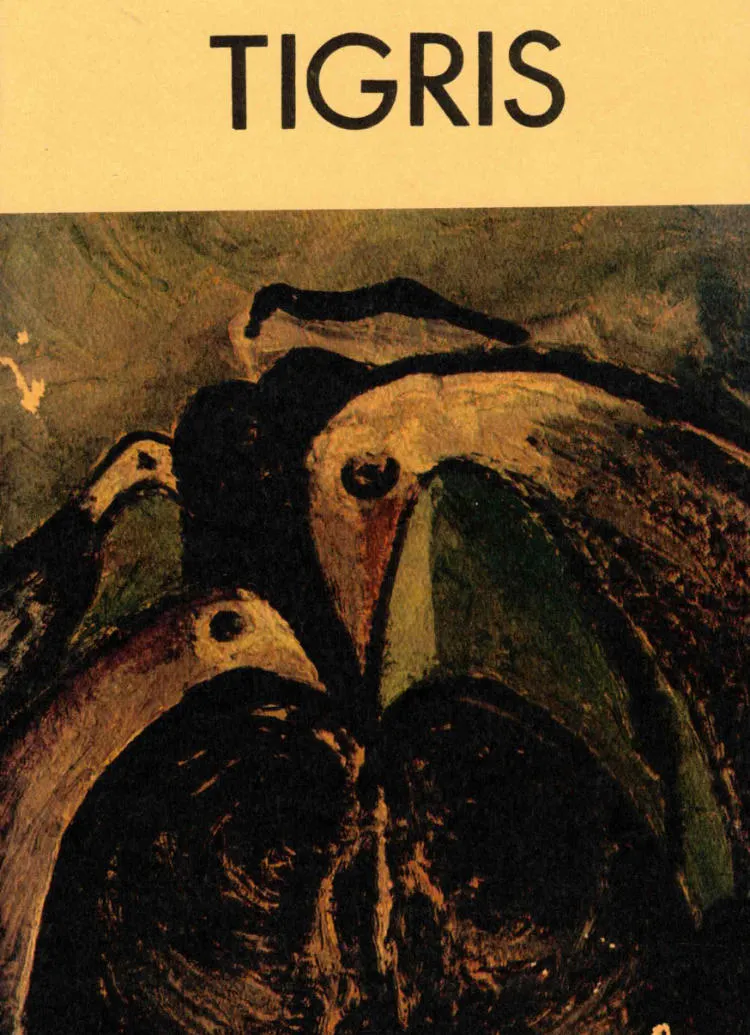
Tigris Vol. 1
In 1971, the great Iraqi poet Sargon Boulus (1944-2007) published a single issue of an English-language literary anthology that he called Tigris. The magazine—a whisper on the literary landscape that appeared three years after Boulus’s arrival in the US—brings together work by Boulus and several of his literary friends, in translation by Boulus and Etel Adnan.
Tigris was not an end in itself, but rather a temporary solution to the lifelong problem of how to devote oneself to poetry across different countries, eras, and styles: how to live poetry. Yet, in so doing, the small anthology includes significant work: Etel Adnan’s “Jebu,” translated by Adnan, and poetry by Boulus, Fouad Rifkah, Yusuf al-Khal, Mouayad al-Rawi, and Riadh Fakhouri, all in Boulus’s translations, as well as a work by Ankido, a “street-activist poet-café worker of importance to the Palestinian Liberation Movement.”

Testimony From A West Bank Village: ‘Illegal Life’ Under Occupation
Various
Resistance dispatch 002
In 2024, the documentary No Other Land, co-produced by Palestinian and Jewish activists from Masafer Yatta drew internattional attention at film festivals, bringing the long-standing occupation, demolitions, and violence in the region into broader public view.
The starting point of this publication emerged from an impromptu decision to draw a family tree covering roughly five hundred villagers of Umm al-Kheir. The author follows two threads simultaneously: one traces verifiable institutional and geographic transformations, tracking how a community is systematically rendered illegal through planning regimes and court rulings; the other comes from lived encounters, oral testimony, and the moments when people entrusted me with their names, their kinship ties, and their past.

University of California Press
Novel Palestine
Palestinian writing imagines the nation, not as a nation-in-waiting but as a living, changing structure that joins people, place, and time into a distinct set of formations. Novel Palestine examines these imaginative structures so that we might move beyond the idea of an incomplete or fragmented reality and speak frankly about the nation that exists and the freedom it seeks. Engaging the writings of Ibrahim Nasrallah, Nora E. H. Parr traces a vocabulary through which Palestine can be discussed as a changing and flexible national network linking people across and within space, time, and community. Through an exploration of the Palestinian literary scene subsequent to its canonical writers, Parr makes the life and work of Nasrallah available to an English-language audience for the first time, offering an intervention in geography while bringing literary theory into conversation with politics and history.
NORA E. H. PARR is a Research Fellow at the University of Birmingham and at the Center for Lebanese Studies. She coedits Middle Eastern Literatures.

Freud and the Non-European
In this influential lecture, Edward Said explores Freud’s foundational work Moses and Monotheism to rethink the relationship between identity, politics and psychoanalysis. The result is a study illuminating both Freud’s thinking and that of Said, on whom the great psychoanalyst was a formative influence.
Was Moses Jewish or an Egyptian? The question undermines any simple ascription of identity, highlighting the limits of these categories. Said suggests that such an unresolved, nuanced sense of identity might, if embodied in political reality, form the basis for a new understanding between Jews and Palestinians. In contrast, Israel's relentless march towards an exclusively Jewish state denies any sense of a more complex, inclusive past.
With an introduction by Christopher Bollas and a response by Jacqueline Rose.

SABR N°04 - Half a life
“Perhaps much of what we once believed was never truth but a gentle and necessary illusion.It was something we chose quietly and almost unconsciously so we could continue without falling apart.”
Bayan Abu Nahla is a visual artist born in 2001 in Gaza, Palestine. Her artistic practice functions as a visual diary, documenting and reflecting rapidly evolving events, both before and after the genocide. Through her work, she explores realities and daily living conditions often unknown to those who have not lived in Gaza.
SABR/Collection is a series of publications that bring together short literary works in a variety of genres. Curated by Nesrine Salem, SABR/Collection wishes to highlight the macro-realities of the authors chosen, to make visible the intersectional nature of struggles.

And most of all I would miss
Picture a pencil curved, implausibly, parabolically. An implement bending back on itself (core straining) so as to be drawing the surest line, even as its eraser-end is simultaneously rubbing that graphite out. What remains almost never was: mark as memorial to foreclosure. Examined from a certain angle, the un-line flickers in and out of thereness. On registration, it lives, it goes forth. Sub rosa, it knows never to clear its throat. It has learnt to calibrate its signature; it can evade infra-red. Propelling itself through the narrowest channels, it proceeds with resolve, flayingly. Mattar’s And most of all I would miss the shadows of the tree’s own leaves cast upon its trunk by the orange streetlight in the sweet blue darks of spring is taut as writing can be. The tone she makes sound is singular and desperately (gloriously) intent.
- Sarah Hayden
Piercing and lucid in its exposition of atmospheric violence and total erasure, Mira Mattar gets to the grain of how the languages of selfhood, mediated but also inhibited by the force of the ‘un-universal’, become complicit in forming the sovereign imperative to self-determination, ‘oh arrogant ambition / to transform / you & keep myself / plumed’, through the reproduction of a ‘contested field / of meaning’, one both marked by the lure and ruse of psychic stability as the real fantasy of occupation, and immanent to concrete, unknown modes of personal resistance and collective recovery thread like a ‘rope / in a knot in a line / of knots’, an inherited ‘excess of memory / mostly portal.’ Mattar carefully gleans in its undecidability, given over to moments of precarious decision without ties or duplicity.
- James Goodwin

Affiliation
Mira Mattar, Judith Abensour and 1 more
Affiliation, de Mira Mattar, autrice londonienne issue de la diaspora palestinienne, explore des thèmes tels que le genre, la famille, la religion, la guerre, l’écologie, le colonialisme et l’amour, en lien avec des lieux comme la Jordanie, le Liban, la Palestine et le Royaume-Uni. Interrogeant nos affiliations personnelles et collectives, et la manière dont les systèmes de pouvoir influencent nos désirs et nos identités, le livre s’ouvre sur quatre Lettres d’Amman qui propulsent le texte poétique dans le mouvement du monde et attestent de la dynamique de l’exil palestinien, où l’éclatement, l’effacement et l’appropriation se mêlent avec les effets contemporains de la mondialisation.
La deuxième partie du livre, intitulée Affiliation (pour mon père) est un long poème rétrospectif qui court sur une trentaine de pages. L’écriture à la première personne de Mira Mattar met en tension des contextes politiques, domestiques, intimes, économiques où se déploient des affiliations coloniales, capitalistes, patriarcales, nationalistes. Elle en restitue les violents processus internes, passant du refus de se soumettre à l’impossible échappée. Dans Affiliation, on fait l’expérience d’être en dehors: en dehors de son corps, en dehors d’un pays, en dehors d’une pièce. Il n’y a aucune position stable, et le sujet se construit dans un éclatement constant. Peu de livres articulent aussi finement expérimentation formelle et nécessité de l’expression verbale. Affiliation est un flux de langage dont on peut sentir l’urgence à chaque vers.

Intifadas
A subversive collection about Palestinian resistance, liberation and art.
Written across Palestine and its diaspora—from Gaza and the West Bank to the United States—Intifadas is a subtly transgressive poetry collection about uprising in its many forms—in art, politics, and in our most personal relationships. Whether by dumping black paint on a park where a tank and fighter jet commemorate a war, or by trying to rescue a moth trapped in a garage, the defiant and resilient voices in this collection subvert traditional narratives of loss. Furious, tender, and darkly funny, Intifadas asks what art can do in the face of catastrophe, and answers with poems that refuse easy consolations.

Tripwire 23 - Work/Anti-work
Work/Anti-work issue with writing by Nat Raha /. lisa minerva luxx /Ghayath Almadhoun, trans. Catherine Cobham / Jacqui Germain / Jazra Khaleed, trans. Peter Constantine / Finn Finneran / Cait O’Kane / Rebecca Kosick / Lara Durback Skye /Lotta Thießen / William Rowe / Danny Hayward / Rona Lorimer / Zoe Beloff / Jike Ayou, trans. Yě Yě / Miguel de Vallester, trans. Erasmo Pantoja / Lucas Martínez / ko ko thett / Hung Q. Tu / Raymond de Borja / etaïnn zwer, trans. Ilan A.L.S. Erikson Weisbrod / Annie Raab on Taylor Portela / Rachael Guynn Wilson on Lyn Hejinian / Will Rowe on Danny Hayward / Chloe Watlington on Joshua Clover.

Prisoner of Love
Starting in 1970, Jean Genet—petty thief, prostitute, modernist master—spent two years in the Palestinian refugee camps in Jordan. Always an outcast himself, Genet was drawn to this displaced people, an attraction that was to prove as complicated for him as it was enduring. Prisoner of Love, written some ten years later, when many of the men Genet had known had been killed, and he himself was dying, is a beautifully observed description of that time and those men as well as a reaffirmation of the author’s commitment not only to the Palestinian revolution but to rebellion itself. For Genet’s most overtly political book is also his most personal—the last step in the unrepentantly sacrilegious pilgrimage first recorded in The Thief’s Journal, and a searching meditation, packed with visions, ruses, and contradictions, on such life-and-death issues as the politics of the image and the seductive and treacherous character of identity. Genet’s final masterpiece is a lyrical and philosophical voyage to the bloody intersection of oppression, terror, and desire at the heart of the contemporary world.

Every Moment Is a Life: Gaza in the Time of Genocide
susan abulhawa, Huzama Hubayeb
In early 2024, writer and activist susan abulhawa managed to enter Gaza twice through the Rafah crossing. There, at the Culture and Free Thought Association, susan held a series of workshops for young people who had been displaced to tent encampments. The lives of all participants were marked by unrelenting Israeli violence and extraordinary loss—of home, family, safety, education, electricity, and all the structures of life. They’d fled from place to place as Israel’s colonial violence swirled around them, complete with food and water insecurity and constant threat. Still, despite the bitterness of life in tents and the dangers of travel, they came together to share in the refuge of writing and community.
Samya recounts a tender moment with an old man mending shoes in the street, while her cousin Saja hides books in her closet, hoping they and her home will still be there when she returns. Ghassan is haunted by the baby he rescued from the rubble, who for a time became his son. Fatima risks it all retrieve her clothes from a danger zone buzzing with drones and warplanes. Maram’s loving aunt is gone, and chaos inhabits Amr’s mind. Samah, Lubna, Rizq, and Nebal take us by the hand through raining death, trails of tears, classroom shelters, and shared clothes in crowded tents.
Every Moment Is a Life delivers rare, unfiltered portraits of life under genocide, platforming the emerging voices struggling to survive in Gaza today. These essays are raw and real, capturing human moments—buying bread, going to the bathroom, sharing a meal, drinking coffee—all set against the backdrop of history’s first livestreamed ethnic cleansing. With courage, anger, love, agony, and—impossibly—hope, these achingly tender voices from Gaza will stay with us, captured in these pages, forever.

The Hungering Years
Utterly magnetic, Summer Farah’s debut poetry collection The Hungering Years is a rush of breathless song, voicing confessions so often left unsung amidst personal and collective crisis. “I am afraid of asking the right questions,” Farah admits. But through intimate conversations with fellow Arab-American writer and literary ancestor Etel Adnan, this work finds the courage to ask: What is art? An escape? A reflection? Another unhealthy attachment? Though the answers are elusive, what steps into the light is a collective of friends whose genuine care and companionship anchor these poems through their spiraling search.
“I am always looking for Palestine, and yes, I am always looking for love,” these poems croon, holding so much of the world even as they trace an inheritance of displacement. The Hungering Years conjures startling landscapes where we may also experience what it is to be consumed by obsession, echoing with songs by Mitski, iconic scenes from Supernatural, and the sound of the Mediterranean Sea. But as Lena Khalaf Tuffaha writes in her introduction, Farah’s repetitions “are more than echo. They are a vernacular of this unspeakable era,” anchored in “questions that keep us reaching toward life,” and questions toward each other.
Building glass structures from her questions, Farah pushes their architecture almost to breaking. Then breaking, the spirit—luminous, actualized—reveals itself through the cracks. Through the landscapes of California, Palestine, and all of the distances in between, there emerges a new sense of devotion to what is possible which might thrust us, together, “off the edge, / in love, towards God.”
With an introduction by poet, essayist, and translator Lena Khalaf Tuffaha.
Summer Farah’s debut collection The Hungering Years bubbles with language, is desirous, sensitive, and hysterically (ferociously) human. “I” is I, is mother, is the guiding wisdom of Etel Adnan, is Palestine, is the work that writes Palestine into the future, is the epistolary thread of love that holds this daring young poet’s work together. “i am an enemy of dust i am an amalgamation of everyone i have ever loved …” writes Farah, enlisting us in this vital poetry against the death cult, lush with solidarity, teeming with the futurity we need. — Wendy Xu, author of The Past
What I most adore about Summer Farah's work, and what most comes alive in The Hungering Years is that there is no such thing as an unworthy affection, nothing unworthy of close and careful attention, nothing unworthy of being pressed up against the undeserving world and becoming something greater. This is a gift and a delight, and through that gift, these poems are richly and generously populated, and teeming with beauty. — Hanif Abdurraqib, author of There’s Always This Year
Summer Farah's words ease me, compel me, motivate me. Her work is agile and brilliant, her mind potent and illustrious—like air, a song, rhythmic and concise. These poems move me to my core, rupturing something deep inside of me about place, Palestine and Etel Adnan. "I memorize no language/but their voices," she writes as I memorize her words again and again, uttering gratitude that I get to be alive and read Summer's words. This book is both a spell and an oracle. — Fariha Róisín, author of Survival Takes a Wild Imagination

Là
Laszlo Umbreit, Sirah Foighel Brutmann and 1 more
Là is an immersive, politically charged sound journey – a lament for the Al Naqab desert in Palestine. It is the result of a collaboration between Sirah Foighel Brutmann, Eitan Efrat, Laszlo Umbreit, and Ot Lemmens. The album combines acoustic instruments like flute and cymbals with processed electronics and mechanical sounds.
The track Ensemble is made from sound recordings of eleven 16mm film projectors, playing simultaneously and in intervals, creating a texture centered around a single pitch – La/A.
The tracks For Her, There, and No are recordings of live sessions played by Laszlo Umbreit and Eitan Efrat.
The album also features an extended text by Rose Higham-Stainton titled Strategies for Survival, spread across a 12-page booklet.