rile*books

Search books

Search books by title, author, publisher, keywords...

Cover of The Hungering Years

Host Publications

The Hungering Years

Summer Farah

€20.00

Utterly magnetic, Summer Farah’s debut poetry collection The Hungering Years is a rush of breathless song, voicing confessions so often left unsung amidst personal and collective crisis. “I am afraid of asking the right questions,” Farah admits. But through intimate conversations with fellow Arab-American writer and literary ancestor Etel Adnan, this work finds the courage to ask: What is art? An escape? A reflection? Another unhealthy attachment? Though the answers are elusive, what steps into the light is a collective of friends whose genuine care and companionship anchor these poems through their spiraling search. 

“I am always looking for Palestine, and yes, I am always looking for love,” these poems croon, holding so much of the world even as they trace an inheritance of displacement. The Hungering Years conjures startling landscapes where we may also experience what it is to be consumed by obsession, echoing with songs by Mitski, iconic scenes from Supernatural, and the sound of the Mediterranean Sea. But as Lena Khalaf Tuffaha writes in her introduction, Farah’s repetitions “are more than echo. They are a vernacular of this unspeakable era,” anchored in “questions that keep us reaching toward life,” and questions toward each other.

Building glass structures from her questions, Farah pushes their architecture almost to breaking. Then breaking, the spirit—luminous, actualized—reveals itself through the cracks. Through the landscapes of California, Palestine, and all of the distances in between, there emerges a new sense of devotion to what is possible which might thrust us, together, “off the edge, / in love, towards God.”

With an introduction by poet, essayist, and translator Lena Khalaf Tuffaha.

Summer Farah’s debut collection The Hungering Years bubbles with language, is desirous, sensitive, and hysterically (ferociously) human. “I” is I, is mother, is the guiding wisdom of Etel Adnan, is Palestine, is the work that writes Palestine into the future, is the epistolary thread of love that holds this daring young poet’s work together. “i am an enemy of dust i am an amalgamation of everyone i have ever loved …” writes Farah, enlisting us in this vital poetry against the death cult, lush with solidarity, teeming with the futurity we need. — Wendy Xu, author of The Past

What I most adore about Summer Farah's work, and what most comes alive in The Hungering Years is that there is no such thing as an unworthy affection, nothing unworthy of close and careful attention, nothing unworthy of being pressed up against the undeserving world and becoming something greater. This is a gift and a delight, and through that gift, these poems are richly and generously populated, and teeming with beauty. — Hanif Abdurraqib, author of There’s Always This Year

Summer Farah's words ease me, compel me, motivate me. Her work is agile and brilliant, her mind potent and illustrious—like air, a song, rhythmic and concise. These poems move me to my core, rupturing something deep inside of me about place, Palestine and Etel Adnan. "I memorize no language/but their voices," she writes as I memorize her words again and again, uttering gratitude that I get to be alive and read Summer's words. This book is both a spell and an oracle. — Fariha Róisín, author of Survival Takes a Wild Imagination

Published in 2026 ┊ 88 pages ┊ Language: English

recommendations

Cover of Positions of the Sun

Belladonna* Collaborative

Positions of the Sun

Lyn Hejinian

Poetry €18.00

The second work in Belladonna* Collaborative’s Germinal Texts series, Lyn Hejinian’s Positions of the Sun is a book of twenty-six interlocking “essays with characters” that explores the mid-2000s financial “crisis” through the movements and daily lives of a wide-ranging cast of characters located in the Bay Area.

In Positions, Hejinian plays the bricoleur, bringing together whatever’s needed in her to approach to the subject—whether the paratactic tactics of poetry, scholarship’s critical patchwork, or dramatis personae set in time that evokes but frustrates narrative.

Earlier iterations of essays 4, 14, and 17 appeared in Belladonna*’s Elders Series #5, edited by Jennifer Scappettone with work by Etel Adnan, Lyn Hejinian, and Jennifer Scappettone.

Cover of Paris, When It's Naked

Post Apollo Press

Paris, When It's Naked

Etel Adnan

Fiction €16.00

Etel Adnan's novel Paris, When It's Naked amazes our retinas, ears, lips, fingertips, and noses with sensing, talking, and envisioning the city of Baudelaire and Delacroix, Mallarme and Picasso, Sartre and Djuna Barnes, Miller and Nin, Vietnamese and African refugees, revolutions and Bohemia.

This tale of the Creative Now is told through the fine-tuned sensibility of Etel Adnan, the expatriate poet-painter who knew the French Capital as wholly as she did Beirut and San Francisco, her other homes. She is also the author of Sitt Marie-Rose, an underground novel of the Lebanese Civil War, and many books of poetry. This work is a philosophically charged lyric in prose. The elan vital of every word evokes the eternal present of this wise woman. A highly personal, life-enhancing masterpiece in a deathly age of impersonality. An indespensable book by an indispensable writer. (Words by Morgan Gibson)

Cover of Black Bedouin

1080 Press

Black Bedouin

Mohammed Zenia, Tenaya Nasser

Poetry €30.00

Black Bedouin, by Mohammed Zenia and Tenaya Nasser is a book of the IMMEDIATE — written immediately (in the span of five days, very literally at the printing press at 1080PRESS) in response to the current genocide against, and in solidarity with, the people of Sudan and in the context of immediate echoes in Palestine, Congo, Pakistan, and more — and throughout it all imbued with the immediacy that the global situation demands of us and our moral consciences. Black Bedouin rings in the creative immediacy of New York School all-night-writing-to-mimeograph-next-day with the political immediacy of a this-is-happening-right-now Crass single or Etel Adnan's incomparable (but here spiritually correlated) The Arab Apocalypse. In other words, Black Bedouin hits every star in a very cool and specific constellation. — Dave Morse

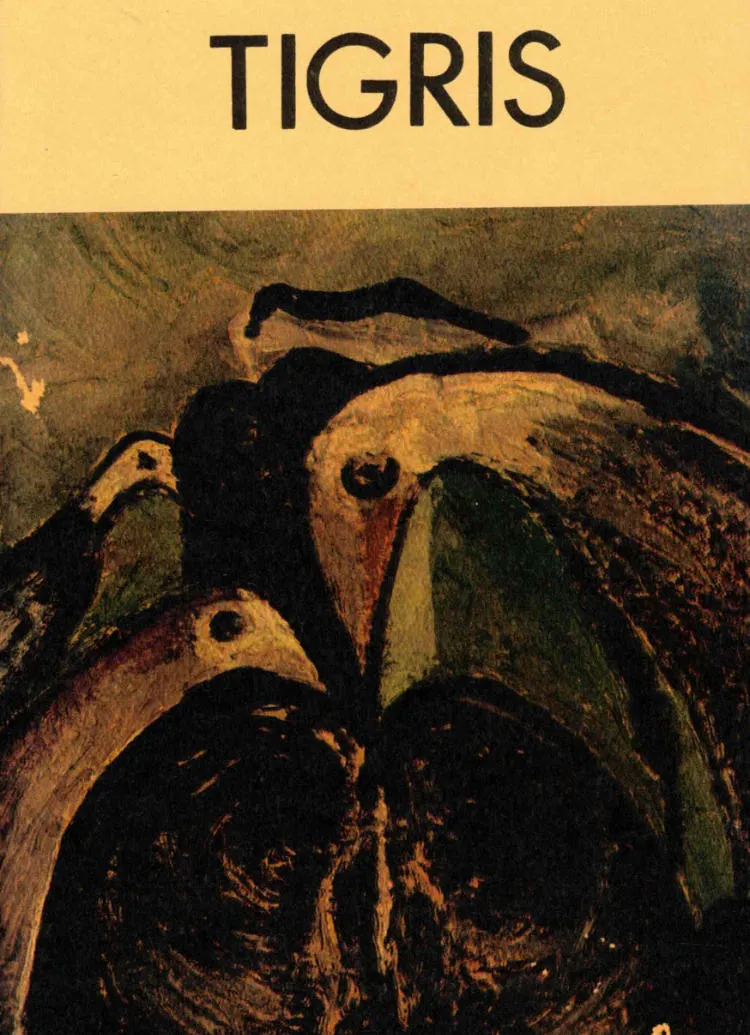
Cover of Tigris Vol. 1

CUNY Center for the Humanities

Tigris Vol. 1

Sargon Boulus

Poetry €16.00

In 1971, the great Iraqi poet Sargon Boulus (1944-2007) published a single issue of an English-language literary anthology that he called Tigris. The magazine—a whisper on the literary landscape that appeared three years after Boulus’s arrival in the US—brings together work by Boulus and several of his literary friends, in translation by Boulus and Etel Adnan.

Tigris was not an end in itself, but rather a temporary solution to the lifelong problem of how to devote oneself to poetry across different countries, eras, and styles: how to live poetry. Yet, in so doing, the small anthology includes significant work: Etel Adnan’s “Jebu,” translated by Adnan, and poetry by Boulus, Fouad Rifkah, Yusuf al-Khal, Mouayad al-Rawi, and Riadh Fakhouri, all in Boulus’s translations, as well as a work by Ankido, a “street-activist poet-café worker of importance to the Palestinian Liberation Movement.”

Cover of Voyage, War, Exile: Three Essays

Litmus Press

Voyage, War, Exile: Three Essays

Etel Adnan

Essays €17.00

Written between 1984 and 1995, this new edition collects three essays by Etel Adnan meditating on a life lived in motion: intellectual, geographic, linguistic and artistic perpetual motion. Published in honor of Adnan’s centennial (2025), these essays are a beacon and remain a piercing and profound model for reckoning with and surviving our times of war and exile.

Voyage, War, and Exile collects three essays by Etel Adnan that present a multilayered meditation on the author’s life within and without Beirut. Adnan reflects upon the intricacies of family, place, and language, asking what it means to be an Arab woman and writer in exile at the end of a century in which “Exile became the existential and metaphysical condition for every Arab.” At once deeply personal to the life of the author and yet ubiquitous in inquiry, Voyage, War, Exile pulls us into the shifting landscape of Lebanon and the United States in the 20th Century through a weaving of philosophical reflection and memory. This volume includes artwork by Simone Fattal.

Praise for Etel Adnan

The work of Etel Adnan—poet, painter, philosopher—is an interrogation of the human experience and a study in worldly engagement…Sorting through decades of memory, loss, and linguistic turns, we drift with her in a sea of thought and expansive meditation. —K.B. Thors, The Lambda Literary Review

Her poetry has the capacity to assemble and discern the ‘sides’ of the self as well as the literature and literary personalities which frame the self of her writing. —Matt Turner, Hyperallergic

Adnan’s receptivity is evident in her fine-tuned attention to detail, at the microscopic and cosmic level alike. Her lens shifts in scale and orientation, defamiliarizing the surroundings we thought we knew and re-introducing us to nature.—Noa Micaela Fields, Medium

Cover of Men in the Off Hours

Vintage Contemporaries

Men in the Off Hours

Anne Carson

Poetry €16.00

In Men in the Off Hours, Carson offers further proof of her tantalizing gifts. Reinventing figures as diverse as Oedipus, Emily Dickinson, and Audubon, Carson sets up startling juxtapositions: Lazarus among video paraphernalia, Virginia Woolf and Thucydides discussing war, Edward Hopper paintings illuminated by St. Augustine. And in a final prose poem, she meditates movingly on the recent death of her mother. With its quiet, acute spirituality and its fearless wit and sensuality, Men in the Off Hours shows us a fiercely individual poet at her best.

Cover of You Who Suffer, Because You Love, Love Still More

pântano books

You Who Suffer, Because You Love, Love Still More

Serubiri Moses

Poetry €16.00

In You Who Suffer, Because You Love, Love Still More, Serubiri Moses offers an intimate and personal study of the lives and loves of pop star Freddy Mercury, combining a detailed epigraphy on the duplicitous nature of Mercury's origins, sexuality, and artistic talent with his own delicate memoir as a poet. Through this series of interlocked poems, yet again Moses lures us into an atmosphere both sensual and scholarly that echoes well past its last verse.

With ardor and grace, Serubiri Moses traverses a catalogue of pop music, visual art, and cultural history to bring his readers to a state of openness — to love, to art, and the freewill of ecstatic experience. Moses’s writing forefronts pleasure as a gateway for deeper critical inquiry, braiding personal memory and epigraphic excursions into sex, stardom, and poetry, reminding us in this journey that "pleasure almost happens without us knowing."
— Tausif Noor

Serubiri Moses, Ugandan curator and author, lives in New York City. He serves as a part-time faculty member at Hunter CUNY, and visiting faculty at the Center for Curatorial Studies, Bard College. He previously held faculty positions at New York University, and the New Centre for Research and Practice, and delivered lectures at Chazen Museum of Art, Art Institute of Chicago, Williams College, Yale University, University of Pittsburgh, The New School, Zeitz Museum of Contemporary Art Africa, and basis voor aktuelle kunst (NL), and University of the Arts Helsinki (FL). As a curator, he has organized exhibitions at museums including MoMA PS1, Long Island City; Kunst-Werke Institute for Contemporary Art, Berlin; the Hessel Museum, Bard College, NY; and the Smithsonian National Museum of African Art. He has curated solo presentations of Carl E. Hazlewood, Reza Aramesh, and is working on a retrospective of Taryn Simon. He previously held a research fellowship at the University of Bayreuth, and received his MA in Curatorial Studies at Bard College, and is an alumni of the Àsìkò International Art Programme. He serves on the editorial team of e-flux journal and his short stories have appeared in print in Ursula, and online in Lolwe. He has published poetry in the online journals Jalada and Badilisha Poetry Exchange, as well as in print journals Kwani? 7, Kwani? 8, and READ: A Journal of Inter-Translation (2022). He is the author of the poetry collection THE MOON IS READING US A BOOK (2023; Pântano Books).

Cover of A Catalogue of Risk

Wendy's Subway

A Catalogue of Risk

Alisha Mascarenhas

Poetry €18.00

Alisha Mascarenhas’s A Catalogue of Risk is a volte-face of the neoliberal market economy’s construction of isolated, individual safety. In her debut book of poems, Mascarenhas lingers in the question of risk as it arises in daily life and intimacy. Through a close study and partial translation of philosopher-psychoanalyst Anne Dufourmantelle’s Éloge du risque (2011), her poems posit risk as a fissure, through which we might imagine yet-unknown futures.

Alisha Mascarenhas’s A Catalogue of Risk is the recipient of the 2022 Carolyn Bush Award.

Alisha Mascarenhas (b. 1989) is a poet and translator and the author, most recently, of the chaplet Contagion Fields (Belladonna* 2021). She has contributed writing to Pamenar Press, The Poetry Project Newsletter, The Recluse, Peripheral Review, and The Felt, among others. Alisha was a 2023 resident at La Baldi Artist’s Residency in Montegiovi, Italy. She holds an MFA in Writing from Pratt Institute in Brooklyn, where she now lives.

There is a body lying across Alisha Mascarenhas’s A Catalogue of Risk. Here is a book of generosity and perdition, that could not anticipate the death of its author, the one these works are addressed to, written for, dreamt by, in a stream of proximities. A strange dismantling of time occurs as a result of quiet reversals in which light is diffracted across belated syntaxes, reaching past life to the living. Though A Catalogue of Risk is “running past the flowers,” it is a slow text that grieves the day’s illuminations. It is a lesson in transmission in which we, readers, are the apprentices of grace, at the edge also of drowning. Here is a book that has been “hungering to be emptied.” So, too, is it a book of promise.
Nathanaël

A Catalogue of Risk is a book of luminous attention. Alisha Mascarenhas gives us the language of a mind tracking both internal and external weathers, tuning and returning herself to beauty, fear, grief and desire. Attending a cascade of emotions, the poet dwells in questions, knowing that to keep open to difficult questions is to keep open to desire. That she risks such openness, thinking always with others, through pain and love, is an astonishment. 
— Madhu Kaza

A Catalogue of Risk poses an evocative challenge, one of prismatic nuance: to pursue multiple angles of intimacy along the life-death continuum of how risk holds, unfolds, and makes one whole. “The definition” of what risk is “is shaded in questions” and runs a gamut of desires and sensations at once libidinal and cerebral. Alisha Mascarenhas risks risk itself with this generous offering of exquisite phenomenology and experiential trace in the form of a full-saturation poetics glowing in amplitude and intensity.
— Brenda Iijima

Cover of An Eros Encyclopedia

Wendy's Subway

An Eros Encyclopedia

Rachel James

Poetry €18.00

To want to reveal; to want to reveal enough; to desire; to desire in the right way, the right amount: in her debut book, Rachel James narrates the desiring subject’s nuanced and entangled intimacies with histories of power. How, in other words, under patriarchy, against misogyny, within capitalist strictures, is knowledge shaped, contained, and transferred? Tracing traditions of theater, pedagogy, and faith, An Eros Encyclopedia offers up desire and the attunement to its many objects as the atmosphere of a life—a method to navigate, perceive, and relate against the illusion of separation.

Cover of Not a Force of Nature

Futurepoem

Not a Force of Nature

Amy De'Ath

Poetry €21.00

If capital makes life a seething, complex nightmare for most people on the planet's surface, if "words do cleave the producer from the land," then what does all this dispossession feel like? Amy De'Ath turns poetry into a hot, potent, and highly funny form of criticism, in which social force is felt intimately, and voiced in the acid niceness of a work email. Amy's poems move like pieces of machinery in a cognitive amusement park, which spit you a thousand feet into the air but keep your viewpoint fixed on the same spot as before—what's different? "Land in Saskatchewan, land in Delhi," or "everything…that you want from women and gays." Not a Force of Nature makes me want to change everything. "Behold me I'm you now," Amy writes—we should be so lucky, to be thus transformed. — Kay Gabriel

Not a Force of Nature's expertly crafted poems explore the catastrophe we live among and speak through. They form a sort of feminist manifesto addressed to all forms of resistance. But also: here are love sonnets! This book is angrily precise and always a lot of fun. "No, you're a Canadianist!" — Kevin Davies

Not a Force of Nature is the kind of book that becomes possible only after rejecting the "we" evoked so often in contemporary literary culture—sometimes said to need poetry now more than ever, sometimes called community. Amy De'Ath's motley vision of solidarity, of "actual emboldened people," is way weirder, more lively, and possible. Nor do these poems content themselves, like the ghost of Marxist theory past, with pointing towards the contradictions that surround them. Do you remember email? Sonnets? Not a Force of Nature is like that, thrashing inside generic forms and always coming next: after the tendency of the rate of profit to fall, after Jane's abortion service, after the 1970s, 80s, and 90s, after Creeley, after Raworth, after Mayer, after the Xenofeminist Manifesto, after Pluto enters Aquarius. "There are still tactics like this roaming free," De'Ath writes. There are still these fervent lyric parries. Be with Not a Force of Nature now. — Stephanie Young

Through slips of verbal acuity, Amy De'Ath scrapes her way out of determinism to a world "made by hands," where our material relations are ours to make and break. History is long and history is short. History is translucent. De'Ath presents the Ferris wheel of capitalist production, where the subject lives once as worker, twice as commodity. Here, in these "concrete trousers," is a "totally liberated" working class poem turning everything into nothing as praxis. — Anahita Jamali Rad