Poetry
Poetry

The Cow
This text is filthy and fertilized, filling and emptying, filling and emptying, atrocious and politic with meaning. The Cow is a mother, a lover, and a murdered lump of meat, rendered in the strongest of languages. I cannot count the altering that happens in the very large rooms that are the guts of her.
To call Ariana Reines’ poetry scatological doesn’t even scratch the surface. “I COULD BE A DIAPER FOR THE DAY’S RESIDUALS,” she writes, and, “She clasped the event to her and proceeded. Fucked her steaming/ eyehole and ended it.” The Cow is a body in the way that texts are bodied—”Are you so intelligent your body doesn’t have you in it.”—but not in the way that allows the text to become desensitized, depersonalized, sterilized.
Winner of the 2006 Alberta Prize

The Undying (paperback)
Blending memoir with critique, an award-winning poet and essayist's devastating exploration of sickness and health, cancer and the cancer industry, in the modern world
A week after her 41st birthday, Anne Boyer was diagnosed with highly aggressive triple-negative breast cancer. For a single mother living payslip to payslip, the condition was both a crisis and an initiation into new ideas about mortality and the gendered politics of illness.
In The Undying - at once her harrowing memoir of survival, and a 21st-century Illness as Metaphor - Boyer draws on sources from ancient Roman dream diarists to cancer vloggers to explore the experience of illness. She investigates the quackeries, casualties and ecological costs of cancer under capitalism, and dives into the long line of women writing about their own illnesses and deaths, among them Audre Lorde, Kathy Acker and Susan Sontag.
Genre-bending, devastating and profoundly humane, The Undying is an unmissably insightful meditation on cancer, the cancer industry and the sicknesses and glories of contemporary life.
Winner of The Pulitzer Prize for Nonfiction 2020; Windham Campbell Prize for Nonfiction 2020

Calamities
A collection of linked essays concerned with the life and mind of the writer by one of the most original voices in contemporary literature. Each essay takes a day as its point of inquiry, observing the body as it moves through time, architecture, and space, gradually demanding a new logic and level of consciousness from the narrator and reader.
"Renee Gladman has always struck me as being a dreamer—she writes that way and the dreaming seems to construct the architecture of the world unfolding before our reading eyes."
—Eileen Myles
WINNER of the 2017 Firecracker Award for Nonfiction from the Community of Literary Magazines and Presses (CLMP).
Renee Gladman is a writer and artist preoccupied with lines, crossings, thresholds, geographies, and syntaxes as they play out in the interstices of poetry and prose. She is the author of ten published works, including a cycle of novels about the city-state Ravicka and its inhabitants, the Ravickians; Calamities, a collection of linked essays on writing and experience, which won the 2017 Firecracker Award in Nonfiction; and a monograph of ink drawings, Prose Architectures. She lives in New England with poet-ceremonialist Danielle Vogel.

A (Trenchart)
How do you trace death? What do you make of the useless objects left behind? Conjuring Cage, Stein, and Francesca Woodman, British poet Sophie Robinson documents the detritus of sudden loss. Layering word and image, object and subject, the said with the unsayable, A is as Caroline Bergvall writes, "[a] work of mourning. Angry, torn, hardly daring to remember", a textual performance of "love that dares to speak as queer."
A is published as part of the TrenchArt: Tracer Series, with a foreword by Caroline Bergvall, an afterword by Diane Ward, and collaborative visual art by Ken Erhlich and Susan Simpson.

Hannah Weiner's Open House
Hannah Weiner's Open House beckons us into a realm of poetry that bends consciousness in order to open the doors of perception. Weiner is one of the great American linguistic inventors of the last thirty years of the 20th century. She created an alchemical poetry that transforms the materials of everyday life into a dimension beyond sensory perception. The pieces collected here are as much conceptual art as sprung prose, experimental mysticism as social realism, autobiography as egoless alyric. Patrick Durgin has brought together touchstone works, some familiar and some never before published. Hannah Weiner's Open House provides the only single volume introduction to the full range of Weiner's vibrant, enthralling, and unique contribution to the poetry of the Americas. (Charles Bernstein)
Hannah Weiner's influence extends from the sixties New York avant-garde, where she was part of an unprecedented confluence of poets, performance and visual artists including Phillip Glass, Andy Warhol, Carolee Schneeman, John Perrault, David Antin, and Bernadette Mayer. Like fellow-traveler Jackson Mac Low, she became an important part of the Language movement of the 70s and 80s, and her influence can be seen today in the so-called New Narrative work stemming from the San Francisco Bay Area.

Antilogy
Drawing from notions of "bad poetry" as the critical undoing of normative taste, Antilogy brings together works by the Brazilian artist and poet Alex Hamburger.
Central to Hamburger's practice and engagement with poetry is a focus on writing as the expression of a performative disruption and playful reworking of semiotic systems. With references to Fluxus intermediality, Brazilian concretism, experimental music, and sound poetry, Hamburger's work dynamically collapses the distinctions between fact and fiction, theory and performance, system and noise. From visual poems to abstract narrative to personal fantasy, Antilogy reminds us about the potent sense of refusal and experimentation that all art should carry.
Alex Hamburger was born in Belgrade, Serbia, in 1948. From the 80s onward his researches and proposals turned to the possibilities of fusion and intertwining of languages, developing works in Verbal, Visual and Sound Poetry, Object-Poem, Artist's books, Installation, Performance art, etc. He has published seven books in various poetical genres, three CDs of Sound Poetry and has performed several performance pieces, some in partnership with the visual artist Marcia X, with whom he established a fruitful relationship throughout the 80s, contributing decisively for a better understanding and acceptance of the above practices in the local art circuit of Rio de Janeiro. His work is held in the collections of contemporary art institutions, in Brazil and abroad, including The Museum of Modern Art, RJ, The Museum of Modern Art, SP, Printed Matter Bookstore, New York, Compendium of Contemporary Fine Prints, Hamburg, ICA, London among others. Alex Hamburger continues to live and work in Rio de Janeiro, Brazil.

Piece of Cake
Bernadette Mayer and Lewis Warsh wrote Piece of Cake as a work of collaborative prose poetry, based on a process of each writing on alternate days in the course of August of 1976-the bicentennial year of the America's Declaration of Independence. It recounts the quotidian details of daily activities, negotiating the exigencies of young, married-with-children life, the artistic path and citizenship. It has the classic "I did this, I did that" of a New York School of Poetry text, as characterized by the poetry of Frank O'Hara, and is somewhat reminiscent of Mayer's work Studying Hunger Journal, written not long before taking up Piece of Cake. Another distinguishing feature of this work is that it is arguably the first significant male-female collaboration in 20th century American poetry. Regarding the possible derivation of the work's title, and exemplary of the work's tenor, is the start of Warsh's entry of August 29: "I also recall getting up and eating a piece of left-over cake (a very sweet store-bought cake with green or possibly pinkish icing) and drinking a glass of milk at the kitchen window. Empty streets, no moon. Michael and Twinkie asleep on the floor of Bernadette's room, Guy and Karen in mine, Bill on the couch in the living room. Marie in her crib. Everyone 'dead to the world,' a phrase I dislike, what a full house.
Bernadette Mayer was born in Brooklyn, New York, and received her B.A. from the New School for Social Research in 1967. She is the author of more than two dozen volumes of poetry. From 1972 to 1974, Mayer and conceptual artist Vito Acconci edited the journal 0 TO 9, and in 1977 she established United Artists Press with the poet Lewis Warsh. She has taught writing workshops at The Poetry Project at St. Mark's Church in New York City for many years, and she served as the Poetry Project's director.
Lewis Warsh is the author of over thirty volumes of poetry, fiction and autobiography, including Out of the Question: Selected Poems (Station Hill, 2017), Alien Abduction (Ugly Duckling Presse, 2015), One Foot Out the Door: Collected Stories (Spuyten Duyvil, 2014), A Place in the Sun (Spuyten Duyvil, 2010) and Inseparable (Granary Books, 2008). He was co-founder, with Bernadette Mayer, of United Artists Magazine and Books, and co-editor, with Anne Waldman, of The Angel Hair Anthology (Granary Books, 2001).
Published January 2020.

Sylvia Path: Collected Poems
Pulitzer Prize winner Sylvia Plath's complete poetic works, edited and introduced by Ted Hughes.
By the time of her death on 11, February 1963, Sylvia Plath had written a large bulk of poetry. To my knowledge, she never scrapped any of her poetic efforts. With one or two exceptions, she brought every piece she worked on to some final form acceptable to her, rejecting at most the odd verse, or a false head or a false tail. Her attitude to her verse was artisan-like: if she couldn't get a table out of the material, she was quite happy to get a chair, or even a toy. The end product for her was not so much a successful poem, as something that had temporarily exhausted her ingenuity. So this book contains not merely what verse she saved, but after 1956 all she wrote.
(Ted Hughes, from the Introduction)
Sylvia Plath was born in 1932 in Massachusetts. Her books include the poetry collections The Colossus, Crossing the Water, Winter Trees, Ariel, and Collected Poems, which won the Pulitzer Prize. A complete and uncut facsimile edition of Ariel was published in 2004 with her original selection and arrangement of poems. She was married to the poet Ted Hughes, with whom she had a daughter, Frieda, and a son, Nicholas. She died in London in 1963.

Glass, Irony & God
Known as a remarkable classicist, Anne Carson weaves contemporary and ancient poetic strands with stunning style in Glass, Irony and God. This collection includes: "The Glass Essay," a powerful poem about the end of a love affair, told in the context of Carson's reading of the Bronte sisters; "Book of Isaiah," a poem evoking the deeply primitive feel of ancient Judaism; and "The Fall of Rome," about her trip to "find" Rome and her struggle to overcome feelings of a terrible alienation there.
Anne Carson was born in Canada and teaches ancient Greek for a living.

the monumental mismemberings
the monumental misrememberings is a meditation on death. It’s a curious insight on the creative and violent ways in which Black girls, women, trans women and femmes often become displaced, experience death, and subjugation as a result of patriarchal systems in America. This debut collection of poems by Mimi Tempestt operates through this specific lens, not to romanticize the pain of Black femme bodies, but to bring light to this sadistic truth. When we turn on the television, when we log into social media, when we look in the mirror, the normalcy of how often and creatively Black women are murdered weighs on our conscience. the monumental misrememberings addresses our unwillingness to grapple with these violences, and places front and center the realities faced by Black femmes.
Size: 5" x 7.5", 88 pages
Self published by Co—Conspirator Press with the support of Women's Center for Creative Work. Designed by MJ Balvanera, Riso-printed by Neko Natalia.

The Nancy Reagan Collection
THE NANCY REAGAN COLLECTION is a response to growing up queer and trans under the rise of HIV-AIDS. Crossing genres and generations, this performance novel remixes the AIDS archive through an ever-spiraling politics and aesthetics of mourning. Alternating chapters offer up a narrative throughline composed of hallucinogenic episodes from the perspective of a nameless, grieving protagonist in the midst of the global carnage of the Reagan dynasty. Part revenge, part fantasy, the book experiments with poetic practices that challenge conceptions of memory and morality, activism and escapism, grief and beauty.
Maxe Crandall is a poet, playwright, and director. He is the author of the chapbooks Emoji for Cher Heart (Belladonna*, 2015) and Together Men Make Paradigms (Portable Press @ Yo-Yo Labs, 2014), and is the founder of the theater company Beautiful Moments in Popular Culture, which produces a poets theater series at the Stud in San Francisco. He has received fellowships from the Poetry Project, Poets House, Lambda Literary, and the Millay Colony for the Arts. Maxe is a lecturer in the Feminist, Gender, and Sexuality Studies Program at Stanford University.

Being Human Is an Occult Practice
In the essay BEING HUMAN IS AN OCCULT PRACTICE, Zurawski argues that studying and sharing literature can function as a means of enriching the impoverished definition of human created by capitalist social relations. Beginning with an analysis of Robert Duncan's description of the moment in his high school classroom when he finds himself called into a life in poetry, this essay explores the possibilities of the literature classroom at the very moment that it's being dismantled by the neoliberalization of our university systems. Zurawski argues that the literary holds a revitalizing potential precisely because of its capacity of exceeding the narrow imaginative aims of life within our contemporary social order.
Magdalena Zurawski is the author of BEING HUMAN IS AN OCCULT PRACTICE (Ugly Duckling Presse, 2020), the novel The Bruise, which won the Ronald Sukenick Award from FC2 in 2008 and a LAMBDA literary award in 2009, and the collection of poems COMPANION ANIMAL, which was published by Litmus Press in 2015 and won a Norma Faber First Book Award from the Poetry Society of America. THE TINIEST MUZZLE SINGS SONGS OF FREEDOM (Wave Books, 2019) is her most recent poetry collection. Her poem/essay Don't Be Scared is available as a chapbook from The Operating System. As an undergraduate Magdalena studied with poets Rosmarie and Keith Waldrop, C.D. Wright, and Peter Gizzi. She has lived in Berlin, New York, Philadelphia, San Francisco, and Durham, NC where she ran the Minor American Reading Series. She is currently Associate Professor of English and Creative Writing at the University of Georgia, where she directs the Creative Writing Program.

The First Books of David Henderson and Mary Korte: A Research
In 1967, the first books of two poets were published by small presses on opposite coasts of the USA: David Henderson's Felix of the Silent Forest and Mary Norbert Korte's Hymn to the Gentle Sun. In this essay, poet, scholar, educator, and publisher Iris Cushing looks at the context of these supposedly minor poets, and through research and conversation with Korte, Henderson, and Diane di Prima, reconstructs the role of small presses in the countercultural resistance of the late 1960s.
Iris Cushing is a poet, scholar, educator and founding editor for Argos Books, an independent poetry press. She is the author, most recently, of THE FIRST BOOKS OF DAVID HENDERSON AND MARY NORBERT KORTE: A RESEARCH (Ugly Duckling Presse, 2020), and Into the Long Long Time: How Mary Korte Saved the Trees (Ink Cap Press, 2019). Her poems and critical writings have appeared in numerous publications, including the Boston Review, Fence, and the Academy of American Poets Poem-A-Day series, and her poetry collection WYOMING (Furniture Press Books, 2014) won the 2013 Furniture Press Poetry Prize. She has edited three chapbooks for the Lost & Found Poetics Documents Initiative: Diane di Prima: Prometheus Unbound as a Magickal Working (Series VIII, 2019), Bobbie Louise Hawkins: The Sounding Word, and Judy Grahn: Selections from Blood, Bread and Roses (Series VI, 2016). A doctoral candidate in English at the CUNY Graduate Center, Iris is currently at work on a biographical dissertation titled Pierce and Pine: Diane di Prima, Mary Norbert Korte and the Question of Matter and Spirit.

chop: a collection of kwansabas for fannie lou hamer
chop is a collection of poems that center on the life and work of proto-feminist and civil rights activist, Fannie Lou Hamer.
A Mississippi native, Treasure Shields Redmond is a poet, speaker, diversity and inclusion coach, and social justice educator. In 2016 she founded her company, Feminine Pronoun Consultants, LLC. Even though Treasure is completing a PhD in English Literature and Criticism, is a published writer, gifted veteran educator, and has spoken on stages all over the U.S. and in Europe, she uses her humble beginnings in the federal housing projects in Meridian, Mississippi to fuel her passion for helping college-bound families navigate college admissions painlessly and pro tably, and o ering perceptive leaders creative diversity and inclusion facilitation. Additional information on her poetry, writing, and multidimensional practice are available at: www.FemininePronoun.com.

The Power of Adrienne Rich: A Biography
The first comprehensive biography of Adrienne Rich, feminist and queer icon and internationally revered National Book Award winning poet.
Adrienne Rich was the female face of American poetry for decades. Her forceful, uncompromising writing has more than stood the test of time, and the life of the woman behind the words is equally impressive. Motivated by personal revelations, Rich transformed herself from a traditional, Radcliffe-educated lyric poet and married mother of three sons into a path-breaking lesbian-feminist author of prose as well as poetry. In doing so, she emerged as both architect and exemplar of the modern feminist movement, breaking ranks to denounce the male-dominated literary establishment and paving the way for the many queer women of letters to take their places in the cultural mainstream. Drawing on a wealth of unpublished materials, including Rich's correspondence and in-depth interviews with numerous people who knew her, Hilary Holladay digs deep into never-before-accessed sources to portray Rich in full dimension and vivid, human detail.

The Complete Text Would Be Insufferable / Language as Prosthesis
We begin with the image of an idea in ruin. A small field of assumptions disassembled. A question no longer in need of its mark. A thought not sure where it began. It starts from the body and language. The debris of these three words, crumbling already at and, did not break apart but congealed the separations once made. We start from a research (project) undone and just beginning.
Typesetting and design: Will Holder
Produced by: A.pass
Chloe Chignell works across choreography and publication taking the body as the central problem, question and location of the research. She invests in writing as a body building practice, examining the ways in which language makes us up.

keeps crashing down the same
keeps crashing down the same period in my text between the paragraphs and i forgot about the crush is a book by Stine Sampers, 114 pages of her collected "predictive text songs" written between April 2018 and January 2019 in Brussels, Ghent, Antwerp, Alveringem, Amsterdam and Berrias-et-Casteljau with a Samsung Galaxy S5 (stolen in October 2018 in Brussels) and a Samsung Galaxy S7 (that had to be taught vocabulary). Cover image by Deveny Faruque, afterword by Maru Mushtrieva:
"Here, the longing for the Other – unsurmountable distance – is actualized not only by the content but also by the compositional design itself. What at first glance appears to be a stream of consciousness, is in fact a synthesis of vocabulary from past text messages. While composing them, Stine Sampers used her phone’s algorithm to decide what to say next, with suggestions coming from the text messages previously exchanged with her friends. The words from different contexts, once chosen carefully, now belong to the careless vocabulary of a machine, welcomed into a loop of misrecognition."
Published Nov 2020

Night
Born in 1925 in Beirut, ETEL ADNAN has written more than a dozen books of poetry, fiction, and essays. A two-volume collection, To look at the sea is to become what one is: An Etel Adnan Reader, was published in 2014. She is a recipient of a PEN Oakland-Josephine Miles Award, the California Book Award, a Lambda Book Award, and a Chevalier des Arts et des Lettres. She lives in Paris and Sausalito, California.
"Trained in philosophy, Beirut-born author/activist Adnan blends a meditation on the meaning of memory with memories themselves, dredged up from a long life. And surely night, her setting here, is the time for such dredging. Adnan rigorously asserts that "reason and memory move together." But she argues that "a remembered event is a return to a mystery," and her writing is eye-openingly lush, gorgeous, even surreal ("waves of roses are blanketing memory"), showing us the mind at work on its unstructured, uncertain edges. The epigrammatic ending, "Conversations with my soul" ("Why are we lonelier when/ together"), will feed even those who don't typically read poetry. VERDICT A good way for sophisticated readers to recall why they first loved verse." — Library Journal


chris mann and grammar
A Lingua Press Bookplay, 1990
Introduction by Kenneth Gaburo,Herbert Brun, Annea Lockwood, David Dunn,John Cage.
Chris Mann (March 9, 1949 Australia–September 12, 2018 New York NY) was an Australian composer, poet and performer specializing in the emerging field of compositional linguistics, coined by Kenneth Gaburo and described by Mann as "the mechanism whereby you understand what I'm saying better than I do".[1] He was, in the last 2 decades of his life, based in New York City.
Mann studied Chinese and linguistics at the University of Melbourne, and his interest in language, systems, and philosophy is evident in his work. Mann founded the New Music Centre in 1972 and taught at the State College of Victoria in the mid-1970s. He then left teaching to work on research projects involving cultural ideas of information theory and has been recognized by UNESCO for his work in that field.[1]
Mann moved to New York in the 1980s and was an associate of American composers John Cage and Kenneth Gaburo. He performed text in collaboration with artists such as Thomas Buckner, David Dunn, Annea Lockwood, Larry Polansky, and Robert Rauschenberg.
Mann recorded with the ensemble Machine For Making Sense with Amanda Stewart, Rik Rue and others, Chris Mann and the Impediments (with two backup singers and Mann reading a text simultaneously while only being able to hear one another), and Chris Mann and The Use. His piece The Plato Songs, a collaboration with Holland Hopson and R. Luke DuBois, features realtime spectral analysis and parsing of the voice into multiple channels based on phonemes. Mann has also participated in the 60x60 project.[2]
Mann taught in the Media Studies Graduate program at The New School. He died in September 2018 after a recurrence of cancer. He is survived by his wife and two children.

Whole Language Language : (1976-1977)
Lingua Press, 1988
Gaburo was born in Somerville, New Jersey. He served as a professor of music at the University of Illinois, the University of California, San Diego, and the University of Iowa. His notable students include James Tenney and Allen Strange. He is renowned as a teacher, pioneer of electronics in music, jazz pianist, writer, ecologist, publisher, and proponent of compositional linguistics.
In 1968, he joined the faculty at the new San Diego campus of the University of California where in 1972 a Rockefeller Foundation grant enabled him to start NMCE IV, this time with an actor, a virtuoso speaker, a mime, a gymnast, and a sound-movement artist (Rosen and Moore 2001). Until his resignation from UCSD in 1975 he produced a large number of integrated theatrical works, such as the collection Lingua and Privacy.
In 1975, Gaburo founded Lingua Press, which produces scores, books, records, audio tapes, videotapes, and films (Rosen and Moore 2001). This firm is dedicated to putting forth unique artist-produced works in all media having to do with language and music. Many of the publications have been exhibited in book art shows throughout the world. Gaburo lived in the Anzo-Borrego desert writing and teaching from 1980 until 1983. In 1980, he was artistic director for the first "authentic" production of Harry Partch's The Bewitched for the Berlin Festival (recorded on Enclosure Five: Harry Partch, innova 405). His understanding of Partch's concept of corporeality has deep connections with his own concern for physicality and how it informs compositions. His 1982 tape work, RE-RUN, for instance, was generated after a 20-hour sensory deprivation exercise.
He became Director of the Experimental Music Studio at the University of Iowa in 1983. The studio put intensive focus on composition, technology, psycho-acoustic perception, performance, and the affirmation of the uniqueness of the individual to create his/her own language reality. At the studio, he founded the Seminar for Cognitive Studies, a forum for discussion of the creative process. His concern for the investigation of music as legitimate research, and composition as the creation of intrinsic appropriate language, led to a series of readings in compositional linguistics for solo performer.
He most often made innovative use of electronics and explored tonality, serialism, and what he called "compositional linguistics" such as in his LINGUA series (Listening). He also wrote minimal pieces such as The Flow of (u) for three voices singing unison.
Gaburo died in 1993 in Iowa City, Iowa.
The archive of his life's work is held at the University of Illinois Music Library.

Minerva - the Miscarriage of the Brain
Minerva the Miscarriage of the Brain collects a decade of work from artist, musician, and author of On Hell, Johanna Hedva. In plays, performances, an encyclopedia, essays, autohagiography, hypnagogic, and hypnapompic poems—in texts whose bodies drift and delight in form—Minerva tunnels into mysticism, madness, motherhood, and magic. Minerva gets dirty with the mess of gender and genius. She does the labor of sleep and dreams. She odysseys through Los Angeles, shapeshifting in stygian night and waking up to wail in the light.

Fiévreuse plébéienne
« On habite ce que l’on peut : la faïence, la baignoire, le hlm, le trottoir, on construit une cabane. Du début à la fin on utilise l’amour comme survie collective. » Fiévreuse plébéienne, Élodie Petit
Fiévreuse plébéienne est un texte en cours qui interroge la façon d’habiter son corps, le monde, ses désirs. Ça parle d’amour, de précarité et de sexualité. Ça emmêle directement le corps au politique, ça prône haut et fort l’expérimentation et le plagiat, ça mélange Dirty dancing pour les gouines et une volonté très forte de faire la révolution. Fiévreuse plébéienne est un livre nouveau de poésie, une recherche durable dans l’écriture sexuelle, une expérience intime.
À lire :
– les zines sur www.elodiepetit.fr
– Elodie Petit : « Que chacune rie à outrance et que les trous du cul soient dilatés » (Fiévreuse plébéienne) de Pierre Niedergang dans Diacritik
– Fiévreuse plébéienne : l’écriture en giclures d’Elodie Petit de Zaz dans Friction Magazine
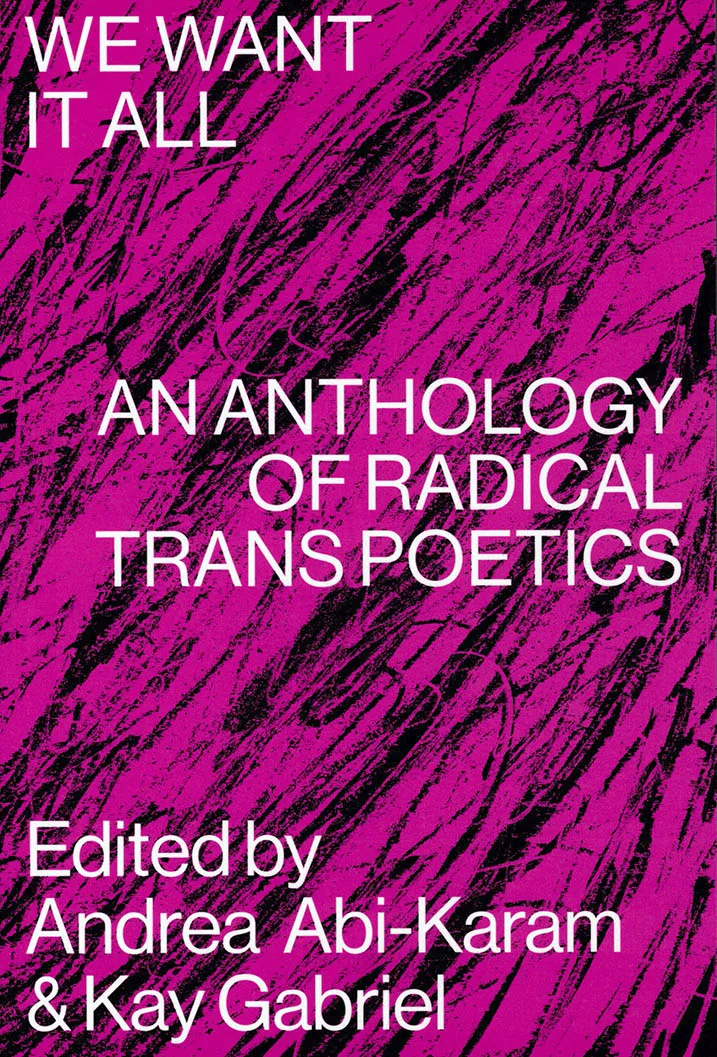
We Want It All: An Anthology of Radical Transpoetics
An anthology of formally inventive writing by trans poets against capital and empire.
With texts by: Andrea Abi-Karam, New York City Sam Ace, South Hadley, MA Bahaar Ahsan, Berkeley, CA jasper avery, Philadelphia, PA Ari Banias, Berkeley, CA Jo Barchi, Chicago, IL Joss Barton, St. Louis, MO Levi Bentley, Philadelphia, PA Jessica Bet, Baltimore, MA Rocket Caleshu, Los Angeles, CA Ching-in Chen, Seattle, WA listen chen, Vancouver, BC Faye Chevalier, Philadelphia, PA Cody-Rose Clevidence, Arkansas Miles Collins-Sibley, Easthampton, MA Valentine Conaty, New York City CA Conrad, Philadelphia, PA Jimmy Cooper, Rochester, MI Maxe Crandall, Oakland, CA José Díaz, Boston, MA Aaron El Sabrout, New Mexico Ian Khara Ellasante, Lewiston, ME Caelan Ernest, New York City, NY NM Esc, San Diego, CA joshua jennifer espinoza, Los Angeles, CA Logan February, Ibadan, Nigeria Ray Filar, Brighton, UK Nora Collen Fulton, Montreal, Canada Kay Gabriel, New York City Callie Gardner, Cardiff, Wales Jesi Gaston, Chicago, IL Harry Josephine Giles, Edinburgh, Scotland Aeon Ginsberg, Baltimore, MD Caspar Heinemann, Berlin, Germany Kamden Hilliard, Greenville, SC Stephen Ira, New York City Cyrée Jarelle Johnson, New York City Peach Kander, New York City Jayson Keery, Western, MA Evan Kleekamp, Los Angeles, CA Noah LeBien, New York City Ty Little, Richmond, VA Zavé Martohardjono, New York City Amy Marvin, Philadelphia, PA Natalie Mesnard, New York City Bianca Rae Messinger, Iowa City, IA Liam O'Brien, New York City Xandria Phillips, Madison, WI Rowan Powell, Santa Cruz, CA Nat Raha, Edinburgh, Scotland Holly Raymond, Philadelphia, PA Jackie S, New York City Trish Salah, Toronto, Canada Raquel Salas Rivera, Philadelphia, PA Mai Schwartz, New York City Kashif Sharma-Patel, London, UK Julian Talamantez Brolaski, Oakland, CA Charles Theonia, New York City Jamie Townsend, Oakland, CA Nora Treatbaby Laurel Uziell, London, UK Rachel Franklin Wood, Boulder, CO Clara Zornado Akasha-Mitra xtian w. and Anaïs Duplan, NYC.
Kay Gabriel is a poet and essayist. She's the author of Elegy Department Spring / Candy Sonnets 1 (BOAAT Press, 2017), the recipient of fellowships from Lambda Literary and the Poetry Project, and recently completed her PhD at Princeton University.
Andrea Abi-Karam is an arab-american genderqueer punk poet-performer cyborg, writing on the art of killing bros, the intricacies of cyborg bodies, trauma & delayed healing. Their chapbook, THE AFTERMATH (Commune Editions), attempts to queer Fanon's vision of how poetry fails to inspire revolution. Andrea's first book, EXTRATRANSMISSION (Kelsey Street Press, 2019), is a poetic critique of the U.S. military's role in the War on Terror.