Books
Books
in random order

Sacred Spells: Collected Works
The collected life-work of an interdisciplinary writer, performer, and central figure in the Black Gay cultural arts and AIDS movements.
In this timely collection of poetry, plays, fiction, and performance texts, Assotto Saint draws upon music and incantation, his Haitian heritage, and a politics of liberation to weaves together a tapestry of literature that celebrates life in the face of death. Influential to contemporary writers such as Essex Hemphill, Marlon Riggs, and Melvin Dixon, Sacred Spells is Saint’s crucial legacy–five hundred incandescent pages of painful, lyric writing that exemplifies the visceral, spiritual dimensions of an artistic practice that’s integral to Black and LGBTQ activist movements worldwide, both historic and present.

Tripwire 22
Featuring work by Sara M Saleh, Joni Prince, Shatr Collective, Carlos Soto Román, Petra Kuppers, Diane Ward, Dianna Settles, Mayra Santos-Febres translated by Seth Michelson, Elena Gomez & Chelsea Hart, Noah Mazer, Daniel Borzutzky, Ash(ley) Michelle C., Ghazal Mosadeq, Darius Simpson, Mohammed Zenia, Mario Payeras translated by Dan Eltringham, Ferreira Gullar translated by Chris Daniels, Christophe Tarkos translated & read by Marty Hiatt, Andrew Spragg on Tom Raworth, Matthew Rana on Ida Börjel, & Paisley Conrad on Harryette Mullen
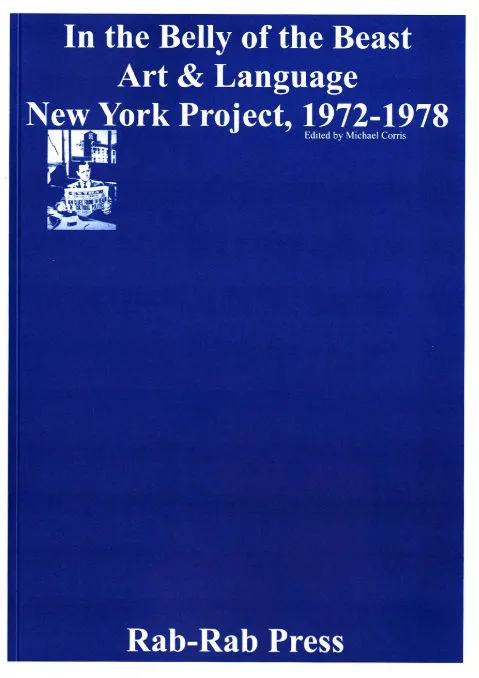
In the Belly of the Beast – Art & Language New York Project 1972-1978
Edited by Michael Corris, the expanded edition of In the Belly of the Beast: Art & Language New York Project 1972-1978 is a survey of the tumultuous years of the political Conceptualism in the mid-seventies New York.
Artists have always experimented with politics, either by organizing themselves or uniting in support of a broader political movement. Today, "activist art" is taught in universities, supported by foundations, and featured in museums and international exhibitions. Is this the only possible way?
In the Belly of the Beast tells a different story, of the work of politically engaged artists and the conflicts they experienced. It is the history of artists wishing to continue working within the boundaries of the artworld and those who were intent on establishing new ideological and class relationships with activists to build a political party.
During the 1970s in New York, the Art & Language collective pioneered institutional critique; published a Marxist-influenced journal; agitated against racism and sexism in museums; challenged the cultural imperialism of international exhibitions; and forged a framework for a socialist organization of artists. This new edition includes previously unpublished documents illuminating the contradictions and disputes that lay at the center of the organization and practices of Art & Language and left-wing groups, such as the Anti-Imperialist Cultural Union and the Artists' Meeting for Cultural Change, mobilizing artists in New York at the time.
The new and expanded edition of In the Belly of the Beast features an extensive interview with Michael Corris, who annotated a collection of previously unavailable documents from the period, including manuscripts, pamphlets, transcripts, and letters.
Art & Language is the name of a group of English artists who choose to work collectively, and the title of a magazine that they founded in 1968. Proposing a critical analysis of the relations between art, society, and politics, Art & Language marks, even in its name, the importance of the “textual turning point” in the 1960s.
Since 1976, Art & Language's project has continued, through Mel Ramsden and Michael Baldwin, with the literary and theoretical collaboration of Charles Harrison. Working with very varied mediums, from painting to rock, these co-founders of Conceptual art remain, even today, attached to observing the consequences of what they themselves call the “depressing collapse of modernism.”

Girlbeast
Highly acclaimed in Denmark, Girlbeast is a fearless, unsettling, and poetic reimagining of the Lolita narrative, where power shifts unpredictably, and desire and coercion become indistinguishable. In a world that fetishises girlhood, it asks whether a girl be blamed for internalising the roles imposed upon her? Can she wield her youth as power in a system designed to render her powerless?
With sharp, fast-paced prose and an addictive plot, Cecilie Lind crafts a daring examination of female agency, sexuality, and the complexities of consent. The novel evokes the idea of the girl as animal – a creature conditioned to be both docile pet and wild beast, torn between submission and rebellion, innocence and desire.
Brave, provocative, and unflinching, Girlbeast is a gripping, vital novel for our times.
WINNER OF THE 2023 DANISH CRITICS PRIZE, SHORTLISTED FOR THE DR NOVEL PRIZE, MONTANA’S LITERATURE PRIZE & THE JYLLANDS-POSTEN FICTION PRIZE
Cecilie Lind (b. 1991) studied at Forfatterskolen (The Danish Academy of Creative Writing), and debuted in 2010 with The Wolf Ate My Eyeliner. Lind’s breakthrough in Denmark came with the publication of the highly acclaimed book-length poem My Child, which was shortlisted for the 2020 Critic’s Prize and the Politiken’s Literary Award. She was awarded The Native Language Prize in 2020, and Girlbeast won the Danish Critics Prize in 2023. Lind’s most recent novel, Bristefærdig (Ripe), was published to critical acclaim in 2025.
Hazel Evans (b. 1994) is an artist, writer and literary translator based near Aarhus, Denmark. She was the 2022/23 emerging translator for Danish to English at the National Centre for Writing, and her debut translation, Into a Star by Puk Qvortrup, was published by Hamish Hamilton. In 2024, she received The Inger and Jens Bruun Translation Prize for her translation of Rasmus Daugbjerg’s Troll, forthcoming from Penguin Press.

Noa & Snow – Poem #9
This book/catalogue is published on the occasion of the final event of Noa & Snow, a gentle experiment between the everyday and the event, at the Volkskundemuseum, Vienna.
Publication Concept Alix Eynaudi, Goda Budvytytė
Design Goda Budvytytė
Printing Robstolk, Amsterdam
Edition 600 copies
Proofreading Bella Marrin
ENVELOPE Pattern design based on the Lila Dress and its signature cording by An Breugelmans
LE VESTIAIRE
Costumes & objects An Breugelmans Tapestries & trompe-l’oeil Cécile Tonizzo Weaves Lydia McGlinchey Photos taken inside of Jason Dodge’ show Cut a Door in the Wolf at Macro Museum by Carlotta Pierleoni Photos in Vienna Samuel Feldhandler
THEM, PROTEXTIONS
Han-Gyeol Lie, Mette Edvartsen, Lydia McGlinchey, Clara Amaral, Ujjwal Kanishka Utkarsh, Jennifer Lacey, Cécile Tonizzo, Sabina Holzer, Alice Chauchat, Jason Dodge, Joachim Hamou, Quim Pujol, Litó Walkey, Serena Lee, Mihret Kebede
PUBLIC MEDITATIONS
Anne Faucheret, Elizabeth Ward, Kirsty Bell, Tony Just, Sabina Holzer, Samuel Feldhandler, Frida Robles
TEXTURAGES Paula Caspão VIGNETTES Alix Eynaudi
Poster picture of Claire Lefèvre’s Grimoire/Giant Notebook/Bison Book Rasa Juškevičiūtė
INSTITUTE OF REST(S)
Alix Eynaudi, Paula Caspão, Quim Pujol
Back side A thread for Alix Eynaudi, woven as a table placement by Genė Janušauskaitė in 1936, out of the flax she had sawn and harvested herself. Photographed by Kristien Daem in 2022, after Aldona Malašauskienė revealed the placement to her son Raimundas.

T (poem)
T is a long poem in multiple parts and its author's second book. “The two genders are YES and NO, so you stutter or else shut up forever”.
From the Afterword: "Between 2017-2018 I was involved in a trial with a group of TERFs after a scuffle emerged during a counter protest against a ‘debate’ about sex-based rights in light of proposed reforms to the Gender Recognition Act which would have made trans people’s lives marginally easier. Luckily I wasn’t actually in the dock, but I appeared to give evidence, and for everyone involved it was a humiliating ordeal as we were doxxed, harrassed online and in real life, while the relentless media campaign which ensued took a toll on the entire trans community. The caricaturesque reduction of a complex interrelation of political positions, epistemologies, traumas and personal grievances into two ‘sides’ ultimately worked to further the persecution of trans people, but nevertheless highlighted a social logic on whose terms the so called debate was forced to appear: sex was pitted against gender (or more revealingly ‘gender identity’), objective biology against subjective ‘self-identification’, nature against culture, or perhaps, first nature against second nature."
What does a poet say (what does anyone say), when placed on the stand, how answer the binary logics forced like a cage in the legally-grounded violence which splittingly interrogates solidarity, the splitting invocation of law? In answer, T spreads across the page as if desperately finding a form for speech acts forced into a garrotted tick-box, a witness stand, video evidence, Nature’s originary disguise as history or vice versa, wrapped inside ‘common sense’ as a pronominal shroud, in the policing of body, speech, and every fungible fibre of being. The author writes: “I want the whole text to be a kind of horrific inorganic body with awkward parts, both to replay at the level of form some of the critiques of organicist thinking with reference to nature that the poem tries to articulate, and also, more glibly, to be somewhat like a trans body, awkwardly fitting together with some parts undercutting others”. An extended enquiry into Materialism and its material (fleshed) stakes, driven through the heart and to the heart of things, T sees lyric poem shudder to line-broken essay to fragment of play to citational drop; in tight compression sprawling, a poem whose argument is necessary and necessarily incomplete, poetry can do thinking, this thinking we do outside and within it, sprung trap, open and closing door.

Correspondences de Appel 1975–2025
This volume brings together 50 years of correspondence from the archive of de Appel contemporary arts centre in Amsterdam. In tracing a relational and affective history of the institution, each piece offers a glimpse into the artistic projects and programmes de Appel has commissioned and championed; the cultural shifts and careers it has nurtured; the celebrations and struggles it has weathered; and the collaborations and friendships sparked along the way. The book gathers materials from more than 100 voices, with paper and digital exchanges covering an intricate web of people, places, and events, ultimately coalescing into what can be perceived as the unified work of an institution.
Includes a light-blue satin Ribbon by Alison Knowles.

Lote
Shola von Reinhold's decadent queer literary debut immerses readers in the pursuit of aesthetics and beauty, while interrogating the removal and obscuring of Black figures from history.
Solitary Mathilda has long harbored a conflicted enchantment bordering on rapture with the "Bright Young Things," the Bloomsbury Group, and their contemporaries of the '20s and '30s, and throughout her life her attempts at reinvention have mirrored their extravagance and artfulness. After discovering a photograph of the forgotten Black modernist poet Hermia Druitt, who ran in the same circles as the Bright Young Things, Mathilda becomes transfixed and resolves to learn as much as she can about the mysterious figure. Her search brings her to a peculiar artists' residency in Dun, a small European town in which Hermia was known to have lived during the '30s. The artists' residency throws her deeper into a lattice of secrets and secret societies that takes hold of her aesthetic imagination. From champagne theft and Black Modernisms to art sabotage, alchemy, and a lotus-eating proto-luxury communist cult, Mathilda's "Escapes" through modes of aesthetic expression lead her to question the convoluted ways truth is made and obscured.
Shola von Reinhold is a Scottish socialite and writer. Shola has been published in the Cambridge Literary Review, The Stockholm Review, was Cove Park's Scottish Emerging Writer 2018 and recently won a Dewar Award for Literature. Shola is a recent graduate from the Creative Writing MLitt at Glasgow which was completed through the Jessica Yorke Writing Scholarship and has previously studied Fine Art at Central Saint Martins. Shola has also written for publications including i-D, AnOther Magazine.

And so on, a single universe
A collection of Pauline Julier’s art that expands from the terrestrial to the cosmos to comment on our place in the universe.
At the interface of documentary and fiction, the multimedia works collected in Pauline Julier take us on a dizzying journey through space and time. Julier’s art travels through the geological ages of planet Earth, through different histories, natural disasters, and the Anthropocene’s paradigm shifts and into outer space. Her background in political science and photography is reflected in her work: looking into the past and the future, she investigates topical questions about our unlimited use of natural resources, escapism, and the colonization of space.
Conceived and designed as a work of art in its own right, this volume offers a comprehensive insight into Julier’s art and thought through a conversation with eminent scholar of science and technology studies Donna Haraway alongside contributions by curator Céline Eidenbenz, anthropologist, and writer Nastassja Martin, and art historian, curator, and author Chus Martínez.
Edited by Céline Eidenbenz and Sarah Mühlebach.
With Contributions by Donna Haraway, Pauline Julier, Nastassja Martin, and Chus Martínez.

Help
Death-obsessed, disengaged and overinvested—the four long poems assembled in Steven Zultanski’s Help theatricalise morbid fascinations, self-protective impulses, and unfocused desire. Help is, at its core, a set of conversations; the result of games played between friends that were then transcribed, edited, and embellished. Participants were asked to talk about loss, the death of acquaintances, secret hiding places, mislaid time, and unmet demands. The resulting poems read like meandering scripts for unrealised plays; incidental excavations of persona and place.
Somewhat reminiscent of Linda Rosenkrantz’s Talk (1968) or Alice Notley’s transcription poems of the 1970s, in Help the poet pretends to be a recording device, and the poem an act of remembering. Zultanski’s writing is at once skeletal and overstuffed, dryly unsentimental and yet dripping with melodrama. Help foregrounds its own contradictions in a collection that is at once both extremely personal and distinctly artificial.
Help brilliantly extends Steven Zultanski’s current phase of writing—looser, more documentary, more situational. In setting up explicit objects of inquiry and conversation—love, death, childhood—the book shows that to know these things is to also know our friends and ourselves. Sustained by an orchestration of relation and memory (and thus reality), affect here is modular, the product of what happens when we transform things by talking about them. A careful and astute experiment in writing and living.
— Jennifer Soong

Spectres #02 – Resonances
Bartolomé Sanson, François Bonnet
The second issue of Spectres is devoted to the concept of resonances, with contributions by Maryanne Amacher, Chris Corsano, Ellen Fullman, Christina Kubisch, Okkyung Lee, Pali Meursault, Jean-Luc Nancy, David Rosenboom, Tomoko Sauvage, The Caretaker, David Toop, and Christian Zanési.
To resonate: re-sonare. To sound again—with the immediate implication of a doubling. Sound and its double: sent back to us, reflected by surfaces, diffracted by edges and corners. Sound amplified, swathed in an acoustics that transforms it. Sound enhanced by its passing through a certain site, a certain milieu. Sound propagated, reaching out into the distance. But to resonate is also to vibrate with sound, in unison, in synchronous oscillation. To marry with its shape, amplifying a common destiny. To join forces with it. And then again, to resonate is to remember, to evoke the past and to bring it back. Or to plunge into the spectrum of sound, to shape it around a certain frequency, to bring out sonic or electric peaks from the becoming of signals.

Steering The Craft
A Twenty-First-Century Guide to Sailing the Sea of Story.
With an introduction by Theo Downes-Le Guin, Karen Joy Fowler, Molly Gloss and Kelly Link.
Steering the Craft is Ursula K. Le Guin’s carrier bag of the tools of a writer’s craft: how – and why – to write. From the sound of language to tenses to point of view, Le Guin offers a comprehensive and generous guide to the fundamental components of narrative, illustrating her incisive analysis with examples from some of her favourite writers. Revised and updated for the twenty-first century, this handbook includes exercises that the writer can do alone or in a group.

The Hour of the Star
The devastating final work by Brazil’s greatest modern writer, The Hour of the Star tells the haunting tale of Macabéa—a typist who lives in the slums of Rio—underfed, sickly, and unloved, yet inwardly free.
Translated from the Portuguese by Benjamin Moser. With a contribution by Paulo Gurgel and Valente Colm Tóibín.
The Hour of the Star, Clarice Lispector's consummate final novel, may well be her masterpiece. Narrated by the cosmopolitan Rodrigo S.M., this brief, strange, and haunting tale is the story of Macabéa, one of life's unfortunates. Living in the slums of Rio de Janeiro and eking out a poor living as a typist, Macabéa loves movies, Coca-Cola, and her rat of a boyfriend; she would like to be like Marilyn Monroe, but she is ugly, underfed, sickly, and unloved. Rodrigo recoils from her wretchedness, and yet he cannot avoid realization that for all her outward misery, Macabéa is inwardly free. She doesn't seem to know how unhappy she should be. Lispector employs her pathetic heroine against her urbane, empty narrator—edge of despair to edge of despair—and, working them like a pair of scissors, she cuts away the reader's preconceived notions about poverty, identity, love, and the art of fiction. In her last novel she takes readers close to the true mystery of life, and leaves us deep in Lispector territory indeed.

A4 review N°2
Chloé Delchini, Justine Gensse and 2 more
Founded in 2023, A4 is a poetry review which showcases and explores contemporary writings practices. Run by Littérature Supersport collective, the object is seen as the extension of their events. The review takes the form of 4 postcards which, when placed side-by-side, form an A4-sheet. A light (even precarious) format for literature that slips into the back pocket of pants and hangs on fridge doors. Each issue features unpublished texts by 4 authors. Wrapped in colors, A4 is distributed by post and available in good bookshops, in Brussels, Liège, Paris and Marseille.
This second issue presents texts by : Chloé Delchini, Justine Gensse, Simon Johannin and Jérôme Poloczek.

Sounds Naughty
In this psychoanalytic pamphlet, Croatian philosopher Karlo Pavlović analyses the perversions of the day. Considering the topic of ASMR, a key example of what he calls the generalised deployment of subtle pornography, of depictions of sexuality "in gloves", he argues that society today should be understood through the blue balls phenomenon. This concept, developed playfully by Pavlović, explains that we are all perverts taking the logic of the drive to its extreme; if the whole point of the drive is not to attain its object, but rather, to circle around it, the perverse subject (as the subject of the present times) has, in fact, no problems with this whatsoever.
Karlo Pavlović is completing his PhD in Philosophy at The University of Ljubljana, supervised by Alenka Zupančič.

Land Keepers
EcoRove’s Land Keepers Reader brings together writers, activists, journalists, farmers, and ecologists from across Bilad al-Sham — Lebanon, Syria, and Palestine — to tell stories of green resistance in the Jabal al-Sheikh ecological zone. Spanning South Lebanon, the occupied Jawlan, and the occupied Galilee, this landscape faces ongoing ecocide, defined as the deliberate destruction of land and ecologies used by the settler-colonial regime to erode livelihoods, cultures, and environments. The Reader highlights these struggles through essays, research and testimonies that show how native communities remain rooted in place, resisting colonial environmental orientalism, greenwashing, and scorched-earth tactics. As part of a wider body of work that includes a documentary film, tapestries, and sculptural pieces, the Reader amplifies indigenous ecological knowledge and envisions regenerative futures for threatened landscapes.
with contributions by Mahdi Sabbagh, Hamza Hamouchene, Public Works, Hussein Chaabane, Hisham Younes, Nadine El-Khoury, Michelle Eid, and Munira Khayyat
From the intro by Ecorove:
"Return, Al’Awda in Arabic, signals the right of return to homeland, a central tenet of the Palestinian struggle. Al’Awda affirms the fundamental historical, legal, collective, and individual right of Palestinians to return to their homeland. But how do we return to the earth after it has been damaged and scorched? In landscapes marked by war, ruins, rubbles, and ecological destruction, can Al’Awda take another form? Can generations of Palestinian diaspora exercise Al’Awda differently? At a time when international legal systems and institutions have failed to secure justice, can return to land be understood beyond legal definitions alone? In times of mass displacement and ecological devastation, Al’Awda may therefore exceed juridical meaning, and live through those who remain on the land and their acts of love, labour, and agriculture."
Each book comes with a 2-color, double-sided risograph-printed bookmark.
Ecorove is Iyad Abou Gaida and Jumanah Abbas.

CUNY Center for the Humanities
Lost & Found: The CUNY Poetics Document Initiative, Series VI
Lost & Found: The CUNY Poetics Document Initiative publishes unexpected, genre-bending works by important 20th century writers. Unearthed from personal and institutional archives in the United States and abroad, these materials are edited by doctoral students at the Graduate Center, CUNY.
LOST & FOUND SERIES VI presents work by Gregory Corso, Judy Grahn, Bobbie Louise Hawkins, and Ted Joans. While the styles and experiences of these writers are radically different, each project presented here enacts a commitment to the exploration of knowledge unbound by disciplinary constraints.
Gregory Corso: Naropa Lectures 1981, introduced by Anne Waldman, includes two transcribed and annotated lectures that illustrate Corso's vast storehouse of cultural knowledge, animating his poetics both on the page and in the classroom.
Bobbie Louise Hawkins: The Sounding Word presents two very different lectures from the Jack Kerouac School of Disembodied Poetics, and a new interview with the author. Whether looking at iconic French novelist Colette or examining the poetics of prose, The Sounding Word describes an unflinching empirical approach to knowledge and its transmission through direct experience.
Judy Grahn: Selections from Blood, Bread, and Roses explores mythic, societal, and personal relationships to menstruation throughout time, and is accompanied by a recent interview with the legendary poet, teacher, scholar, and activist.
Ted Joans: Poet Painter / Former Villager Now / World Traveller, introduced by Diane di Prima, presents an array of previously unpublished texts on jazz, surrealism, travel guides to Africa and Paris, his inimitable Negative Cowboy, and photographs from his life and times. As writers, each considers and refigures the malleable conditions of historical truth and the pursuit of knowledge as part of their creative process. And as readers, we are encouraged to do the same.
SERIES VI includes:
Gregory Corso: Naropa Lectures 1981 (Part I & II) (ed. William Camponovo, Mary Catherine Kinniburgh, Öykü Tekten)
Bobbie Louise Hawkins: The Sounding Word (ed. Iris Cushing)
Judy Grahn: Selections from Blood, Bread, and Roses (ed. Iemanjá Brown & Iris Cushing)
Ted Joans: Poet Painter / Former Villager Now / World Traveller (Part I & II) (ed. Wendy Tronrud & Ammiel Alcalay)

Eternal Current Events: Early Writings
Chris Marker, Jackson B. Smith
Before making his first films in the 1950s, Chris Marker was a regular contributor to the Paris-based magazine Esprit from 1946 to 1952. Unbound by genre or form, Marker's pieces range from short stories, essays, poems, and reviews to fabricated reportage and invented news affairs, all gemmed with the hallmarks of his style: a blurring of reality and imagination, a wry sense of humor, a sustained political engagement, and, of course, a limitless curiosity for animal life.
Eternal current events marks the first time these exemplary works are available in English, published in an adapted facsimile of the original periodical. In these short selections, what one encounters is less a past life before his turn toward cinema than a preamble to his celebrated body of work. Moving images did not replace Marker’s production as a writer but were incorporated into it. Before the “imaginary films” there were “imaginary current events”; before the travels through time in La Jetée there was a bulletin rethinking the psychogeography of the around-the-world trip; and before the musings on a Japanese temple consecrated to cats in Sans Soleil, there was a summary report on the theological implications of the 1952 Parisian Cat Fair. Marker did not just begin his career as a writer, he remained one throughout his life.

Água Viva
In Água Viva Clarice Lispector aims to 'capture the present'. Her direct, confessional and unfiltered meditations on everything from life and time to perfume and sleep are strange and hypnotic in their emotional power and have been a huge influence on many artists and writers, including one Brazilian musician who read it one hundred and eleven times. Despite its apparent spontaneity, this is a masterly work of art, which rearranges language and plays in the gaps between reality and fiction.
Clarice Lispector (December 10, 1920 – December 9, 1977) was a Brazilian writer acclaimed internationally for her innovative novels and short stories. Born to a Jewish family in Podolia in Western Ukraine, as an infant she moved to Brazil with her family, amidst the disasters engulfing her native land following the First World War.

Raving
McKenzie Wark takes readers into the undisclosed locations of New York's thriving queer rave scene, showing how raving to techno is an art and technique at which queer and trans bodies might be particularly adept, but which is for anyone who lets the beat seduce them.
Contents
1. Rave as Practice
2. Xeno-euphoria
3. Ketamine Femmunism
4. Enlustment
5. Resonant Abstraction
6. Excessive Machine
"How to write a book about raving as a practice that practices rave? From k-nights spent on Brooklyn's and Berlin's junkspace dance floors, McKenzie Wark abstracts a life practice of ressociation in a dance of autoconceptualization and allotheorization. In crossing toward the stranger's gift of 'letting go of ourselves as private property, ' Raving is nothing less than Wark's femmunist manifesto, her tractatus on techno's blackness, her treatise for a twenty-first-century trans ethics."—Kodwo Eshun

Black Revelry: In Honor of ‘The Sugar Shack’
An experiment in book making, which takes up the form of the LP record as a starting point for re-configuring the haptics of the printed book. Presented as a collection of unbound pages inside a gatefold record sleeve, the publication includes a pressed record, as well as written, visual and sonic contributions from scholars, poets, artists, choreographers and DJs.
Through the logic of the detail, each contributor imaginatively (re)produces Ernie Barnes’s iconic painting The Sugar Shack as an archive of personal histories and a universe of intergenerational connections. Held together as an album, it is a performance to be made at home, which invites readers/listeners to feel art’s histories and to be in them with their bodies.
d.a. carter with contributions by Taylor Renée Aldridge; Samiya Bashir; La Marr Jurelle Bruce; DJ Lynnée Denise, Jennifer Harge, Duane Lee Holland, Jr., William H. Mosley, III, Zoé Samudzi, S*an D. Henry-Smith, Melanie Stevens and Phillip B. Williams.

Gaza, un génocide annoncé
La nouvelle catastrophe subie par le peuple palestinien est pire que la Nakba de 1948. C'est le premier génocide perpétré par un État industriel avancé depuis 1945, avec la participation des États-Unis et la soutien de l'Occident, France incluse. Chercheur franco-libanais spécialiste du Moyen-Orient, auteur de nombreux ouvrages traduit en vingt langues et contributeur régulier au Monde diplomatique, Gilbert Achcar dévoile le processus historique qui a mené à ce génocide et mène une réflexion rigoureuse et documentée sur ses conséquences pour le peuple palestinien, les peuples de la région et pour l'ensemble des relations internationales.

What Is Sex?
Why sexuality is at the point of a "short circuit" between ontology and epistemology.
Consider sublimation, conventionally understood as a substitute satisfaction for missing sexual satisfaction. But what if, as Lacan claims, we can get exactly the same satisfaction that we get from sex from talking (or writing, painting, praying, or other activities)? The point is not to explain the satisfaction from talking by pointing to its sexual origin, but that the satisfaction from talking is itself sexual. The satisfaction from talking contains a key to sexual satisfaction (and not the other way around), even a key to sexuality itself and its inherent contradictions. The Lacanian perspective would make the answer to the simple-seeming question, "What is sex?" rather more complex. In this volume in the Short Circuits series, Alenka Zupančič approaches the question from just this perspective, considering sexuality a properly philosophical problem for psychoanalysis; and by psychoanalysis, she means that of Freud and Lacan, not that of the kind of clinician practitioners called by Lacan "orthopedists of the unconscious."
Zupančič argues that sexuality is at the point of a "short circuit" between ontology and epistemology. Sexuality and knowledge are structured around a fundamental negativity, which unites them at the point of the unconscious. The unconscious (as linked to sexuality) is the concept of an inherent link between being and knowledge in their very negativity.

Blade Pitch Control Unit
Blade Pitch Control Unit is a gathering of Sean Bonney’s work in poetry between 2000-2005. It collects together all the work from his previous pamphlets that he still feels is valid, plus a number of previously unpublished pieces.
The presentation of this work in a single volume makes clear the scope of his project as a psychogeographic/historical exploration of the possibilities of political verse that would seek to obliterate the pitfalls of simple protest or the expression of easily assimilable opinions.
The work moves from psychogeographical registerings of Greenwich and the Isle of Dogs at the time of the Millennium Dome, through excavations of the ghosts of millennial heresies still present in contemporary London, and into a charting of the effects of official mendacity on the psyche of any individual citizen who knows that all private experience is collective.
The events of recent history play a major role, sometimes obliquely, sometimes less so, but Bonney refuses to allow his voice to be merely an outraged commentary on contemporary woes. Instead, he presents a poetry that makes clear that the protestor is also culpable, but equally a poetry that understands that only through a registering of this position can a way out be found.
For Bonney, a poem is typically a highly rhythmic (or arrhythmic) object that seeks through maximum density to communicate a dialectical relationship with the cosmos, and to explore the faultlines of official history and urbanism through which possibilities of liberation can be traced.