Books
Books
in random order

Brickmakers
Oscar Tamai and Elvio Miranda, the patriarchs of two families of brickmakers, have for years nursed a mutual hatred, but their teenage sons, Pájaro and Ángelito, somehow fell in love. Brickmakers begins as Pájaro and Marciano, Ángelito's older brother, lie dying in the mud at the base of a Ferris wheel. Inhabiting a dreamlike state between life and death, they recall the events that forced them to pay the price of their fathers' petty feud.
The Tamai and Miranda f-amilies are caught, like the Capulets and the Montagues, in an almost mythic conflict, one that emerges from stubborn pride and intractable machismo. Like her heralded debut, The Wind That Lays Waste, Selva Almada's fierce and tender second novel is an unforgettable portrayal of characters who initially seem to stand in opposition, but are ultimately revealed to be bound by their similarities.
Almada enlarges the tradition of some of the most distinctive prose stylists of our time. In Brickmakers, she furthers her extraordinary exploration of masculinity and the realities of working-class rural life. This is another exquisitely written and powerfully told story by a major international voice.

La locataire
The Tenant is a monographic critical essay by Marie Canet. It is the first text to directly address the connections between McKenzie’s work, pornography, and special effects. The title refers to the way the artist moves through different periods and aesthetic spaces, appropriating their codes in order to construct new visual fictions. The book is infused with post-#MeToo feminist thinking, alternative uses of biography, reflections on the art world, and contemporary debates surrounding appropriation, embodiment, and the status of the artwork.
McKenzie and Canet worked with each other for over eight years, on projects like Atelier E.B: Passer-by catalogue, published on the occasion of the Fondation Galeries Lafayette exhibition, or the book Pervert or Detective, a conversation between Lucy McKenzie and artist Reba Maybury. This collaboration now culminated in an exhibition and a book: Plastic Newspaper (presented at CRAC Sète in March 2026) and Lucy McKenzie, The Tenant.
Texts by Marie Canet and Lucy McKenzie
Translations: Catherine Petit & Paul Buck (Marie Canet), Juliette Desorgues (Lucy McKenzie)
Published in connection with the exhibition Lucy McKenzie, Plastic Newspaper, at Crac Occitanie, Centre régional d‘art contemporain Occitanie/Pyrénées-Méditerranée à Sète, 21.03.-06.09.26

Tendrils: Ecopoetics of Community and Justice
Tendrils threads through grief, joy and solidarity toward futures shaped by collaboration and care. Reaching through ecological crises, these poems seek new ways of living kinship in the more-than-human world.
This anthology gathers international voices that entangle, illuminate and resist: a collective turn to the future with renewal and possibility.
Edited and introduced by fieldnotes collective: Pratyusha, Jessica J. Lee, Alycia Pirmohamed and Nina Mingya Powles.
With contributions by Shasta Hanif Ali, Hala Alyan, Hana Pera Aoake, Polly Atkin, Kara Barlow, Khairani Barokka, Kat Benedict, Ahimsa Timoteo Bodhrán, Corinna Board, Jody Chan, Supriya Kaur Dhaliwal, Kerri ní Dochartaigh, Carlina Duan, Chloe Elliott, Zoë Fay-Stindt, Sophie Hoyle, Petero Kalulé (petals), Bhanu Kapil, Jayant Kashyap, Maija Makela, Lola Olufemi, Carl Phillips, Nat Raha, Shumin Tan, Dženana Vucic and Alice Willitts.

The Consequences
The Consequences is a hybrid collection of prose and poetry; an autofictional examination of the pain of a transatlantic relocation from New York to the blanketing beige of Paris to rejoin a totemic muse. It also focuses on corgi attacks, Maryland, painful anxiety, the struggle to accept the things one cannot change, the third party and the past as adamantine shackles. The "towering sexual iconography of Mike Immerman" looms over the disorientation of a reluctant resident in “the City of Light.”

Pirate Care: Acts Against the Criminalization of Solidarity
Tomislav Medak, Marcell Mars and 1 more
In many places around the world, the freedom to simply care for one another is under attack by the powerful, and acts of solidarity are being made illegal. In a moment of struggle defined by the rollback of social welfare programs, the criminalisation of migration, and the right-wing clampdown on bodily autonomy, radical networks of care are fighting back.
From volunteer rescue boats in the Mediterranean to underground labs for preparing gender-affirming hormones, from the sharing of copyrighted health knowledge to the provision of abortion and contraception, people are reclaiming the means to care for one another in defiance of a system that devalues and exploits the labour of care.
Against atomised despair, Pirate Care shows that fighting back isn't only about legal and legislative changes but also about organizing, direct action, and disobedient care.

Publi Fluor, Letter Business in Brussels
A self-taught typographic letterer, Chrystel Crickx used to cut out letters by hand and sell them by the piece in her Publi Fluor shop in Schaerbeek, Belgium. Commercialized between 1975 and 2000 for local advertising and signage purposes, these letters have since been digitized and made more widely available to users outside of the Belgian borders and in other contexts. At the margins of standard means of communication, they have contributed to shape (and still do) the urban visual landscape, in Brussels and elsewhere.
This non-standard, collective essay attempts both to recount the life of a type model — as well as of its successive authors and their tools — while expanding the field of investigation to examine the cracks between the different stories summoned up by Chrystel Crickx's practice summons up.

Maquillage as Meditation: Carmelo Bene and the Undead
Partly a script, partly a personal voyage into the psyche of diseducation, this book happens, has happened and will happen on the 31st of October in a place called ‘The Palace of Melancholy’. In this temporal and spatial loop, the figure of Italian actor, author, director, philosopher, and public persona Carmelo Bene is summoned to hopefully be dismissed once and for all. Bene is looked at by the author reluctantly and yet resolutely through inner voices of dissent, shame and rebellion. He is imagined in gatherings that didn’t happen and read through an epistemology of contradiction. In Giannini’s company and support, Snejanka Mihaylova, Jacopo Miliani, and Arnisa Zeqo probe the walls of the Palace, looking for an exit.

Le Chauffage — Issue #2
Francesca Percival, Felix Rapp and 1 more
Le Chauffage (french for “The Heater”) is an artist-run publication based in Brussels and Vancouver. It is conceived as a cross-continental, community oriented platform. Le Chauffage brings together the work and writing of artists / friends from different cities with the intent to spark discussion and fuel casual forms of critical discourse.
The second issue of Le Chauffage contains photographs and texts, photographs of text, photographs as text and vice versa. Loosely thinking through the format of The Photo Essay celebrated by John Szarkowski in an eponymously titled exhibition at MoMA in 1965, this issue considers some of the artistic possibilities that can be found in such an archaic and historically male-dominated form.
Many of the contributions that make up this second issue are not photo essays per se. But each one of them considers the printed page as a space in its own right. The magazine becomes an interior where words and images entertain a malleable and distinctly porous relationship. At times, it is also a space where artists and writers from different cities were invited to meet and collaborate. And since interest in other people is also an interest in yourself, it is always unclear who is really transforming who?
Contributions by: Bob Cain & Linda Miller, Moyra Davey, Laurie Kang, Niklas Taleb, Madeleine Paré & Diane Severin Nguyen, Josephine Pryde, Slow Reading Club, Ken Lum, Isaac Thomas, Vijai Maia Patchineelam, Artun Alaska Arasli & Graeme Wahn, Stephen Waddell, Maya Beaudry & Chloe Chignell, Lisa Robertson, groana melendez, Victoria Antoinette Megens and Will Holder.
Editors: Emile Rubino and Felix Rapp
Co-Editor: Francesca Percival
Design: Francesca Percival and Felix Rapp
Cover Design: Francesca Percival
Printed by: Cassochrome, Belgium
Edition of 350

Temporal Territories: An Anthology on Indigenous Experimental Cinema
Cousin Collective, Raven Chacon
Collected writings, artworks and manifestos outlining the developments in Indigenous cinema and its most adventurous practitioners.
Founded in 2018, COUSIN Collective is dedicated to promoting Indigenous artists working with the moving image. Temporal Territories is the collective's critical anthology on Indigenous experimental cinema, bringing together new works, reprints of key writings, theoretical interventions, artist portfolios, intergenerational dialogues and manifestos. With topics ranging from science fiction to found-footage filmmaking to the strange case of the DeMille Indians, the volume surveys a varied and vital body of work, and suggests new forms still to come.
As COUSIN writes in their introduction, "We hope this collection can be something like a celebration, a point along your path that fosters conversations and connections. ...There are no rules to this thing, and you are not alone."
Contributors include: Raven Chacon, Colectivo Los Ingrávidos, Lou Cornum, Grace Dillon, Guillermo Gómez-Peña, Miguel Hilari, Sky Hopinka, Kite, Adam Khalil, Zack Khalil, Pedro Neves Marques, Fox Maxy, Michael Metzger, Jas M. Morgan, Caroline Monnet, Shelley Niro, Adam Piron, Tiare Ribeaux, Diana Flores Ruíz, Walter Scott, Girish Shambu, Paul Chaat Smith, Adam Spry, Elizabeth Weatherford.
This book was published in conjunction with COUSIN Collective.

Blade Pitch Control Unit
Blade Pitch Control Unit is a gathering of Sean Bonney’s work in poetry between 2000-2005. It collects together all the work from his previous pamphlets that he still feels is valid, plus a number of previously unpublished pieces.
The presentation of this work in a single volume makes clear the scope of his project as a psychogeographic/historical exploration of the possibilities of political verse that would seek to obliterate the pitfalls of simple protest or the expression of easily assimilable opinions.
The work moves from psychogeographical registerings of Greenwich and the Isle of Dogs at the time of the Millennium Dome, through excavations of the ghosts of millennial heresies still present in contemporary London, and into a charting of the effects of official mendacity on the psyche of any individual citizen who knows that all private experience is collective.
The events of recent history play a major role, sometimes obliquely, sometimes less so, but Bonney refuses to allow his voice to be merely an outraged commentary on contemporary woes. Instead, he presents a poetry that makes clear that the protestor is also culpable, but equally a poetry that understands that only through a registering of this position can a way out be found.
For Bonney, a poem is typically a highly rhythmic (or arrhythmic) object that seeks through maximum density to communicate a dialectical relationship with the cosmos, and to explore the faultlines of official history and urbanism through which possibilities of liberation can be traced.

Glaring
Glaring: a sustained look of anger, an obvious fact, a situation of such brightness and intensity that vision is obscured. In his debut book of poems, Benjamin Krusling is concerned with reading domination and violence and entering their psychotic motion, the better to do otherwise. Through the thicket of anti-blackness, militarism, surveillance, impoverishment, and interpersonal abuse and violence, Glaring investigates the things that haunt daily life and make love difficult, possible, necessary.
Benjamin Krusling's Glaring is the winner of our 2019 Open Reading Period, and was selected by guest judge Lucy Ives.

The Alphabet Book
In 1971, Michael Morris and Vincent Tarsov—founders of the Vancouver-based artist network Image Bank—invited Eric Metcalfe, Gary Lee Nova, Glenn Lewis and Paul Oberst to create their own, unique alphabet. NowForty years later, with the permission of the participating artists and the help of Image Bank, these historic silk-screened alphabets have finally been published together. The Alphabet Book is designed by Marc Hollenstein, who was inspired to reinitiate the alphabet publication project after having a conversation with Glenn Lewis during the opening of Lewis’ retrospective exhibition at Kunstverein back in 2014.
This Death is Not One
Jasbir K. Puar, Nasser Abourahme and 1 more
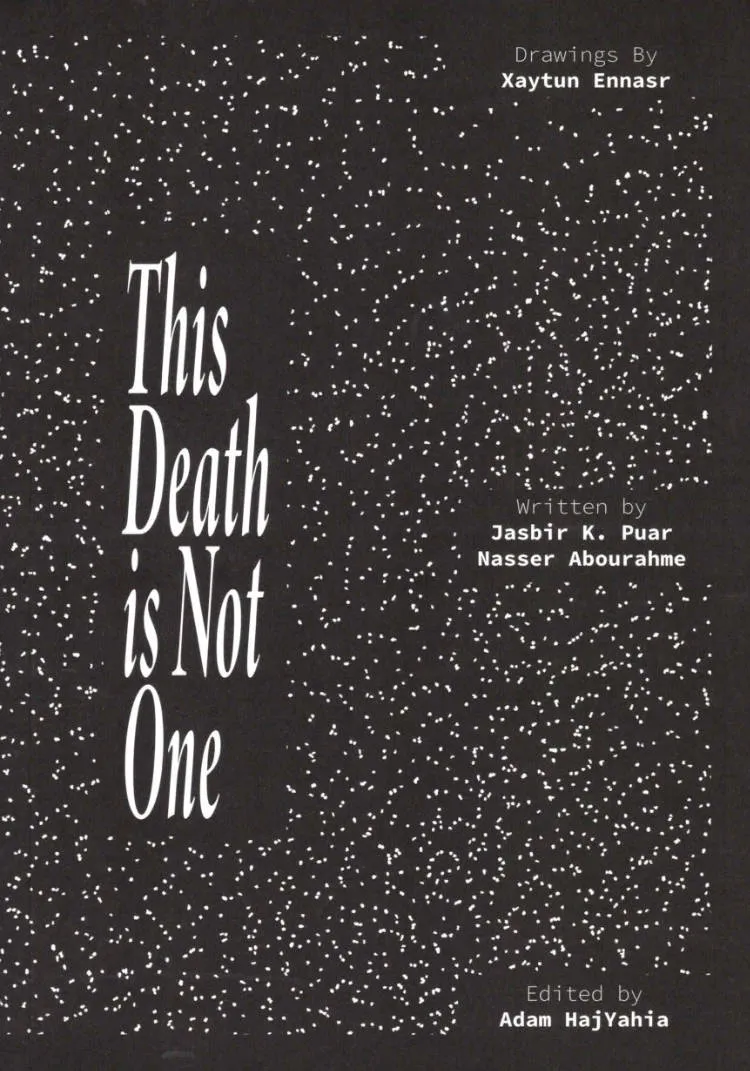
The publication of The Right to Maim by Jasbir K. Puar in 2017 was critical to advancing studies on disability and to further articulating how the body figures in the nexus of capacity and debility across racializing and extractive neoliberal lines. It offered a complex and rigorous anti-capitalist account of disability that is useful to both scholarly work and political and social organizing. However, despite its paramount contribution to scholarship on Palestine, delivered by its scathing analysis of the Israeli biopolitical policy—its right to maim—in how the injured Palestinian body is produced and reproduced, its reception was difficult, and hard to stomach. It cohered a political logic in writing before it was visibly evident on the ground. In the moment and aftermath of the Great March of Return (2018-19), Puar’s offerings became much harder to ignore, as the event crystallized a mass maiming campaign of Palestinian protesters inside the edges of the militarized borders of Gaza.
The occasion of this publication by Bilna’es marks the first translation into Arabic of the chapter “Will Not Let Die”: Debilitation and Inhuman Biopolitics in Palestine, alongside the postscript of The Right to Maim. Not simply a reissue of previously published work or a translation, This Death is Not One includes a new preface from Jasbir K. Puar revisiting the right to maim from within this moment of genocide in Gaza that interrogates the new vectors of living and dying under settler-colonialism, and how maiming, in fact, speaks of extermination; an introduction by Nasser Abourahme reflecting on the book’s stakes in the present and its reception in the past, alongside searing analysis of genocide in excess of the law, and what this reveals and forecloses in how we understand the juridical body and militancy in the wake of Zionism; and original drawings by Xaytun Ennasr that inscribe a relation between land and body mapped through cosmological patterns tracing the relation between martyrs, who are referred to as moons, and the moon, a symbol for martyrdom in Palestine.
Jasbir K. Puar is Distinguished Faculty of Arts Professor in the Social Justice Institute at the University of British Columbia, Extraordinary Professor in the Women’s and Gender Studies Department at the University of the Western Cape in Cape Town, South Africa, and Professor Emerita at Rutgers University where she was faculty in the Women’s, Gender, and Sexuality Studies Department for 23 years. Puar is the author of the award-winning books: The Right to Maim: Debility, Capacity, Disability (2017), and Terrorist Assemblages: Homonationalism in Queer Times (2007).
Nasser Abourahme is a writer and teacher, and is currently assistant professor at Bowdoin College. He’s the author of The Time beneath the Concrete: Palestine between Camp and Colony (Duke University Press, 2025), which was awarded the 2025 Palestine Book Award.
Xaytun Ennasr is an artist and designer. She works across experimental video games, paintings, prints, ceramics, installations, and text. She often uses science fiction, folklore, and radical softness as affective tools for revolutionary cultural production, specifically Palestinian liberation and sovereignty. Her work often deals with questions of land, cartography, transness, gender, and the living environment.
Drawings by Xaytun Ennasr
Translation to Arabic:
“Living in Genocide” by Jasbir K. Puar, translated by The Archilogue
“Our names, our remains” by Nasser Abourahme, translated by The Archilogue
The Right to Maim, Chapter 4: “Will not let die: Debilitation and Inhuman Biopolitics in Palestine ” and the The Right to Maim Postscript by Jasbir K. Puar, translated by Bekriah Mawasi

Prisoner of Love
Starting in 1970, Jean Genet—petty thief, prostitute, modernist master—spent two years in the Palestinian refugee camps in Jordan. Always an outcast himself, Genet was drawn to this displaced people, an attraction that was to prove as complicated for him as it was enduring. Prisoner of Love, written some ten years later, when many of the men Genet had known had been killed, and he himself was dying, is a beautifully observed description of that time and those men as well as a reaffirmation of the author’s commitment not only to the Palestinian revolution but to rebellion itself. For Genet’s most overtly political book is also his most personal—the last step in the unrepentantly sacrilegious pilgrimage first recorded in The Thief’s Journal, and a searching meditation, packed with visions, ruses, and contradictions, on such life-and-death issues as the politics of the image and the seductive and treacherous character of identity. Genet’s final masterpiece is a lyrical and philosophical voyage to the bloody intersection of oppression, terror, and desire at the heart of the contemporary world.

Postcommodity, Alex Waterman and Ociciwan: “in memoriam…”
Ociciwan Contemporary Art Collective
Eighty-page programme book score, and libretto, for performances by Indigenous musicians of in memoriam…Mary Cecil,Victoria Callihoo (née Belcourt), and Eleanor (Helene) Thomas Garneau and Robert Ashley’s in memoriam... Curated and edited by Ociciwan Contemporary Art Collective.
[from back cover] …in memoriam Mary Cecil,Victoria Callihoo (née Belcourt), and Eleanor (Helene) Thomas Garneau adds a new score and production by Postcommodity and Alex Waterman to a suite of four early scores by the American composer Robert Ashley. The fifth score honours the lives of Mary Cecil, Victoria Callihoo (née Belcourt), and Eleanor (Helene) Thomas Garneau, three Indigenous women from territory at the turn of the Century as it became the province of Alberta. This significant addition continues Ashley’s project investigating the connections between musical forms and constructs of historicization, opening a conversation regarding whom and how we memorialize individuals and inscribe their legacies.
[from essay by Candice Hopkins] What histories are remembered and who is doing the remembering? What form do these rememberings take? It is not as simple as taking down one monument and replacing it with another. We need to ask more questions, take note of the voids that stand in for the past, and actively make way for other voices, particularly those are trapped under the ‘sea ice of English’. “Listen for sounds”, writes the Tlingit poet and anthropologist Nora Marks Dauenhauer, “They are as important as voices. Listen. Listen. Listen. Listen.”

On Pillow Talk

slow emergency siren, ongoing: Accessing Handsworth Songs
A unique limited edition accessible publication documenting a project to make Black Audio Film Collective’s seminal 1986 film Handsworth Songs more, and differently, accessible. Designed by Daly & Lyon it presents a new commissioned annotated audio description script from Elaine Lillian Joseph and new creative captions commissioned from the Care-fuffle Working Group alongside new essays by Clive Nwonka and Sarah Hayden.
The publication was produced in collaboration with Voices in the Gallery and with the support and advice of the UK Association for Accessible Formats and financial support from AHRC. The publication is also available in website form designed by An Endless Supply at slowemergencysiren.org.uk

Issue #9: Companions
Irene de Craen, Katia Krupennikova
The editorial/imaginative centre of the ninth issue of Errant Journal is located in the regions that have experienced Russian imperial aggression from where it makes connections across times, geographies, and ontologies to explore the radical potential of companionship. Companionship is understood not as agreement, but as a shared responsibility across unequal histories. It means not being full without the other. While forms of imperial and colonial violence might differ in places and through times, the issue recognizes how colonial mechanisms are sustained, how they present themselves as if they were past while shapeshifting and continuing in new forms and places in the present. By bringing these contexts in relation, this issue aims to show how certain borders, biases, clichés, and power structures travel, mutate, and shape both human and non-human lives and landscapes. Ultimately, companionship is about prioritizing life and about insisting that no oppression is singular.
This issue is a concept by and co-edited with Katia Krupennikova.
Contributors: Adriana Arroyo, Keto Gorgadze, Andreas Kalkun, Chung Kai Lee, Samira Makki, Ana Mikadze, Petrică Mogoș, Fabienne Rachmadiev, Vaim Sarv, Victoria Soyan Peemot, Czyka Tumaliuan, Iryna Zamuruieva, Irene de Craen, Katia Krupennikova
Sexe 2
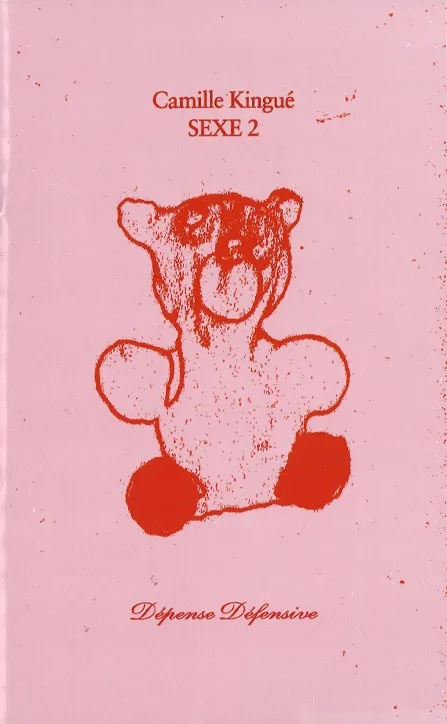
Confession sur le désir (l’action et l’objet du), les liens de mutualité et de résistance, Sexe 2 alterne prose et versification en 27 fragments numérotés à l’adresse plus ou moins dure, plus ou moins sincère, plus ou moins formulée car plus ou moins éloignée du Toi et du Je. Camille Kingué s’attache à révéler, à voir quelque chose à travers son image réelle et virtuelle, agrandie et rétrécie, droite et renversée, déployant une recherche des principes de l’amour (l’amour comme amour, pourquoi est ce qu’il y a de l’amour) où la métaphysique et la compréhension de soi – donc de l’autre – n’ont jamais été aussi sexy.
Claire Star Finch, dans la magnifique préface qu’iel signe au début de l’ouvrage, écrit : « Après avoir lu tous les livres de Kingué, je ne sais pas si je crois en “l’amour”, que ce soit en tant que substantif absolu ou en tant que proto-résidu de tout ce que “le sexe” peut signifier. Mais je crois définitivement qu’il faut l’écrire. » Définitivement.

The Joy of Electronic Music
This book is for people who love electronic music, people who probably have a synthesizer or two at home. It’s for people who tell themselves that they should find some time for their passion, who blame themselves for not making enough music. This book is for them.
For decades, I thought that I could be a music producer. But over the years, I have discovered that my contribution to the electronic scene wasn’t exactly the music itself. Although I was lucky enough to produce a few successful tracks in Lithuania, back in the ‘90s, my actual achievement turned out to be raising interest in electronic music, for other young people. I’m still surprised when someone remembers my old tracks, but I’m very proud when someone tells me that listening to me speak on the radio about Berlin techno changed their dreams back in the day. Later, in the 2000s, I was part of the early SoundCloud team. The code we wrote has touched hundreds of millions people around the world. No track or song I would have ever produced would have had such an effect. There is a reason that Brian Eno says the evolution of music is moved by technology as much as it is by artists. The people who created Logic and Ableton, those who code SoundCloud and Spotify, design Korg and Roland synths, they influence the course of music on a massive scale. The development of music technology is the work of many people and I’m happy to call myself one of that gang.
This book is a natural extension of those ideas. It’s not based on scientific or journalistic research, but it’s not a biography, either. I imagine this book sitting on a studio desk, or in a gig bag. In the process, I hope that some young music creators will find answers here, and inspirations, to the questions they’ve been wrestling with for a long time.

Pages 11 - Stage So Near So Far
Nasrin Tabatabai, Babak Afrassiabi
The new issue consists of 8 plays and performance texts by Iranian women writers living in or outside Iran. Whether based on actual experience, fictional, or drawn from archives, these texts deal in one way or another with the question of the stage. They produce a contested space of performance that is inevitably linked to the performer's body, whose thresholds are stretched and contracted into potentially new forms of staging. The authors in this issue place their writing in performative relation to the specific historical and sociopolitical conditions in which they live and work. In many ways, the writings interrogate the politics that delineate the stage itself.
The authors in this special issue are: Nasim Ahmadpour, Nil (Alista) Aghaee, Naghmeh Manavi, Athena Farrokhzad, Nazanin Sanatkar, Azade Shahmiri, Zahra Mohseni and Naghmeh Samini.

Boys Alive
A daring novel, once widely censored, about the scrappy, harrowing, and inventive lives of Rome's unhoused youth by one of Italy's greatest film directors.
Boys Alive, published in 1955, was Pier Paolo Pasolini's first work of fiction and it remains his best known. Written in the aftermath of Pasolini's move from the provinces to Rome, the novel captures the. hunger and anger, waywardness and squalor of the big city. The life of the novel is the life of the city streets; from the streets, too, come its raw, mongrel, assaultive language. Here unblinkered realism and passionate lyricism meet in a vision of a vast urban inferno, blazing with darkness and light.
There is no one story to the book, only stories, splitting off, breaking away, going nowhere, flaming out, stories in which scenes of comic debacle, bitter conflict, wild joy, and crushing disappointment quickly follow. Pasolini's young characters have nothing to trade on except youth, and the struggle to live is unending. They loot, hustle, scavenge, steal. Somehow money will turn up; as soon as it does it will get spent. The main thing, in any case, is to have fun, and so the boys boast and vie, the desperate uncertainty of their days and nights offset by the fabulous inventiveness of their words. A warehouse heist, a night of gambling, the hunt for sex: The world of Boys Alive is a world in convulsion where at any instant disaster may strike.
Tim Parks' new translation of Pasolini's early masterpiece brings out the salt and brilliance of a still-scandalous work of art.

Mouvement #129
The new “left-wing Catholics”; education under Trump and the American brain drain; theater, porn, and bullfighting with Lorraine de Sagazan; an X-ray journey with the nuclear nomads; soccer, Gen Z, and algorithmic governance in Morocco; Pedro Rhino, cinema at the end of the neocolonial mirage...
Founded in 1995, Mouvement is a French “indisciplinary cultural magazine”, published quaterly.

Drawing the Surface of Dance: A Biography in Charts
Soloing on the page, choreographer Annie-B Parson rethinks choreography as dance on paper. Parson draws her dances into new graphic structures calling attention to the visual facts of the materiality of each dance work she has made. These drawings serve as both maps of her pieces in the aftermath of performance, and a consideration of the elements of dance itself.
Divided into three chapters, the book opens with diagrams of the objects in each of her pieces grouped into chart-structures. These charts reconsider her dances both from the perspective of the resonance of things, and for their abstract compositional properties. In chapter two, Parson delves into the choreographic mind, charting such ideas as an equality in the perception of objects and movement, and the poetics of a kinetic grammar. Charts of erasure, layering and language serve as dynamic and prismatic tools for dance making. Lastly, nodding to the history of chance operations in dance, Parson creates a generative card game of 52 compositional elements for artists of any medium to cut out and play as a method for creating new material. Within the duality of form and content, this book explores the meanings that form itself holds, and Parson's visual maps of choreographic ideas inspire new thinking around the shared elements underneath all art making.
ANNIE-B PARSON is a choreographer and artistic director of Big Dance Theater. Parson has also made choreography for rock shows, marching bands, symphonies, movies, museums, objects, augmented reality, and people: David Byrne, David Bowie, St. Vincent, Mikhail Baryshnikov, Wendy Whelan, Laurie Anderson, Nico Muhly, Jonathan Demme, and the Martha Graham Dance Co. SIOBHAN BURKE writes on dance for the New York Times and other publications. She teaches at Barnard College.