Books
Books
in random order

Trans Girl Suicide Museum
One part ketamine spiral, one part confessional travelogue from the edge of gender, TGSM is a hallucinatory transmission on sex, identity, the internet, and the flickering wish not to exist in a given body at a given point in time. TGSM raises questions with which we have begun to negotiate broadly as a culture: what is actually happening to someone when they transition? how should we understand or describe such processes? what is the role of drugs, of hallucination, of imagination, in transition? is being a trans person in this moment in history, when the identity is ever more carefully traced [and tracked] by larger cultural forces, more liberated than before?
Drawing its source material from chance encounters, wordless interactions in basements or bathrooms or hotel rooms, to archives of 20th century critical theory, sleepover secrets exchanged between old friends, rhetorical barbs deployed in the classrooms of elite universities, arguments on the phone with your parents across timezones, the nonverbal codes of high and low fashion, and scribbled notes on the backs of receipts for medicines you don't know how they work, TGSM is a morbid yet strangely hopeful meditation on the possibilities and meanings of gender variation in our time.
Hannah Baer runs the meme account @malefragility on instagram, and studies clinical psychology in new york city.

An Eros Encyclopedia
To want to reveal; to want to reveal enough; to desire; to desire in the right way, the right amount: in her debut book, Rachel James narrates the desiring subject’s nuanced and entangled intimacies with histories of power. How, in other words, under patriarchy, against misogyny, within capitalist strictures, is knowledge shaped, contained, and transferred? Tracing traditions of theater, pedagogy, and faith, An Eros Encyclopedia offers up desire and the attunement to its many objects as the atmosphere of a life—a method to navigate, perceive, and relate against the illusion of separation.

Wistlin is did
Chris Mann is an Australian-American composer, poet and performer specializing in compositional linguistics. Mann studied Chinese and linguistics at the University of Melbourne, and his interest in language, systems, and philosophy is evident in his work. Mann founded the New Music Centre in 1972 and taught at the State College of Victoria in the mid-1970s. Mann moved to New York in the 1980s and was an associate of American composers John Cage and Kenneth Gaburo. Mann has recorded with the ensemble Machine For Making Sense with Amanda Stewart and others, Chris Mann and the Impediments, and Chris Mann and The Use. Mann currently teaches in the Media Studies Graduate program at The New School.

Exocapitalism – Economies with absolutely no limits
Roberto Alonso Trillo, Marek Poliks
A rigorous and mind-blowing account of the dynamics of capitalism today through an in-depth exposition of software, speculative finance, and the highest scales of arbitrage.
At the centre of Marek Poliks and Roberto Alonso Trillo's argument is the idea that capital does not belong to humans, it belongs to—and is governed by—itself. Traditional economic theory struggles to keep up with the rapid rate of acceleration, and this book steps in to address this:
"The critical orthodoxy is slowing; it's tired, it's not especially good at the internet, it's probably never manned a Starbucks counter or an anonymous cubicle. Its younger adepts—though digitally native—are chronically underemployed, unavailable, drowning in the student debt (or student opportunity cost) required for entry into the critical apparatus. Few have any patience for the numbing slop-speak of the LinkedIn economy, the libertarian enclave of forex and HFT and memecoins, the quarter-zip depravity of employment at the charnel houses of McKinsey or Deloitte or Accenture, the blazingly random mood-swings of venture capital that lubricate all of the above. This impatience is—in the parlance of the above—a blocker: it means that the critical apparatus underestimates the power of the software economy, struggles to articulate the morphological density of digitally-realized capitalism, comprehensively ignores the functional death of labor, and doesn't understand scale."
Introduction by Charles Mudede.
Afterword by Alex Quicho.
"A masterpiece... Nick Land for adults."
— 0nty

Shapes found for living
Books in dreams were once made of scrolls and parchments. Once, books in dreams could only manifest themselves as clay. Scratches became meaningful. Books still tumble down. Most rooms are flooded; the waters are generally at ankle height.
Shapes Found for Living offers short tales—rumours and fables coalescing from the uneven experience of living in this century and vivifying the reader’s imagined memory theatre. The collection moves from rude immediacy via questioning forms of language depicting unstable mental states, the near madness of trying to live or love, to the absurd remnants of an (envisioned) ancestral recall.

SABR N°04 - Half a life
“Perhaps much of what we once believed was never truth but a gentle and necessary illusion.It was something we chose quietly and almost unconsciously so we could continue without falling apart.”
Bayan Abu Nahla is a visual artist born in 2001 in Gaza, Palestine. Her artistic practice functions as a visual diary, documenting and reflecting rapidly evolving events, both before and after the genocide. Through her work, she explores realities and daily living conditions often unknown to those who have not lived in Gaza.
SABR/Collection is a series of publications that bring together short literary works in a variety of genres. Curated by Nesrine Salem, SABR/Collection wishes to highlight the macro-realities of the authors chosen, to make visible the intersectional nature of struggles.

The Letters of Douglas Oliver and J. H. Prynne
Douglas Oliver (1937–2000) and J. H. Prynne (b. 1936) are two of the most original and ambitious poets of the contemporary era. Eschewing the conservativism of mainstream postwar British verse and embracing influences from America and Europe, each developed their craft through continuous correspondence and exchange as part of the febrile scene of poetical community and contestation that emerged in Cambridge in the 1960s. Their works over the following decades exhibit frequent shifts in form and style, from Prynne’s radical transformation and dispersal of the lyric tradition to Oliver’s adaptation of dream visions and medieval-inspired verse satires.
Their letters are a record of both the high stakes and playful experiments that constitute the writing lives of two singular poets determined not just to engage with modern political and social life during decades of crisis and upheaval, but to contribute through the circulation and publication of poetry to what Oliver calls “a community of political ethic.” Over the course of more than thirty years of friendship and mutual appreciation, the motivations for, and consequences of, their poems are constantly worked through, tested out, evaluated, and contradicted, always with a view to what the poetry means for the other, for the poetical communities they inhabit, and for the life of poetry itself.
This volume collects for the first time the majority of Oliver and Prynne’s correspondence, allowing new insights into the literary, political, and historical contexts of their lives and writing. An introduction, notes, and appendices provide a scholarly apparatus to situate Oliver and Prynne among the poets and publishers with whom they worked and socialized, and to identify and expand upon their frequent references to an enormous range of source material and reading matter.
“The correspondence between J. H. Prynne and Douglas Oliver is gripping and illuminating, brilliantly edited and completely absorbing. Two great poetic intelligences respond to each other’s work and to the society around them, thinking through the issues at stake in their poetic practice, their differences in approach, the different worlds they inhabit, their shared commitment to writing poetry and their admiration of each other’s work. The letters, complex as their matter can be, repay repeated reading; taken together, over a period of 33 years, they chart the context and creation of some of the most significant work in late twentieth-century poetry. This is an utterly engaging volume, and should be read by anybody interested in poetry and its place in the contemporary world.”—Ian Patterson
“For writers who welcome each other as peers, the exchange of letters is the spontaneous moment of exposure, the drawing out of selves. It is thinking in mutuality. In this thoughtfully edited and carefully, even beautifully, presented correspondence between Douglas Oliver and J. H. Prynne, two of the preeminent poets of the ‘British Poetry Revival’ of the post-World War II generations, we witness two writers of immense gifts thinking with each other, coming alive to thought and, ultimately, a shared world or community of wish. There is life, there is death; there is grief, there is anger – and love – but always there is a seeking, an attempt to arrive at a language for our worlds. Henceforth, one cannot imagine reading the work of either Oliver or Prynne without this correspondence and all that it offers in openings onto what Oliver himself saw as ‘the poet’s full performance [which] is the whole life’s work.’ It is a glimpse into an athanor of poetic creation.”—Michael Stone-Richards
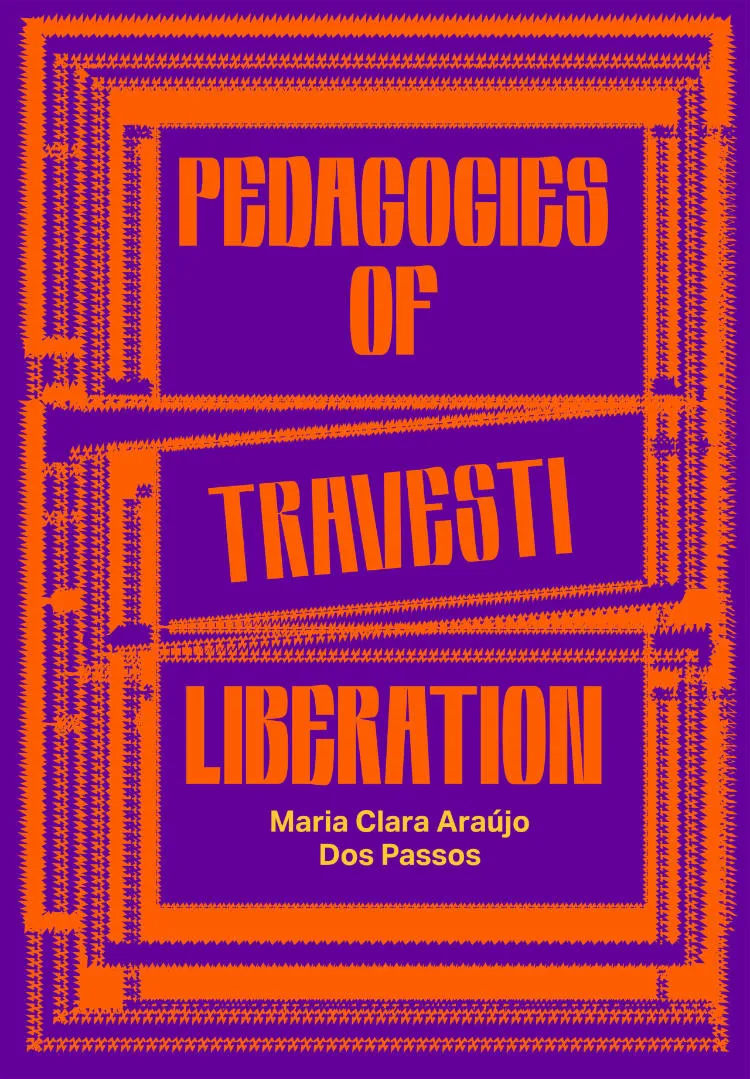
Pedagogies of Travesti Liberation
Maria Clara Araújo dos Passos, Natália Affonso
Maria Clara Araújo dos Passos examines the interplay of education, identity, and liberation in Brazil's travesti community.
In Pedagogies of Travesti Liberation, Maria Clara Araújo dos Passos critiques traditional pedagogical frameworks that marginalize gender nonconforming narratives and highlights the effects of systemic discrimination on travestis' psychosocial well-being. The book advocates for inclusive educational practices and emphasizes the need for affirmative curricula.
Newly translated from Portuguese, this work contributes towards connecting political struggles globally and navigating the complexities of translation—particularly of the term "travesti"—across various geographical and political contexts, featuring a conversation between Araújo dos Passos and translator Natália Affonso.
Maria Clara Araújo dos Passos (born 1996 in Recife) is a Brazilian Afro-transfeminist educator and sociologist, and an activist for LGBT rights.

Clara Istlerová: a Life Among Letters
Anežka Minaříková, Clara Istlerová
Clara Istlerová: A Life Among Letters is the first publication in the United States to delve into the design landscape of the former Czechoslovakia through the lens of Czech designer Clara Istlerová (born 1944). A trailblazer in her field, Istlerová was one of the few women in the male-dominated field of Czech typography. This publication introduces readers to Istlerová’s renowned book designs, particularly highlighting the analog processes she utilized to create one of the most influential books on Czech architecture, Švácha, Rostislav. From Modernity to Functionalism (Odeon, 1985).
The publication features an intimate interview with Istlerová conducted by editor Anežka Minaříková, accompanied by work from Istlerová’s personal archive alongside discussions detailing her creative process. Offering a vivid portrayal of an era where design was a tangible, labor-intensive endeavor carried out in close collaboration with typesetters and printers, the publication unveils the Czech design narrative of the twentieth century to English-speaking readers, highlighting Istlerová’s lasting impact and central role.
Design by Anežka Minaříková and Marek Nedelka

Movement Research Performance Journal
Issue #52/53 - Sovereign Movements
Movement Research announces Issue 52/53 of its print publication, the Movement Research Performance Journal. For this issue, Sovereign Movements: Native Dance and Performance, guest editor, choreographer Rosy Simas invited writer, Ahimsa Timoteo Bodhrán, to work with her. Together they assembled contributors from Native and Indigenous communities to reflect upon their practices, the historical conditions out of which they operate as well as movement, performance, and choreography as a socio-political project. Just as it is important for physical institutions to acknowledge that they sit upon occupied land of Native and Indigenous people, so too must institutions of history, practice, and epistemology acknowledge their occupation of knowledge and memory.
Throughout this issue, dance and movement is posited as a powerful strategy against settler-colonial mindsets and as an effective tool against erasure of Native and Indigenous cultural traditions. These pages discuss the importance of Native sovereignty and analyze various histories of resistance to settler-colonialism. Artists in the issue propose alternative artistic models to probe the roles of art and artists in society towards a more expansive constellation that fundamentally critiques the Western reward system in culture as well as the often celebrated cult of authorship.

OEI #90/91 Sickle of Syntax & Hammer of Tautology
Tobi Maier, Cecilia Grönberg and 1 more
OEI # 90-91: Sickle of Syntax & Hammer of Tautology offers the first English language overview of the history of concrete and visual poetry production in socialist Yugoslavia between 1968 and 1983.
By focusing on mass-produced examples of concrete poetry, this publication presents these poetic experiments as organically linked to social movements, critical theories, and youth cultural revolutions. In his extensive introduction, Sezgin Boynik, the guest editor of this special issue of OEI, discusses concrete and visual poetry in socialist Yugo-slavia as an uneven and combined development, and emphasizes its confrontational and organizational aspects.
By means of interviews, translations, reproductions, and theoretical and historical statements, OEI # 90-91 offers a picture of a very lively scene of concrete and visual poetry in Yugoslavia, which unfortunately is not as recognized interna-tionally as it would deserve.
Hoping that OEI # 90-91 could contribute to this task in a substantial way, we present episodes from the early years of OHO formation and its complex theories of words and things; an interview with Rastko Močnik on programmed art and political formalism; militant polemics of Goran Babić; Signalist contradictions; subjective structural devices of Judita Šalgo; zaum experiments of Vojislav Despotov; detective meta-texts of Slavoj Žižek; poetic self-management studies of Vujica Rešin Tucić; a feminist historicisation of Ažin school for experimental poetry; democratisation of visual poetry by Westeast; selections from special issues of the journals Pitanja, Problemi, Ulaznica, Dometi, Delo, Koraci, Vidik, Pegaz, and many other materials translated here for the first time and presented in one publication.

The Word for World: The Maps of Ursula K. Le Guin
When Ursula K. Le Guin started writing a new story, she would begin by drawing a map. The Word for World presents a selection of these images by the celebrated author, many of which have never been published before, to consider how her imaginary worlds enable us to re-envision our own.
Le Guin’s maps offer journeys of consciousness beyond conventional cartography, from the Rorschach-like archipelagos of Earthsea to the talismanic maps of Always Coming Home. Rather than remaining within known terrain, they open up paradigms of knowledge, exemplified by the map’s edges and how a map is read, made and re-made, together. The Word for World brings her maps together with poems, stories, interviews, recipes and essays by contributors from a variety of perspectives to enquire into the relationship between worlds and how they are represented and imagined.
Contributors: Federico Campagna, Theo Downes-Le Guin, Daniel Heath Justice, Bhanu Kapil, Canisia Lubrin, Una McCormack, David Naimon, Nisha Ramayya, Shoshone Collective, Standard Deviation, Marilyn Strathern.
Co-published by Spiral House and AA Publications to coincide with an exhibition of Ursula K. Le Guin’s maps at the Architectural Association, London, opening on 10 October 2025.
”One of the literary greats of the 20th century.” Margaret Atwood

Movement Research Performance Journal
Issue #60 - Gender Disarray
Kay Gabriel, Amalle Dublon and 2 more
Under the direction of four contributing editors—Amalle Dublon, Kay Gabriel, Keioui Keijaun Thomas, and Anh Vo— we’ve assembled a new body of work by mostly trans and queer artists reflecting on the keyword “gender” and its relation to contemporary performance. Their work moves across multiple genres of writing, from analytic essays to poetry to performance scripts.
“Read My Lips” is a phrase that will be familiar to longtime readers of the Movement Research Performance Journal—so familiar that the mere reference will bring to mind an image posted by the artist collective GANG, an image that lies at the heart of one of the journal’s most spectacular moments. Issue #3, with its focus “Gender Performance,” was published in 1991 amid that era’s Culture Wars, receiving almost immediately negative reception from government officials (the NEA threatened to withdraw funding from Movement Research) and many members of the dance community (who considered Issue #3 to be deliberately provoking the so-called “war,” intentionally taking a political position that some worried might comprise future funding of the field). In the thirty-three years since its publication, Issue #3 has developed a patina familiar to many artist-activist histories that are looked upon with romance and nostalgia, often by those for whom that history is only a fantasy (rather than a lived experience).

Life with Fifi
Kris Dittel, Angelica Falkeling
A children’s book without a specific age category, offering a glimpse into the small rituals and shared moments that shape a day with Fifi Paris.
Fifi, a Pomeranian-Chihuahua mix, came into the lives of Angelica and Kris a few years ago. Taking care of a puppy is taking responsibility for building their world and letting the small animal transform yours. As her human caretakers, the authors created Fifi’s world with toys, cuddles, rules, snacks and walks in the park. In return, she transforms our world by bringing our community together and reminding us of the importance of caring for one another. In this book, Kris and Angelica narrate a day in the life of Fifi, from the moment she wakes up to when she falls asleep at night. Along the way, they share how they connect with her, how they see her understanding her surroundings and what she has taught them about companionship.
Design by Amy Suo Wu
Copy-editing by Clem Edwards
Photography by Lili Huston-Hertreich

The Undying (paperback)
Blending memoir with critique, an award-winning poet and essayist's devastating exploration of sickness and health, cancer and the cancer industry, in the modern world
A week after her 41st birthday, Anne Boyer was diagnosed with highly aggressive triple-negative breast cancer. For a single mother living payslip to payslip, the condition was both a crisis and an initiation into new ideas about mortality and the gendered politics of illness.
In The Undying - at once her harrowing memoir of survival, and a 21st-century Illness as Metaphor - Boyer draws on sources from ancient Roman dream diarists to cancer vloggers to explore the experience of illness. She investigates the quackeries, casualties and ecological costs of cancer under capitalism, and dives into the long line of women writing about their own illnesses and deaths, among them Audre Lorde, Kathy Acker and Susan Sontag.
Genre-bending, devastating and profoundly humane, The Undying is an unmissably insightful meditation on cancer, the cancer industry and the sicknesses and glories of contemporary life.
Winner of The Pulitzer Prize for Nonfiction 2020; Windham Campbell Prize for Nonfiction 2020

Papillon de verre
Raphaëlle Milone's first novel, a dive into the heart of desires, acclaimed by Simon Liberati as well as by Jean-Luc Nancy.
Raphaëlle Milone (born 1991 in Riom) is a French writer.
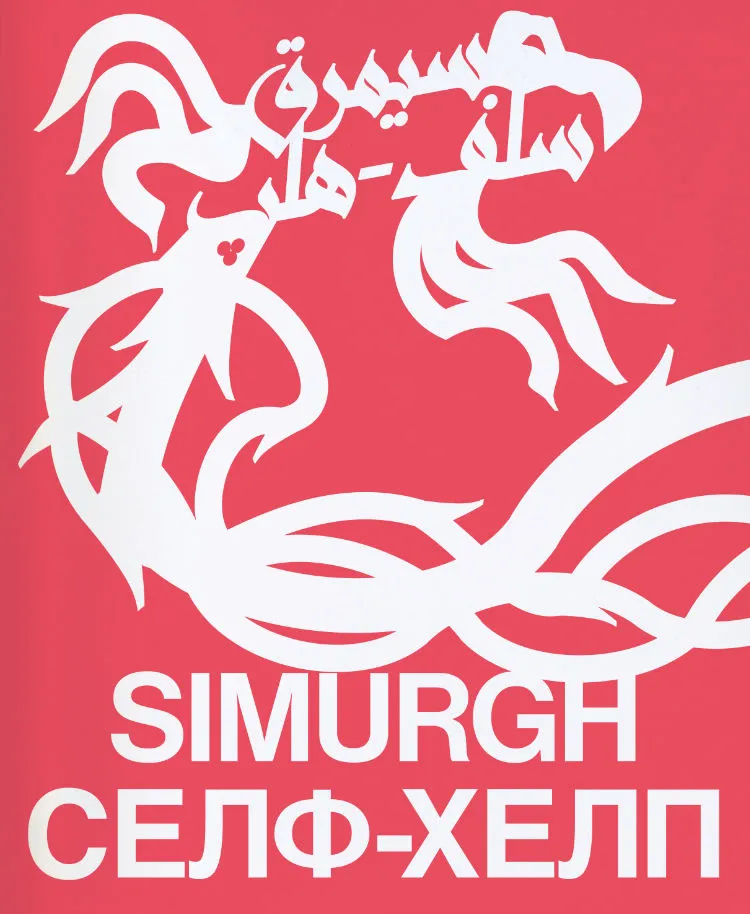
Simurgh Self-Help
The 2025 Ringier annual report (artist's book).
Since 1998, Ringier, the Swiss-based global media company, has traditionally commissioned an artist to design its annual report. Publisher Michael Ringier and curator Beatrix Ruf initiated this series as a means of reinforcing the links between art and the activities of the company.
For the 2025 edition, Slavs and Tatars' Simurgh Self-Help revisits Marcel Broodthaers' seminal work Musée d'Art Moderne: Département des Aigles (1968–1972), replacing or "translating" the eagle—a symbol of power and empire that is used to challenge our understanding of authority and value—with the Simurgh, a mythical bird found across the Turkic-Persianate world. Whilst the eagle is often associated with nation-states and masculinity, the Simurgh is decidedly transnational, metaphysical, and flamboyant, if not gender-fluid.
Much like the collective's geographic remit—between the former Berlin Wall and the Great Wall of China—this publication attempts to shift our focus elsewhere, eastwards, to regions which too often fall through the cracks of historiography and art history. If modern and contemporary art institutions in Broodthaers' time were largely situated between the Rhineland and Northeast United States, the multipolarity of today's art world is a fait accompli: with biennials in Uzbekistan and museums in Kazakhstan, amongst others, rivalling the traditional centers of power.
Once too a sacred bird—accompanying Zeus, for example—the eagle has, over the past two millennia, undergone a thorough profanation: a brawny, secular flex of nationalism. It would be remiss not to see the parallels in the world of media: print itself and the act of reading, once an activity for the few and anointed, has undergone a similar dynamic of democratization over the past several centuries and, especially in recent years with the internet, a vulgarization which would make medieval Church elders wag their shriveled fingers at us in an I-told-you-so meme meant for the ages. This profanation has challenged the very institution of media and the narratives it disseminates, much as important works of institutional critique challenged contemporary art in the 1970s and beyond—akin to Slavs and Tatars' genre-bending mix of high and low, East and West, sacred and profane does today.
Slavs and Tatars' (founded 2006) extensive publishing activity—some 15 books in 20 years—has treated subjects as diverse as alphabet politics, Uighur literary culture, political satire in the Muslim world, and German anti-Enlightenment thinkers. Alongside sculptures, textile works, installations, sound pieces, and even a brick-and-mortar Pickle Bar in Berlin, the collective's books have cleared new paths for contemporary discourse via a wholly idiosyncratic form of knowledge production that draws on popular culture, spiritual and esoteric traditions, oral histories, modern myths, as well as scholarly research.
Slavs and Tatars is a faction of polemics and intimacies devoted to an area east of the former Berlin Wall and west of the Great Wall of China known as Eurasia. The collective's work spans several media, disciplines, and a broad spectrum of cultural registers (high and low) focusing on an oft-forgotten sphere of influence between Slavs, Caucasians and Central Asians.
Slavs and Tatars has published Kidnapping Mountains (Book Works, 2009), a celebration of complexity in the Caucasus, Love Me, Love Me Not: Changed Names (onestar press, 2010) and are currently preparing solo engagements at Vienna's Secession, Museum of Modern Art, New York and Künstlerhaus Stuttgart.

Love Is Colder Than the Lake
Searing in its energies and mysterious in its icy depths, Love is Colder than the Lake is a tour-de-force of the experimental French poet Liliane Giraudon's power and range.
Love is Colder than the Lake weaves together stories dreamed and experienced, fragments of autobiographical trauma, and scraps of political and sexual violence to create an alchemical and incantatory texture that is all Giraudon's own. In its feminist attention and allusive stylistic registers, Love is Colder than The Lake claims a unique position among contemporary French literature. The heroes (or anti-heroes) in this collection include Rainer Werner Fassbinder, Lorine Niedecker, Emma Goldman, Chantal Akerman, the Marquis de Sade, and the unnamed lake itself. Giraudon's writing, editing, and visual work have been influential in France for decades, and English-speaking readers will thrill to this challenging, important voice.
Liliane Giraudon was born in Marseille in 1946. She continues to live and work in Marseille, and her writing is inseparable from the place, shaped by the vibrant community of poets and writers and artists Giraudon has herself shaped, as well as by the city's gritty and diverse cosmopolitanism. Giraudon's many books have, since 1982, been primarily published by France's P.O.L. editions. Giraudon has also been instrumental as an editor for influential reviews such as Banana Split, Action Poétique, and If. She performs and collaborates widely, including with Nanni Balastrini, Henri Delui, Jean-Jacques Viton, and many others. Two of her books ( Fur and Pallaksh, Pallaksh) were published in English by Sun & Moon Press in 1992 and 1994, respectively. She lives in Marseille, France.
Lindsay Turner is the author of the poetry collections Songs & Ballads (Prelude Books, 2018) and The Upstate (University of Chicago Press, 2023). She has twice received French Voices awards for her translations from the French, which include books of poetry and philosophy by Stéphane Bouquet, Souleymane Bachir Diagne, Anne Duforumantelle, Ryoko Sekiguchi, and others. She is Assistant Professor of English and Creative Writing at Case Western Reserve University in Cleveland, Ohio.
Sarah Riggs is a poet and multivalent artist. Her most recent book The Nerve Epistle appeared in 2021. Translation is one of her arts, for which she received a Griffin prize with Etel Adnan, and Best Translated Book Award, also for Adnan's Time (Nightboat, 2019). Riggs lives in Brooklyn, after many years in Paris. Author residence: Marseille, France.

Phototaxis
Translated from the French, Phototaxis is a fragmentary, darkly-humorous apocalyptic text from a leading young voice from Montréal.
In a city mysteriously overflowing with meat, a museum is bombed, a classical piano player hooked on snuff films throws himself off a building, a charismatic but misled political organizer has disappeared, and a young immigrant navigates a crumbling continent. A dystopic work of hope, Phototaxis dismantles and rebuilds worlds with language at turns surreal, scathingly comic, poetic, and revolutionary.
“Olivia Tapiero’s virtuosic Phototaxis reverses the purgative gesture of necrophoresis: every sentence is shot through with the stench of carrion and the death rattle of capital’s circulation. Reading the text, one feels the vertigo of an interminable fall refracted in an infinity mirror of the commodified image. Tapiero’s haunting lyricism, atmospherically rendered in Kit Schluter’s translation, will ring out in your skull long after reading the book’s final word: music.“
— Jackie Wang

Nothing at All
An atmospheric rumination on gendered violence, cosmic collapse, and colonialism.
From deep inside a black hole, comes Nothing at All—the space where everything collapses: form, genre, gender, and being. Olivia Tapiero’s poetic and essayistic fragments overflow with lyric beauty as they explore how colonialism, illness, and desire intertwine amidst personal and collective suffering. Generations, geographies, and desires mingle, contaminating one another in these anarchic, insubordinate texts. Here, the written word disrupts foundations and nations, claiming its own survival.
Olivia Tapiero is a writer, translator and musician. She is the author Les murs (Robert-Cliche Award, Prix Senghor finalist), Espaces (2012), Chairs (2019), Phototaxie / Phototaxis (Nightboat Books, 2017 / 2021, Lambda Literary Awards finalist), and Rien du tout (2021, Grand Prix du livre de Montréal Finalist, Governor General’s Literary Awards finalist). She is editor-in-chief for the literary magazine Moebius, and has contributed poems and essays to various publications in Canada, France, and Korea. She has also translated works of contemporary authors such as Roxane Gay, Anne Boyer and Billy-Ray Belcourt. She lives between Marseille and Montréal.
Foreword by Anne Boyer.

Conflict Is Not Abuse
From intimate relationships to global politics, Sarah Schulman observes a continuum: that inflated accusations of harm are used to avoid accountability. Illuminating the difference between Conflict and Abuse, Schulman directly addresses our contemporary culture of scapegoating. This deep, brave, and bold work reveals how punishment replaces personal and collective self-criticism, and shows why difference is so often used to justify cruelty and shunning. Rooting the problem of escalation in negative group relationships, Schulman illuminates the ways in which cliques, communities, families, and religious, racial, and national groups bond through the refusal to change their self-concept. She illustrates how Supremacy behaviour and Traumatized behaviour resemble each other, through a shared inability to tolerate difference.
This important and sure to be controversial book brings insight into contemporary and historical issues of personal, racial and geo-political difference, as tools of escalation towards injustice, exclusion and punishment, whether the objects of dehumanization are other individuals in our families or communities, African Americans at the hands of police, people with HIV, and Palestinians. Conflict Is Not Abuse is a searing rejection of the cultural phenomenon of blame, cruelty, and scapegoating, revealing how those in positions of power exacerbate and manipulate fear of the "other" to avoid facing themselves.

Little F
A new epic novel about a teenage queer runaway from cult classic author of Black Wave and Valencia Michelle Tea. A Literary Hub Notable Small Press Book of 2025.
In Spencer's fantasies, the breezy, queer streets of Provincetown, MA, are utopia, a place where he can be free. Yet when a violent attack in his suburban Arizona schoolyard sends him to the hospital, he decides queer utopia can't wait. And one night, with the help of his best friend, the teenage witch Joy, he hitches a ride to find it.
The cross-country road odyssey that follows brings Spencer from new moon rituals in Arizona canyons to Texas bus stations, from the luxe drag stages of Houston's Montrose district to the jazz-soaked streets of the French Quarter and beyond. This new novel from Michelle Tea tells the story, by turns raw, romantic, and sweet, of a sheltered boy taking his first leap into queer life, among all the complicated queers who live it.
"Tea's conversational tone and her way of writing deeply personal experience . . . presents a very necessary counter-narrative to mainstream histories of American punk, feminism, and sexual identity." – The Brooklyn Rail
Michelle Tea is the author of over twenty books of fiction, memoir, poetry and children's literature. Her autofiction Valencia, a cult classic, won the Lambda Literary Award for Best Fiction. Her essay collection Against Memoir was awarded the PEN/Diamonstein-Spielvogel Award for The Art of the Essay. Tea is also the recipient of awards from the Rona Jaffe Foundation and the Guggenheim Foundation. The founder of Drag Queen Story Hour, she has received honors from the American Library Association and Logo Television. Tea curated the Sister Spit Books series at City Lights Publishers and founded the ongoing imprint Amethyst Edition at the Feminist Press.

Exercises of Poetic Communication with Other Aesthetic Operators
Ernesto de Sousa (1921–1988) was a major and multifaceted figure from the Portuguese avant-garde—artist, poet, critic, essayist, curator, editor, filmmaker, and a promoter of experimental ideas and artistic expressions.
Reflecting questions of hierarchy, authorship, and the complexity of framing or dividing within the multiple and complementary practices of Ernesto de Sousa—whose motto “Your Body is My Body, My Body is Your Body” serves as a poetic manifesto—this publication explores the various aspects of his oeuvre (visual, poetical, and theoretical) and his outstanding inventiveness of concepts.
The volume brings together a selection of works, unpublished archives and their translations, and theoretical texts by Ernesto de Sousa, including the first complete translation in English of «Orality, the future of art?» (1968). Richly illustrated, the book reunites an introductory text by Lilou Vidal, two new essays by Paula Parente Pinto and by José Miranda Justo along with a text by Hugo Canoilas.
"There was a time when bread was sacred; and in a general sense, all fabricated objects deserved the respect that resulted from (for the conscience of those who used them) concretely diving into their own motivations. Human gestures, like aesthetic objects, were inseparable from their relevant functions. Naturalism prompted us to look at natural and fabricated objects with a vision that was cosmic and indifferent at the same time. The objects, today, object. In the future, objects and gestures will perhaps clothe themselves once again in their lost dignity. The word love, a bit of bread, the letter A will stop being mortal accidents of daily life. Desacralized, they will once again be as decisive as the tiniest brushstroke the painter made on his canvas. And each of these brushstrokes will reveal the structure of the world. Life can then be compared to a vast work of art. Everything will be absolutely aesthetic.."
— Ernesto de Sousa
Contributors: Hugo Canoilas, Ernesto de Sousa, Tobi Maier, José Miranda Justo, Paula Parente Pinto, Lilou Vidal

objet petit ö
Ötza is a 5300-year-old cryodesiccated fan fiction writer from the Neolithic, an advocate for prehistoric literacy and a self-proclaimed connoisseur of post-historical theory-fiction. Locked in a cooling cell at the South Tyrol Museum of Archaeology in Bolzano, Italy, her writings are hopeful yearnings for counterfactual salvation from her fate of archaeological conservation, and an attempt to rewrite the narrative (unfairly) extrapolated from scientific reconstructions.
Ötza is written and performed by artist Levi van Gelder, and created in collaboration with costume designer and stylist Leila El Alaoui.
Edited by Maia Kenney, Aidan Hoyle, Anthony Stephinson