rile*books

Search books

Search books by title, author, publisher, keywords...

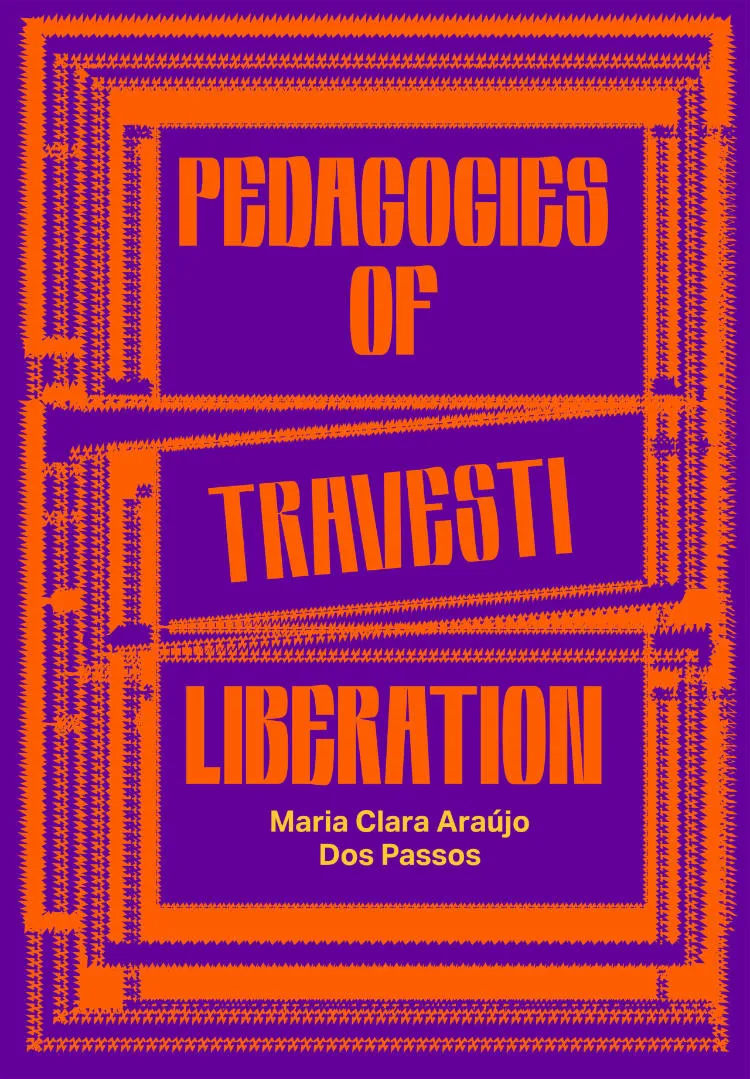
Cover of Pedagogies of Travesti Liberation

Archive Books

Pedagogies of Travesti Liberation

Maria Clara Araújo dos Passos

€15.00

Maria Clara Araújo dos Passos examines the interplay of education, identity, and liberation in Brazil's travesti community.

In Pedagogies of Travesti Liberation, Maria Clara Araújo dos Passos critiques traditional pedagogical frameworks that marginalize gender nonconforming narratives and highlights the effects of systemic discrimination on travestis' psychosocial well-being. The book advocates for inclusive educational practices and emphasizes the need for affirmative curricula.
Newly translated from Portuguese, this work contributes towards connecting political struggles globally and navigating the complexities of translation—particularly of the term "travesti"—across various geographical and political contexts, featuring a conversation between Araújo dos Passos and translator Natália Affonso.

Maria Clara Araújo dos Passos (born 1996 in Recife) is a Brazilian Afro-transfeminist educator and sociologist, and an activist for LGBT rights.

Published in 2025 ┊ 208 pages ┊ Language: English

recommendations

Cover of Metropolitan Voids Agency

Archive Books

Metropolitan Voids Agency

Margherita Moscardini, Zasha Colah and 1 more

Metropolitan Voids Agency is the first monographic publication dedicated to the collected works of artist Margherita Moscardini. The book recounts the work carried out by Moscardini spanning seventeen years, between 2008 and 2024, inviting a reading of her practice in its entirety as an investigation into ‘urban voids’: those which Moscardini has recognized and designated as voids, or those she has herself invented in the urban fabric.

Cover of Encounters – Embodied Practices

Archive Books

Encounters – Embodied Practices

Sandhya Daemgen, Raphael Hillebrandt and 2 more

Conversations about embodied strategies of knowledge production and knowledge transmission based on the choreographic and curatorial practices of about fifteen international choreographers, performers, dramaturges and curators.

In the context of the numerous ethical-political challenges of the global present, actors from the dance and choreography scene both in Berlin and internationally talk about forms of knowledge production beyond the prevailing conception found in Western modernity. They counter the mind-body separation and the notion of a universality of knowledge with multiplicities of knowledge production that emerge with and from the reality of differently situated bodies.

What potential do embodied practices offer for emancipatory movements? How can community be created through these practices, and what responsibilities does this entail? What role does the body play in the preservation and transmission of knowledge?

In this publication, edited by the choreographers and curators Martha Hincapié Charry, Sandhya Daemgen, Raphael Moussa Hillebrand and Matthias Mohr; Lukas Avendaño, Wagner Carvalho, Sandhya Daemgen, Ismail Fayed, Alex Hennig, Raphael Moussa Hillebrand, Martha Hincapié Charry, Isabel Lewis, Matthias Mohr, Prince Ofori, Mother "Leo" Saint Laurent, Léna Szirmay-Kalos, Thiago Granato and July Weber conduct conversations about embodied strategies of knowledge production and knowledge transmission based on their respective choreographic and curatorial practices.

Cover of I Speak Radio

Archive Books

I Speak Radio

Anna Bromley, Achim Lengerer and 1 more

Publishing a selection of her radiophonic essays here for the first time, I Speak Radio reflects Anne Bromley's collaborative radio practice.

Since 2010, Anna Bromley has been inviting artists, activists and cultural researchers into the radio studio to explore language and voice together, in the context of sound, politics and everyday life. What began as an artists' radio research format has developed over the years into a series of exhibition pieces focusing on radio and its visible and invisible transmission bodies.
Publishing a selection of her radiophonic essays here for the first time, I Speak Radio reflects Bromley's collaborative radio practice. The publication also provides insight into the corresponding exhibition formats of these projects, including cooperations with a large number of artists, activists, radio makers and theorists. An index of images and texts on Bromley's other artistic works is inserted into the book.
I Speak Radio opens with Bromley's eponymous multimedia essay on the feminist appropriation of early radio technology in the 1920s. A Voice Exists in Voicing, the series of radio essays and sonic portraits with which Bromley opened the Manifesta Radio in Prishtina in the summer of 2022, comprises the core of the book. The accompanying visual element to this section is a series of drawings by Michael Fesca. Contextualizing texts by Catherine Nichols and Hedwig Fijen provide an introduction to A Voice Exists in Voicing. Finally, Bromley talks to media activist Diana McCarty about the politics of persistent radio voices and considers critical perspectives on radio as a medium within art exhibitions.

The reader series Scriptings: Political Scenarios publishes carefully selected scripts and texts by artists that refer neither to academic forms nor to purely literary forms of writing, but rather embed "text" as a fully integral part of contemporary political and visual art practice.

Contributions by Anna Bromley, Diana McCarty, Hedwig Fijen, Catherine Nichols, Tetsuo Kogawa, Alla Mitrofanova, JD Zazie.

Cover of My Mother My Home

Archive Books

My Mother My Home

Chipo Chipaziwa

Performance €18.00

Who claims abstraction? What are the limits of abstraction? Are statelessness, dislocation and feelings of (un) belonging embodiments of an abstracted self that is in itself a work in progress? How could performance art—an artistic practice that places significant importance on presence and legibility of form—transgress into the realm of the abstract and the illegible in an effort to protect the artist’s likeness while shedding light on what it means to be in their body in relation to this world?

Chipo Chipaziwa’s My Mother My Home establishes itself as a query on the aspects of belonging and the artist’s own personhood that acts as the foundation of her practice. The question of where one’s personhood begins and ends within an artwork has appeared to be ever prevalent within the realm of visual art and is more relevant within the canon of performance art.

Writers: Chipo Chipaziwa, Denise Ferreira da Silva, Olumoroti George

Contributing artists: Margaret Joba-Woodruff, Sophia Lapres, and David Ezra Wang
Edited by Katrina Geotjen

Cover of Studies on Squats

Archive Books

Studies on Squats

Yon Natalie Mik

Studies on Squats is an evocative exploration of embodied resistance and political movement that uses the multifaceted posture of the “Asian Squat” as a lens through which broader concepts of migration, illness, and resilience are examined. In Studies on Squats, the body—in its most vulnerable and potent states—becomes a speculative site for reclaiming agency by crafting new forms of protest that draw from ancestral strength, humor and eroticism. This posture, rich with cultural resonance, offers as an entry point to imagine ways in which the body can engage in acts of defiance against systems of oppression. Studies on Squats  invites the audience to consider how dance and choreographic thinking can serve as tools for envisioning alternative futures, where artistry empowers those enduring systemic social injustices to transform their realities. 

Cover of Appendix Project

Prototype Publishing

Appendix Project

Kate Zambreno

Essays €16.00

Written in the course of the year following the publication of Book of Mutter, and inspired by the lectures of Roland Barthes, Anne Carson, and Jorge Luis Borges, Appendix Project collects eleven talks and essays. These surprising and moving performances, underscored by the sleeplessness of the first year of their child’s life, contain their dazzling thinking through the work of On Kawara, Roland Barthes, W.G. Sebald, Bhanu Kapil, Walter Benjamin, Theresa Hak Kyung Cha, Marguerite Duras, Marlene Dumas, Louise Bourgeois, Doris Salcedo, Jenny Holzer, and more.

Cover of A take away cup and a cloud

Self-Published

A take away cup and a cloud

Oda Brekke

Essays €10.00

A take away cup and a cloud is an essay written alongside the dance performance Seems to be by Denise Lim and Stina Ehn. It plays with a variety of containers–the list form being one. By mixing a personal with a historical gaze it traces the trajectory of mundane commodities and  the replacement of material with imaterial objects brought about to the everyday by technical progress. 

Cover of Afterimage No. 11, Sighting Snow

The Visible Press

Afterimage No. 11, Sighting Snow

Simon Field, Guy L'Eclair

Essays €16.00

The independent British film journal Afterimage published thirteen issues between 1970 and 1987. International in scope, it surveyed the many forms of radical cinema during an extraordinary period of film history. Having emerged in the wake of post-1968 cultural and political change, Afterimage charted contemporary developments with special issues on themes such as the avant-garde, Latin American cinema and visionary animation, and also looked back at early film pioneers. It published many of the leading critics of the period and vitally provided a forum for filmmakers’ writings and manifestos.

Cover of Semi-Nomadic Debt-Ridden Bedouins

Lenz Press

Semi-Nomadic Debt-Ridden Bedouins

Basma al-Sharif

Essays €35.00

Semi-Nomadic Debt-Ridden Bedouins offers an in-depth look at nearly two decades of artistic output by the Palestinian artist and filmmaker Basma al-Sharif. Retracing her practice from recent works back to her earliest experiments, the book provides an original overview of how her visual language and conceptual concerns have evolved over time.

Basma al-Sharif's films and installations navigate the unstable terrains of displacement, colonialism, and representation—often shaped by the ongoing reality of the occupation of Palestine. Through a rich selection of images and curatorial essays, the monograph highlights the layered political and cinematic frameworks within which her works are embedded.

Also included are two newly commissioned literary contributions: a fictional piece by Karim Kattan that resonates with the themes of place and estrangement, and a conversation between al-Sharif and the artist Diego Marcon, in which they reflect on shared affinities, artistic processes, and their long-standing dialogue. Blurring the personal and the political, the real and the imagined, Semi-Nomadic Debt-Ridden Bedouins captures the complexity and urgency of al-Sharif's artistic journey.

Texts by Basma al-Sharif, Karim Kattan, Diego Marcon, et al.

Basma al-Sharif (born 1983 in Koweit) is a Palestinian artist working in cinema and installation. She developed her practice nomadically between the Middle East, Europe, and North America and is currently based in Berlin. Her practice looks at cyclical political conflicts and confronts the legacy of colonialism through satirical, immersive, and lyrical works.

Cover of Eternal Current Events: Early Writings

Inpatient Press

Eternal Current Events: Early Writings

Chris Marker, Jackson B. Smith

Before making his first films in the 1950s, Chris Marker was a regular contributor to the Paris-based magazine Esprit from 1946 to 1952. Unbound by genre or form, Marker's pieces range from short stories, essays, poems, and reviews to fabricated reportage and invented news affairs, all gemmed with the hallmarks of his style: a blurring of reality and imagination, a wry sense of humor, a sustained political engagement, and, of course, a limitless curiosity for animal life.

Eternal current events marks the first time these exemplary works are available in English, published in an adapted facsimile of the original periodical. In these short selections, what one encounters is less a past life before his turn toward cinema than a preamble to his celebrated body of work. Moving images did not replace Marker’s production as a writer but were incorporated into it. Before the “imaginary films” there were “imaginary current events”; before the travels through time in La Jetée there was a bulletin rethinking the psychogeography of the around-the-world trip; and before the musings on a Japanese temple consecrated to cats in Sans Soleil, there was a summary report on the theological implications of the 1952 Parisian Cat Fair. Marker did not just begin his career as a writer, he remained one throughout his life.