rile*books

Search books

Search books by title, author, publisher, keywords...

Cover of Love Is Colder Than the Lake

Nightboat Books

Love Is Colder Than the Lake

Liliane Giraudon

€18.00

Searing in its energies and mysterious in its icy depths, Love is Colder than the Lake is a tour-de-force of the experimental French poet Liliane Giraudon's power and range. 

Love is Colder than the Lake weaves together stories dreamed and experienced, fragments of autobiographical trauma, and scraps of political and sexual violence to create an alchemical and incantatory texture that is all Giraudon's own. In its feminist attention and allusive stylistic registers, Love is Colder than The Lake claims a unique position among contemporary French literature. The heroes (or anti-heroes) in this collection include Rainer Werner Fassbinder, Lorine Niedecker, Emma Goldman, Chantal Akerman, the Marquis de Sade, and the unnamed lake itself. Giraudon's writing, editing, and visual work have been influential in France for decades, and English-speaking readers will thrill to this challenging, important voice.

Liliane Giraudon was born in Marseille in 1946. She continues to live and work in Marseille, and her writing is inseparable from the place, shaped by the vibrant community of poets and writers and artists Giraudon has herself shaped, as well as by the city's gritty and diverse cosmopolitanism. Giraudon's many books have, since 1982, been primarily published by France's P.O.L. editions. Giraudon has also been instrumental as an editor for influential reviews such as Banana Split, Action Poétique, and If. She performs and collaborates widely, including with Nanni Balastrini, Henri Delui, Jean-Jacques Viton, and many others. Two of her books ( Fur and Pallaksh, Pallaksh) were published in English by Sun & Moon Press in 1992 and 1994, respectively. She lives in Marseille, France.

Lindsay Turner is the author of the poetry collections Songs & Ballads (Prelude Books, 2018) and The Upstate (University of Chicago Press, 2023). She has twice received French Voices awards for her translations from the French, which include books of poetry and philosophy by Stéphane Bouquet, Souleymane Bachir Diagne, Anne Duforumantelle, Ryoko Sekiguchi, and others. She is Assistant Professor of English and Creative Writing at Case Western Reserve University in Cleveland, Ohio.

Sarah Riggs is a poet and multivalent artist. Her most recent book The Nerve Epistle appeared in 2021. Translation is one of her arts, for which she received a Griffin prize with Etel Adnan, and Best Translated Book Award, also for Adnan's Time (Nightboat, 2019). Riggs lives in Brooklyn, after many years in Paris. Author residence: Marseille, France.

Published in 2024 ┊ 112 pages ┊ Language: English

recommendations

Cover of I Love Shopping

Nightboat Books

I Love Shopping

Lauren Cook

Erotica €16.00

Chickens have a collective soul. Heaven is full of the skateboarders you kissed in middle school. If the algorithm is its own hell, Lauren Cook, author of the critically (and uncritically) acclaimed Sex Goblin, stands in front of it fully armored. I Love Shopping invites its readers to inhabit a world just like ours, reflected through a big, benevolent funhouse mirror.

First published in a limited edition, this is the first trade edition of the cult classic.

Cover of Apparitions: (Nines)

Nightboat Books

Apparitions: (Nines)

Nat Raha

Poetry €18.00

Injecting the disruptive potential of collective action into the body of the poem, Nat Raha's invigorating experiment resuscitates Anglophone poetry.

Amidst the violence of capitalism and state and imperial power, there is Nat Raha's apparitions (nines) in its "charred golden minidress," ushering us into a space of grief and resistance, the embodiment and intimacy of queer, trans, and diasporic Black and brown people. Written as a series of "niners," a poetic form consisting of nine nine-syllable lines, apparitions (nines) is at once a brash and subversive rejoinder to the Anglophone sonnet, as well as an ode to beauty, collectivity, and tenderness which emerges from—and far surpasses—constraint.

"These poems are eccentric in the most literal sense, Raha’s writing pushing at the edges of the mainstream of poetry, presenting a punk, transfeminist revision of poetic norms. . . apparitions (nines) deserves to be read—for its insights and newness, and the studs of pleasure it doles out." - Lou Selfridge, Frieze

“Welcome the poems that split us open, ‘frequencies/ to be removed from the air.’ Nat Raha has sharpened the lines, their serrated letters leaving us marked, poems to touch again on the skin, feel our doom undo its direction for enduring solidarity; the best love.” - CAConrad

Dr Nat Raha is a poet and activist-scholar whose previous books of poetry include of sirens, body & faultlines (2018), countersonnets (2013), and Octet (2010). Her work has appeared in 100 Queer Poems (2022), We Want It All: An Anthology of Radical Trans Poetics (Nightboat, 2020), Liberating the Canon: An Anthology of Innovative Literature (2018), on Poem-a-Day, and in South Atlantic Quarterly, TSQ: Transgender Studies Quarterly, Transgender Marxism,and Wasafiri Magazin. With Mijke Van der Drift, she co-edits the Radical Transfeminism zine and has co-authored articles for Social Text, The New Feminist Literary Studies, and the book Trans Femme Futures: Abolitionist Ethics for Transfeminist Worlds. Nat completed her PhD in queer Marxism at the University of Sussex, and is Lecturer in Fine Art Critical Studies at the Glasgow School of Art.

Cover of The Nightmare Sequence

Nightboat Books

The Nightmare Sequence

Omar Sakr, Safdar Ahmed

Poetry €20.00

An extraordinary collaboration by an award-winning duo—poet Omar Sakr and visual artist Safdar Ahmed–that bears witness to the genocide in Gaza.

The Nightmare Sequence is a searing response to the atrocities in Gaza and beyond since October 2023. Heartbreaking and humane, it is a necessary portrait of the violence committed by Israel and its Western allies. Through poetry and visual art, Omar Sakr and Safdar Ahmed capture these historic injustices, while also critiquing the role of art and media—including their own—in this time. Born of collective suffering and despair, their collaboration interrogates the position of witness: the terrible and helpless distance of vision, the impact of being exposed to violence of this scale on a daily basis, and what it means to live in a society that is actively participating in the catastrophic destruction of Arabs and Muslims overseas. With a foreword by Palestinian American poet George Abraham, this book will serve as a vital record in decades to come.

Cover of Acker

Nightboat Books

Acker

Douglas A. Martin

A lyric essay written through Kathy Acker's evocative prose, public statements, and private archives.

A cover of Kathy Acker’s career and a study of the development of narrative in her books deftly tracing Acker’s interactions with a diverse palette of avant-gardisms, world letters, cultures, and theory. Martin follows Acker through New York’s downtown St. Mark’s Poetry Project scene, Black Mountain College, and the Beats, as Acker embarks on her own deconstructions of subjects autobiographical and historical, art procedurals, proto-conceptual writing, legacies, and spirits.

Cover of Time Also Will Make It Interesting: Selected Journals

Nightboat Books

Time Also Will Make It Interesting: Selected Journals

Red Jordan Arobateau

Fiction €23.00

The selected journals of trans, mixed-race artist and dyke erotica writer Red Jordan Arobateau.

Best known for his erotic lesbian fiction, Red Jordan Arobateau was also a prolific painter who maintained and self-published a journal for roughly twenty years, documenting his experiences at the “abject bottom” of life in the US. Edited and introduced by poet and scholar Cameron Awkward-Rich with a foreword by Michelle Tea and paintings by Arobateau, Time Also Will Make It Interesting captures Arobateau’s life as a young dyke in the criminalized cultures of 1950s-60s gay bars of Chicago and New York; his transition from dyke to trans man in late 1990s San Francisco; and his return to painting and an unfolding spirituality within that rapidly gentrifying city. 

Queerly messy, ornery, and stuffed with Arobateau’s wisdom, this volume is what he might have called, “a novel combined with a journal—da novel/journal! Taking all the liberty in the world! A domain where verse can be inserted, dreams recorded, my everyday political rants printed out, combined with my forté—fiction! All under one binding & title!”

Foreword by Michelle Tea.

Cover of Lost & Found: The CUNY Poetics Document Initiative, Series III

CUNY Center for the Humanities

Lost & Found: The CUNY Poetics Document Initiative, Series III

John Wieners, Lorine Niedecker and 3 more

Anthology €35.00

Lost & Found: The CUNY Poetics Document Initiative publishes unexpected, genre-bending works by important 20th century writers. Unearthed from personal and institutional archives in the United States and abroad, these materials are edited by doctoral students at the Graduate Center, CUNY.

SERIES III is a collection of 8 chapbooks that authenticate Edward Dahlberg's claim that "There is more political energy in friendship than in ideology."

Langston Hughes & Nancy Cunard cement their personal relationship by penning notes across the ocean throughout the Spanish Civil War. After meeting at Black Mountain, John Wieners & Charles Olson remain in close correspondence until months before Olson's death. In "Old Father, Old Artificer," part lecture and part evocation of Charles Olson, Diane di Prima helps to establish how key figures in "New American Poetry" were processing their own past, while the breathless Olson lecture by Ed Dorn erodes the fictive dualism that pits poetic theory against practical action. In his letters, Michael Rumaker invites you to share his life, its radiant pursuit of love, "dirty realism," literature, and lasting community, and Joanne Kyger booms "communication is essential" in her Letters to & from. In Homemade Poems, a gift-book mailed to a friend in 1964, Lorine Niedecker insists that the handmade chapbook is the material continuation of the poems so carefully nestled in its pages.

Breaking up the monolith of the historical lens, Series III continues to track individuals as they tell their stories, cast their lifelines, and position themselves in relation to the times they lived in—and the times we live in—through intimate journals, letters, lectures, and friendships. Edited, annotated, and with accompanying essays, The London Review of Books calls this "a serious and worthy enterprise." Diane di Prima calls the series "a gold mine" and Joanne Kyger writes: "What a brilliant cast of characters. Just exactly what one (myself) would like to read."

SERIES III includes:

Lorine Niedecker: Homemade Poems (John Harkey, editor)

John Wieners & Charles Olson: Selected Correspondence (Parts I & II) (Michael Seth Stewart, editor)

Diane di Prima: Charles Olson Memorial Lecture (Ammiel Alcalay and Ana Božičević, editors)

Edward Dorn: The Olson Memorial Lectures (Lindsey Freer, editor)

Michael Rumaker: Selected Letters (Megan Paslawski, editor)

Letters to & from Joanne Kyger (Ammiel Alcalay and Joanne Kyger, editors)

Langston Hughes, Nancy Cunard & Louise Thompson: Poetry, Politics & Friendship in the Spanish Civil War (Anne Donlon, editor)

Cover of Positions of the Sun

Belladonna* Collaborative

Positions of the Sun

Lyn Hejinian

Poetry €18.00

The second work in Belladonna* Collaborative’s Germinal Texts series, Lyn Hejinian’s Positions of the Sun is a book of twenty-six interlocking “essays with characters” that explores the mid-2000s financial “crisis” through the movements and daily lives of a wide-ranging cast of characters located in the Bay Area.

In Positions, Hejinian plays the bricoleur, bringing together whatever’s needed in her to approach to the subject—whether the paratactic tactics of poetry, scholarship’s critical patchwork, or dramatis personae set in time that evokes but frustrates narrative.

Earlier iterations of essays 4, 14, and 17 appeared in Belladonna*’s Elders Series #5, edited by Jennifer Scappettone with work by Etel Adnan, Lyn Hejinian, and Jennifer Scappettone.

Cover of Fidback, Revue de cinéma n° 01

Fidback

Fidback, Revue de cinéma n° 01

Tsveta Dobreva, Cyril Neyrat

Le numéro 1 de la revue de cinéma Fidback éditée par le FIDMarseille, avec un retour sur la 35e édition du festival, un regard rétrospectif sur des films qui ont fait l'actualité mondiale du cinéma en 2024, une carte blanche à Clara Schulmann, et un portrait de l'artiste et cinéaste Declan Clarke par Alice Leroy.

Retour sur six films issus de la sélection officielle du FID, par des auteurs, critiques et écrivains de langues française et étrangères. Les textes critiques sont accompagnés d'entretiens, de documents ou de matériaux inédits. De Amsevrid, premier film magistral du cinéaste algérien Tahar Kessi, jusqu'au Tríptico de Mondongo du maestro argentin Mariano Llinás, ce bouquet de films est un condensé de l'édition 2024 du festival – une poignée de films parmi tous ceux qui auraient mérité le retour.

Le choix des huit films sur lesquels nous avons invité des auteurs et autrices à poser leur regard est en soi un geste critique. Il nous a semblé que les derniers films d'Albert Serra, Miguel Gomes, Alain Guiraudie, Jia Zhangke et Victor Iriarte méritaient plus que d'autres l'inscription dans le temps long de la revue. Films restaurés, écrits édités, rétrospective et exposition au Jeu de Paume : Chantal Akerman fut pour beaucoup, cette année, une révélation. Naked Acts, le film ressuscité de Bridgett Davis, aura marqué ceux qui ont eu la chance de le voir.

Pour sa carte blanche, Clara Schulmann a choisi le film Lucciole (2021), de Pauline Curnier Jardin. Mais son texte porte au-delà de l'œuvre, il déplace le geste critique en un récit spéculatif sur la manière dont une vie et un travail se tissent sur une trame faite de lieux, d'histoires, de personnes.

Alice Leroy est la première à faire le portrait de l'artiste et cinéaste irlandais et berlinois Declan Clarke : à prendre la mesure, à tracer les perspectives d'une œuvre majeure, bien qu'encore méconnue, du cinéma d'aujourd'hui.

Fidback est une revue de cinéma éditée par le FIDMarseille. Chaque année, elle dessine une image-constellation du cinéma aimé et défendu par le festival.

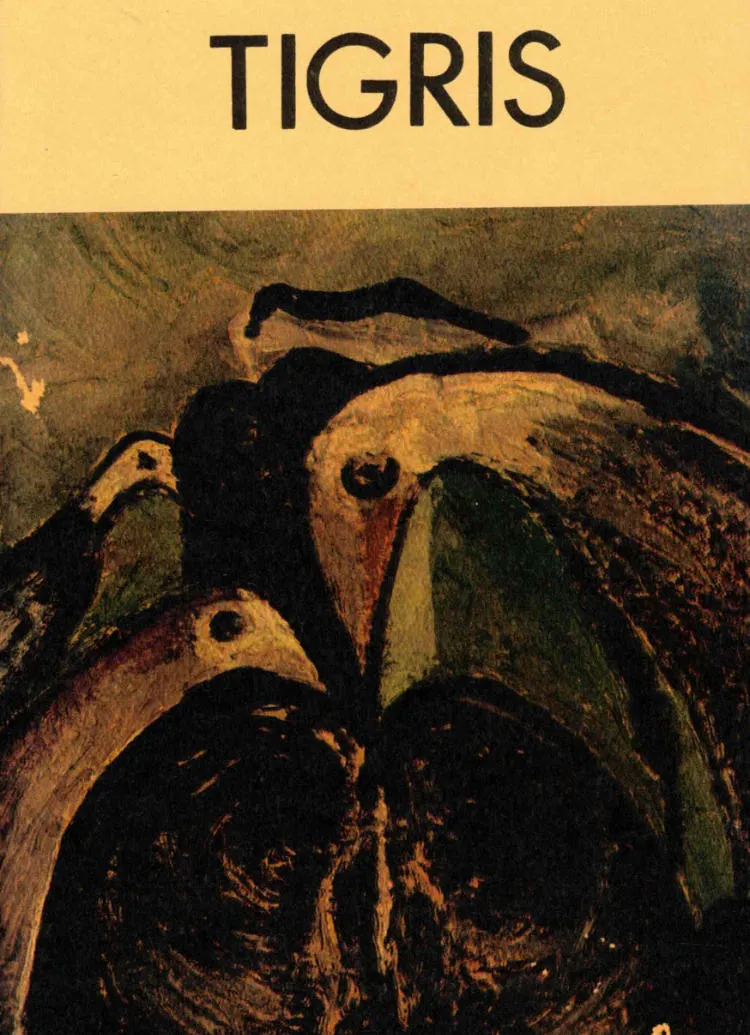
Cover of Tigris Vol. 1

CUNY Center for the Humanities

Tigris Vol. 1

Sargon Boulus

Poetry €16.00

In 1971, the great Iraqi poet Sargon Boulus (1944-2007) published a single issue of an English-language literary anthology that he called Tigris. The magazine—a whisper on the literary landscape that appeared three years after Boulus’s arrival in the US—brings together work by Boulus and several of his literary friends, in translation by Boulus and Etel Adnan.

Tigris was not an end in itself, but rather a temporary solution to the lifelong problem of how to devote oneself to poetry across different countries, eras, and styles: how to live poetry. Yet, in so doing, the small anthology includes significant work: Etel Adnan’s “Jebu,” translated by Adnan, and poetry by Boulus, Fouad Rifkah, Yusuf al-Khal, Mouayad al-Rawi, and Riadh Fakhouri, all in Boulus’s translations, as well as a work by Ankido, a “street-activist poet-café worker of importance to the Palestinian Liberation Movement.”

Cover of Day Book

Ma Bibliotheque

Day Book

Gill Houghton

Non-fiction €17.00

Looking at pictures, she was reminded of the lack of time. And anyway, where did all the time go?

In Day Book a woman artist looks at time in an address to quotidian events and their unfolding. Exploring motherhood, unpaid labour, childcare, and the time of the artist, she reads the work of contemporary women filmmakers through the earlier works of filmmakers, writers, and photographers, including Chantal Akerman and Marguerite Duras, Natalia Ginzburg and Christa Wolf, Bertien van Manen and Bernadette Mayer. The inability to capture the accumulation of days emerges—a form without form, day after day after day.

Cover of Language Arts

Wendy's Subway

Language Arts

Justin Allen

Poetry €18.00

Justin Allen’s Language Arts takes up writing as an integral part of an interdisciplinary art practice. Across poems, essays, lyrics, screenwriting, and drawings, works touch on themes of music and subculture, African diasporic language, visual art, and more, bringing together Allen's numerous influences into one collection.

Justin Allen's Language Arts is the 2022 Open Reading Period Editors' Pick.

About the author
Justin Allen is a writer and performer from Northern Virginia. With a background in tap dancing and creative writing, his work often combines a variety of art forms. He has been commissioned by The Chocolate Factory Theater and The Shed and has held residencies at ISSUE Project Room and the Center for Afrofuturist Studies. He has received support from Franklin Furnace, Foundation for Contemporary Arts, and the Jerome Foundation, and shared his work both stateside and abroad.

"In Hatnaha, Justin Allen has reinvented the myth of Atlantis for our postlapsarian age. His art of language cannibalizes the American grammar book, spawning gorgeous new idiolects. Through the buzz and rumble of Afro-diasporic sound clash, Allen hears the frequency of bodies becoming ungovernable. Set to a soundtrack of punk phonotactics, Language Arts is just the book to toss over the barbed wire fences that cordon us off from our post-Reparations future." —Tavia Nyong’o

"Language Arts shares a name with an elementary school class I always wished was more “art” and less rote memorization, and it fully delivers on that desire with its spellbinding assortment of prose poetry, screamo lyricism, screenplay, conlang, and Black political fiction as vibrant as any comp on physical media or stream. nunats nen-tuk nutaks dipa. Justin Allen creates an executable file, one that's bound to spread like Soulja Boy's "Crank That" renamed “britney_spears-hitmebabyonemoretimeremix.mp3," but without the need for tricknology." —Devin Kenny

Cover of  Memory

Semiotext(e)

Memory

Dorothea Lasky

Poetry €18.00

A spiritual homage to Bernadette Mayer's monumental artwork of the same title, Dorothea Lasky's Memory is a cycle of "poet's essays" stirred by two profound questions. What constitutes personhood and consciousness? What memories get lost, and why?

Expansive in her quest for answers, Lasky launches an inspired investigation of the forces that form our lives and deepest senses of ourselves. She identifies three dimensions of memory—ancestral, personal, and poetic—and in her singularly clear voice, undertakes to enter into their mysteries. From those recesses, she returns with a wide-ranging collection of essays that like lyric poems find the universal inside the particular. Memory reflects on the banal; private emotions and historical trauma; dear departed poets (Diane di Prima, Lucie Brock-Broido); her father's battle with Alzheimer's; and cultural events that have become charged sites of collective reminiscence (the moon landing, the music of Neutral Milk Hotel). Other pieces face the flip side of memory, asking what's left where memory is absent, and what's "real" beyond the horizon of death. The book closes with "Time, the Rose, and the Moon," an ars poetica published here in English for the first time, which offers the ancient symbol of the Ouroboros as a figure for the nonlinear processes of time, memory, and art.

Like Mayer before her, Lasky reveals memory to be huge and haunting, as she accumulates impressions that challenge the very possibility of fixed meaning. "Every rose has the scent of death," she writes. "And poetry is a perfume. That will stay on your body forever.... Whatever happens this time around, remember that."

Dorothea Lasky is the author of six full-length collections of poetry, including, most recently, The Shining (2023). She is also the author of the prose book Animal (2019) and a forthcoming book about Sappho, as well as the editor of Essays (2023) and a coeditor of Open the Door: How to Excite Young People About Poetry (2013). Her writing has appeared in POETRY, The New Yorker, The Paris Review, The Atlantic, and Boston Review, among other places.