rile*books

Search books

Search books by title, author, publisher, keywords...

Cover of Oraison funèbre pour Zelda1990

Dépense Défensive

Oraison funèbre pour Zelda1990

Romane Constant

€15.00

D’eux, il ne reste que les mots de celle qui a croisé leur route. Le crissement de pneus qui sifflent avant un malheur qui tarde à se produire. Sanctification plus que célébration, Oraison funèbre pour Zelda1990 est une tentative de communication au-delà de la matière physique de l’énonciation, un dialogue interne qui convoque « par moment le frère, par moment l’ami parti », toujours la ruine, la consommation de la séparation avec le tout. À travers quatre parties qui font écho à la structure des éloges funèbres de la Grèce antique, Romane Constant réouvre la poésie des plaies larges et profondes que les vers lapidaires d’Hélène Bessette – sur qui l’autrice mène un travail de recherche – ont laissé dans l’histoire moderne de la littérature, et signe un texte bouleversant sur la difficulté des choses qui ne (se) passent pas, la force de celles que l’on voit suspendues par le cou au bord d’une paix impossible à trouver. Oraison funèbre pour Zelda1990 est une douleur croissante, avec écoulement et rougeur.

Romane Constant vit et travaille à Paris. Elle explore à travers différents supports les questions relationnelles, d’intimité, du corps et du genre. Attachée aux Ardennes où elle a grandi, elle s’intéresse également à l’héritage de la classe ouvrière et aux traumatismes intergénérationnels.
Published in 2023 ┊ 60 pages ┊ Language: French

recommendations

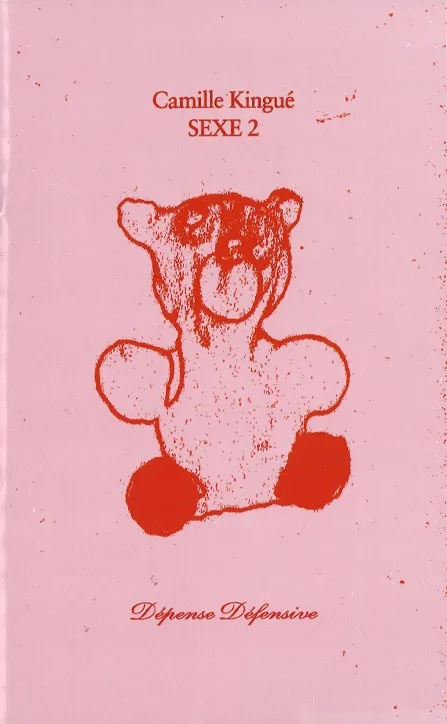
Cover of Sexe 2

Dépense Défensive

Sexe 2

Camille Kingué

Poetry €12.00

Confession sur le désir (l’action et l’objet du), les liens de mutualité et de résistance, Sexe 2 alterne prose et versification en 27 fragments numérotés à l’adresse plus ou moins dure, plus ou moins sincère, plus ou moins formulée car plus ou moins éloignée du Toi et du Je. Camille Kingué s’attache à révéler, à voir quelque chose à travers son image réelle et virtuelle, agrandie et rétrécie, droite et renversée, déployant une recherche des principes de l’amour (l’amour comme amour, pourquoi est ce qu’il y a de l’amour) où la métaphysique et la compréhension de soi – donc de l’autre – n’ont jamais été aussi sexy.

Claire Star Finch, dans la magnifique préface qu’iel signe au début de l’ouvrage, écrit : « Après avoir lu tous les livres de Kingué, je ne sais pas si je crois en “l’amour”, que ce soit en tant que substantif absolu ou en tant que proto-résidu de tout ce que “le sexe” peut signifier. Mais je crois définitivement qu’il faut l’écrire. » Définitivement.

Cover of Crue

Dépense Défensive

Crue

Théo Robine-Langlois

Poetry €12.00

L’Île-de-France a été engloutie. Submergée par de l’eau liquide. C’est à peu près tout ce que l’on sait. Crue est un long poème construit sur un rythme ternaire, une suite de tercets libres entrecoupés de symboles typographiques étranges dont la signification exacte semble avoir été perdue dans l’inondation. Il y a dans le va-et-vient soutenu du texte comme dans celui de la mer, ses gestes répétés, toujours successifs, quelque chose de l’automation ; l’acceptation sans révolte d’une nouvelle nature sous-marine hybride, plus uniquement humaine, à la langue noyée, gorgée de néologismes, méthodique, néanmoins sentimentale. Car ici la cruauté sinistre de la nature fait écho aux émotions du narrateur. Le paysage-état d’âme est désolé, apocalyptique mais comme résigné, nu. Crue sonde les abysses de la civilisation et des comportements humains. Peut-être un des textes les plus personnels de Théo Robine-Langlois.

Cover of Secrèt

Dépense Défensive

Secrèt

Théo Robine-Langlois

Fiction €12.00

Mystique des rues vides et peu éclatantes des banlieues pavillonnaires, ce court poème en prose interpelle par sa langue sombre. Dans une parodie de messe noire – beigeasse comme le crépis des façades –, Théo Robine-Langlois dépeint le monde mystérieux des maisons individuelles, du repli sur soi démonique, et des vieilles qui marmonnent entre leurs gencives au retour du marché, le panier plein de gros sel et de radis noirs en guise d'hostie. Les mots occitans qui ponctuent le texte comme des conjurations en accroissent l’escur.

Cover of New York Temps

Dépense Défensive

New York Temps

Aurelia Guo, Salomé Burstein

Poetry €15.00

Composé à la fois de récits personnels, de citations et de collages provenant notamment du New York Times, New York Temps suggère une discontinuité des états intérieurs, accentuée par la multiplicité des orateur.ices : les voix se succèdent à elles-mêmes, sont à chaque moment ce qu’elles n’étaient pas celui d’avant, apprenantes et à l’écoute de tout ce qui n’est pas elles. À travers des questions d’intertextualité et de sampling en poésie, le texte porte en lui une violence immanente – rendue plus intérieure, faite sienne –, une gêne, non seulement ressentie, mais aussi imposée, comme une protestation.

Titre original : NYT. Publié pour la première fois chez Gauss PDF en 2018. Traduit de l’anglais par Salomé Burstein.

Aurelia Guo est écrivaine et chercheuse à Londres. Elle est également l’autrice de World of Interiors (Divided Publishing, 2022).

Cover of Lili Is Crying

New Directions Publishing

Lili Is Crying

Hélène Bessette, Kate Briggs

Fiction €17.00

A forgotten mid-century genius, recently rediscovered in France and never before translated into English, Hélène Bessette is a treasure and a bracing force to reckon with.

With a contribution by Eimear McBride
A New Yorker Best Book of 2025

Lili Is Crying, Hélène Bessette’s debut novel, conveys with singular force the fraughtness and depth of the troubling relationship between Lili and her mother, Charlotte. With a near-mythic quality, Bessette's stripped-back prose evokes at once the pain of thwarted love—of desire run cold—and the promise of renewal. Lauded by critics on its initial 1953 publication for its boundary-pushing style, Lili Is Crying catapulted Bessette to cult status in France. The novel is moving and maddening in turns, with its characters trapped in their own cruelties and sorrows, but in its spareness and strength it feels true. "Show me a woman who's chosen something." Bessette's books were hailed for their unusual economy of expression, rarity, strange humor, and sheer vivacity. She characterized her new kind of novel as "a freshly cut slice of life, whose force comes from its lack of commentary."

Cover of Event Factory

Dorothy, a publishing project

Event Factory

Renee Gladman

Fiction €17.00

A “linguist-traveler” arrives by plane to Ravicka, a city of yellow air in which an undefined crisis is causing the inhabitants to flee. Although fluent in the native language, she quickly finds herself on the outside of every experience. Things happen to her, events transpire, but it is as if the city itself, the performance of life there, eludes her. Setting out to uncover the source of the city’s erosion, she is beset by this other crisis—an ontological crisis—as she struggles to retain a sense of what is happening.

Event Factory is the first in a series of novels (also available are the second, The Ravickians; the third, Ana Patova Crosses a Bridge; and the fourth, Houses of Ravicka) that Renee Gladman is writing about the invented city-state of Ravicka, a foreign “other” place fraught with the crises of American urban experience, not least the fundamental problem of how to move through the world at all.

Cover of Retail Vérité

San Serriffe

Retail Vérité

A Maior

Fiction €14.00

Once upon a time there was a shopping center just off Dam Square, a stone’s throw from the Madame Tussauds, not far from Primark, two streets across De Bijenkorf overshadowing the Magna Plaza, and just a couple doors down the Royal Palace in the middle of Amsterdam. It was the place where drag queen Tuu Lipa performed and Yeung sold eau de car engine oil. It was also where Mr. R looked for his human lover, where Inez became a millionaire, and where Yahoo launched its metaverse. “Welcome to the YAniverse,” greeted the Yahoo assistant…

Retail Vérité is the outcome of writing workshops organized by A Maior at San Serriffe. Through a blend of improvisation, larping and speed dating, the participants sketched characters and dialogues on-site.
This cohort featured Anouk Asselineau, Alva Bücking, Katherina Gorodynska, Chieri Higa, SeungJi Jo, Simon Marsiglia, Christina Ntanovasili, Young Eun Park, Ignacy Radtke, Matthew Senkowycz, Maja Simisic, Mehmet Süzgün, Simone Wegman, Bruno Zhu and others.

A Maior is a clothing and home goods store located in the outskirts of Viseu, Portugal. Since 2016, an eponymous exhibition program has taken place within the shopping environment. A Maior is managed by the staff, the artist Bruno Zhu and his family. A Maior has been featured in exhibitions at Melly, Rotterdam; Frans Hals Museum, Haarlem; Kunsthalle Freeport, Porto; X Museum, Beijing; Life Sport and BQ, both Berlin. In 2022, A Maior was the writer-in-residence at San Serriffe in Amsterdam, who commissioned Retail Verité, A Maior’s first novella.

With A Maior, Anouk Asselineau, Alva Bücking, Katherina Gorodynska, Chieri Higa, SeungJi Jo, Simon Marsiglia, Christina Ntanovasili, Young Eun Park, Ignacy Radtke, Matthew Senkowycz, Maja Simisic, Mehmet Süzgün, Simone Wegman, Bruno Zhu.
Designed by Elisabeth Klement

Cover of Theory & Practice

Catapult

Theory & Practice

Michelle de Kretser

Fiction €25.00

With echoes of Shirley Hazzard and Virginia Woolf, a new novel of startling intelligence from prize–winning author Michelle de Kretser, following a woman looking back on her young adulthood, and grappling with the collision of her emotions and her values.

In the late 1980s, the narrator of Theory & Practice—a first generation immigrant from Sri Lanka who moved to Sydney in her childhood—sets up a life in Melbourne for graduate school. Jilted by a lover who cheats on her with another self-described "feminist," she is thrown into deeper confusion about her identity and the people around her.

The narrator begins to fall for a man named Kit, who is in a “deconstructed relationship” with a woman named Olivia. She struggles to square her feminism against her jealousy toward Olivia—and her anti-colonialism against her feelings about Virginia Woolf, whose work she is called to despite her racism.

What happens when our desires run contrary to our beliefs? What should we do when the failings of revered figures come to light? Who is shamed when the truth is told? In Theory & Practice, Michelle de Kretser offers a spellbinding meditation on the moral complexities that arise in this gap. Peopled with brilliantly drawn characters, the novel also stitches together fiction and essay, taking up Woolf’s quest for adventurous literary form.

Cover of Confidences / Oracle

OCT0

Confidences / Oracle

Ivan Cheng

Fiction €13.00

Oracles don’t require belief—they now theatrically suspend disbelief. No longer advisors of world policy, they run Locus Solus, a town that has come to ramble around an eponymous theatre and chocolate factories. Theo, a centuries-old vampire intent on remaining contemporary through performance, visits Locus Solus, which is hosting Praise Estate, an international theatre festival. He uses the festival as an opportunity to stay with Gean, his oracle boyfriend, who is there visiting family. Theo has a fetish for the future, fixated on the one thing he is in no shortage of.

Confidences / Oracle is a lover’s trip to a weeklong theatre festival. A vehicle for recontextualising recent performance scripts and texts, Oracle is the third instalment in Ivan Cheng’s Confidences series, which intertwines vampires and performance as sites for circulation and recognition.

Cover of Autobiography of Cotton

And Other Stories

Autobiography of Cotton

Cristina Rivera Garza, Christina MacSweeney

Fiction €19.00

A novel about how cotton workers transformed the Mexico-US borderlands, by a Pulitzer Prize–winning author.

In 1934, a young José Revueltas traveled to Tamaulipas to support the cotton workers’ strike in Estación Camarón, which became the basis of his landmark novel, Human Mourning. In her own groundbreaking novel, Autobiography of Cotton, Cristina Rivera Garza recounts her grandparents’ journey from mining towns to those same cotton fields as it intersects with Revueltas’s life in a vivid and evocative history of cotton cultivation along the Mexico-US border.

Through archival research and personal narrative, Rivera Garza chronicles the way cotton transformed the borderlands by reconstructing the cotton workers’ strike and reveals how cycles of deprivation and ecocide persist across generations. Deeply personal and politically acute, Rivera Garza crafts a new kind of border novel that tells how a brittle land radically altered her grandparents’ lives and the territories they helped develop. An intimate fictionalization, Autobiography of Cotton reveals a rich social history of agricultural colonization, labor activism, environmental degradation, and cross-border migration.