rile*books

Search books

Search books by title, author, publisher, keywords...

Cover of Iliazda at the Birthday Party – Autobiographical Lecture, 1922

Rab-Rab Press

Iliazda at the Birthday Party – Autobiographical Lecture, 1922

Iliazda

€14.00

The English translation of Zdanevich's Dadaist autobiographical lecture in Paris in 1922, where he adopts the name Iliazda. In this entertaining lecture, the achievements of the avant-garde is presented as a combination of zaum, polymorphous sexuality, aleatory forms and scatological interpretation of culture.

The second volume of the bie bao series presents a eulogy entitled Iliazda at the Birthday Party, a pseudo-autobiographical lecture delivered by Ilya Zdanevich in Paris in 1922. It reports on Zdanevich's artistic and political adventures up until then. Along with an autobiography full of self-admiration, in this lecture Zdanevich gives an interpretation of his zaum dramas inspired by Freudianism, and humorously describes a colourful image of the Russian microcosm in Montparnasse. 

Additionally, this second volume also includes Iliazd's letter to Ardengo Soffici from 1964, where one can read, in the most unambiguous terms, about Zdanevich's positions against war, imperialism, and all forms of nationalism. Subtitled 50 Years of Russian Futurism, the letter to Soffici presents us with an altogether new Zdanevich—a "fellow traveller" in both leftist and avant-garde circles. As well as the extended introduction and extensive annotations, the texts are further contextualised with Johanna Drucker's visual presentation of the birth of the Iliazd cult.

The bie bao series will include eight publications, covering many layers of Zdanevich's rich theoretical and artistic output. Each volume consists of a bio-bibliographical introduction, a commentary, a translation with annotations, and artistic intervention.

Iliazd (Ilya Zdanevich, 1894-1975) was a Russian poet, designer, typographer, theoretician, art critic, and publisher, close to the avant-garde circles and one of the promoters of Futurism in Russia, author of a poetic work, drama written in zaum abstract poetic trans-sense or "transrational" language, and novels.

Published in 2022 ┊ 96 pages ┊ Language: English

recommendations

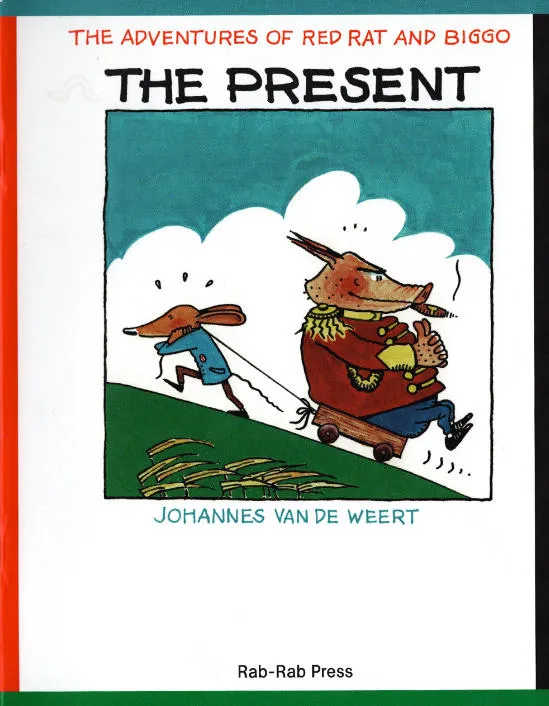
Cover of The Adventures of Red Rat and BIGGO – The Present

Rab-Rab Press

The Adventures of Red Rat and BIGGO – The Present

Johannes van de Weert

A children's book by Johannes van de Weert, a veteran of the punk underground (Rondos, The Ex, Red Rat, Raket).

The Adventures of Red Rat and BIGGO – The Present is a remake of Bram konijn en Piet de muis [Bram the Rabbit and Piet the Mouse], a 1982 children's book by Johannes van de Weert, a veteran of the Dutch punk underground who played with Rondos and The Ex, and who was the force behind Red Rat and Raket editions.
The Present is a 2010 remake telling the story of a bully pig who terrifies a poor rat on a daily basis. After a while, the rat falls ill with fear and has to stay in bed. The lonely, evil pig has no one to play with and becomes depressed. The pig gives the rat a present—a bunch of beautiful flowers—and all is well. Now the two can play together.
The 2010 remake, featuring different characters and intended for a North Korean audience, was never published. The 2025 English version opens with an introduction by Van de Weert, telling a bizarre story of a failed political career and an absurd vaudeville class struggle behind the seemingly harmless educational children's book.

Johannes van de Weert was a cartoonist active in the Rotterdam punk and squatter's movements of the 1980s. He was a singer with the punk band De Rondos and he started self-publishing small comic booklets in the late 1970s. He created his character "Redrat" for the fanzine Raket in 1980. The character soon became an icon for the squatter's movement.

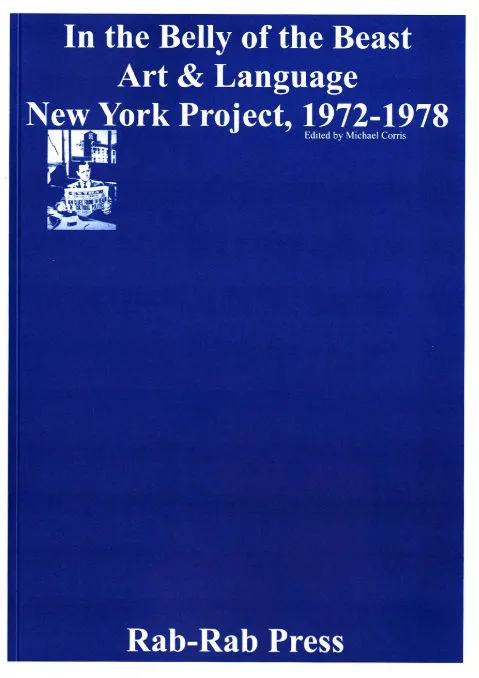
Cover of In the Belly of the Beast – Art & Language New York Project 1972-1978

Rab-Rab Press

In the Belly of the Beast – Art & Language New York Project 1972-1978

Art & Language

Edited by Michael Corris, the expanded edition of In the Belly of the Beast: Art & Language New York Project 1972-1978 is a survey of the tumultuous years of the political Conceptualism in the mid-seventies New York.

Artists have always experimented with politics, either by organizing themselves or uniting in support of a broader political movement. Today, "activist art" is taught in universities, supported by foundations, and featured in museums and international exhibitions. Is this the only possible way?

In the Belly of the Beast tells a different story, of the work of politically engaged artists and the conflicts they experienced. It is the history of artists wishing to continue working within the boundaries of the artworld and those who were intent on establishing new ideological and class relationships with activists to build a political party.

During the 1970s in New York, the Art & Language collective pioneered institutional critique; published a Marxist-influenced journal; agitated against racism and sexism in museums; challenged the cultural imperialism of international exhibitions; and forged a framework for a socialist organization of artists. This new edition includes previously unpublished documents illuminating the contradictions and disputes that lay at the center of the organization and practices of Art & Language and left-wing groups, such as the Anti-Imperialist Cultural Union and the Artists' Meeting for Cultural Change, mobilizing artists in New York at the time.

The new and expanded edition of In the Belly of the Beast features an extensive interview with Michael Corris, who annotated a collection of previously unavailable documents from the period, including manuscripts, pamphlets, transcripts, and letters.

Art & Language is the name of a group of English artists who choose to work collectively, and the title of a magazine that they founded in 1968. Proposing a critical analysis of the relations between art, society, and politics, Art & Language marks, even in its name, the importance of the “textual turning point” in the 1960s.

Since 1976, Art & Language's project has continued, through Mel Ramsden and Michael Baldwin, with the literary and theoretical collaboration of Charles Harrison. Working with very varied mediums, from painting to rock, these co-founders of Conceptual art remain, even today, attached to observing the consequences of what they themselves call the “depressing collapse of modernism.”

Cover of Rab-Rab, Issue 5

Rab-Rab Press

Rab-Rab, Issue 5

Rab-Rab

Periodicals €27.00

The fifth issue of Rab-Rab: Journal of Political and Formal Inquiries in Art includes stories about nation traitors, fierce masses, socialist women struggles, love-forms, psychedelic counter-revolutionaries, workers unions, Brecht fiddlers, jazz surrealism, Soviet trains, and anti-fascism.

Among the contributors to the fifth issue are Anna Thew, Yehuda Safran, Peter Gidal, Cana Bilir-Meier, David Black, Marjo Liukkonen, Alejandro Pedregal, Peter Hallward, Minna Henriksson, and Jyrki Siukonen.

It has also two extensive dossiers. One dedicated to Franklin Rosemont is presented by Joe Feinberg and is introducing some unpublished and difficult to find texts parallel with writings of T-Bone Slim and Joe Hill. The other dossier on Robert Linhart is presented by Tevfik Rada, and it includes a translation of a chapter from Linhart's book on productivism, an article against Western bourgeois dissidents, and an interview with him.

Cover of Wanting Something Completely Different – 111 Vignettes of Left-Wing Figures, Themes, Films, and Writers

Rab-Rab Press

Wanting Something Completely Different – 111 Vignettes of Left-Wing Figures, Themes, Films, and Writers

Jairus Banaji

Non-fiction €20.00

A collection (montage) of biographies and themes written by Jairus Banaji.
Wanting Something Completely Different discusses a range of political figures, themes, directors and writers in a series of brief, evocative descriptions ('vignettes') aimed at laying out a vision of a modern, cosmopolitan left that can think creatively about the world we live in. The political figures include both thinkers and activists from a wide range of backgrounds—from Frantz Fanon and the Palestinian novelist Ghassan Kanafani to the theologian Dietrich Bonhoeffer and the murdered Russian journalist Anna Politkovskaya. The themes range equally widely from the death of Walter Benjamin (reconstructed here from a remarkable documentary on the same theme) and the slaying of Pasolini to the work of British Marxist Perry Anderson, or the corrupt nature of India's leading corporate groups, or the outstanding contributions of Italian and U.S. Black feminists to feminist theory. And under the rubrics which discuss film and literature, there is the same striving for diversity and depth.

The vignettes collected in this Rab-Rab book first circulated on Facebook over some seven years or more and are reproduced here with a new introduction and extensive bibliographical references and notes.

Jairus Banaji is a historian and revolutionary Marxist activist. He received the Isaac and Tamara Deutscher Memorial Prize in 2011. His academic work has ranged widely across sources and languages, with major books on Late Antiquity and commercial capitalism as well as numerous papers and articles.

Cover of Biting the Hand – Traces of Resistance in the Art & Language diaspora

Rab-Rab Press

Biting the Hand – Traces of Resistance in the Art & Language diaspora

Paul Wood

€30.00

Extensive survey of the politically outward-looking Conceptualism emerging from Art & Language in the UK. Especially considering its critique of the norms of Modernist art practices in contemporary art, particularly practices of art education.

Edited, compiled and introduced by Paul Wood, Biting the Hand: Traces of Resistance in the Art & Language diaspora is about a dissident formation of artists active in the UK in the 1970s and 80s.

The book tells the story of artists engaging with a critique of then-contemporary modernist art education, who have embarked on a series of theoretical investigations which became increasingly politicised under the pressures of an evolving social crisis. Increased racism, unemployment and attacks on the organised working class all raised questions about how a critical art might respond.

By the late 1970s, these radical artists, mostly in the orbit of the Art & Language group, were producing posters and leaflets for a wide range of left-wing causes, as well as analyses of the politics of art and design education and the role of cultural ideology in maintaining consensus. In the 1980s, as Thatcherism tightened its grip, those involved went their separate ways into areas as diverse as media work, trade unionism, health and education.

Biting the Hand has three parts: a retrospective introduction setting the formation in its historical context, and two annotated documentary sections presenting examples of the work as both text and image, written and edited by Paul Wood.

It also includes a foreword by Sezgin Boynik, publisher, and an afterword by Ann Stephen, curator and art historian, further expanding on the book's subject.

For many years Paul Wood worked for the Art History Department of the Open University. His publications from that period include Conceptual Art (2000), Western Art and the Wider World (2013), and the four-volume anthology Art in Theory (1990-2020), co-edited with Charles Harrison and others.

Edited, compiled and introduced by Paul Wood.
Foreword by Sezgin Boynik; afterword by Ann Stephen.

Cover of The Century of Artists' Books

Granary Books

The Century of Artists' Books

Johanna Drucker

Johanna Drucker's The Century of Artists' Books is the seminal full-length study of the development of artists' books as a twentieth-century art form. By situating artists' books within the context of mainstream developments in the visual arts, Drucker raises critical and theoretical issues as well as providing a historical overview of the medium. Within its pages, she explores more than two hundred individual books in relation to their structure, form, and conceptualization. This latest edition of the book features a new preface by Drucker and includes an introduction by New York Times senior art critic Holland Cotter.

Cover of Ezio Gribaudo - The Weight of the Concrete

Grazer Kunstverein

Ezio Gribaudo - The Weight of the Concrete

Lilou Vidal, Tom Engels and 1 more

Monograph €36.00

The Weight of the Concrete explores the legacy of the Turinese artist and publisher Ezio Gribaudo (1929–2022), examining his multifaceted oeuvre at the confluence of image and language. This publication, named after Il Peso del Concreto (1968)—a seminal work that featured Gribaudo’s early graphic creations alongside an anthology of concrete poetry edited by the poet Adriano Spatola (1941–88)—places Gribaudo’s work in conversation with approximately forty artists and poets from different generations, all of whom similarly engage with explorations of text, form, and visual expression.

Reflecting the editorial premise of Il Peso del Concreto, The Weight of the Concrete revisits the influential anthology, including archive material that documents its production, and reimagines it, pairing Gribaudo’s graphic work with a new selection of historical and contemporary concrete and experimental poetry.

At the heart of the volume is Gribaudo’s emblematic Logogrifi series, developed from the 1960s onward. The Logogrifi reveal his deep engagement with the art of bookmaking and fascination with industrial printing processes, relief matrices, typefaces, and language games.

In this new edition, the editors take the opportunity to revisit Gribaudo’s pioneering work, examining previously overlooked dimensions—gendered, geographical, and technological—and exploring contemporary associations beyond the original context. The book also includes essays that elucidate the poetic and political interplay between image, language, and materiality.

This publication is released following Ezio Gribaudo – The Weight of the Concrete, an exhibition held at the Grazer Kunstverein in Graz, Austria (2023–24), and at the Museion—Museum of Modern and Contemporary Art in Bolzano-Bozen, Italy (2024).

Edited by Tom Engels and Lilou Vidal
Published by Axis Axis and Grazer Kunstverein

Contributions by Anni Albers, Mirella Bentivoglio, Tomaso Binga, Irma Blank, Al Cartio, Paula Claire, CAConrad, Natalie Czech, Betty Danon, Constance DeJong, Mirtha Dermisache, Johanna Drucker, Bryana Fritz, Ilse Garnier, Liliane Giraudon, Susan Howe, Alison Knowles, Katalin Ladik, Liliane Lijn, Hanne Lippard, Sara Magenheimer, Françoise Mairey, Nadia Marcus, Giulia Niccolai, Alice Notley, Ewa Partum, sadé powell, N. H. Pritchard, Cia Rinne, Neide Dias de Sá, Giovanna Sandri, Mary Ellen Solt, Alice Theobald, Colleen Thibaudeau, Patrizia Vicinelli, Pascal Vonlanthen, Hannah Weiner, and Ruth Wolf-Rehfeldt

Essays by Alex Balgiu, Tom Engels, Nadia Marcus, Luca Lo Pinto, Mónica de la Torre, and Lilou Vidal

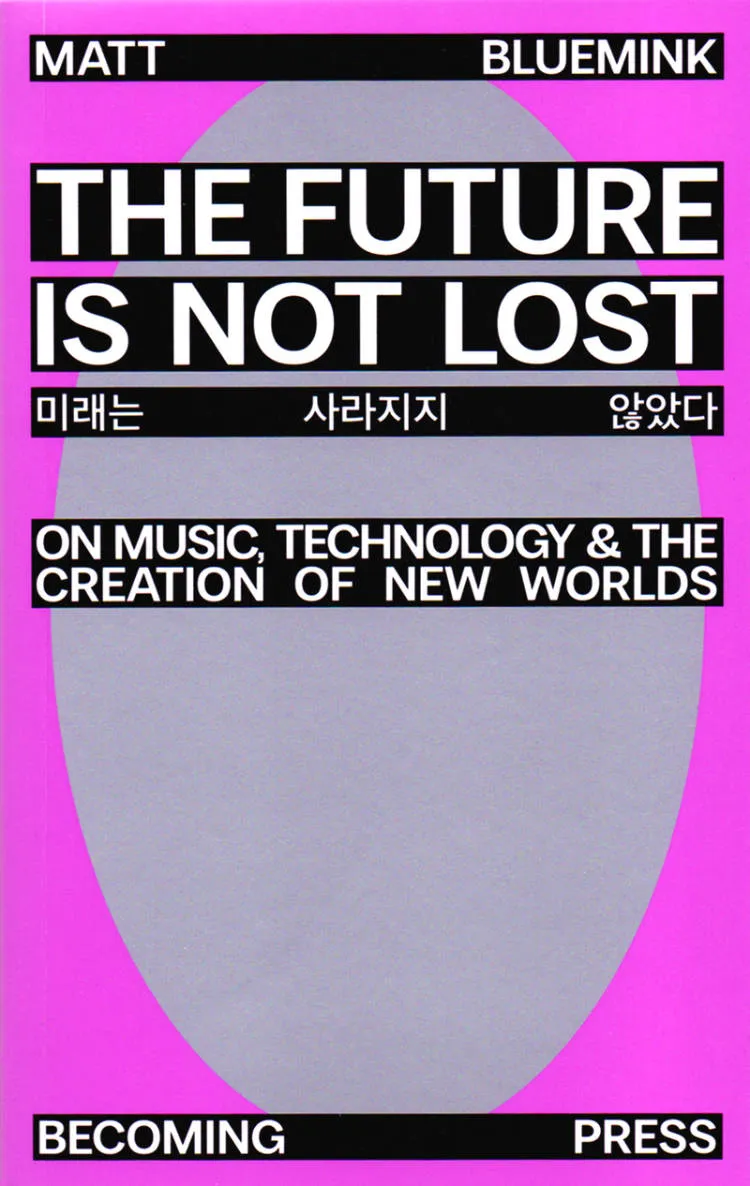
Cover of The Future is not Lost: On Music, Technology, and the Creation of New Worlds

becoming press

The Future is not Lost: On Music, Technology, and the Creation of New Worlds

Matt Bluemink, Alessandro Sbordoni

Non-fiction €16.00

Mark Fisher taught a generation to hear the future's disappearance in contemporary music, as if the rhythm of the world was synchronised to the periodic flowering of new creative forms. His diagnosis was devastating: stagnation in music was akin to a venous insufficiency, or worse, some kind of nuclear winter that would ward off the spring for endless generations to come. 

Drawing on musicians like SOPHIE, Arca and Iglooghost, Matt Bluemink declares that the future is not lost; it still speaks to us through music. If Fisher’s Hauntology — dwelling on ghosts of the past — is the logic of depression, then Bluemink’s Anti-Hauntology posits a logic of hope where voices from the future continue to guide the development of the present. 

Island-hopping through Stiegler's philosophy of technics, Simondon's theory of individuation, and the spatial imaginaries of cyberpunk and solarpunk, Bluemink builds a theoretical framework equal to the times — one that takes seriously our capacity to, not only diagnose the world, but remake it. In order to create a new future we must re-imagine our relationship with music, with technology, and with culture. The world of tomorrow is a blank canvas; an open book. New beginnings are always possible. 

Matt Bluemink is the founder and editor-in-chief of Blue Labyrinths online magazine. His research is focused on the relationship between the philosophy of technology, media theory and urbanism. He also writes on contemporary music, literature, and digital culture. 

Cover of An Archive of Feelings

Duke University Press

An Archive of Feelings

Ann Cvetkovich

LGBTQI+ €30.00

In this bold new work of cultural criticism, Ann Cvetkovich develops a queer approach to trauma. She argues for the importance of recognizing—and archiving—accounts of trauma that belong as much to the ordinary and everyday as to the domain of catastrophe. An Archive of Feelings contends that the field of trauma studies, limited by too strict a division between the public and the private, has overlooked the experiences of women and queers. Rejecting the pathologizing understandings of trauma that permeate medical and clinical discourses on the subject, Cvetkovich develops instead a sex-positive approach missing even from most feminist work on trauma. She challenges the field to engage more fully with sexual trauma and the wide range of feelings in its vicinity, including those associated with butch-femme sex and aids activism and caretaking.  

An Archive of Feelings brings together oral histories from lesbian activists involved in act up/New York; readings of literature by Dorothy Allison, Leslie Feinberg, Cherríe Moraga, and Shani Mootoo; videos by Jean Carlomusto and Pratibha Parmar; and performances by Lisa Kron, Carmelita Tropicana, and the bands Le Tigre and Tribe 8. Cvetkovich reveals how activism, performance, and literature give rise to public cultures that work through trauma and transform the conditions producing it. By looking closely at connections between sexuality, trauma, and the creation of lesbian public cultures, Cvetkovich makes those experiences that have been pushed to the peripheries of trauma culture the defining principles of a new construction of sexual trauma—one in which trauma catalyzes the creation of cultural archives and political communities.

Cover of Black Phoenix: Third World Perspectives on Contemporary Art and Culture

Primary Information

Black Phoenix: Third World Perspectives on Contemporary Art and Culture

Rasheed Araeen, Mahmood Jamal

Anthology €24.00

Facsimile compilation of the late-'70s journal on diasporic and colonial histories that paved the way for the British Black Arts Movement.

Published in three issues between 1978 and 1979, Black Phoenix: Journal of Contemporary Art & Culture in the Third World (the subtitle was changed to Third World Perspectives on Contemporary Art and Culture for its second and third issues) stands as a key document of its time. More than a decade after '60s liberation movements and the historic Bandung and Tricontinental Conferences that called for social and political alignment and solidarity to dismantle Western imperialism and (neo)colonialism, Black Phoenix issued a rallying call for the formation of a Third World, liberatory arts and culture movement on the eve of Margaret Thatcher's election in 1979.

Based in the UK, and both international and national in scope, Black Phoenix positioned diasporic and colonial histories at the center of an evolving anti-racist and anti-imperialist consciousness in late 1970s Britain—one that would yield complex and nuanced discourses on race, class and postcolonial theory in England in the decade that followed.

A precursor to the British Black Arts Movement that formed in 1982 (which encompassed such cultural practitioners as the Black Audio Film Collective and cultural studies theorist Stuart Hall), Black Phoenix proposed a horizon for Blackness beyond racial binaries, across the Third World and the colonized of the interior in the West.

This single-volume facsimile reprint gathers all three issues of the journal, which include contributions by art critics, scholars, artists, poets and writers, including editors Rasheed Araaen and Mahmood Jamal, Guy Brett, Kenneth Coutts-Smith, Ariel Dorfman, Eduardo Galeano, N. Kilele, Babatunde Lawal, David Medalla, Ayyub Malik, Susil Sirivardana and Chris Wanjala.

Cover of Gender and Postsecularity in Visual Culture and Knowledge Production

Sternberg Press

Gender and Postsecularity in Visual Culture and Knowledge Production

Boka En, Sabine Grenz and 2 more

Non-fiction €21.00

A collection exploring the intersections of gender and religion in post-secular knowledge production and visual culture.

Over the last three decades, religious practices and belongings have gained increased visibility across the globe, turning secularity and its relationship with religion into subjects of intense interdisciplinary and international debate. Previously marginalized in gender studies, the secular and the religious now attract growing interest in academic and activist feminism, prompting a critical reflection on secularity's emancipatory potential. This publication aims to foster this interest by providing a platform for interdisciplinary and transregional discussions on the complex dynamics of secularity, religiosity, and gender, as well as new approaches to explore these relationships.
 The contributions examine the entanglements and boundaries of religions and secularities in everyday life, art, culture, and knowledge production. By presenting relevant case studies, this book underscores an understanding of religion as both a category of knowledge and a marker of identity.

Cover of Schizo-Culture: The Event, The Book

Semiotext(e)

Schizo-Culture: The Event, The Book

Sylvère Lotringer, David Morris

The legendary 1975 "Schizo-Culture" conference, conceived by the early Semiotext(e) collective, began as an attempt to introduce the then-unknown radical philosophies of post-'68 France to the American avant-garde. The event featured a series of seminal papers, from Deleuze's first presentation of the concept of the "rhizome" to Foucault's introduction of his History of Sexuality project. The conference was equally important on a political level, and brought together a diverse group of activists, thinkers, patients, and ex-cons in order to address the challenge of penal and psychiatric institutions. The combination proved to be explosive, but amid the fighting and confusion "Schizo-Culture" revealed deep ruptures in left politics, French thought, and American culture.

The "Schizo-Culture" issue of the Semiotext(e) journal came three years later. Designed by a group of artists and filmmakers including Kathryn Bigelow and Denise Green, it documented the chaotic creativity of an emerging downtown New York scene, and offered interviews with artists, theorists, writers, and No Wave and pre-punk musicians together with new texts from Deleuze, Foucault, R. D. Laing, and other conference participants.

This slip-cased edition includes The Book: 1978, a facsimile reproduction of the original Schizo-Culture publication; and The Event: 1975, a previously unpublished and comprehensive record of the conference that set it all off. It assembles many previously unpublished texts, including a detailed selection of interviews reconstructing the events, and features Félix Guattari, William Burroughs, Kathy Acker, Michel Foucault, Sylvère Lotringer, Guy Hocquenghem, Gilles Deleuze, John Rajchman, Robert Wilson, Joel Kovel, Jack Smith, Jean-François Lyotard, Ti-Grace Atkinson, François Peraldi, and John Cage.