rile*books

Search books

Search books by title, author, publisher, keywords...

Explore

Categories
Visit
Collections
Publishers
Back in stock
Any books
Cover of Cancelled Confessions (or Disavowals)

Siglio Press

Cancelled Confessions (or Disavowals)

Claude Cahun

€36.00

First published in 1930 by anti-fascist, avant-garde publisher Éditions du Carrefour in Paris as Aveux non Avenus, Cancelled Confessions (or Disavowals) is Claude Cahun’s wildly radical answer to an invitation to write a memoir. Shattering the very premise of the “memoir”—the singularity of identity—into sharp and prismatic fragments, Cahun assembles an ever-mutating inquiry into the instability of “self” and its many masks.

Masculine? Feminine? It depends on the situation. Neuter is the only gender that always suits me.

Using a multitude of forms (fables, jokes, aphorisms, letters, dialogues, dreams, hymns, pronouncements, etc.), to plumb the subjects of desire, love, gender, sex, fear, faith, religion, and vanity (among others), Cancelled Confessions (or Disavowals) is a tour-de-force work of resistance: it provokes the reader to enter the capacious, provocative, playful, and deeply imaginative space constructed by Cahun in defiance of all categorization, to repudiate a delimited, censured world and embrace, instead, the outcasts and cast-offs, the unknowable and the unknown.

I believe, but in the conditional: I would like to believe.

Thoughtfully redesigned to emulate the original artist’s book, this revised edition of the out-of-print English translation by Susan de Muth—originally published in the UK by the Tate in 2007 and in the U.S. by MIT Press in 2008—includes novelist and critic Pierre Mac Orlan’s original 1930 preface along with contemporary essays by scholar Amelia Groom and translator de Muth. Almost 100-years-old, it is not only prescient, but urgent, in.

It’s not enough to be vanquished, you also have to know how to turn defeat to your advantage.

Translated by Susan de Muth, preface by Pierre Mac Orlan, essay by Amelia Groom.

Published in 2025 ┊ 272 pages ┊ Language: English

recommendations

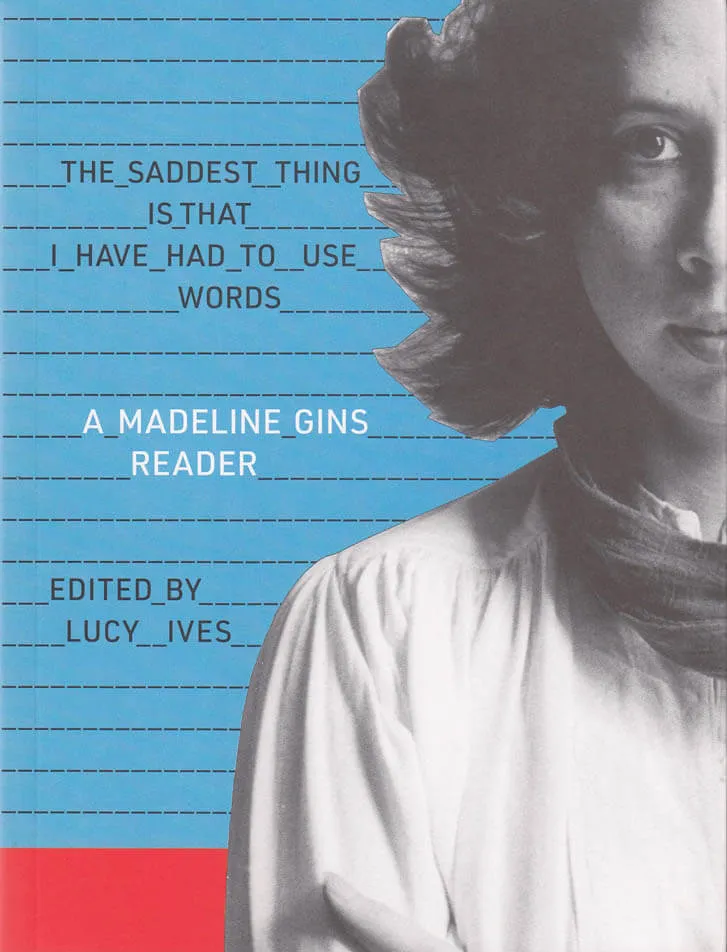
Cover of The Saddest Thing Is That I Have Had to Use Words: A Madeline Gins Reader

Siglio Press

The Saddest Thing Is That I Have Had to Use Words: A Madeline Gins Reader

Madeline Gins

Poetry €28.00

Poet, philosopher, speculative architect and transdisciplinary artist, Madeline Gins is well known for her collaborations with her husband, the artist Arakawa, on the experimental architectural project Reversible Destiny, in which they sought to arrest mortality by transforming the built environment. Yet, her own writings — in the form of poetry, essays, experimental prose and philosophical inquiries — represent her most visionary and transformative work. Like Gertrude Stein before her, Gins transfigures grammar and liberates words. Like her contemporaries in conceptual art, her writing is attuned to the energized, collaborative space between reader and page.

The Saddest Thing Is That I Have Had to Use Words: A Madeline Gins Reader is a revelatory anthology, edited and with an introduction by the writer and critic Lucy Ives. It brings never-before-published poems and essays together with a complete facsimile reproduction of Gins' 1969 masterpiece, WORD RAIN (or A Discursive Introduction to the Intimate Philosophical Investigations of G, R, E, T, A, G, A, R, B, O, It Says), along with substantial excerpts from her two later books What the President Will Say and Do!! (1984) and Helen Keller or Arakawa (1994). Long out of print or unpublished, Gins' poems and prose form a powerful corpus of experimental literature, one which is sure to upend existing narratives of American poetics at the close of the 20th century.

Edited by Lucy Ives. 

Cover of  Terrassen – Privilege: An Yvonne Rainer Filmography

At Last Books

Terrassen – Privilege: An Yvonne Rainer Filmography

Terrassen

Published as appendix to the Yvonne Rainer Retrospective (November 6-28 2024), organised by Terrassen at Palads Cinema, Copenhagen.

Yvonne Rainer (b. 1934), one of the great American artists of her generation, revolutionised dance and choreography in the 1960s. Yet over the course of two decades - from the early 1970s to the mid-1990s - Rainer also directed seven feature films, each intensely discursive and consistently inviting critical reflection. Radically diverse and impossible to categorise, her films carve out their own space between documentary, fiction, performance, and the avant-garde. For decades, these films have been difficult to access, and when shown, they were often confined to small monitors in large museum settings. Now, newly restored in 4K, they were presented in a retrospective by Terrassen in 2024 - the first of its kind in Denmark. 

The retrospective culminated in the publication of a new Yvonne Rainer filmography, with contributions from Babette Mangolte, Ursula Andkjær Olsen, Mira Adoumier, Emily Wardill, Emily LaBarge, Amelia Groom, Valérie Massadian, Iman Mohammed, Frida Sandström and Yvonne Rainer herself.

Cover of Burn & Gloom! Glow & Moon!

Sternberg Press

Burn & Gloom! Glow & Moon!

Katrina Daschner

Monograph €19.00

Retrospective monograph: a journey through over two decades of intersectional and queering practices in film, performance, sculpture, community work, and textiles.

In Daschner's textile-based works, threads are minimal yet highly visible, akin to the pinch needed to wake up from a dream. These works—as well as her collages—merge with her confronting yet inviting image politics: she cuts and pastes stories of love and pleasure, violence and resilience, death and rebirth.
The written contributions reflect on Katrina Daschner as part of a hardworking generation of queer artists and makers who have been responding to the major conceptual shifts and gender upheavals happening in contemporary art since the 1990s, especially in New York and London. They highlight Katrina Daschner's longstanding line of intersectional queer interest that continues to undermine (neo-)liberal, heteropatriarchal conceptions of sexuality, gender, subjectivity, and relationships

Edited by Övül Ö. Durmuşoğlu.
Texts by Amelia Groom, Tim Stüttgen; foreword by Övül Ö. Durmuşoğlu; interviews by Rike Frank.

Cover of We are not where we need to be, but we ain't where we were.

L’Amazone & Privilege

We are not where we need to be, but we ain't where we were.

Tiphanie Blanc, Lili Reynaud-Dewar and 1 more

We are not where we need to be but, we ain't where we were is the first volume of a new series of publications by the collective Wages For Wages Against that reports on active research engaged within the artistic professions and institutions since 2017. Its aim is to question the underlying neoliberal logics in the contemporary art world, by orienting our object of study towards the struggles that impact it. With this publication, our hope is to put into practice various values specific to the campaign: the existence of a systematic and fair remuneration, a desire for transparency, the sharing of knowledge, and the visibilization of demands proper to the field of the visual arts and concomitant struggles. It is the result of militant experiences, at the convergence of our individual experiences and collective questionings.

With texts by Tiphanie Blanc, Antonella Corsani, Fanny Lallart, Lili Reynaud-Dewar, Ramaya Tegegne and an interview with Outrage Collectif.

Cover of the boy, the bucket and the persistent tide

Bog Bodies Press

the boy, the bucket and the persistent tide

charlie jermyn

Fiction €24.00

the netherlands has been the home of irishman charlie jermyn for the last 5 years; it’s a nation that has been dredged up from the water and which attempts, to this day, to hold back the persistent tide. in this brilliant and very-hard-to-describe debut novel, jermyn brings the common and absurd to crisp, shimmering life through his essays and short non-fiction pieces, reminding us to take note of the mad and brilliant world around us before the tide comes in again.

illustrated by samuel van heijningen

Cover of Impossible Dreams

Daisy Editions

Impossible Dreams

Pati Hill

Pati Hill's cult novel, available for the first time since 1976.

Impossible Dreams was Pati Hill's last published novel, released in 1976 after it was partially published two years earlier in the Carolina Quarterly under the title "An Angry French Housewife." Hill tells the story of Geneviève, a middle-aged woman whose life is turned upside down when she unexpectedly falls in love with her neighbor, Dolly. Mixing anecdotes with existential thoughts, the novel describes the gradual disruption of the heroine's daily life. Almost every chapter (the length of which varies from a single sentence to no more than three pages) is accompanied by a xerograph of a photograph, selected by Hill with permission from its maker. The resulting combination of text and image constitutes her most ambitious attempt to produce a work in which "the two elements fuse to become something other than either."

This novel is also one of the most incisive examples of Hill's writing—dry and impartial, yet managing to capture the contradictory feelings of her characters. In a letter addressed to the photographer Eva Rubinstein asking for reproduction rights, she writes: "My book is about a woman with a little girl and a husband who falls in love with a woman and a little girl and a husband and loses them all, just like in your mirror. It doesn't sound very cheerful but it is mainly funny."

Daisy, an independent publishing house, releases a facsimile of the out-of-print work that, after almost 50 years since its initial publication, has become a coveted collector's item.

"Impossible Dreams charmed me with its droll and irreverent tone when it was first published. Hill's use of embedded photographs was unexpected and transgressive for its me. Brilliant!"
Anne Turyn, photographer, educator and founding editor, Top Stories

Pati Hill (1921, Ashland, Kentucky – 2014, Sens, France) left behind a litterary and artistic output spanning roughly 60 years . After a short but dazzling career as a model, between 1951 and 1962 she wrote a dozen short stories—several of which were published in George Plimpton's prestigious literary journal, The Paris Review—and five books which earned her real critical recognition. Hill published One Thing I Know in 1962 after giving birth to her first and only daughter. She was then forty-one years old, and would later claim to have decided at that time to "stop writing in favour of housekeeping.''

Edited by Ana Baliza and Baptiste Pinteaux.

Cover of Portrait of the Artist as a Writer

Colorama

Portrait of the Artist as a Writer

Stefanie Leinhos

"Portrait of the Artist as a Writer" is a collection of short stories, quotes and drawings about dinosaurs, gay lesbians and how to lose a joke at the lake.

Risoprinted in pumpkin and purple, perfect binding with glue, first edition of 300, Berlin 2022.

Cover of Amanda

Maria Editions

Amanda

Olga Micińska

Fiction €15.00

The artist book Amanda is greatly inspired by “Tradeswomen” quarterly magazine for women in blue-collar work, published in the 1980’s and 1990’s in the United States. Amanda is similarly thought as a periodical dealing with the subjects of technology and industry from a feminist (not solely female) angle. The first issue contains fiction stories of an emancipatory character, citing trade associations, oil industry in Iran and ghosts of the printer feeders.

The publication is made in the framework of The Building Institute, an experimental organisation aiming to strengthen the position of femmes builders in the domain of technical construction work. Amanda brings together literary texts by Maria Toumazou, Samantha McCulloch, Sepideh Karami and Madeleine Morley, combining fiction stories with visual artwork. 

Olga Micińska is a visual artist currently living in Amsterdam. Graduated from the MA Art Praxis program at the Dutch Art Institute and holds an MFA in Sculpture from the Academy of Fine Arts in Warsaw. Also trained as a woodworker, collaborates with craft studios of various domains. Recently she has initiated The Building Institute.

The Building Institute (TBI) is an experimental platform aiming to emancipate the undermined knowledges dwelling in the craft domains, and to unpack diverse questions related to technology and the means of production. TBI combines art’s speculative competences with the grounded practice of manual labor, manifesting its objectives through educational activities, exhibitions, and publications.