Books
Books
published in 2024

KW Institute for Contemporary Art
Pia Arke
Pia Arke, Ros Carter and 1 more
Pia Arke (1958–2007) was a Greenlandic Inuk and Danish artist, writer and photographer. She is known for her self-portraits and landscape photographs of Kalaallit Nunaat (Greenland), as well as for her paintings, collages, performative film works and writing. Arke strove to make visible the silence that surrounded the colonial history and complex political and cultural relationship between Greenland and Denmark.
This publication accompanies the first international exhibitions of Arke’s work outside of Greenland and the Nordic countries, happening over the course of 2024 at John Hansard Gallery in Southampton (UK) and at KW Institute for Contemporary Art in Berlin (DE). It reflects on Arke’s ideas and legacy in a wider international context and aims to demonstrate how the work she made and the ideas she expressed connect with current discourse and contemporary thinking.
Texts by Krist Gruijthuijsen, Woodrow Kernohan, Ros Carter, Alice Maude-Roxby, Mette Sandbye, Tiara Roxanne, Sofie Krogh Christensen, Nivi Christensen, Siri Paulsen, Trinh T. Minh-ha

Verlag der Buchhandlung Walther König
Movement Notation
Eshkol and Wachmann focused dance on its basic element: the movement of the human body. They treated the different parts of the body as separate instruments, similar to the musical instruments of an orchestra–each with its own rules for the movements to be performed. This new edition of the 1958 publication is supplemented by contributions from Eshkol’s companions and further archive material, which contextualizes and supplements the history of the 'EWMN’s‘ origins and embeds it in contemporary discourses on dance and movement.
The publication is published in the context of the performance 'Pause: The Noa Eshkol Chamber Dance Group‘ at KW Institute for Contemporary Art (August 2023), as well as the exhibition 'Noa Eshkol: No Time to Dance‘ at the Georg Kolbe Museum (15 March–25 August 2024). The new edition was developed together with the 'Noa Eshkol Foundation for Movement Notation‘.

Verlag der Buchhandlung Walther König
Ian Burn: Collected Writings 1966–1993
Ian Burn has been described as many things: an activist, a trade-unionist, a journalist, an art critic, a curator and an art historian—or, as he once described himself in a moment of self-deprecating alienation, ‘an ex-conceptual artist’. Born in Geelong in 1939, Burn studied painting in Melbourne and went on to live and work in London and New York. Burn moved back to Australia in 1977 and passed away in 1993 at the age of 53. Burn sought to grapple with how art history intersects and engages with contemporary art and political debate, arguing for a decentred view of the world.
His legacy is international and can be seen in retrospective exhibitions as recent as 2022, and his work remains a key touchstone in art history. Edited by Burn’s friend, frequent collaborator and eminent art historian, Dr Ann Stephen, this volume brings together 49 pieces of Burn’s own agile and expansive writings alongside a vast collection of his artworks. The collection concludes with reflections on Burn’s life and work from prominent figures and past collaborators in the form of memorial lectures.
Ian Burn: COLLECTED WRITINGS 1966–1993 is edited by Ann Stephen and designed by Robert Milne, with contributions by Art & Language, Adrian Piper, Paul Wood, Allan Sekula, and Mel Ramsden.

CUNY Center for the Humanities
“This Great River”—Translating the Beats into Arabic
Sargon Boulus, Khaled al-Hilli
The Great River—Translating the Beats into Arabic traces the literary encounters of Sargon Boulus (1944-2007), an Iraqi poet who was part of the vibrant literary scene of late 60’s San Francisco. His life was marked by a period of restless traveling, that he would later describe as an attempt to pursue a poetic imaginary. This project continues to map his proximity to the Beat poets, his short-lived Bay Area poetry journal, Tigris, and his other English language publications.
This publication includes a facsimile reproduction of Tigris, featuring a long poem “Jebu” by Boulus’ good friend Etel Adnan.

Terra Cosmica / Traces of Georealism
An ‘end-times’ philosophical enquiry in which the author argues with stones and geological time to compose a suite of interlinked fragments. An act of lapidary; a five-part antagonisation of the elements; an essay on representation, visualisation and prediction; an ecologue on ecology.
Our age is characterised by the increasing humanisation of a planet that is more and more subject to metaphoric representation and visualisation.
The memorialisation, anthropomorphism, and narratological charge of time has birthed an intellectual industry in which the summation of history plays out like a hand of cards. A game in which retrospect and hindsight informs our present and sits us ever at the mercy of prediction and chance in a time increasingly defined by catastrophe, and as emergent crises affect every stratum of life and lived experience. We are currently witnessing a mutation of our thinking that disrupts the mythical imaginary that had hitherto confined viruses, climate change and atmospheric turbulence to an unalterable background in the all-too-human narrative of the struggle against nature.
Tusa’s Terra Cosmica / Traces of Georealism is the result of a series of lectures and essays—a quintet of pieces published over the course of a four-year period—that, woven together into a new collation of interlinked fragments, calls time on time to consider the new form of planetary realism resultant of this restructuring of the imagination. Tusa presents a cosmic remapping of our modes of thinking that assumes that our contemporary moment is absented from its representability, its history of representations, and all means of explanation, thus remaining open to a sense of its own infinity… Open to an encounter with that which remains absent and unknowable, with neither horizon nor memory available as any weathervane for comprehension and action. Tusa’s work is a scrutiny of our exosystemic condition; a suite of exploratory antagonisms on the need for a new philosophical perspectivism of time, of earth, and a new charter for the foundations of thought and thinking.

The Secret History Of Kate Bush (And The Strange Art Of Pop)
The Secret History of Kate Bush, first published in 1982 as Kate was on the verge of superstardom, is a daring and unorthodox dive into the world of music, fame, and cultural obsession. Written by Fred Vermorel—a close associate of Malcolm McLaren and Vivienne Westwood, and renowned for his subversive "anti-biographies"—the book shatters the boundaries of traditional celebrity profiles. Told from the perspective of a die-hard fan, it unveils the mystique of one of pop’s most elusive icons while exposing the capitalist machinery driving the entertainment industry. Part biography, part cultural critique, and entirely provocative, this is not just a book about Kate Bush but a rebellious manifesto against the commodification of art.
Republished in 2022 by Le Gospel in France, this special edition goes even deeper with unpublished treasures from Vermorel’s personal archive. Featuring an exclusive interview with Kate’s father, Dr. Robert Bush, a razor-sharp foreword by novelist and musician Tony O’Neill (Digging the Vein), and Vermorel’s own afterword reflecting on his explosive work four decades later, this is a must-read for anyone fascinated by Kate Bush, the art of fandom, and the raw power of creative rebellion. Fred Vermorel is a pioneer of the in-depth study of celebrity and fan cultures, best known for his controversial "anti-biographies" of pop icons including the Sex Pistols, Kate Bush, Vivienne Westwood, and Kate Moss.
CUNY Center for the Humanities
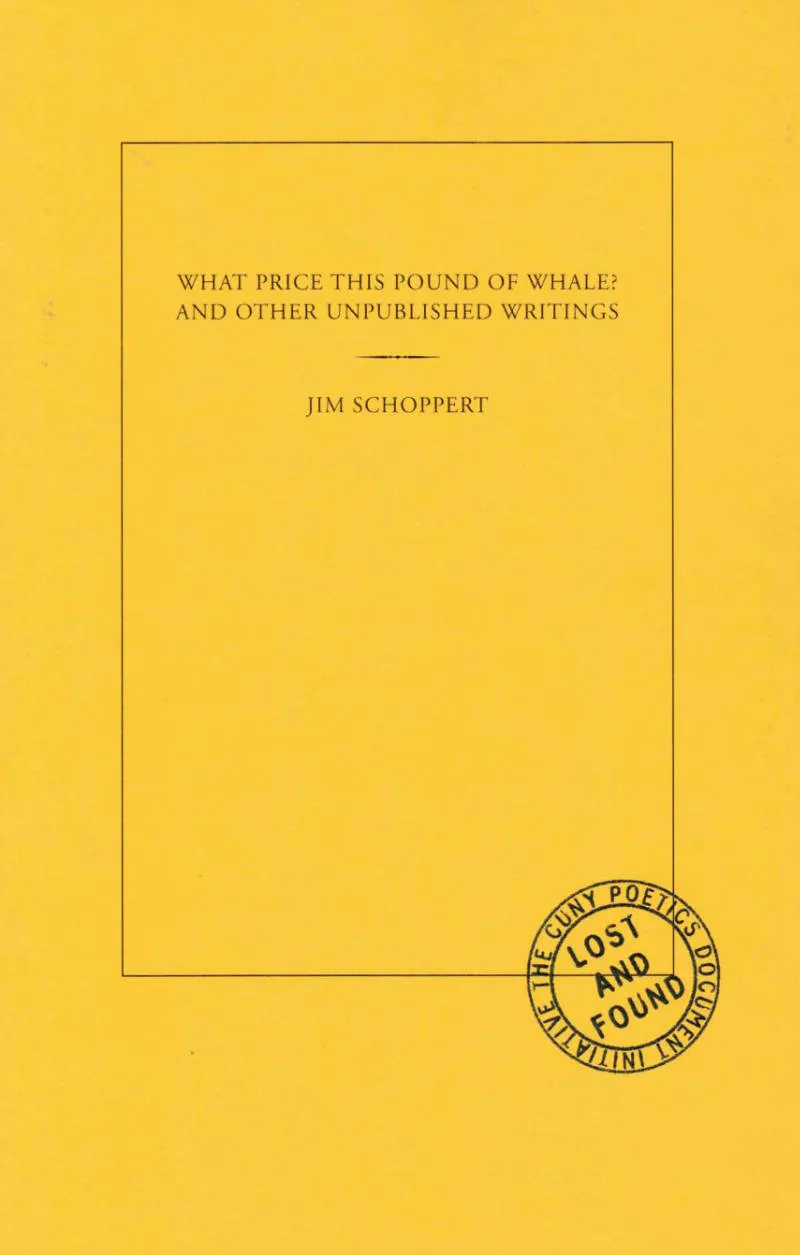
What Price This Pound of Whale? and Other Unpublished Writings
The Tlingit artist Jim Schoppert (1947-1992) was among the most accomplished, innovative, and prolific Alaska Native artists of the twentieth century. His whimsical sculptures and large scale painted wooden carvings reconfigure Tlingit visual motifs, and he challenged the binary categories against which Indigenous artists are so often defined, such as traditional and contemporary, historic and innovative, and artist or craftsperson. While known primarily for his modernist interventions in Tlingit visual traditions, Schoppert was also a prolific writer, an eloquent speaker, and an ardent advocate for Alaska Native artists. This publication brings together a selection of his unpublished poetry and writings from the artist’s personal papers. Presented alongside never before seen sketches and studies, this selection bridges Schoppert’s written and artistic practices in a deeply personal portrait of the artist and Alaska Native life that upsets preconceptions about Native art and unsettles the established narrative of Euro-American and Indigenous aesthetic relations.
Jim Schoppert (1947-1992) was a Tlingit multidisciplinary artist and writer. He was a Taku Tlingit Raven of the Ishkahittaan (Inland Frog) clan from his Tlingit mother and half-German from his father and carried the Łingit name Dom-Yetz. Born in Juneau, Alaska, he earned a BFA in Sculpture and Printmaking from the University of Alaska—Anchorage and an MFA from the University of Washington. In addition to his artistic career, Schoppert was instrumental in promoting Alaska Native arts and organizations. He was Director of Arts and Crafts at the Cook Inlet Native Association, Director of the Alaska Arts in Prisons Program for the University of Alaska Juneau, and organized exhibitions and workshops across Alaska and the Pacific Northwest. He was visiting professor in visual art at the University of Alaska, Fairbanks and directed its Native Art Center. He sat on the Washington State Arts Commission and on the boards of the Alaska State Council on the Arts and the Institute of Alaska Native Arts. His work is held in public and private collections across the United States, including the Smithsonian National Museum of the American Indian, the Anchorage Museum, the Heard Museum, and the Newark Museum, among others. His writing and poetry has appeared in The Greenfield Review and Journal of Alaska Native Arts, among other publications.

Constructing Worlds Otherwise
Raúl Zibechi, George Ygarza Quispe
A new collection from one of Latin America's most dynamic radical thinkers—in the tradition of Frantz Fanon and Eduardo Galeano.
Through a survey of the most marginalized voices across Latin America—feminists, the Indigenous, people of African descent, and inhabitants of urban favelas and rural towns—Zibechi introduces the Anglo world to a range of critical perspectives and new forms of struggle in Peru, Mexico, Brazil, Colombia, and Bolivia. His book contributes to global geographies of autonomous and anti-state thinking, including that of the revolutionaries in Rojava and Abdullah Öcalan, ideological theorist of Kurdish resistance, for a rich and dynamic survey of movements of nonstate power. Constructing Worlds Otherwise comes at a time when the global left—struggling to expand its vision in an era of climate chaos and rising authoritarianism—finds itself at an impasse, desperate to animate and renew its critical imaginary.

The Consequences
The Consequences is a hybrid collection of prose and poetry; an autofictional examination of the pain of a transatlantic relocation from New York to the blanketing beige of Paris to rejoin a totemic muse. It also focuses on corgi attacks, Maryland, painful anxiety, the struggle to accept the things one cannot change, the third party and the past as adamantine shackles. The "towering sexual iconography of Mike Immerman" looms over the disorientation of a reluctant resident in “the City of Light.”

Issue #7: Embodying Resistance
The seventh issue of Errant Journal is guest edited by Ghiwa Sayegh and aims to interrogate the role of the body in strategies of resistance from below. Taking Palestine as a starting point, the ongoing genocide committed by Israel and other colonial powers and the people’s continued struggle for liberation inform the issue’s thinking and praxis. From this political standpoint, it explores the ways in which bodies – that are sexualized, criminalized, racialized, crip – have been able to divert and subvert in order to fight back. To resist from the body is what crip theory tells us is a matter of need. It is a body that no longer fears deviation, specifically because of how cheap our lives are considered and how dangerous our futures are treated. It is about finding community and kinship when we are told we are alone.
Contributors:
Myriam Amri, Lama Abou Kharroub, yasamin ghalehnoie, Keto Gorgadze, Johanna Hedva, Samia Henni, MaxX • ماكس, Ada Maricia Patterson, Ghiwa Sayegh, Nikita Sena, Mridula Sharma

Destination: Tashkent – Experiences of Cinematic Internationalism
The legacy and posterity of the Tashkent Festival for Asian, African and Latin American Cinema, which was held between 1968 and 1988 in Uzbekistan.
Between 1968 and 1988, the Tashkent Festival of Asian, African, and — from 1976 onwards — Latin American Cinema was held in Tashkent, Uzbekistan. As an exercise in soft power and a response to anti-colonial movements and the socio-political upheaval of the late 1960s, the festival grew into a unique gathering for film professionals and became an important platform for South-South solidarity that went beyond the cinema halls of Tashkent. In essays and conversations by researchers, film-makers, and organizers of contemporary film festivals, the Destination: Tashkent Reader reappraises the original festival's programming, while also looking critically at its legacy. From the vantage point of Berlin-based diasporas of Asia, Africa, and Latin America, the reader also investigates how such practices of encounters and collaboration resonate within the film scenes of these three continents today.
Contributions by Cana Bilir-Meier, Souleymane Cissé, Pascale Fakhry, Zach Ramon Fitzpatrick, Sophie Genske, Timur Karpov, Ali Khamraev, Valeriya Kim, Carlos Kong, Bonaventure Soh Bejeng Ndikung, Maren Niemeyer Jacqueline Nsiah, Furqat Palvan-Zade, Marie Helene Pereira, Elena Razlogova, Aykan Safoğlu, Masha Salazkina, Alex Moussa Sawadogo, Can Sungu, Echo Xuedan Tang, Sarnt Utamachote.

sae-kki-eo by AFSAR Si詩Salon(Poetry Salon)
“sae-kki-eo” is AFSAR’s (Asian Feminist Studio for Art and Research) debut publication documenting activities from April-August 2024. The project brought together AFSAR Si詩Salon(Poetry Salon) members globally on Discord to share poetry and explore feminist/queer writing approaches. The publication features members’ personal poetry, workshop documentation, and research discussions about women’s poetry and queer poetic expression. The Korean title “sae-kki-eo” allows for multiple interpretations, including meanings related to derivatives, interruption, and plant propagation, suggesting ideas of growth and creative intervention. Since it was primarily written in Korean, it naturally intersects with the necessity of poetry translation, though this was not the original intention.

Pfeil Magazine #18 – Body
From its anatomy and autonomy to its death and diet, this issue focuses on the motif Body and all its meanings, direct and indirect, for instance as in relation to human and non-human bearers of bodies, its inhabitants like bacteria and organs, its social, medical and juridical conditions, its intoxications, chemical processes, traumas, transitions, well-being, replacements, weaknesses, and its opposites.
Contributors: Adam Dickinson, Andrea Éva Győri, A.L. Steiner, Alexandra Ivanciu, Barak Zemer, Bernhard Willhelm, Clara Lena Langenbach, Clémentine Bedos, Constance DeJong, Daisy Hildyard, Fanny Howe, Hanne Loreck, Hasti, Holly Hunter, Ingrid Jäger, Jannis Marwitz, Jess Arndt, Johannes Kuczera, Jolanta Nowaczyk, Henriette Maier, Mag Gabbert, Maja Smrekar, Manuel Vason, R.I.P. Germain, Rebekka Endler, Sonja Yakovleva
Within the format of a magazine, each page of Pfeil represents the floor, walls, or ceiling which together create an imagined room displaying a printed exhibition. Each issue is dedicated to a specific word, and artists are invited and given space to work on and with this term, and to construct or deconstruct the architecture around it. Combined, the contributions transform into an organic display surrounding the leitmotif.

French Cooking for One
French cuisine, classic though it is, still holds delicious surprises. From quick bites for busy days to sumptuous main courses for those who enjoy spending more time in the kitchen, the focus throughout is on dishes that are simple and fun to prepare, and results that are mouthwatering to contemplate and, of course, to eat. A unique work of literary and culinary joie de vivre, part food memoir, part recipe book, French Cooking for One is Michèle Roberts' first cookbook, and a quirky take on Édouard de Pomiane's ten-minute cooking classic. Once a food writer for the New Statesman, Roberts was born in 1949 and raised in a bilingual French-English household, learning to cook from her French grandparents in Normandy. Her love of food and cookery has always shone through in her novels and short stories.

CUNY Center for the Humanities
Algeria: Capital Algiers
Algeria, Capital: Algiers by Anna Gréki is co-published by Pinsapo Press and CUNY Lost & Found, translated by Marine Cornuet, and introduced by Ammiel Alcalay.
Anna Gréki (1931-1966) was an Algerian poet of French descent. A member of the Algerian Communist Party, she was arrested and imprisoned for her participation in the Algerian liberation struggle in Algiers, in 1957. Algérie, capitale Alger, a collection of poems written during Gréki's imprisonment, was published in 1963 in a French and Arabic bilingual edition. Algeria, Capital: Algiers makes this work available to English readers for the first time.
"Anna Gréki was a particularly inconvenient pied noir—not loyal enough for the French colonists and too compromised for the Algerian nationalists—and so she was shunted to the margins of Algerian literary history. Nevertheless, it’s time she takes her place at the center of that narrative, and these accomplished translations constitute a necessary English-language introduction to this secret garden of Maghrebi poetry. Gréki’s poetry is electrified by the heady heights of the war of liberation, but arguably it finds its truest expression in her paeans to the wild hills and impregnable peaks of the Aurès mountains, where she was born and where she found a sense of peace which otherwise eluded her in her brief life." —André Naffis-Sahely
“Nothing happens here but everything burns.” From the prison where she was tortured by French authorities in 1950s Algeria, Anna Greki stays in touch, feverishly, with “this world of vulnerable flesh.” Addressed to her friends and comrades in struggle, to the land and the leaves and the birds, these poems defy “the war, this male ax,” invoking the future with “a trust so total / I can almost touch it.” Marine Cornuet’s translation deftly conveys Greki’s intimate language of the senses, to “transcribe with words what is done without them.” —Omar Berrada
"How fitting that a bilingual edition of Anna Gréki’s poems should be published now: a French poet born in Algeria, anti-colonialist (imprisoned for that) as Algeria battled for independence, writing in French, like Kateb Yacine, to show her freedom from French hegemony, but also her freedom as a woman writer to forge a transcendent and engaged poetics." —Marilyn Hacker

Stars in My Pocket Like Grains of Sand
The story of a truly galactic civilization with over 6,000 inhabited worlds.
Stars in My Pocket Like Grains of Sand is a science fiction masterpiece, an essay on the inexplicability of sexual attractiveness, and an examination of interstellar politics among far-flung worlds. First published in 1984, the novel's central issues—technology, globalization, gender, sexuality, and multiculturalism—have only become more pressing with the passage of time.
The novel's topic is information itself: What are the repercussions, once it has been made public, that two individuals have been found to be each other's perfect erotic object out to "point nine-nine-nine and several nines percent more"? What will it do to the individuals involved, to the city they inhabit, to their geosector, to their entire world society, especially when one is an illiterate worker, the sole survivor of a world destroyed by "cultural fugue," and the other is—you!

Tips of the sung
Tips of the Sung is a collection of interdisciplinary texts from Samuel Brzeski composed over the five years whilst he was Associate Artist at Lydgalleriet. The collection brings together performance scripts for voice and video with newly composed texts for the page. Centring on the vibrations of the voice, the texts exist somewhere between signification and delirium, at times making more sound than sense.
The texts are full of bumbling mumbles, meandering hums, homophones, inner voices, affirmations, motivations, subvocalisations, resolutions, errors in speech production, peach seduction, car maintenance manuals, self-help fallacies, roomy echo chambers, overheard language lessons, morning meditations, and other forms of verbal rehearsal at the limits of language.

Afghanistan
Afghanistan is my father’s homeland. He was born in Kabul in 1945 and later moved first to France, then to Switzerland in the 1970s. In my mind, Afghanistan exists as a geography with blurred edges, something I feel the need to reconcile with. It’s a place I’ve only ever known through stories, a source of memories that, over time, have shifted and become distorted.
Contributors: Luca Cerizza, Farid Rahimi, Said Rahimi, Susanna Ravelli, Francesca Recchia, Zafar Sayan, and Dawood Tawana

Film X Autochthonous Struggles Today
Nicole Brenez, Jonathan Larcher and 2 more
First global exploration of contemporary forms of filmmaking from political and cultural self-determination movements of Autochthonous communities and peoples.
Film X Autochthonous Struggles Today brings together for the first time filmmakers, activists, film curators, and scholars who share a common interest in filmmaking practices that emerge from and participate in the various situations of struggle that the Autochthonous/Indigenous/Native/Aboriginal/First Nations peoples and communities are involved in worldwide.
Starting with the Edison Studio's 1894 short films Buffalo Dance and Sioux Ghost Dance, representations of Autochthonous peoples have been part of cinema right from its inception. The vast majority of these representations, however, have not been produced by nor for Autochthonous peoples. In the wake of political and cultural self-determination movements of the 1960s and 1970s, and with the gradual democratization and accessibility of the tools of moving-image making, Autochthonous communities have displaced and renewed cinema's forms and means of production, increasingly reclaiming their right for self-representation by way of film and video.
Along with the vibrant forms of moving images arising from within the communities, close to their existential political concerns, filmmaking has also become a potent tool in Autochthonous struggles. This book answers the need to take a global look at the diverse ways of filmmaking that fight for land rights and against environmental injustice (Brazil, Morocco, Taiwan, USA), that resist neocolonial domination, economic and political exploitation (Japan, Philippines), that offer a counterpoint during low intensity or drawn-out armed conflicts (Colombia, Mexico), that invent strategies of counter information and representation (Australia, Canada, Russia, Samoa), and that strive for visibility.
Contributions by Myrla Baldonado, Mayaw Biho, Nadir Bouhmouch, Ricardo Matos Cabo, Carolina Canguçu, Amaranta Cesar, Karrabing Film Collective, Rupert Cox, Nicolas Défossé, Etienne De France, Sophie Gergaud, John Gianvito, David Harper, Aurélie Journée-Duez, Blackhouse Lowe, Caroline San Martin, Laura Langa Martínez, Isael Maxakali, Sueli Maxakali, Dan Taulapapa Mcmullin, Chie Mikami, Francisco Vázquez Mota, Omar Moujane, Marie Pierre-Bouthier, Perrine Poupin, Ariel Arango Prada, Beatriz Rodovalho, Roberto Romero, Jonathan Sims, Mercedes Vicente, Jamahke Welsh.

A small book of Ojika Recipes
This is not a cook book, but a collection of recipes that Olya Oleinic gathered during her residency on Ojika Island (Nagasaki, Japan). Sometimes a bit lost in translation, it represents her attempts to connect to her new environment.
This book is part of a catalog series for the Ojika Artist in Island Program, which is supported by Ojika Town and Nagasaki Prefecture, as well as The Netherlands Embassy in Tokyo.

The Queer Arab Glossary
When conventional language does not equip us with the tools to speak about ourselves, we create our own. Slang expresses words and feelings that break down boundaries. It is a form of protest and fills in the gaps.
The Queer Arab Glossary is the first published collection of Arabic LGBTQ+ slang. This bold guide captures the lexicon of the queer Arab community in all its differences, quirks and felicities. Featuring fascinating facts and anecdotes, it contains more than 300 terms in both English and Arabic, ranging from the humorous to the harrowing, serious to tongue-in-cheek, pejorative to endearing. Here, leading queer Arab artists, academics, activists and writers offer insightful essays situating this groundbreaking glossary in a modern social and political context.
With beautiful, witty illustrations, The Queer Arab Glossary is a powerful response to pervasive myths and stereotypes around sexuality and an invitation to take a journey into queerness throughout the Arab world.
Contributors include Saqer Almarri, Nisrine Chaer, Sophie Chamas, Rana Issa, Adam HajYahia, Suneela Mubayi, Mejdulene Bernard Shomali, Hamed Sinno and Abdellah Taïa.
The Queer Arab Glossary was made possible with the generous support of the Arab Fund for Arts and Culture – AFAC, Mophradat, Bashar Assaf and Mohammed Fakhro.
Foreword by Rabih Alameddine

The Hormone of Darkness: A Playlist
In Tilsa Otta’s The Hormone of Darkness, we find a queer, Latinx person who has lived through iterations of authoritarian rule, and who answers these conditions by creating poetry that doubles down on a life force that precedes and exceeds received notions of the poetic. Here poetry is bawdy, fabulist, and spiritual—in short, it is alive. Otta has created a heaven where readers can go after they die.
Drawing from four volumes spanning Otta’s career, translator-poet Farid Matuk has curated a playlist we can dance and dream to, one that honors Otta’s drive toward liberation through both perreo in the club and transdimensional wandering among the stars.
We can go on like that forever
building paradise from our urges
out of our fetishes our loves our vices
How lucky
We’ll wait for you then
Don’t be too long
Bookmark the page
We’ll be Here
—From “The New Heaven”
Translated from the Spanish by Farid Matuk.

4 Tales
The power of Sabahattin Ali comes from beyond his words. It is his sense of observation, insight and commitment to fight for a fairer society that have carried his voice into the modern day.
The four tales in this book - Death of the Giants, A Tale of Love, A Tale of Sheep and The Glass Pavilion - were compiled and published in Sırça Köşk [The Glass Pavilion] in 1947. At the time Sabahattin Ali penned these tales, the young Turkish Republic was still struggling to establish a proper democracy with one sole party in parliament. In 1948 the Turkish Council of Ministers decided to ban Sırça Köşk, and all remaining copies were swiftly confiscated. Even after his death, the words of Sabahattin Ali were deemed as a governmental threat and for decades publishers were reluctant to print his work.
Almost eighty years later, these political and social tales remain just as poignant. Does this showcase Sabahattin Ali’s visionary spirit or a general lack of vision within our societies?

5 Prison songs / 5 Hapishane Şarkısı
This booklet is a collection of 5 Prison Songs written by Sabahattin Ali in 1932-1933 whilst imprisoned in Konya and Sinop, Turkey.
Bu kitapçık Sabahattin Ali’nin 1932-1933 senelerinde önce Konya sonra Sinop hapishanesinde kaleme aldığı 5 Hapishane Şarkısı içerir.