Books
Books
published in 2023

Being a Chair. Essays on Choreographic Poetry
Imagine words approaching a dance eyes closed or sleepwalking, words adrift beyond what can be envisioned beforehand, prompting writer and reader alike into a zone where time multiplies, where bodies grow footnotes and paper skin, savour the taste of language, attune their ears to the wavelength of blue. In a string of brief essays on her practice of writing choreographic poetry and scores, Janne-Camilla Lyster offers reflections on time, memory and the senses, on translation, punctuation and rhythm, on mistakes and crevasses, on the impossible and yet other things. What does it take to enter another form of existence, say, a chair?
Janne-Camilla Lyster is a writer, dancer and choreographer. She has published poetry, novels, essays and plays.
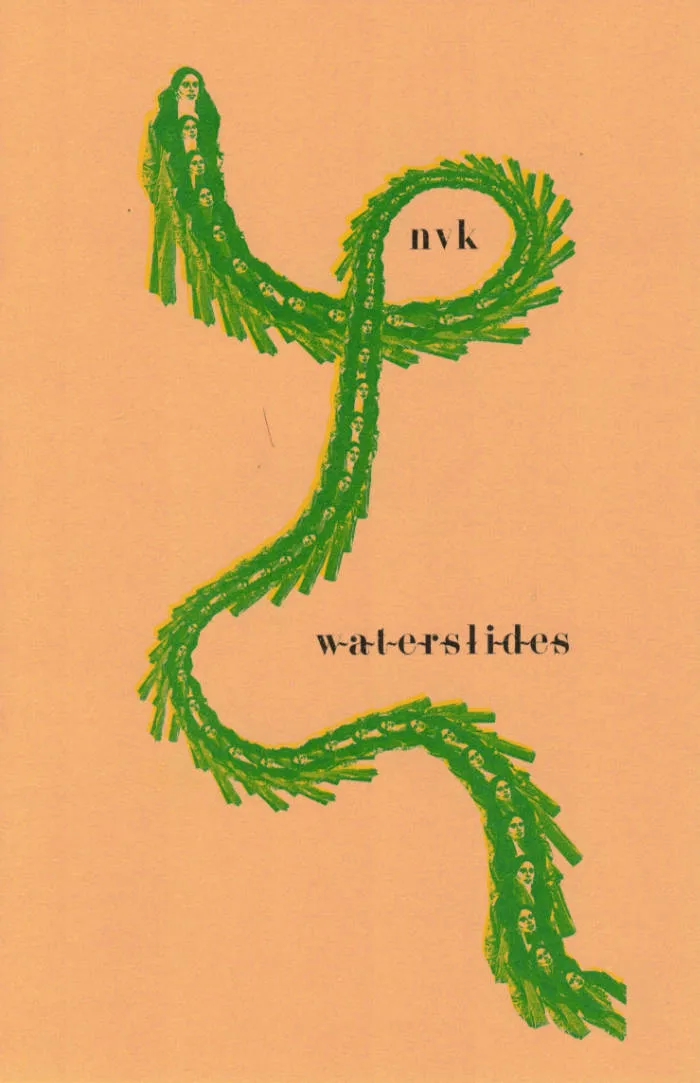
Waterslides
"Waterslides is a falling and plunging, short starts and stops aided by movement, until we splash, climb and plunge again. Each sliding is the same but different—with each descent new expectations and thoughts swirl, shifting focus and gaining new insights or blockages. Waterslides are brief moments of remembering, remembering as a present tense activity, one that happens as we think of it, projected on our now. The waterslide is the moment of past and present working in tandem, a movement of repeating, revisiting and remembering all at once.”
Written by nvk 2021-2023. Dedicated to Judi, MM & TNN.
A version of these poems was published as an audio work through Ignota Press’ The Mountain (2023) and included in a reading with James Loop on Montez Press Radio (2023). nvk would like to thank Jan Matthé, Stine Sampers and Michelangelo Miccolis for their patience & love.
This book was first presented at Kransen in Antwerp, May 6th 2023, with a performance by Sassy (costume by Rosa Schützendorf). Printed and bound at Risiko Press, Borgerhout. Cover image by nvk. Fonts: Adonis, Garamond Pro. Limited to 150 copies.
128x195mm, 16p., stapled, cover: green, yellow and black risoprint on 160gsm caramel paper, inside: black and blue riso on 120gsm Munken Pure paper.

Traveling in the Dark
A fully-fledged artistic project expanded with writings, poems, and aphorisms by the artist alongside various interviews.
Traveling in the Dark is an exhibition and a publication by the world-renowned film director, poet, writer, music composer, literary critic, and art theorist Trinh T. Minh-ha. The book is a fully fledged artistic project conceived by Trinh from the script and visuals of her film What about China? and expanded with her writings, poems, and aphorisms as well as various interviews that investigate "a relationship to infinity," "memory of the mirror," and the "in-between." The book offers an experience with many possible entries, words, voices, thoughts, images, and pauses. As a visual, poetic, and philosophical experience, Traveling in the Darkinvites us to rethink and experience "reality" differently from an approach mainly based on knowledge and re-presentation that we already possess or that is imposed on us. In other words: How can we learn to see our world without a priori seeing and knowing? In a time when the "all-seen" and "all-told" invade and control our daily lives, our private spheres and urban spaces, where are the areas of invisibility and shadows that leave us autonomy to see and to think, to say and to represent, to remember and to imagine? Traveling in the Dark engages the visitor and reader in an open montage of visual, sonic, and poetic textures, whose resonances, vibrations, recollections, exchanges, brushes, reflections, and passages undermine any pretense of fixed identity, historical truth, or prescribed territory.
Published on the occasion of the eponymous exhibition at Rockbund Art Museum, Shanghai, in 2022-2023.
Born in Vietnam in 1952, Trinh T. Minh-ha is an artist, writer, music composer, filmmaker, and literary theorist, teaching as Distinguished Professor of the Graduate School in the departments of Gender & Women's Studies and Rhetoric at the University of California, Berkeley, San Francisco.

Parangolé – Between Revolt and Poetry
Reference trilingual monograph / a conceptual art's discourse around Hélio Oiticica's parangolés.
The tension generated between euro-centric and peripheral conceptualisms is put into question, in order to insert the work of Oiticica in the international Neo-Avantgarde logic, where life transits into art, and art into life. The research carried out by Delmari Romero Keith and Marc Pottier validates the idea that vindicates art's power as a social denunciation vehicle and a poetic-politic complaint. This proposal re-dimensions Oiticica's work and positions it beyond conceptual and performative trends. Parangolés rekindle the postmodern allegorical impulse that activates fragments which manifest structures of cancelled imaginary. They are manifestations of atavistic referents, ancestral rituals, and residual memory—appropriated from the Brazilian favelas and the carnival—and links between the rhythms of the body and those of nature. Performative action, which covers the sensorial aspects of a human being—a radical elaboration of Neoconcretism connected to Merleau-Ponty's phenomenology.
Hélio Oiticica's Parangolés are a manifestation of canons different to the euro-centric ones. In them, we find the crossing between the cult and the vernacular, a strategy of artistic renovation. They incorporate a multi-disciplinary proposal—dance, movement, contortions, music, rhythm, poetry and, above all, exuberant colors—to stage the displacement of a fluid and hybrid identity that harasses, agitates, and protests against social inequalities. Hélio Oiticica's Parangolé devours autochthonous customs and mainstream aesthetic influences. This genre hybridization, this anthropophagic awakening, revealed the centripetal force of the movement that, in the end, meant a criticism of the time's statu quo.
Hélio Oiticica (1937-1980) was a Brazilian artist and theorist, sculptor, painter, performer, filmmaker and writer. Founder of the Tropicália movement in the late 1960s, he is known for his participation in the neo-concretism movement, for his innovative use of color, and for what he called "environmental art," which included the Parangolés and the Penetrables.

A is for Anarchist
A sardonic spin on the ABC book, A is for Anarchist is a sharp knife in a drawer full of safety scissors.
Wryly written by critically acclaimed rapper billy woods and sublimely illustrated by artist m. musgrove, A is for Anarchist upends the traditional ABC format with earnestness that belies its irreverence. Anarchist takes modest ideas, like E is for Energy and G is for Ghosts, and flips them into incisive commentary on modern life and the state of the world. Also, it has to be the only alphabet book with annotated footnotes and a Nas reference.
woods is a writer, rapper, and father who needed somethingcool to read to his children. The child of a Jamaican intellectual and a Zimbabwean revolutionary, woods's childhood spent between the U.S., Africa, and the West Indies leaves its imprint on all his work. musgrove is a Brooklyn-based painter, illustrator, and amateur animator. She is inspired by Wimmen's Comix, William Morris, and tumult.

Biography of X (hardcover)
When X—an iconoclastic artist, writer, and polarizing shape-shifter—falls dead in her office, her widow, CM, wild with grief and refusing everyone's good advice, hurls herself into writing a biography of the woman she deified. Though X was recognized as a crucial creative force of her era, she kept a tight grip on her life story. Not even CM knows where X was born, and in her quest to find out, she opens a Pandora's box of secrets, betrayals, and destruction. All the while, she immerses herself in the history of the Southern Territory, a fascist theocracy that split from the rest of the country after World War II, and which finally, in the present day, is being forced into an uneasy reunification.

F.R. David - Zeros And Ones
G. Leung, W. Holder and 2 more
Riffing off the title, this volume includes an interview with Carolyn Lazard – an artist whose conceptual and often spare videos, sculptures, installations, and performances explore the full amplitude of relation – by Catherine Damman, plus a feature on New York-based contemporary artist Tishan Hsu, whose practice examines the “embodiment of technology”, and contributions by time-based media artist Silvia Kolbowski, for whom political resistance, the unconscious, and structures of spectatorship are a central concern of all her projects; choreographer and dancer Yvonne Rainer; and science fiction author Octavia Butler.
Retroactively compiled from the curators*’ footnotes to the exhibition handout of the 2021 exhibition Zeros and Ones, at KW Berlin.
Dedicated to the Sadie Plant book of the same name (Zeros + ones: digital women + the new techno culture, 1997), the issue embodies a (cybernetic) reading & writing machine, as it co-authors artists’ work.
* Edited with Kathrin Benthele, Anna Gritz, and Ghislaine Leung - the edition has 180 pages, 4 colour plates, two bookmarks, an otherwise unavailable postcard donated by the Stanley Brouwn estate, and… SIXTEEN possible covers, reproducing a work by Lutz Bacher.

Space Crone
Ursula K. Le Guin witnessed and contributed to many of the twentieth century’s rebellions and upheavals, including women’s liberation, the Civil Rights movement and US anti-war and environmental activism.
Spanning fifty years of her life and work, Space Crone brings together Le Guin’s writings on feminism and gender for the first time, offering new insights into her imaginative, multispecies feminist consciousness: from its roots in deep ecology and philosophies of non-violence to her self-education about racism and her writing on motherhood and ageing.

The Feminist Killjoy Handbook
Drawing on her own stories and those of others, especially Black and brown feminists and queer thinkers, Sara Ahmed combines depth of thought with honesty and intimacy. The Feminist Killjoy Handbook unpicks the lies our culture tells us and provides a form of solidarity and companionship that can be returned to over a lifetime.
We have to keep saying it because they keep doing it.
Do colleagues roll their eyes in a meeting when you use words like sexism or racism? Do you refuse to laugh at jokes that aren't funny? Have you been called divisive for pointing out a division? Then you are a feminist killjoy, and this handbook is for you.
The term killjoy has been used to dismiss feminism by claiming that it causes misery. But by naming ourselves feminist killjoys, we recover a feminist history, turning it into a source of strength as well as an inspiration.

Gay Betrayals: Two Works Series Vol. 5
Leo Bersani, Hannah Quinlan and 1 more
Bersani’s prescient and long unavailable polemic against gay assimilation, a plea for “antimonogamous promiscuity,” illustrated with artistic interventions
In 1997, during a symposium at Centre Pompidou, pioneering queer theorist Leo Bersani presented a prescient critique of the assimilative tendencies that made “gays melt into the very culture they like to think of themselves as undermining.” For Bersani, queer activism, mired in micropolitics, had relinquished the radical task of reconfiguring the horizon of the possible. Later published as “Gay Betrayals” in the pioneering (and now unavailable) collection Is the Rectum a Grave?, Bersani’s intervention champions a truly disruptive vision of homosexuality, one that betrays the relational, identitarian and communitarian foundations of bourgeois heterosexual respectability through “antimonogamous promiscuity.”
Building on artistic research into the politics of queer spaces and culture some 20 years later, British artist duo Hannah Quinlan and Rosie Hastings revisit Bersani’s polemic with a response in three acts. Through a kaleidoscopic array of drawings, preparatory sketches and egg tempera paintings, a narrative of everyday (homo)sociality emerges.
Leo Bersani (1931–2022) was an American theorist best known for his books Is the Rectum a Grave?, Homos and Receptive Bodies. Born in the Bronx, he graduated from Harvard in 1952 and eventually joined the University of California, Berkeley, where he became an influential teacher, remaining there for the rest of his career.

I, Boombox
Robert Glück's new book I, Boombox is a long poem fashioned from the author's misreadings. In that sense, it's a queer autobiography in which Glück dreams on the page.
"Rimbaud infamously claimed that I is an other, but for Bob I is a flicker of error, or a wandering ear that invents. He has made a home for several decades of errant listening in this sinuous long poem, which light heartedly teases the modernist tradition it also subverts. In true mock-heroic manner, Bob reveals from his gay marble desk how God's laughter glides in and out of garden festival, action film, and sublet alike. I have been waiting for this book for years and it sweetly exceeds all of my hopes."—Lisa Robertson
"In I, Boombox, Robert Glück makes it clear that dreams are as real as the spurts of sentences we use to discover them. Scoring the 'umbilical/indescribabilia' that accompanies unconscious feeling into a thin strip of thickly montaged verse, the 'invisible speakers' that populate Glück's poem—their misreadings and cant half-truths, their headlines and lies—turn dream's content into poetic foam. In this mind's eye—the 'suburb' is blithely rendered into a thing 'superb, ' and 'loneliness' roars with the face of a 'lioness /and intimacy.' I, Boombox is a poem of frothy divinations tempered by the slapstick of speech. It suggests that desire without sense is desire nevertheless—and this is a delight to understand."—Shiv Kotecha
Winner of the Gertrude Stein Award for Innovative Poetry in English.
Robert Glück served as director of San Francisco State University's The Poetry Center, co-director of Small Press Traffic Literary Center, and associate editor at Lapis Press. His books include two novels, Jack the Modernist and Margery Kempe, two books of stories, ELEMENTS OF A COFFEE SERVICE and Denny Smith, a book of poems, Reader, and with Kathleen Fraser, a book of prose poems, In Commemoration of the Visit. With Bruce Boone, Glück translated La Fontaine for a book of that name. With Camille Roy, Mary Berger, and Gail Scott, he edited Biting the Error: Writers on Narrative. Glück prefaced Between Life and Death, a volume of Frank Moore's paintings, and, with artist Dean Smith, made the film Aliengnosis, based on readings from I, Boombox. Other books include Communal Nude: Collected Essays, and Parables, an editioned artist book with Cuban artists José Angel Toirac and Meira Marrero D'az. Margery Kempe was republished by NYRB Classics in 2020 and his novel About Ed by NYRB in 2023.

Rent Boy
It's New York City, 1981, and everyone wants to be at the Emerson Club, from Cindy Crawford to Cindy Adams; from Famous Roger, one-time lion of the talk shows, to Sandy Miller, the "downtown" writer with the tattoos and the leather; from Lauren Hutton to the art star who does the thing with the broken plates. Everyone, that is, except Danny. Danny just works there, waiting tables to put himself through architecture school, turning tricks on the side. And when he's not on the clock, he's recording the sexual, aesthetic, and financial transactions that make up his life, in gruesome detail. But even a clever boy like Danny can wind up on the menu. Blinded by love for his fellow rent boy, Chip—as gorgeous as he is reckless—Danny is about to learn that there's more than one way to turn your body into cash, and that cynicism is no defense when the real scalpels come out. A gimlet-eyed crime novel with an inventively filthy mind, Rent Boy is Gary Indiana at his most outrageous—and his best.
A noir tour-de-force set in the world of hustlers from "one of America's darkest and funniest chroniclers." (The Guardian)

Ce Qui Vit La Nuit
“Je voyais ce qui était écrit sur les murs. Ce n’était plus les années 1990. Ce n’était même plus le Pacifique Nord-Ouest. Quelque chose était arrivé qui avait tout balayé et j’avais été abandonnée enfermée dans un sarcophage puant, rêvant de l’endroit où j’étais née, me sentant très triste parce que cet endroit aussi avait été ramassé et fourré dans la gueule du monde.”
Elle a 17 ans, sort à peine de l’adolescence et pourtant elle est déjà en rupture totale avec le monde qui l’entoure et la violente. Fuyant sa famille d’accueil, elle part à la recherche de Kim, une sœur adoptive adorée qui a pris la route un peu avant elle. En chemin, elle tombe sur une bande d’enfants perdus, junkies violents devenus vampires qui dérivent de concerts en hold-ups, de parkings de supermarchés en gares routières. Sur les routes crasseuses de l’Oregon, cette riot grrrl d’un genre un peu particulier commence à entendre une voix, celle d’une pionnière morte de froid des siècles auparavant, qui se mêlent à celles de toutes les laissées-pour-compte de la société américaine.
Texte culte de la contre-culture aux USA, publié en 2010 et immédiatement salué comme un choc, le premier roman de Grace Krilanovich n’est pas un récit traditionnel. Héritière de William S. Burroughs, Kathy Acker, Stephen King et David Lynch, elle explose les carcans de la narration et offre une œuvre à la lisière de la littérature gothique et du roman d’horreur, invitant à une plongée rare dans le milieu punk hardcore américain des années 1990.

Oei
‘Oei’ is the title of a notebook that Guy Rombouts (b. 1949) filled from front to back with the word ‘oei’, during a week in the month of July in the year 1976.
(‘oei’ [uj] is a Dutch-language interjection uttered to express a spontaneous reaction to an unexpected occurrence. [The closest English equivalent would be ‘ouch’.])
Weaving this word as one long stream of thought through the pages of the book under ever-changing guises creates a primal litany in which mistakes are sung over and over again in all their impossibility.
The facsimile of the notebook ‘oei’ is published in full and full size as Posture Pockets N° 3.
‘Oei’ is also the title of the one-room exhibition at Ghent’s S.M.A.K. (31.03-14.05.2023) in which the artist bridges the early beginnings of his practice and transforms this wondrous word into a total installation.
According to Rombouts, direct communication is not possible through our language and consequently some feelings cannot be expressed. Therefore, from the 1960s onwards, he started looking for systems in which form and content could coincide as much as possible.
At the beginning of the 1980s, the acrophonic (the sound of the initial letter) Rombouts font was put on paper, where words could literally take shape again. In 1986, he and his life companion and artistic partner Monica Droste (1958-1998) renamed the intersectionless Rombouts script AZART, among other things an old French spelling of the word ‘hazard’ and also a reference to the Russian word ‘azart’ that stands for ‘in the fire of the game’.

Radical Futurisms – Ecologies of Collapse / Chronopolitics / Justice to Come
What comes after end-of-world narratives: visions of just futurity and multispecies flourishing.
There is widespread consensus that we are living at the end—of democracy, of liberalism, of capitalism, of a healthy planet, of the Holocene, of civilization as we know it. In this book, drawing on radical futurisms and visions of justice-to-come emerging from the traditions of the oppressed—Indigenous, African-American, multispecies, anti-capitalist—as materialized in experimental visual cultural, new media, aesthetic practices, and social movements, T. J. Demos poses speculative questions about what comes after end-of-world narratives. He argues that it's as vital to defeat fatalistic nihilism as it is to defeat the false solutions of green capitalism and algorithmic governance.
How might we decolonize the future, and cultivate an emancipated chronopolitics in relation to an undetermined not-yet? If we are to avoid climate emergency's cooptation by technofixes, and the defuturing of multitudes by xenophobic eco-fascism, Demos argues, we must cultivate visions of just futurity and multispecies flourishing.

Some Rockin' – Dan Graham Interviews
A collection of Dan Graham's interviews and conversations with a wide array of individuals from various backgrounds and disciplines.
Dan Graham was a contrarian. His art confronted viewers with a multiplicity of possible perceptions and intersubjective experiences. Some Rockin' was his last project and—through conversations with friends, artists, architects, curators, and former assistants—articulates his sensitivity to context, media, and people. The interviews address rock music and urbanism, humor and astrology, history and the hybrid form. Mediating historical and social experience was a major concern of his. "The Museum in Evolution," an essay he finished just before his death, and published here, highlights that nothing is final in becoming. Rather, it allows for: Some Rockin'.

Eros the Bittersweet: An Essay
Anne Carson's remarkable first book about the paradoxical nature of romantic love. Since it was first published, Eros the Bittersweet, Anne Carson's lyrical meditation on love in ancient Greek literature and philosophy, has established itself as a favorite among an unusually broad audience, including classicists, essayists, poets, and general readers.
Beginning with the poet Sappho's invention of the word "bittersweet" to describe Eros, Carson's original and beautifully written book is a wide-ranging reflection on the conflicted nature of romantic love, which is both "miserable" and "one of the greatest pleasures we have."

Borrowing Positions. Role-Playing Design & Architecture. BOOTLEG
Ott Kagovere, Kaisa Karvinen and 1 more
A speculative book reflecting on design and architecture centred LARPs (Live Action Role-Play) organised by the Trojan Horse collective. The book is an exploration of Live Action Role-Play as a design and architecture research tool. By inviting the reader to try on different characters, switch roles and reconsider their everyday practices, the book aims to approach issues such as identity, performativity, gender, colonialism, care and fear in the context of architecture, design and urban planning.
Texts by Ana Yin Aiwen, Teo Ala-Ruona, Michael A. Fowler, Ott Kagovere, Kaisa Karvinen, Tommi Vasko.

The Fifth Wound
A baroque work of intimate myth exploring one woman's interdimensional search for beauty and embodiment, through kaleidoscopic renderings of hospital corridors, brutal breakups, and passionate romance.
The Fifth Wound is a phantasmagorical roman à clef about passion as a way of life. In one dimension, this is a love story—Aurora & Ezekiel—a separation and a reunion. In another, we witness a tale of multiple traumatic encounters with transphobic violence. And on yet another plane, a story of ecstatic visionary experience swirls, shatters, and sparkles. Featuring time travel, medieval nuns, knifings, and t4t romance, The Fifth Woundindulges the blur between fantasy and reality. Its winding sentences open like portals, inviting the reader into the intimacy of embodiment—both its pain and its pleasures.
Named a must read book of 2023 by Nylon, BookRiot, Vulture, The Millions, and Ms. Magazine!

Oh, Tongue (english edition)
A new revised version of the notebook of the legendary American dancer, artist and choreographer Simone Forti in which she shares her poetry as well as her thoughts on dance, the body, writing, the state of the world. A collection of experimental texts, imagined dialogues, news animations and poetic thoughts on life and politics. The book contains an afterword by Fred Dewey and a postscript by poet and Fluxus artist Jackson MacLow.
American dancer and choreographer Simone Forti (born 1935 in Florence, Italy) has been a leading figure in the development of contemporary performance over more than fifty years. Artist, choreographer, dancer, writer, Forti has dedicated herself to the research of a kinesthetic awareness, always engaging with experimentation and improvisation. Investigating the relationship between object and body, through animal studies, news animations and land portraits, she reconfigured the concept of performance and dance. Forti emigrated from Italy with her family via Switzerland to Los Angeles in 1938, where she subsequently studied for four years with choreographer Anna Halprin and has since spent most of her life. She joined the experimental downtown art scene in New York during the emergence of performance art, process-based work and Minimal Art and spent a fruitful time in Rome in the late 1960s, where she used the spaces of L'Attico to study and perform. Her work is seen as a precursor of the famous Judson Dance Theater—a group of artists experimenting with dance, including Trisha Brown, Steve Paxton, and Yvonne Rainer—and Minimal Art, although she prefers to be referred simply as a "movement artist."

Postsensual Aesthetics: on the logic of the curatorial
In this original work of aesthetic theory, James Voorhies argues that we live in the shadow of old ways of thinking about art that emphasize the immediate visual experience of an autonomous art object. But theory must change as artistic and curatorial production has changed. It should encompass the full range of activities through which we encounter art and exhibitions, in which reading and thinking are central to the aesthetic experience. Voorhies advances the theoretical framework of a "postsensual aesthetics," which does not mean we are beyond a sensual engagement with objects, but rather embraces the cognitive connections with ideas that unite art and knowledge production. Cognitive engagements with art often begin with publications conceived as integral to exhibitions, conveying the knowledge and research artists and curators produce, and continuing in time and space beyond traditional curatorial frames. The idea, and not just visual immediacy, is now art's defining moment.
Voorhies reframes aesthetic criteria to account for the liminal, cognitive spaces inside and outside of the exhibition. Surveying a wide range of artists, curators, exhibitions, and related publications, he repositions the aesthetic theory of Theodor Adorno, and draws inspiration from Rosalind Krauss and Fredric Jameson, to describe a contemporary "logic of the curatorial." He demonstrates how, even as we increasingly expect to learn from contemporary art, we must avoid an instrumentalist and reductive view of art as a mere source of information. As Voorhies shows through an analysis of two major global exhibitions, dOCUMENTA (13) (artistic director Carolyn Christov-Bakargiev) and Documenta11 (artistic director Okwui Enwezor), and of Ute Meta Bauer's curatorial work at the Centre for Contemporary Art Singapore, it is imperative for artistic research to retain its unique role in the production of knowledge.

Exposé-es : d'après Ce que le sida m'a fait d'Elisabeth Lebovici
Fonds Mercator, Palais de Tokyo
Ce catalogue qui accompagne l’exposition Exposé·es ne se divise pas en chapitres, mais entrelace les genres et les modalités d’écriture et de documentation, avec des formats variés. Il comprend notamment une multitude de courts entretiens ou écrits autour des pratiques des artistes et de personnes concernées, des essais commandés à des auteur·rices et des séquences d’images, représentant les travaux des artistes de l’exposition, ou documentant des projets artistiques qui ont eu lieu historiquement dans le contexte de ces luttes.
Avec les artistes : Les Ami·es du Patchwork des noms, Bambanani Women’s Group, Bastille, yann beauvais, Black Audio Film Collective, Gregg Bordowitz, Jesse Darling, Moyra Davey, Guillaume Dustan, fierce pussy (Nancy Brooks Brody, Joy Episalla, Zoe Leonard, Carrie Yamaoka), Nan Goldin, Felix Gonzalez-Torres, Hervé Guibert, Barbara Hammer, Derek Jarman, Michel Journiac, Zoe Leonard, audrey liebot, Pascal Lièvre, Santu Mofokeng, Jean-Luc Moulène, Henrik Olesen, Bruno Pélassy, Benoît Piéron, Lili Reynaud-Dewar, Jimmy Robert, Régis Samba-Kounzi & Julien Devemy, Marion Scemama, Lionel Soukaz & Stéphane Gérard, Georges Tony Stoll, Philippe Thomas, David Wojnarowicz
Et les auteur·ices : Clémence Allezard, Cécile Chartrain, Vinciane Despret, Mylène Ferrand, Amandine Gay, Philippe Joanny, Elisabeth Lebovici, Nicolas Linnert, Sylvère Lotringer, Tim Madesclaire, Helen Molesworth, Veronica Noseda, Peggy Pierrot, François Piron, Donald Rodney, Jane Solomon, Jo-ey Tang, Gaëtan Thomas
Design graphique : Roxanne Maillet

The Speak Angel Series
The Speak Angel Series is composed of six full-length books in various forms but towards the achievement of a unifying epic narrative in which the poet, as character, leads all the souls of all the living and dead to a point zero where the remaking of the cosmos can be performed. As this is being done, the official public world takes place in Paris, France and the United States, and new “characters” are incorporated from the news and from the poet’s life.
The forms include a long-line narrative broken by lyric stand-alones, an operatic form designed to make the reader chant if reading aloud, two spiritual sequels to the author’s book The Descent of Alette, written in the same stanzaic form, a book that is simply a collection of different kinds of poems, a book formed by literary collaging, and a final, long book that is the volume’s ultimate culmination.
The Speak Angel Series took years to accomplish but is finally ready; it is meant to be read for plot, pleasure, musical experience, wisdom and truth. Why not? The books present something like a cosmology in the philosophical sense, a reading of existence and of death. The dead are very close-by and available in the series, which is a work of stunning ambition.

Early Works
Early Works collects Alice Notley’s first four out of print poetry collections, along with 80 pages of previously uncollected material. A must have for any Notley fan. Includes original collection cover artwork by Philip Guston, Philip Whalen and George Schneeman, among others.
From editor Nick Sturm’s “Introduction” to Early Works:
In the author’s note that begins Grave of Light: New and Selected Poems 1970-2005, Alice Notley writes, “My publishing history is awkward and untidy, though colorful and even beautiful.” I have always been enamored of this sentence, which reminds us that an array of dispersed and varying publishing contexts are the original sites that give shape to such a book’s form. It is also something of an invitation into that color and untidiness, a prompt to become more curious about the awkwardness and beauty of Notley’s publishing history. This book, Early Works, accounts for a significant portion of that history by bringing back into print the complete versions of her first four books, a little-known 22-poem sonnet sequence, and a large selection of early uncollected poems gathered from little magazines. In doing so, Early Works joins an important set of recent volumes that put Notley’s earlier poetry back into circulation, including Manhattan Luck (Hearts Desire, 2014), which collects four long poems written between 1978 and 1984, and Songs for the Unborn Second Baby, originally published by United Artists in 1979 and reissued in a facsimile edition by London-based Distance No Object in 2021. Each in their own way, and especially taken together, these books continue to confirm that, as Ted Berrigan writes in The Poetry Project Newsletter in 1981, “Alice Notley is even better than anyone has yet said she is.”