Books
Books
published in 2020

From The Prop To The Inside
FROM THE PROP TO THE INSIDE gathers texts on the concept of the prop—as object, requisite and support—on stage and in the exhibition space. The starting points of this book are objects and installations of the artist Michaela Schweighofer, which deal with the stage as a platform and the sculpture as a prop.
The authors are friends: artists, critics and curators whom she has invited to write a text at the interface of their and her practice. The contributions within take on multiple forms; letters, essays and interviews—they are intended to create a theoretical-subjective anthology that makes visible the phenomena of the private as symptoms of the structural, as well as to provide a direct insight into contemporary artistic creation.
Text: Juliane Bischoff, Veronika Eberhart, Cornelia Lein, Cathrin Mayer, Gianna Virgina Prein, Agnieszka Roguski, Juliane Saupe, Michaela Schweighofer & Chloe Stead

BFTK — Issue 4: On Translation, Transmission & Transposition
Andrew Walsh‐Lister, Matthew Stuart and 2 more
Bricks from the Kiln is an irregular journal edited by Andrew Lister and Matthew Stuart, sometimes with guest editors, that presents graphic design and typography as disciplines activated by and through other disciplines and lenses such as language, archives, collage, and more. It borrows its title from the glossary notes of Ret Marut’s "Der Ziegelbrenner," which was the ‘size, shape and colour of a brick’, and ran for 13 issues between 1917 and 1921.
The latest installment, "#4: On Translation, Transmission & Transposition," was published as an event (and now) a publication, with events at London College of Communication, Burley Fisher Books & Pig Rock bothy, Socttish National Gallery of Modern Art, and Inga (in November, 2019).
GREENING
Helen Marten
(front / back flaps)
JOY & HAPPINESS, FIDELITY
& INTIMACY IN TRANSLATION
Sophie Collins
(pp.4–13)
PLANETARY TRANSLATION
Don Mee Choi
(pp.15–19)
TRANSLATION AND A LIPOGRAM:
OR, ON FORMS OF AGAIN-WRITING
AND NO- (OR NOT THAT-) WRITING
Kate Briggs
(pp.23–33)
UNHOMING (1 of 4):
FOLLOWING HÖLDERLIN’S ‘HEIMAT’
Phil Baber
(pp.35–47)
SNOW WHITE AND THE WHITE
OF THE HUMAN EYEBALLS
Joyce Dixon
(pp.51–62)
ALTAMIRALTAMIRALTAMIRA
Florian Roithmayr
(pp.65–116)
LEVEL UP, LEVEL DOWN
Jen Calleja
(pp.119–124)
TRANS.MISSION [A.DIALOGUE]:
A JAVASCRIPT FOR THREE VOICES
J.R. Carpenter
(pp.127–134)
THE MECHANISATION OF ART
Edgar Wind
(glosses / annotations / insertions by
Natalie Ferris & Bryony Quinn)
(pp.137–144)
UNHOMING (2 of 4)
Phil Baber
(p.147)
COMMISSION FOR A NOIR MOVIE
B IN THE BAY OF BISCAY
Rebecca Collins
(pp.151–157)
UNHOMING (3 of 4)
Phil Baber
(pp.150–162)
EVERY CONTACT LEAVES A TRACE;
TRANSCRIBING OSTEON
Naomi Pearce
(pp.165–170)
HOW DOES A WORK END?
Karen Di Franco
(pp.173–193)
METONYMY Op.1 & Op.2
James Bulley
(pp.197–201)
AFRIKAN ALPHABETS EXTENDED
Saki Mafundikwa
(pp.204–207)
SUSAN HILLER: 1983
Natalie Ferris
(pp.209–217)
EVERY TELLING HAS A TALING /
EVERY STORY HAS AN ENDING
Matthew Stuart
(pp.220–233)
GRAPHIC PROPRIOCEPTION
James Langdon
(pp.235–254)
UNHOMING (4 of 4)
Phil Baber
(pp.257–263)
TUNNELLING AND AGGREGATING
FOR DESIGN RESEARCH
Bryony Quinn (text) &
Peter Nencini (images)
(pp.265–272)
LET IT PERCOLATE:
A MANIFESTO FOR READING
Sophie Seita
(pp.275–280)
288 pgs, 22.4 × 17 cm, Softcover, 2020

OEI #86/87 Publishing Practices, Publishing Poetics
Tobi Maier, Cecilia Grönberg and 1 more
Once more, an astonishing issue of OEI – a thrilling, compelling, stimulating feast of ideas regarding publishing and the book: the perfect big companion to read and hug in bed while the virus spreads outside.
Bringing together contributions from circa 130 publishing structures, publishing communities, magazines, small press endeavors, artists, poets, writers, editors, theoreticians, curators, scholars, and art bookstores, OEI # 86–87 reflects upon the challenges, pressures and possibilities of publishing and creating publics in different contexts and places in a time of far-reaching – economical, medial, political, social, technological – transformations.
The potential and the versatility of publishing open it to a diversity of practices and approaches in the arts, but as an eminently social form of art, a collective or micro-collective work with shared responsibilities, it is also a never-ending process of “crafting a variegated approach to how you create, publish, distribute, and build a social ecosystem around your efforts”, of trying to “build up and strengthen the community around these printed forms” (Temporary Services).
It is the conviction of OEI #86–87 that print has the power to play an important part in the construction of social spaces, of a social world. As Benjamin Thorel puts it in one of the essays in the issue, “conceiving of the dynamics of publishing as making publics as well as making things public is not a pun – insofar as the artists/publishers encompass, beyond the book itself, its possible ‘lives’, imagining the different spaces, and the different people, amongst whom a publication will circulate.” This is what Michael Warner has called “a public [as] poetic worldmaking”, implying “that all discourse or performance addressed to a public must characterize the world in which it attempts to circulate, projecting for that world a concrete and livable shape, and attempting to realize that world through address.”
This is also, as stressed by Annette Gilbert and others, what can make publishing such an active force, a force co-constituting texts and publications and publics. Indeed, with Michalis Pichler, it is tempting to say that in publishing as practice – perhaps more than in any other art field – “artists have been able to assert the aesthetic value of their own socio-politically informed concerns and to engage, often under precarious conditions, in cultural activities fully aligned with their political values.”
OEI #86–87 also includes sections on and with contemporary poetry from Canada; Fluxus publishing; Krister Brandt/Astrid Gogglesworth; Kalas på BORD (Öyvind Fahlström); Lars Fredrikson; Claude Royet-Journoud’s poetry magazines; Carl Einstein; Gail Scott; Ållebergshändelser; OEI #79: edit/publish/distribute!; “det offentligas försvinnande” and many many other things. [publisher’s note]
Design by Konst & Teknik

Visualisation. L'interprétation modélisante
Les diagrammes, cartes et visualisations de données ont conquis le domaine de la recherche en arts, lettres et sciences humaines. Pour certains chercheurs, ces formes graphiques consistent à exploiter des données quantitatives jusqu’ici délaissées, pour d’autres, elles offrent la possibilité d’explorer les relations discrètes qu’entretiennent des corpus hétérogènes. Mais sur quels fondements épistémologiques reposent ces opérations techniques et intellectuelles ? Dans le cadre de la production du savoir et de son interprétation en régime numérique, est-il possible de dépasser le simple effet d’affichage des données, certes bluffant au premier abord, et d’envisager autrement les interfaces et les logiciels ?
Considérée aujourd’hui comme l’une des plus importantes théoriciennes des humanités numériques, Johanna Drucker livre dans cet ouvrage, spécialement rédigé pour la collection, une alternative aux formes dominantes de la visualisation de l’information. Héritière de la tradition humaniste, elle propose une approche qui réhabilite l’idée d’un sujet situé et incarné qui expérimente et conceptualise les connaissances par le prisme de la représentation graphique.

Writing in Space, 1973–2019
Writing in Space, 1973-2019 gathers the writings of conceptual artist Lorraine O'Grady, who for over forty years has investigated the complicated relationship between text and image.
A firsthand account of O'Grady's wide-ranging practice, this volume contains statements, scripts, and previously unpublished notes charting the development of her performance work and conceptual photography; her art and music criticism that appeared in the Village Voice and Artforum; critical and theoretical essays on art and culture, including her classic "Olympia's Maid"; and interviews in which O'Grady maps, expands, and complicates the intellectual terrain of her work. She examines issues ranging from black female subjectivity to diaspora and race and representation in contemporary art, exploring both their personal and their institutional implications.
O'Grady's writings—introduced in this collection by critic and curator Aruna D'Souza—offer a unique window into her artistic and intellectual evolution while consistently plumbing the political possibilities of art.
Edited by Aruna D'Souza

Weaknesses
Afternoon Editions no. 2: text and drawings by Chrysa Parkinson titled Weaknesses. Between January and March 2019 Time has fallen asleep in the afternoon sunshine was presented as a solo-exhibition at Index Foundation in Stockholm. During this period Chrysa Parkinson was invited as a guest writer for Afternoon Editions. Weaknesses is a leap in memory.

History Of A Tree
In a reality in which the boundaries between cinema, art, installation and multimedia experimentation seem to be increasingly blurred, History of a Tree by Flatform is a project that sets out to radically alter the idea of the portrait in western art.
A non-human living organism – the Oak of the Hundred Knights of Tricase, the oldest Vallonea oak in Europe at the age of 900 years – and the territory in which it has stood for centuries become the subject: through a film and a robotized video installation, statements become a portrait, and are transformed into a work of art.
The book retraces the genesis, development and implementation of this original idea, providing a visual score, the film in 80 images, dialogues in ten languages, the contributions of a tree searcher, an art historian and two philosophers, as well as a series of in-depth essays drawing on the fields of science, history, anthropology, music and linguistics.

How To Wash A Heart
How To Wash A Heart, Kapil's first full-length collection published in the U.K., depicts the complex relations that emerge between an immigrant guest and a citizen host. Drawn from a first performance at the ICA in London in 2019, and using poetry as a mode of interrogation that is both rigorous, compassionate, surreal, comic, painful and tender, by turn, Kapil begins to ask difficult and urgent questions about the limits of inclusion, hospitality and care.
Winner of the T.S. Eliot Prize 2020.
Poetry Book Society Choice for Summer 2020.

Why Call it Labor? On Motherhood and Art Work
This publication comprises four essays and one conversation with contemporary artists and curators discussing their experience of becoming mothers as professionals in the arts, its reality and effects. While their reflections represent a similar strata of art worker in terms of background, class, and career trajectory, the impact of instruments of patriarchy on rendering maternity invisible that they describe is recognizable and insidious.
Contributions by Mai Abu ElDahab, Basma Alsharif, Lara Khaldi, Mary Jirmanus Saba, and Mirene Arsanios with Nikki Columbus.
Edited by Mai Abu ElDahab
Published by Mophradat and Archive Books
Text design layout by Valerie Arif
Arabic and English

Reynaldo Rivera
Lauren Mackler, Hedi El Kholti
Throughout the 1980s and 1990s, Reynaldo Rivera took personal photos of the Los Angeles that he lived in and knew: a world of cheap rent, house parties, subversive fashion, underground bands, and a handful of Latino gay and transvestite bars: Mugi’s, The Silverlake Lounge, and La Plaza. Most of these bars are long closed and many of the performers have died. But in Rivera’s photographs, these men and women live on in a silvery landscape of makeshift old-style cinematic glamour, a fabulous flight from unacceptable reality.
As a teenager, Rivera took refuge in used bookstores and thrift stores, where he discovered old photo books of Mexican film stars and the work of Lisette Model, Brassai, and Bresson. Inspired, he bought a camera and began photographing people at his hotel. In 1981 he moved to Echo Park and began taking photos for the LA Weekly.
This book is an ensemble of almost 200 images selected by Hedi El Kholti and Lauren Mackler spanning more than two decades in Los Angeles and Mexico. The book also includes Luis Bauz’s story, “Tatiana,” about one of the subjects of these photographs; a critical essay on Rivera’s work by Chris Kraus; and a novella-length conversation between Rivera and his friend and contemporary Vaginal Davis about their lives, work, fantasies, and collective histories.
Edited by Hedi El Kholti and Lauren Mackler
With Luis Bauz, Vaginal Davis and Chris Kraus

Homie
Homie is Danez Smith’s magnificent anthem about the saving grace of friendship. Rooted in the loss of one of Smith’s close friends, this book comes out of the search for joy and intimacy within a nation where both can seem scarce and getting scarcer. In poems of rare power and generosity, Smith acknowledges that in a country overrun by violence, xenophobia, and disparity, and in a body defined by race, queerness, and diagnosis, it can be hard to survive, even harder to remember reasons for living. But then the phone lights up, or a shout comes up to the window, and family—blood and chosen—arrives with just the right food and some redemption.
Part friendship diary, part bright elegy, part war cry, Homie is the exuberant new book written for Danez and for Danez’s friends and for you and for yours.
& colin kaepernick is my president, who kneels on the air
bent toward a branch, throwing apples down to the children
& vets & rihanna is my president, walking out of global summitswith wine glass in hand, our taxes returned in goldto dust our faces into coins
& my mama is my president, her grace stuntson amazing, brown hands breaking brown bread overmouths of the hungry until there are none unfed & my grandma is my president
& her cabinet is her cabinetcause she knows to trust what the pan knowshow the skillet wins the war
—from “my president”

Sonnet(s)
A lost gem of permutational conceptualism from a key figure in artist's book culture, available again
Known internationally as one of Mexico's most important conceptual artists, Ulises Carrión (1941-89) played a decisive role in defining and conceptualizing the genre of the artists' book through his manifesto, The New Art of Making Books (1975), which he wrote soon after the 1972 publication of SONNET(S) and his move from Mexico City to Amsterdam, where he opened the legendary bookshop gallery, Other Books and So, the first space dedicated exclusively to artists' publications and an important precursor to such artists' book hubs as Printed Matter.
One of Carrión's earliest bookworks, SONNET(S) represents a landmark shift in the artist's output from poetry to artists' books. Here, Carrión takes a single poem by Dante Gabriel Rossetti through 50 typographic and procedural permutations. This republication is supplemented by new essays on Carrión's bookworks by contemporary artists, writers, and scholars from Mexico, Europe and the US.
Published March 2021

Translation is a Mode = Translation is an Anti-neocolonial Mode
Don Mee Choi is the author of three books of poetry and hybrid essays, and an award-winning translator of contemporary Korean women’s poetry. In this pamphlet, Translation is a Mode=Translation is an Anti-neocolonial Mode, she explores translation and language in the context of US imperialism—through the eyes of a “foreigner;” a translator; a child in Timoka, the made-up city of Ingmar Bergman’s The Silence; a child from a neocolony.
This pamphlet is part of UDP’s 2020 Pamphlet Series: twenty commissioned essays on collective work, translation, performance, pedagogy, poetics, and small press publishing. Each offers a different approach to the pamphlet as a form of working in the present, an engagement at once sustained and ephemeral.

Beefy's Tune (Dean Blunt Edit)
Dean Blunt is one of the most important British artist of the current century because he fundamentally does not care about Britain. His importance makes it shocking that such little critical attention has been paid to his work. His indifference explains it.
Dhanveer Singh Brar’s ‘Beefy’s Tune (Dean Blunt Edit)’ looks to initiate a conversation that needs to be had about Dean Blunt, about Britain (through Blunt’s indifference to it), and about Blackness in Britain (through the depth and complexity of Blunt’s feeling for it). Using the 2016 album ‘BBF Hosted By DJ Escrow’ as a means of navigation, Brar hears Blunt in order to access the long contested dream of Britain’s disappearance that was conducted under the name of Black British Arts. Partial (in the sense of his relation to Blunt) and partial (in the sense of unfinished), ‘Beefy’s Tune (Dean Blunt Edit)’ see’s Dhanveer Singh Brar give the dream a grammar, if not a name.
Dhanveer Singh Brar is a theorist and scholar who teaches in the Department of Visual Cultures at Goldsmiths, University of London. His is a member of Le Mardi Gras Listening Collective and Lovers Discourse. Brar’s second book ‘Teklife, Ghettoville, Eski: The Sonic Ecologies of Black Music in the Early Twenty-First Century’ will be published by Goldsmiths Press/MIT Press in Spring 2021
"To encounter BBF Hosted by DJ Escrow through Dhanveer Brar’s ears is to see Babylon through his eyes, and to sense Britain—to uncover with 'accuracy, brutality and beauty' the complexities of its meaning—through the social music, social vision and social feel of those who refuse the Britishness that is withheld from them. Brar discerns Dean Blunt’s rightful place in a cultural field where critical discourse and sonic dream are fundaments of a dub university curriculum whose various approaches show the absolute necessity and generativity of stealth, flaw and the resistance to category. Blunt’s “love letter to the blackness of Hackney” deserves the most rigorous, gentle, erudite attention. Happily, Dhanveer Brar is here to provide it." – Fred Moten.

Glaring
Glaring: a sustained look of anger, an obvious fact, a situation of such brightness and intensity that vision is obscured. In his debut book of poems, Benjamin Krusling is concerned with reading domination and violence and entering their psychotic motion, the better to do otherwise. Through the thicket of anti-blackness, militarism, surveillance, impoverishment, and interpersonal abuse and violence, Glaring investigates the things that haunt daily life and make love difficult, possible, necessary.
Benjamin Krusling's Glaring is the winner of our 2019 Open Reading Period, and was selected by guest judge Lucy Ives.

The Undying (paperback)
Blending memoir with critique, an award-winning poet and essayist's devastating exploration of sickness and health, cancer and the cancer industry, in the modern world
A week after her 41st birthday, Anne Boyer was diagnosed with highly aggressive triple-negative breast cancer. For a single mother living payslip to payslip, the condition was both a crisis and an initiation into new ideas about mortality and the gendered politics of illness.
In The Undying - at once her harrowing memoir of survival, and a 21st-century Illness as Metaphor - Boyer draws on sources from ancient Roman dream diarists to cancer vloggers to explore the experience of illness. She investigates the quackeries, casualties and ecological costs of cancer under capitalism, and dives into the long line of women writing about their own illnesses and deaths, among them Audre Lorde, Kathy Acker and Susan Sontag.
Genre-bending, devastating and profoundly humane, The Undying is an unmissably insightful meditation on cancer, the cancer industry and the sicknesses and glories of contemporary life.
Winner of The Pulitzer Prize for Nonfiction 2020; Windham Campbell Prize for Nonfiction 2020

Antilogy
Drawing from notions of "bad poetry" as the critical undoing of normative taste, Antilogy brings together works by the Brazilian artist and poet Alex Hamburger.
Central to Hamburger's practice and engagement with poetry is a focus on writing as the expression of a performative disruption and playful reworking of semiotic systems. With references to Fluxus intermediality, Brazilian concretism, experimental music, and sound poetry, Hamburger's work dynamically collapses the distinctions between fact and fiction, theory and performance, system and noise. From visual poems to abstract narrative to personal fantasy, Antilogy reminds us about the potent sense of refusal and experimentation that all art should carry.
Alex Hamburger was born in Belgrade, Serbia, in 1948. From the 80s onward his researches and proposals turned to the possibilities of fusion and intertwining of languages, developing works in Verbal, Visual and Sound Poetry, Object-Poem, Artist's books, Installation, Performance art, etc. He has published seven books in various poetical genres, three CDs of Sound Poetry and has performed several performance pieces, some in partnership with the visual artist Marcia X, with whom he established a fruitful relationship throughout the 80s, contributing decisively for a better understanding and acceptance of the above practices in the local art circuit of Rio de Janeiro. His work is held in the collections of contemporary art institutions, in Brazil and abroad, including The Museum of Modern Art, RJ, The Museum of Modern Art, SP, Printed Matter Bookstore, New York, Compendium of Contemporary Fine Prints, Hamburg, ICA, London among others. Alex Hamburger continues to live and work in Rio de Janeiro, Brazil.

A Textbook for the Ecocene
A Textbook for the Ecocene is a how-to guide for connecting to self, community and planet. The Ecocene is an emergent and imagined geologic era where all humyns are living in reciprocity with their ecosystems again. Each textbook chapter shares practical exercises to try at home, Earth-centered theory and spirituality, and interviews with Black and Indigenous Earth warriors—cultural workers generating planetary liberation in their everyday lives. These testimonios from Johanna Iraheta, Bruje Fuego, Raquel Lemus, Patty Denisse, Jasmine Nyende, Queen Hollins and Olivia Chumacero shine with wisdom and advice for new and seasoned Earth stewards alike. Created originally as Sarita Dougherty's DIY PhD Dissertation, A Textbook for the Ecocene is a curricula for eco-feminista educations, DIY degrees and planetary destinies. We are activating the Ecocene right now, one step at a time. What we pay attention to grows.
Self-published by Co—Conspirator Press with the support of Women's Center for Creative Work. Edited by Simone Krug, copy edited by Gowri Chandra and Demi Corso. Designed by MJ Balvanera, Riso-printed by Neko Natalia.
SARITA DOUGHERTY (she/her, they/them) is a painter, parent, collaborator and educator of Cajun, Irish and Andean descent. Sarita is a cocreator of The School for the Ecocene Cooperative, offering a DIY PhD and more programs for planetary liberation. She currently lives and cultivates habitat on Ohlone Land. Sarita’s book, A Textbook for the Ecocene, is a continuation of her Artist Residency at The Feminist Center for Creative Work in Fall 2018.

The Nancy Reagan Collection
THE NANCY REAGAN COLLECTION is a response to growing up queer and trans under the rise of HIV-AIDS. Crossing genres and generations, this performance novel remixes the AIDS archive through an ever-spiraling politics and aesthetics of mourning. Alternating chapters offer up a narrative throughline composed of hallucinogenic episodes from the perspective of a nameless, grieving protagonist in the midst of the global carnage of the Reagan dynasty. Part revenge, part fantasy, the book experiments with poetic practices that challenge conceptions of memory and morality, activism and escapism, grief and beauty.
Maxe Crandall is a poet, playwright, and director. He is the author of the chapbooks Emoji for Cher Heart (Belladonna*, 2015) and Together Men Make Paradigms (Portable Press @ Yo-Yo Labs, 2014), and is the founder of the theater company Beautiful Moments in Popular Culture, which produces a poets theater series at the Stud in San Francisco. He has received fellowships from the Poetry Project, Poets House, Lambda Literary, and the Millay Colony for the Arts. Maxe is a lecturer in the Feminist, Gender, and Sexuality Studies Program at Stanford University.

The Complete Text Would Be Insufferable / Language as Prosthesis
We begin with the image of an idea in ruin. A small field of assumptions disassembled. A question no longer in need of its mark. A thought not sure where it began. It starts from the body and language. The debris of these three words, crumbling already at and, did not break apart but congealed the separations once made. We start from a research (project) undone and just beginning.
Typesetting and design: Will Holder
Produced by: A.pass
Chloe Chignell works across choreography and publication taking the body as the central problem, question and location of the research. She invests in writing as a body building practice, examining the ways in which language makes us up.

Undrowned: Black Feminist Lessons from Marine Mammals
Undrowned is a book-length meditation for social movements and our whole species based on the subversive and transformative guidance of marine mammals. Our aquatic cousins are queer, fierce, protective of each other, complex, shaped by conflict, and struggling to survive the extractive and militarized conditions our species has imposed on the ocean. Gumbs employs a brilliant mix of poetic sensibility and naturalist observation to show what they might teach us, producing not a specific agenda but an unfolding space for wondering and questioning. From the relationship between the endangered North Atlantic Right Whale and Gumbs's Shinnecock and enslaved ancestors to the ways echolocation changes our understandings of "vision" and visionary action, this is a masterful use of metaphor and natural models in the service of social justice.
With Foreword by adrienne maree brown
Alexis Pauline Gumbs is a poet, independent scholar, and activist. She is the author of Spill: Scenes of Black Feminist Fugitivity, M Archive: After the End of the World, and Dub: Finding Ceremony; coeditor of Revolutionary Mothering: Love on the Front Lines; and the founder of Brilliance Remastered, an online network and series of retreats and online intensives serving community accountable intellectuals and artists.

The Sense of Brown
The Sense of Brown is José Esteban Muñoz's treatise on brownness and being as well as his most direct address to queer Latinx studies. In this book, which he was completing at the time of his death, Muñoz examines the work of playwrights Ricardo Bracho and Nilo Cruz, artists Nao Bustamante, Isaac Julien, and Tania Bruguera, and singer José Feliciano, among others, arguing for a sense of brownness that is not fixed within the racial and national contours of Latinidad.
This sense of brown is not about the individualized brown subject; rather, it demonstrates that for brown peoples, being exists within what Muñoz calls the brown commons—a lifeworld, queer ecology, and form of collectivity. In analyzing minoritarian affect, ethnicity as a structure of feeling, and brown feelings as they emerge in, through, and beside art and performance, Muñoz illustrates how the sense of brown serves as the basis for other ways of knowing and being in the world.
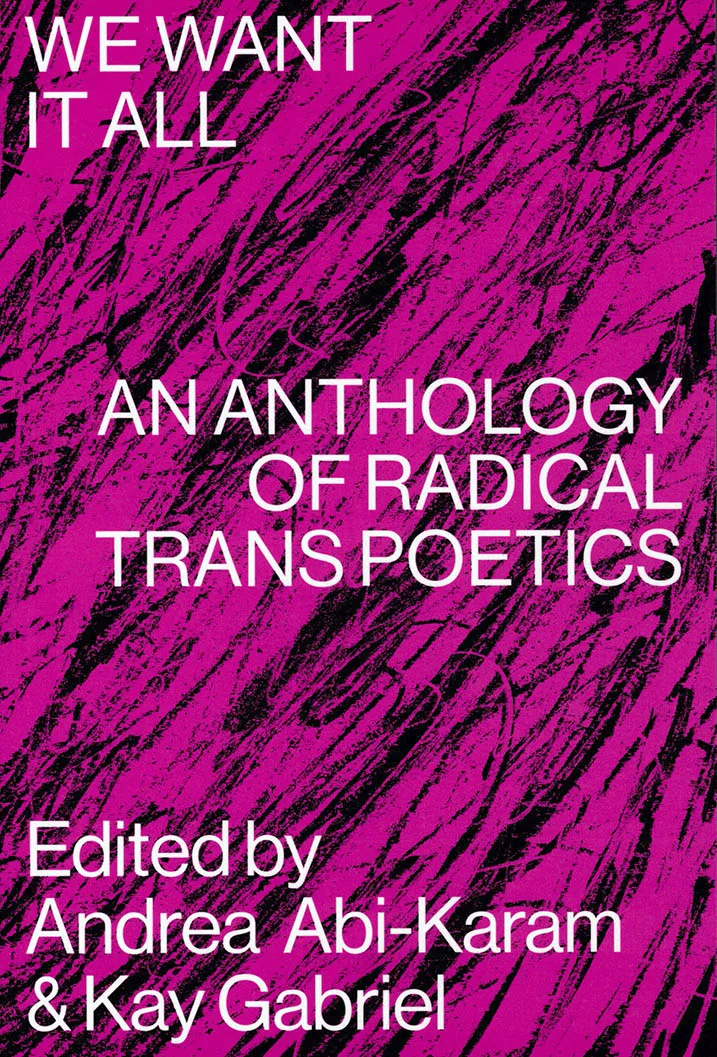
We Want It All: An Anthology of Radical Transpoetics
An anthology of formally inventive writing by trans poets against capital and empire.
With texts by: Andrea Abi-Karam, New York City Sam Ace, South Hadley, MA Bahaar Ahsan, Berkeley, CA jasper avery, Philadelphia, PA Ari Banias, Berkeley, CA Jo Barchi, Chicago, IL Joss Barton, St. Louis, MO Levi Bentley, Philadelphia, PA Jessica Bet, Baltimore, MA Rocket Caleshu, Los Angeles, CA Ching-in Chen, Seattle, WA listen chen, Vancouver, BC Faye Chevalier, Philadelphia, PA Cody-Rose Clevidence, Arkansas Miles Collins-Sibley, Easthampton, MA Valentine Conaty, New York City CA Conrad, Philadelphia, PA Jimmy Cooper, Rochester, MI Maxe Crandall, Oakland, CA José Díaz, Boston, MA Aaron El Sabrout, New Mexico Ian Khara Ellasante, Lewiston, ME Caelan Ernest, New York City, NY NM Esc, San Diego, CA joshua jennifer espinoza, Los Angeles, CA Logan February, Ibadan, Nigeria Ray Filar, Brighton, UK Nora Collen Fulton, Montreal, Canada Kay Gabriel, New York City Callie Gardner, Cardiff, Wales Jesi Gaston, Chicago, IL Harry Josephine Giles, Edinburgh, Scotland Aeon Ginsberg, Baltimore, MD Caspar Heinemann, Berlin, Germany Kamden Hilliard, Greenville, SC Stephen Ira, New York City Cyrée Jarelle Johnson, New York City Peach Kander, New York City Jayson Keery, Western, MA Evan Kleekamp, Los Angeles, CA Noah LeBien, New York City Ty Little, Richmond, VA Zavé Martohardjono, New York City Amy Marvin, Philadelphia, PA Natalie Mesnard, New York City Bianca Rae Messinger, Iowa City, IA Liam O'Brien, New York City Xandria Phillips, Madison, WI Rowan Powell, Santa Cruz, CA Nat Raha, Edinburgh, Scotland Holly Raymond, Philadelphia, PA Jackie S, New York City Trish Salah, Toronto, Canada Raquel Salas Rivera, Philadelphia, PA Mai Schwartz, New York City Kashif Sharma-Patel, London, UK Julian Talamantez Brolaski, Oakland, CA Charles Theonia, New York City Jamie Townsend, Oakland, CA Nora Treatbaby Laurel Uziell, London, UK Rachel Franklin Wood, Boulder, CO Clara Zornado Akasha-Mitra xtian w. and Anaïs Duplan, NYC.
Kay Gabriel is a poet and essayist. She's the author of Elegy Department Spring / Candy Sonnets 1 (BOAAT Press, 2017), the recipient of fellowships from Lambda Literary and the Poetry Project, and recently completed her PhD at Princeton University.
Andrea Abi-Karam is an arab-american genderqueer punk poet-performer cyborg, writing on the art of killing bros, the intricacies of cyborg bodies, trauma & delayed healing. Their chapbook, THE AFTERMATH (Commune Editions), attempts to queer Fanon's vision of how poetry fails to inspire revolution. Andrea's first book, EXTRATRANSMISSION (Kelsey Street Press, 2019), is a poetic critique of the U.S. military's role in the War on Terror.

Schismatics
Schismatics consists of 10 short stories, in a fictitious way dealing with forgotten historical personas. Among them, artist Goda Palekaitė includes Mary Anning –– an amateur discoverer of dinosaurs, Emanuel Swedenborg –– a mystic who empirically explored the architecture of heaven, and Essad Bey –– a Jewish-Muslim writer and orientalist. Here their lives are revived and balance between the lines of history and story.
The book fuses elements of fiction, academic writing, and artistic research, and intertwines with rumors, forgeries, and inventions. Previously, its characters and narratives have already appeared in Palekaitė’s performances and installations, which are presented in the middle of this bilingual edition. In the introductory essay, Valerio Del Baglivo analyses the author’s exploration of facts and fiction, the mechanisms of knowledge production, and the trans-chronological perception of time. At the end of the book, Monika Lipšic ‘Riddle’ reflects on a ‘schismatic poetics’.
Goda Palekaitė is a contemporary artist and researcher whose work combines visual, literary, performative, and anthropological practices. Exploring the politics of historical narratives, the agency of dreams and collective imagination, and social conditions of creativity, her work evolves around long-term projects that manifest as performances, scenographies, installations, and texts. Her performances, solo and group shows are being presented internationally. In 2019 Goda Palekaitė received The Golden Stage Cross and the Young Artist’s Prize for her artistic contributions across disciplines.
Published September 2020