Books
Books
Arabic editions

Arabic, between Love and War
In Arabic, the word for love حب is one letter shorter than the word for war حرب
Here, translators gather to perform an intimate labour, moving words from Arabic into English, or reversing such direction as language dissolves into cities, landscapes, or portals that open to rubble, or only air.
These poems reverberate in the space between there and here, silence and voice, original and translation, and the polarities of war and love.
George Abraham, Eman Abukhadra, Omar Aljaffal, Norah Alkharashi, Lamia Abbas Amara, Nour Balousha, Samar Diab, Najlaa Osman Eltom, Miled Faiza (& Karen McNeil), Zeena Faulk, Ibrahim Fawzy, Daad Haddad, Yasmine Haj, Mayada Ibrahim, Rana Issa, Ali Mahmoud Khudayyir, Hiba Moustafa, Suneela Mubayi, Mariam Naji, Ibrahim Nasrallah, Nashwa Nasreldin, Kamal Nasser, Nofel, Qasim Saudi, Lena Khalaf Tuffaha, & Fadwa Tuqan.
May the poems gathered here––in translation, and in their original voice––spark introspection, remedy, and acts of imagination in between. ––Yasmine Haj, “To Speak to Each Other” (introduction)
trace: translating [x] invites readers to think about writing, place, and community; and to consider what is gained, lost, or missing, in processes of translation.

Nest
Gregory Carlock, Christina Atik
“Ishtar said goodbye to the elephants, goodbye to the clowns, waved to a group of admirers who had gathered on East 43rd Street, and was ushered into a shiny new Escalade, which the NYPD reserved for such occasions. ‘I am the earth,’ she said, as the cops forced her head through the doorframe. The motorcade, fit for heads of state, went 40 down the West Side Highway, past rollerblading homosexuals and New School undergraduates, who held signs with slogans like ‘ISHTAR WE LOVE YOU!’ ‘ARREST ERESHKIGAL AND GILGAMESH,’ and ‘DOWN WITH CAPITALISM.’”
Nest is Gregory Carlock’s vision of Manhattan razed to the ground by Ishtar—Akkadian goddess of love, sex & war—following her liberation from NYPD arrest.
This poem, in 31 sections, combines the 4000-year-old Gilgamesh epic, pre-Islamic poetry, Sufi snippets & Carlock’s own Emily-Dickinsonesque rhymes to vent sulphurous @ New York/Washington’s rape’n plunder of Planetary Mind. Illustrated by the Lebanese artist, Christina Atik.
CUNY Center for the Humanities
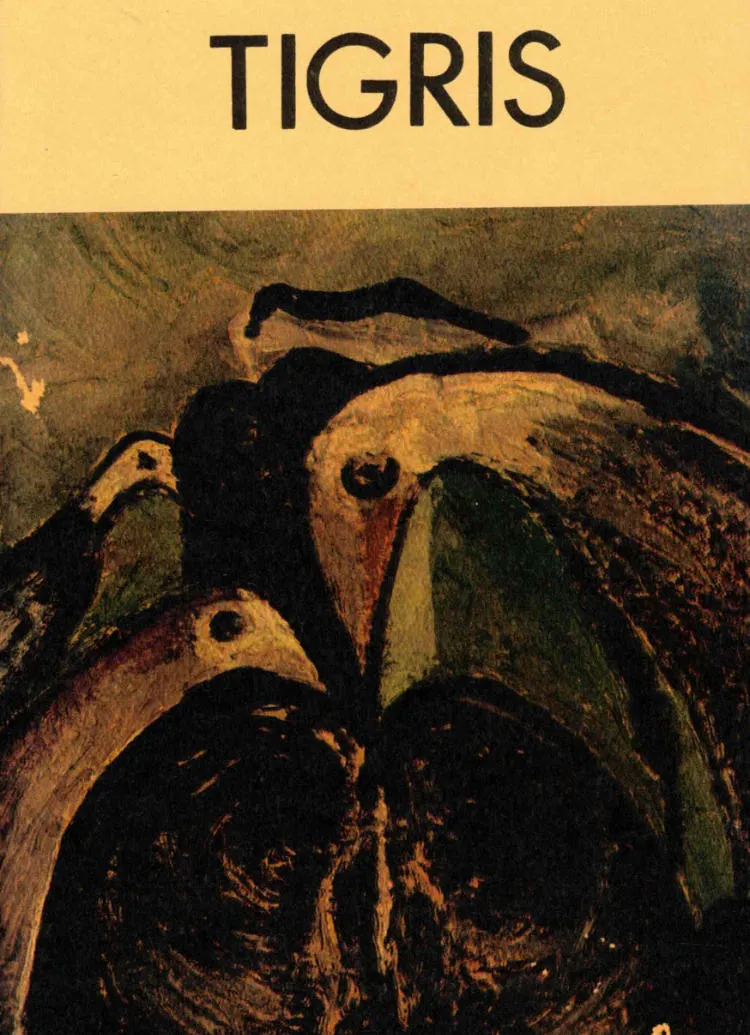
Tigris Vol. 1
In 1971, the great Iraqi poet Sargon Boulus (1944-2007) published a single issue of an English-language literary anthology that he called Tigris. The magazine—a whisper on the literary landscape that appeared three years after Boulus’s arrival in the US—brings together work by Boulus and several of his literary friends, in translation by Boulus and Etel Adnan.
Tigris was not an end in itself, but rather a temporary solution to the lifelong problem of how to devote oneself to poetry across different countries, eras, and styles: how to live poetry. Yet, in so doing, the small anthology includes significant work: Etel Adnan’s “Jebu,” translated by Adnan, and poetry by Boulus, Fouad Rifkah, Yusuf al-Khal, Mouayad al-Rawi, and Riadh Fakhouri, all in Boulus’s translations, as well as a work by Ankido, a “street-activist poet-café worker of importance to the Palestinian Liberation Movement.”
This Death is Not One
Jasbir K. Puar, Nasser Abourahme and 1 more
The publication of The Right to Maim by Jasbir K. Puar in 2017 was critical to advancing studies on disability and to further articulating how the body figures in the nexus of capacity and debility across racializing and extractive neoliberal lines. It offered a complex and rigorous anti-capitalist account of disability that is useful to both scholarly work and political and social organizing. However, despite its paramount contribution to scholarship on Palestine, delivered by its scathing analysis of the Israeli biopolitical policy—its right to maim—in how the injured Palestinian body is produced and reproduced, its reception was difficult, and hard to stomach. It cohered a political logic in writing before it was visibly evident on the ground. In the moment and aftermath of the Great March of Return (2018-19), Puar’s offerings became much harder to ignore, as the event crystallized a mass maiming campaign of Palestinian protesters inside the edges of the militarized borders of Gaza.
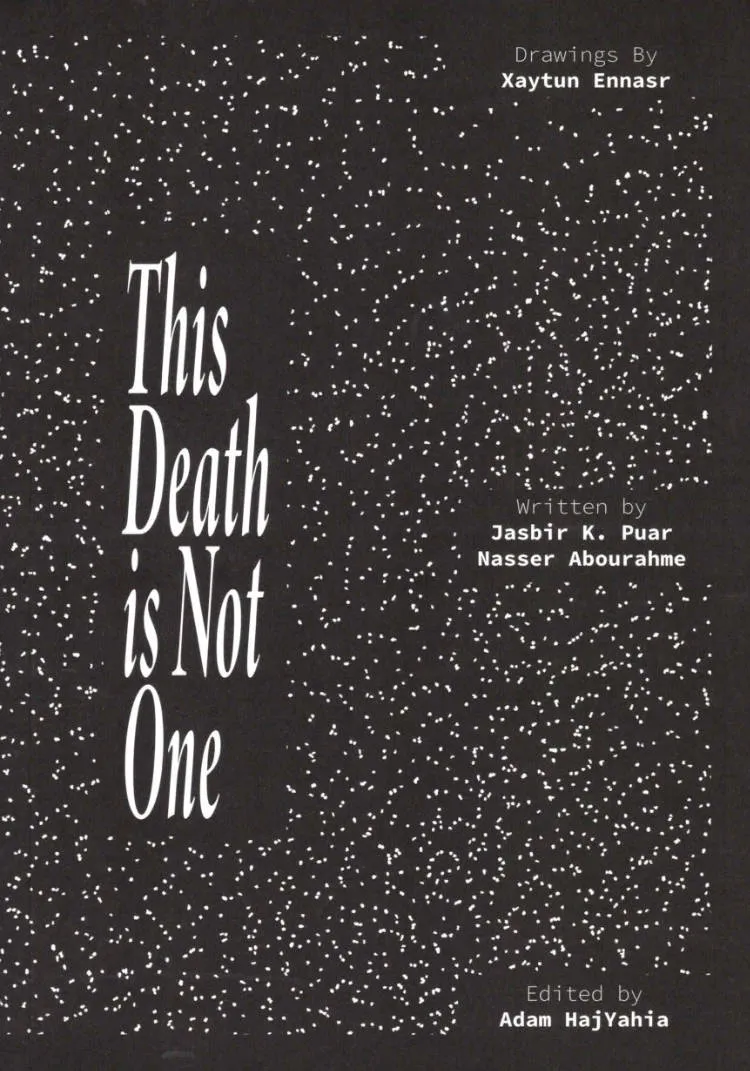
The occasion of this publication by Bilna’es marks the first translation into Arabic of the chapter “Will Not Let Die”: Debilitation and Inhuman Biopolitics in Palestine, alongside the postscript of The Right to Maim. Not simply a reissue of previously published work or a translation, This Death is Not One includes a new preface from Jasbir K. Puar revisiting the right to maim from within this moment of genocide in Gaza that interrogates the new vectors of living and dying under settler-colonialism, and how maiming, in fact, speaks of extermination; an introduction by Nasser Abourahme reflecting on the book’s stakes in the present and its reception in the past, alongside searing analysis of genocide in excess of the law, and what this reveals and forecloses in how we understand the juridical body and militancy in the wake of Zionism; and original drawings by Xaytun Ennasr that inscribe a relation between land and body mapped through cosmological patterns tracing the relation between martyrs, who are referred to as moons, and the moon, a symbol for martyrdom in Palestine.
Jasbir K. Puar is Distinguished Faculty of Arts Professor in the Social Justice Institute at the University of British Columbia, Extraordinary Professor in the Women’s and Gender Studies Department at the University of the Western Cape in Cape Town, South Africa, and Professor Emerita at Rutgers University where she was faculty in the Women’s, Gender, and Sexuality Studies Department for 23 years. Puar is the author of the award-winning books: The Right to Maim: Debility, Capacity, Disability (2017), and Terrorist Assemblages: Homonationalism in Queer Times (2007).
Nasser Abourahme is a writer and teacher, and is currently assistant professor at Bowdoin College. He’s the author of The Time beneath the Concrete: Palestine between Camp and Colony (Duke University Press, 2025), which was awarded the 2025 Palestine Book Award.
Xaytun Ennasr is an artist and designer. She works across experimental video games, paintings, prints, ceramics, installations, and text. She often uses science fiction, folklore, and radical softness as affective tools for revolutionary cultural production, specifically Palestinian liberation and sovereignty. Her work often deals with questions of land, cartography, transness, gender, and the living environment.
Drawings by Xaytun Ennasr
Translation to Arabic:
“Living in Genocide” by Jasbir K. Puar, translated by The Archilogue
“Our names, our remains” by Nasser Abourahme, translated by The Archilogue
The Right to Maim, Chapter 4: “Will not let die: Debilitation and Inhuman Biopolitics in Palestine ” and the The Right to Maim Postscript by Jasbir K. Puar, translated by Bekriah Mawasi

Wanderlust
Soufiane Ababri's sketchbooks.
Soufiane Ababri (b. 1985, Rabat) is a Moroccan artist based in France. His protean work (drawings, installations, performances) explores questions of gender, homosexuality, racism and colonialism.

SABR N°04 - Half a life
“Perhaps much of what we once believed was never truth but a gentle and necessary illusion.It was something we chose quietly and almost unconsciously so we could continue without falling apart.”
Bayan Abu Nahla is a visual artist born in 2001 in Gaza, Palestine. Her artistic practice functions as a visual diary, documenting and reflecting rapidly evolving events, both before and after the genocide. Through her work, she explores realities and daily living conditions often unknown to those who have not lived in Gaza.
SABR/Collection is a series of publications that bring together short literary works in a variety of genres. Curated by Nesrine Salem, SABR/Collection wishes to highlight the macro-realities of the authors chosen, to make visible the intersectional nature of struggles.

Every Moment Is a Life: Gaza in the Time of Genocide
susan abulhawa, Huzama Hubayeb
In early 2024, writer and activist susan abulhawa managed to enter Gaza twice through the Rafah crossing. There, at the Culture and Free Thought Association, susan held a series of workshops for young people who had been displaced to tent encampments. The lives of all participants were marked by unrelenting Israeli violence and extraordinary loss—of home, family, safety, education, electricity, and all the structures of life. They’d fled from place to place as Israel’s colonial violence swirled around them, complete with food and water insecurity and constant threat. Still, despite the bitterness of life in tents and the dangers of travel, they came together to share in the refuge of writing and community.
Samya recounts a tender moment with an old man mending shoes in the street, while her cousin Saja hides books in her closet, hoping they and her home will still be there when she returns. Ghassan is haunted by the baby he rescued from the rubble, who for a time became his son. Fatima risks it all retrieve her clothes from a danger zone buzzing with drones and warplanes. Maram’s loving aunt is gone, and chaos inhabits Amr’s mind. Samah, Lubna, Rizq, and Nebal take us by the hand through raining death, trails of tears, classroom shelters, and shared clothes in crowded tents.
Every Moment Is a Life delivers rare, unfiltered portraits of life under genocide, platforming the emerging voices struggling to survive in Gaza today. These essays are raw and real, capturing human moments—buying bread, going to the bathroom, sharing a meal, drinking coffee—all set against the backdrop of history’s first livestreamed ethnic cleansing. With courage, anger, love, agony, and—impossibly—hope, these achingly tender voices from Gaza will stay with us, captured in these pages, forever.

Elegies of the Earth
Ahmad Shamlou, Niloufar Talebi
A sweeping centennial edition of Iran’s iconic twentieth-century poet of liberty, whose work shaped modern Persian poetry. Known for his political engagement and deep humanism, and his pivotal role in Persian poetry’s modernist turn toward free verse, Ahmad Shamlou (1925–2000) crafted poems that carried both lyrical intimacy and cultural force. A central, defiant voice in Iran’s modern literary history, Shamlou championed the power of poetry as an instrument of liberation. His work, long suppressed in his homeland, remains urgent for readers everywhere confronting censorship, exile, and erasure. This bilingual edition honors Shamlou’s centennial with the most expansive selection of his poetry to date in English, encompassing his wide thematic range: from fierce protest to intimate love, mythic storytelling to existential reflection. Niloufar Talebi’s vibrant translations and deeply researched commentary shine new light on Shamlou’s legacy and his relevance today.

Smoke Drifts
Nadia Anjuman, Diana Arterian and 1 more
Afghan poet Nadia Anjuman (1980-2005) drew on the lineage of Persian and Sufi writing and her life under Taliban rule, attending to love, oppression, myth, and devotion through lyrics that both embrace and resist tradition. Anjuman grew up in the Herat, Afghanistan, a city known for centuries for its poetry. While the Taliban was in power, Anjuman met with other women in what appeared to be a needlepoint school, one of the few sanctioned pastimes for women, to secretly discuss literature and poetry. After the fall of the Taliban, Anjuman was finally able to attend university. She wrote and published a celebrated volume of poetry and was set to publish another before her early death due to domestic violence. Selections from both of Anjuman’s collections are presented here for the first time in English.

Ruins and Other Poems
Samer Abu Hawwash, Huda J. Fakhreddine
In these poems, Samer Abu Hawwash stands upon ancient and modern ruins, engaging with the archetypal Arabic qasida and its echoes in the present, set against a backdrop of exile, displacement, and genocide. The site of the ruin, the journey, and the return home are the three movements of the archetypal Arabic form with which Samer contends in his book-length poem.
Writing in and from the moment of crisis, the poet keeps returning to ruins, forfeiting the journey and the hope of return and resolution, rearranging the elements of poetry in the Arabic tradition in search of closure or consolation—in a gesture, a shadow, a memory, an object. The five poems that follow “Ruins” in this book root themselves in monumental loss. When “it no longer matters if anyone loves us” and “we will lose this war,” nothing remains but the poem, the witness, the signpost in the wasteland of history.

Afghanistan
Afghanistan is my father’s homeland. He was born in Kabul in 1945 and later moved first to France, then to Switzerland in the 1970s. In my mind, Afghanistan exists as a geography with blurred edges, something I feel the need to reconcile with. It’s a place I’ve only ever known through stories, a source of memories that, over time, have shifted and become distorted.
Contributors: Luca Cerizza, Farid Rahimi, Said Rahimi, Susanna Ravelli, Francesca Recchia, Zafar Sayan, and Dawood Tawana

MAKAN #3 / Synthetic Agencies
Building on the foundations of the first two issues, Synthetic Agencies invites a rethinking [and unthinking] of the assumptions, polarities, and discontents surrounding the notion of agency. Traditionally defined in Western thought as the capacity to act and effect change, agency is inseparable from questions of power and the often invisible structures through which power operates. The various contributions interrogate how agency is produced, constrained, or distributed through the systems of knowledge, design, and governance that shape our built environments, technologies, media, and cultures. They were are invited to right (as much as write on) agency, reflecting on how it operates across different scales and contexts, and imagining alternative worlds or configurations. Ultimately, Synthetic Agencies understands agency not as a fixed attribute but as a contested lens through which we might read, reshape, or resist the conditions of the present.
With contributions by Amine Houari, Driss Ksikes, Fehras Publishing Practices, Hamed Sinno, Helga Tawil-Souri, Lada Hršak, Mayada Madbouly, Myriam Ababsa, Nzinga Biegueng Mboup, Ola Hassanain, Omer Shah, OPPA, Salma Barmani, Samia Henni, Tarek El-Ariss, Zaidoun Hajjar.

MAKAN #2 / Manufacturing Narratives
In its second issue, Manufacturing Narratives, Makan focuses on how interrogating narrativity can provoke fundamental questions about how societies define or choose to accept societal or historical truths in today’s world. Spanning across [and beyond] the Mashreq and Maghreb, the various contributions reflect a shared space of inquiry that bridges geographies and fosters emergent dialogues across shifting territorialities. This issue invited contributors to right (as much as write) narratives: to question authorship and its social collectivities, to retell alternative public histories, to explore gender roles, and to unsettle the exoticism, folklorization, and political textures of fiction as a practice of indiscipline. Together, these contributions re-articulate the genealogies of our present through the pluralities of the past, offering tools to imagine and manufacture alternative futures, and realities otherwise.
With contributions by Ala Younis, Bari Abbassi, George Bajalia, Karim Kattan, Karima Kadaoui, Tamkeen, Kenza Sefrioui, Lahbib El Moumi, Laila Hida, Maureen Mougin, Mohamed Amer Meziane, Monica Basbous, Nadia Tazi, Sénamé Koffi Agbodjinou, Salma Barmani, Sonia Terrab, Soufiane Hennani, Yto Barrada.

48Kg.
Cristina Viti, Batool Abu Akleen and 4 more
One of the most viscerally affecting collections of poems I have ever read. Devastatingly precise and unforgettable images emerge from every line. The Arabic and the English sit side by side on the pages of this book but the effect is deeper than language, it meets the reader in the heart. I wept reading this brilliant, natural, gifted young poet and wished her subject was something other than this atrocity visited upon her and her people.
What is happening in Gaza is a genocide not a war, but not since Akhmatova have I read poetry that so potently reckons with the relationship between war and the body. They create a new category of literary grace out of the cataclysm. These are poems of fire and agony, bombing and starvation, but they are also poems of grace, cleverness, tenderness and yearning. A great international poet arrives with this collection, but it is also a landmark work of resistance. No human should have to write their poetry from inside death's dominion, but Batool Abu Akleen has done it and the result is truly astonishing.
— Max Porter
A debut collection from the Palestinian poet—Modern Poetry in Translation’s ‘Poet in Residence,’ 2024—a bilingual assembly of forty-eight poems in which each work accounts for a single kilogram; a body’s mass; a testament to a sieged city; a vivid and visceral voicing of the personal and the public in the midsts of unspeakable violence.
Translated from the Arabic by the poet with Graham Liddell, Wiam El-Tamami, Cristina Viti & Yasmin Zaher

Nawar's Sketchbook
I am not deep, although my eyes are, like a black sea that has been forgotten, as many have told me.
Noura Alsouma’s zine “Nawar’s Sketchbook” is a liquid lament by the Berlin-based Syrian visual artist and printmaker, riveted to eyes that see and therefore shed tears, channeling the heartfelt exposure of the sketchbooks Noura fills to the bleed.
With a moving text by the artist in the original Arabic, reproduced in her handwriting, as well as in English translation by Suja Sawafta.

Lentil Space – Recipes from Artists' Homes
A compilation of recipes from the Arab world that were presented by artists for Mophradat's online cooking show Lentil Space.
Adapted from its namesake online program produced by Mophradat, co-curated by Mai Abu ElDahab and Reem Shilleh, from 2021 to 2023, this book is a celebration of the varied cuisine of the Arab world and its relationship with inherited food practices and the cultures of cooking and talking about food.
With contributions by Adam HajYahia and Haitham Haddad, Deena Abdelwahed, Laila Hida with Amine Lahrach, Mohamed Abdelkarim with Abla elBahrawy, Nadah El Shazly, amongst many others, this cookbook includes recipes chosen and prepared by the artists in an intimate setting coupled with stories both personal and about their art practice.

Pommes Girl / أحتفل بالحياة التي تحتفل بي
Rim Battal, Abdelilah Khattabi
The story of a meeting between a woman and a man linked by music for one night, in a nuptial dance of bodies and words doomed to failure: an ode to desire by the Franco-Moroccan poetess.
Rim Battal (born 1987 in Casablanca, lives and works between Paris and Rabat since 2012) is a French artist and poet.
Edited by Yasmina Naji.
Translated into Arabic by Abdelilah Khattabi.

Can We Rule It Out? Collective Ideas for keeping sexual abuse out of art spaces
Habiba Effat, Naira Antoun and 1 more
“With this collection of texts, reflections, questions, documents, we invite our readers, colleagues, and peer organizations to engage in difficult, often fraught, discussions about sexual abuse in art spaces. We do not want these conversations to always start at zero, as if a lot of work around sexual abuse hasn’t been done already. There is copious activism, scholarship, and creativity on this topic, if one wants to find it. What this publication would like to do is contribute to the work that has already been done and to be a waypost toward what remains to be done.”
Commissioned and edited by: Karim Kattan and Mai Abu ElDahab
Contributors are Adam HajYahia, Habiba Effat, Karim Kattan, Mai Abu ElDahab, Marnie Slater, Naira Antoun, and Salma El Tarzi
Notes compiled and written by Ahmed Medhat, Marina Samir, Nana Abuelsoud, and Salma El Tarzi, with edits and comments by Sahar Mandour
Translation from Egyptian Arabic of “Notes on Justice” by Yasmine Haj
Copyedited and proofread by Jenifer Evans
Designed by Loraine Furter and Naïma Ben Ayed

كيف تلتئم – عن الأمومة وأشباحها - How to Mend: Motherhood and Its Ghosts
A highly personal and sensitive exploration of motherhood.
In How to Mend: On Motherhood and its Ghosts, Iman Mersal navigates a long and winding road, from the only surviving picture of the author has with her mother, to a deep search through what memory, photography, dreams and writing, a search of what is lost between the mainstream and more personal representations of motherhood and its struggles. How to mend the gap between the representation and the real, the photograph and its subject, the self and the other, the mother and her child.
"If I'd been more aware and someone had asked me about 'my mother's picture' I would have shown them the bird she'd stitched onto the canvas herself. It is not aesthetic vision or skill that summons my mother's presence in this canvas, but the slight punctum the bird gives me. I get nothing of this sort from our studio portrait. The bird's eyes are always looking at me, as though they belong to her. The bird: motionless, for whose sake my mother sat and stitched by the window where the light came in, each pinprick a symbolic laceration in the process of its embodiment: cuts by the hundred to make it whole."
Iman Mersal (born 1966 à Mit 'Adlan) is an Egyptian poet, writer, academic and translator. She works as an Associate professor of Arabic literature and Middle Eastern studies at the University of Alberta, Canada. An anthology of her works was translated into more than twenty languages and she has five poetry collections published.

Why Call it Labor? On Motherhood and Art Work
This publication comprises four essays and one conversation with contemporary artists and curators discussing their experience of becoming mothers as professionals in the arts, its reality and effects. While their reflections represent a similar strata of art worker in terms of background, class, and career trajectory, the impact of instruments of patriarchy on rendering maternity invisible that they describe is recognizable and insidious.
Contributions by Mai Abu ElDahab, Basma Alsharif, Lara Khaldi, Mary Jirmanus Saba, and Mirene Arsanios with Nikki Columbus.
Edited by Mai Abu ElDahab
Published by Mophradat and Archive Books
Text design layout by Valerie Arif
Arabic and English