Books
Books
Paperback

Re-Enchanting the World
In this edited collection of work spanning more than 20 years, Silvia Federici provides a detailed history and critique of the politics of the commons from a feminist perspective. In her clear and combative voice, Federici provides readers with an analysis of some of the key issues in contemporary thinking on this subject. Drawing on rich historical research, she maps the connections between the previous forms of enclosure that occurred with the birth of capitalism and the destruction of the commons and the "new enclosures" at the heart of the present phase of global capitalist accumulation.
Considering the commons from a feminist perspective, this collection argues that women and reproductive work are crucial to both our economic survival and the construction of a world free from the capitalist hierarchies. Federici is clear that the commons should not be understood as happy islands in a sea of exploitative relations—but rather autonomous spaces from which to challenge the existing organization of life and labor.

Deep Listening
Deep Listening is a practice created by composer Pauline Oliveros in order to enhance her own as well as other's listening skills. She teaches this practice worldwide in workshops, retreats and in her ground breaking Deep Listening classes at Rensselaer Polytechnic Institute and Mills College. Deep Listening practice is accessible to anyone with an interest in listening. Undergraduates with no musical training benefit from the practices and successfully engage in creative sound projects. Many report life changing effects from participating in the Deep Listening classes and retreats.

The Wind Escorts The Sky
The Wind Escorts The Sky (Weld 2017) is the second part of Pontus Pettersson’s project Poetic Procedures. The project and performance looks into the relation between dance and poetry and how these practices can unfold in the situation of a dance class and with the case of The wind Escorts The Sky; a stage performance. This is the publication that came out of that practice.

Writing Wounds to Heal

Magenta Soul Whip
Lisa Robertson writes poems that mine the past, its ideas, its personages, its syntax, to construct a lexicon of the future. Her poems both court and cuckold subjectivity by unmasking its fundament of sex and hesitancy, the coil of doubt in its certitude. Reading her laments and utopias, we realize that language, whiplike, casts ahead of itself a fortuitous form. The form brims here pleasurably with dogs, movie stars, broths, painting's detritus, Latin and pillage.
Erudite and startling, the poems in Lisa Robertson's Magenta Soul Whip, occasional works written over the past fifteen years, turn vestige into architecture, chagrin into resplendence. In them, we recognize our grand, saddened century.


Mother Nature is a Lesbian

Anthology of Failure
GenderFail: An Anthology On Failure is the first in a series of publications that look into various concepts of failure from the perspectives of artists, activists, writers, and curators. The failures discussed in this publication come from various different places - from personal, political, institutional, and collective sources. Each participant was invited to contribute a work surrounding failure - especially as it pertains to their own experiences - to expand upon topics of ableism, mental health, passing, whiteness, colonization, police brutality and other illustrations of failure put onto us by dominant culture. This resulting collection might fail to articulate a cohesive interpretation of something as complex as failure, but will hopefully incite a collective consciousness that is as messy as it is thought provoking.
Contributions by: Manuel Arturo, Abreu, American Artist, Sasha Costanza-Chock, Demian DinéYazhi, Johanna Hedva, Nicole Killian, Andrea Liu, Be Oakley, Nate Pyper, Sable Elyse smith, Alok Vaid-Menon, Augustine Zegers.

Mother Reader
'My aim for Mother Reader has been to bring together examples of the best writing on motherhood of the last sixty years, writing that tells firsthand of the mother's experience.
Many of the writings in Mother Reader comment on and interpolate one another, in citations, in footnotes, in direct homage. As I was assembling this collection one text would lead to one another, treasure-hunt fashion, the clue provided by an acknowledgement or bibliography. And just as often the writing circles back.
In Mother Reader chapters are excerpted from autobiographies, memoirs, and novels; entries are lifted from diaries; essays and stories are culled from collections, anthologies, and periodicals. My project has been to assemble a compendium or sampler of these ''kindred spirit'' works on motherhood, so that readers, and especially mothers with limited time on their hands, can access in one volume the best literature on the subject and know where turn to continue reading." [Moyra Davey in the introduction]
Writings by Margaret Atwood, Susan Bee, Rosellen Brown, Myrel Chernick, Lydia Davis, Buchi Emeta, Annie Ernaux, Mary Gaitskill, Susan Griffin, Nancy Hutson, Mary Kelly, Jane Lazarre, Ursula K. Le Guin, Doris Lessing, Ellen McMahon, Margaret Mead, Vivian Montgomery, Toni Morrison, Tillie Olsen, Alicia Ostrker, Grace Paley, Sylvia Plath, Adrienne Rich, Sara Ruddick, Lynda Schor, Mira Schor, Dena Schottenkirk, Mona Simpson, Elizabeth Smart, Joan Snyder, Elke Solomon, Susan Rubin Suleiman, Alice Walker, Joy Williams, Martha Wilson, Barbara Zucker.

TABLOID
The poems of TABLOID (Zoe Darsee's Sympathies & Nat Marcus' Interview) reflect the position of its writers as actors and interpreters, as participants in pop and club culture, and as agents within a community. TABLOID is a relic of a social scene (Berlin, 2014), as such, its effects are intended to be both social and literary. The texts are brash, heartfelt, retributive and performative - they place the form of a poem alongside a conversation, rumor, or Facebook message.
Favoring this state of disposal over delicacy, the everyday over the elevated, TABLOID is produced on newsprint. The poems are scaled to the size of a column of gossip or current events; unbound, the pages will wear, shift, and possibly have a falling out. TABLOID is a newspaper founded in Berlin in the late spring of 2014. All poetry included in the first issue was written during that time and through the summer.

Ecodeviance
A series of 23 (Soma)tic poetry rituals and resulting poems by CAConrad. Poetry rituals such as riding escalators and showing photographs of himself to strangers asking, “Excuse me, have you seen this person?” In another he pollinates flowers for security cameras, exclaiming, “I’M A POLLINATOR, I’M A POLLINATOR!” One was written with a ghost, another by stargazing to build his own constellations. (Soma)tic rituals are a practice of unorthodox steps aimed at breaking us out of the quotidian and into a more political and physical spiritual consciousness of The New Wilderness.

After Cinema
This book marks the ten-year anniversary of the project A Collective Memory by Azin Feizabadi. The project encompasses five narrative-driven films, alongside other artworks. Each film has its own urgency, approach, and point of departure. The films naturally vary in their subjects, they touch upon stories of migration, uprising, transformation, revolution, renewal, collapse, defeat, depression, and desire that connect the life of the artist with those around him. The research materials that have come up over the course of this project consist, on the one hand, of concrete historical events and, on the other hand, all the innumerable, fragmented personal memories spread between pats, presents, and futures that narrate every-changing stories of how things were, are, and may be.
Contributors: Jens Maier-Rothe & Ashkan Sepahvand (co-editors) Shahab Fotouhi, Nanna Heidenreich, Sarah Rifky, Rasha Salti, Ashkan Sepahvand, Jan Verwoert, Chiara Figone

A Sand Book
Deadpan, epic, and searingly charismatic, A Sand Book is at once relatable and out-of-this-world. In poems tracking climate change, bystanderism, state murder, sexual trauma, shopping, ghosting, love, and the transcendent shock of prophecy, A Sand Book chronicles new dimensions of consciousness for our strange and desperate times. What does the destruction of our soil have to do with the weather in the human soul? From sand in the gizzards of birds to the iridescence on the surface of spilt oil, from sand storms on Mars to our internet-addicted present, from the desertifying mountains of Haiti to Sandy Hook to Hurricane Sandy to Sandra Bland, A Sand Book is both a travelogue and a book of mourning.
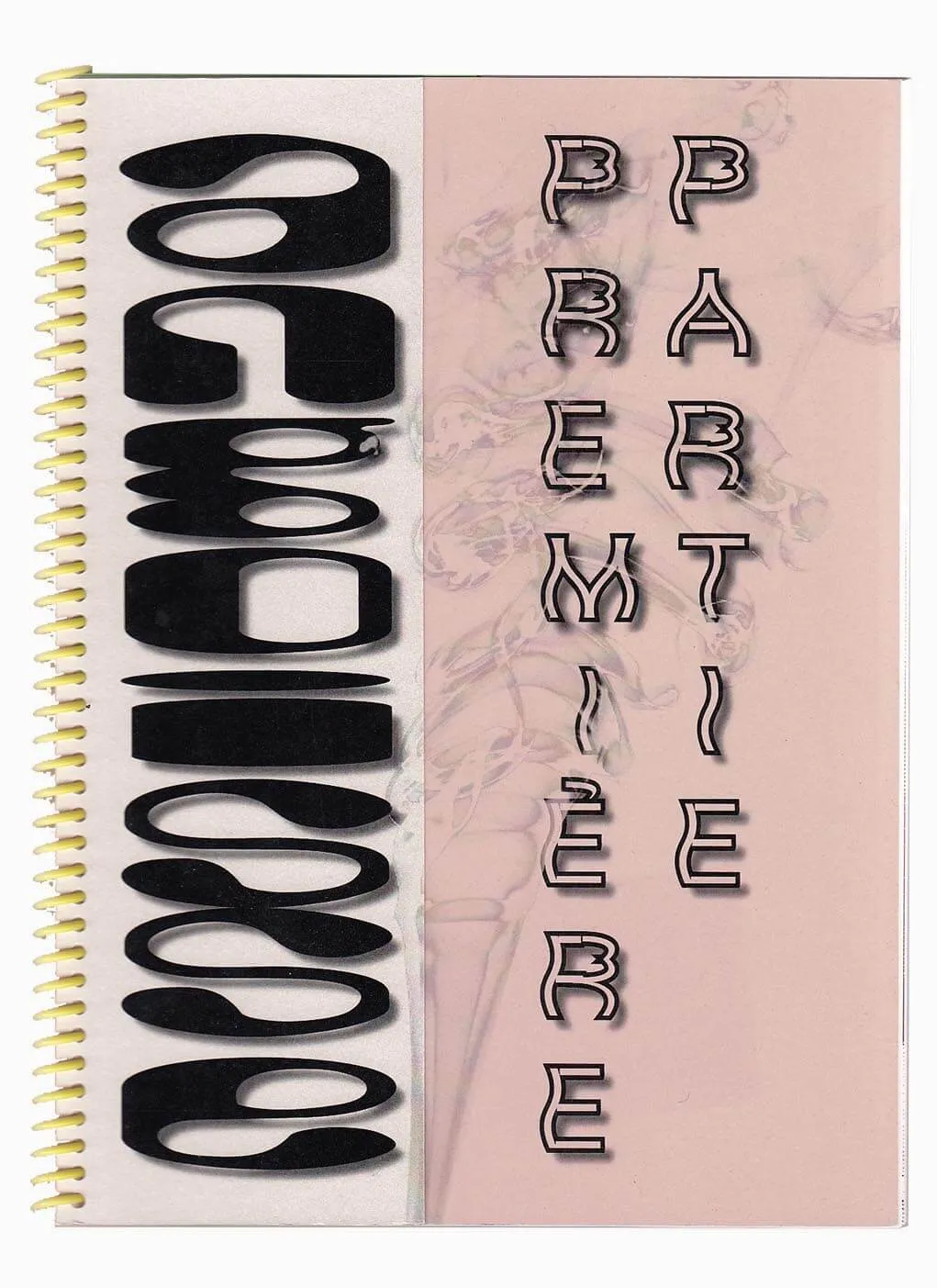
Angoisse: Première Partie
Angoisse: Première Partie departs from the original script written for and used during its performance. The publication was then adapted listening to the sound recording and expanded with transcriptions of interactions, gestures and actions. Special edition w silk-printed handkerchiefs to weep on and wipe off those cold sweats. Graphic design, Roxanne Maillet.
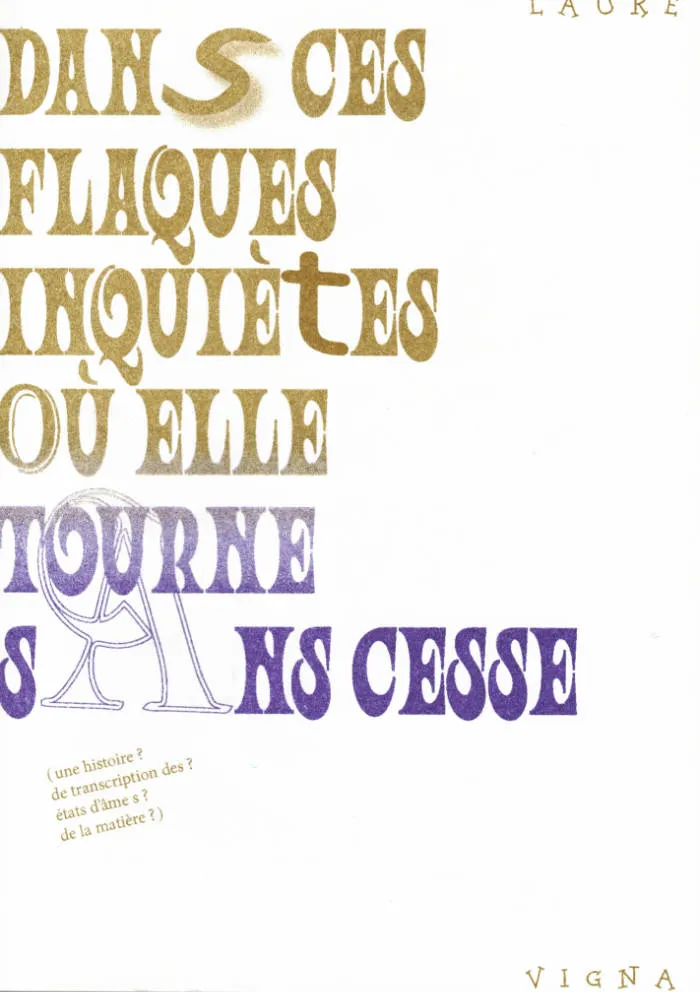
In These Worried Puddles / Dans ces flaques inquiètes
This bilingual edition in two booklets (French/English) brings together short texts and narratives by Laure Vigna, accompanied by notes from news media and scientific articles. Several narrators, with more or less abstract identities alternately representing materials, sculptural forms, or the author, seem to speak under the effect of their emotional states.
Sharing the same spaces of action and words, they merge throughout the text, forming only one physical body at the end. In a collaborative effort between Laure Vigna and graphic designer Roxanne Maillet, the publication reveals research conducted on typography and letters as body, receptacles, and spaces.
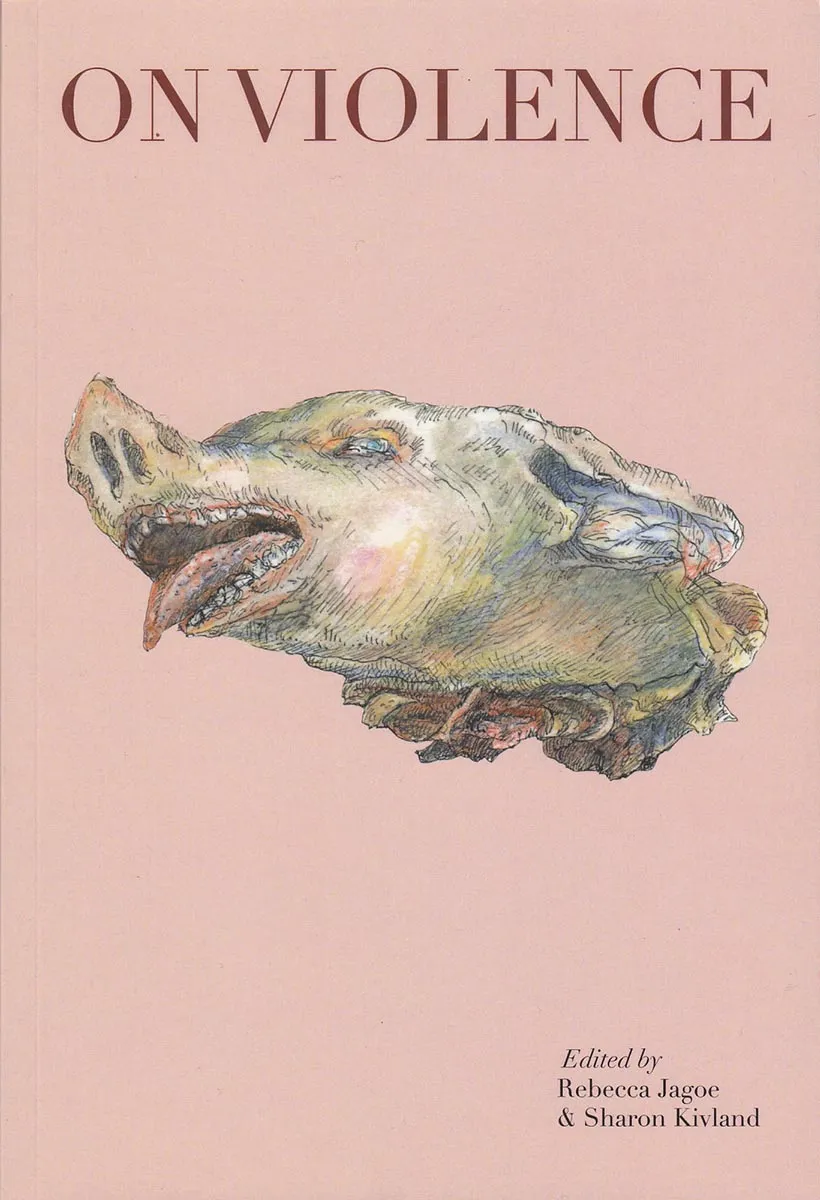
On Violence
Violence is in language and violence is language. The violence of language stratifies voices into those that matter and those that do not, using ideas of appropriate form and structure as its weaponry. It claims propriety and politeness are the correct mode of address, when urgency and anger are what is needed. Where languages intersect, hierarchies of language become means for domination and colonization, for othering, suppression, negation, and obliteration. The demand for a correctness of grammar, the refusal to see what is seen as incorrect, the dismissal of vernacular in favour of the homogenised tongue: all are violent. The narrative of history is a narrative of violence. The contributions herein refuse this narrative. They explore how violence permeates and performs in language, how language may be seized, taken back to be used against the overwhelming force of structural and institutional violence that passes as acceptable or normal. Violence may be a force for rupture, for refusal, for dissent, for the herstories that refuse to cohere into a dominant narrative.
Contributors: Travis Alabanza, Katherine Angel, Skye Arundhati-Thomas, Mieke Bal, Janani Balasubramanian, Elena Bajo, Jordan Baseman, Emma Bolland, Pavel Büchler, Paul Buck,Kirsten Cooke, Jih-Fie Cheng, John Cunningham, Andy Fisher, Caspar Heinemann, Jakob Kolding, Candice Lin, Rudy Loewe, Nick Mwaluko, Vanessa Place, Katharina Poos, Tai Shani, Linda Stupart, Benjamin Swaim, Jonathan Trayner, Jala Wahid, Isobel Wohl, Sarah Wood
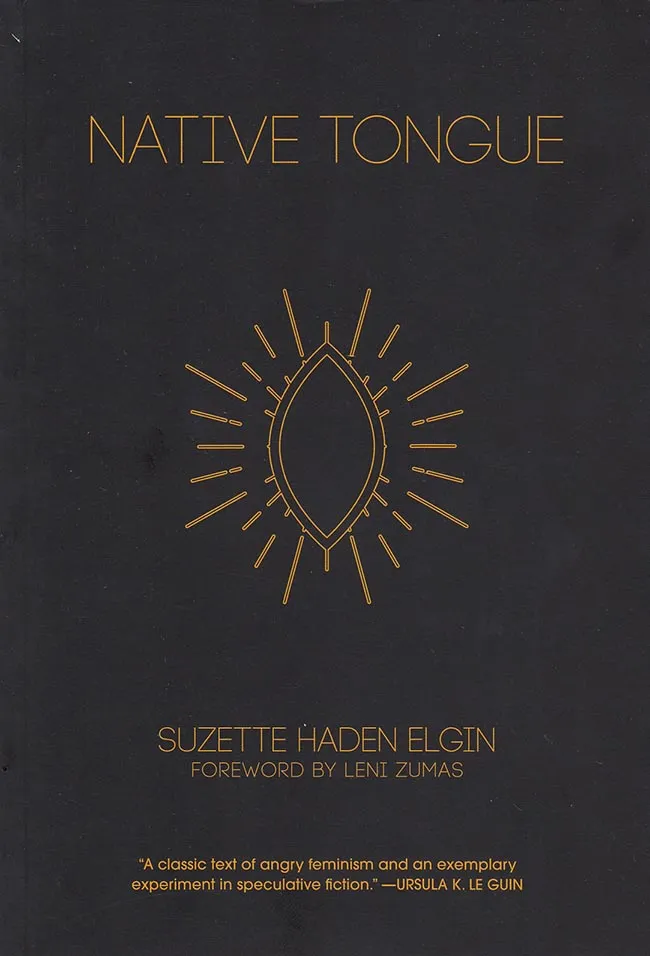
Native Tongue
Originally published in 1984, this classic dystopian trilogy is a testament to the power of language and women's collective action.
In 2205, the Nineteenth Amendment has long been repealed and women are only valued for their utility. The Earth's economy depends on an insular group of linguists who "breed" women to be perfect interstellar translators until they are sent to the Barren House to await death. But instead, these women are slowly creating a language of their own to make resistance possible. Ignorant to this brewing revolution, Nazareth, a brilliant linguist, and Michaela, a servant, both seek emancipation in their own ways. But their personal rebellions risk exposing the secret language, and threaten the possibility of freedom for all.
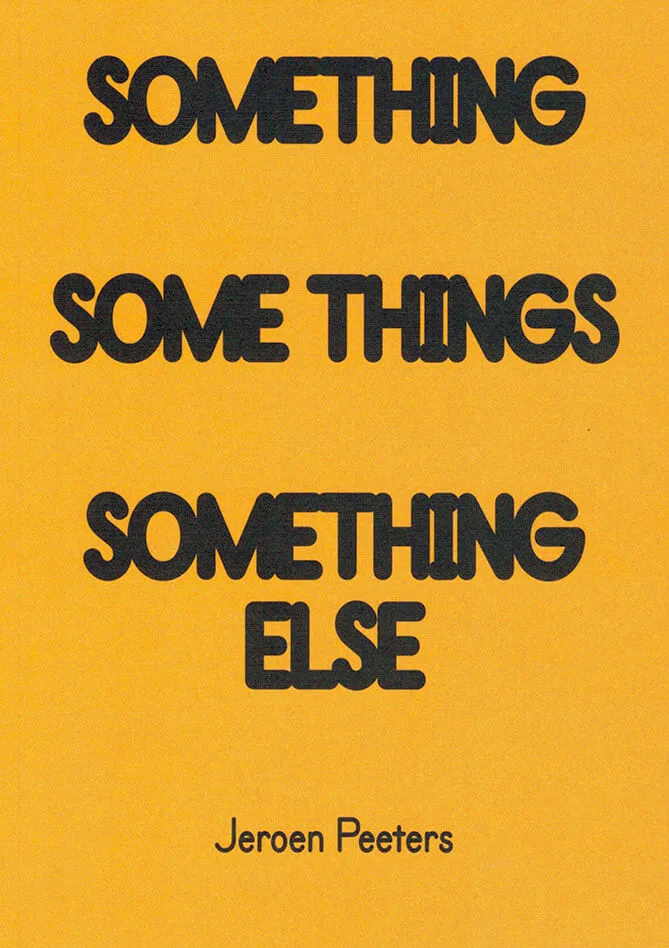
Something Some Things Something Else
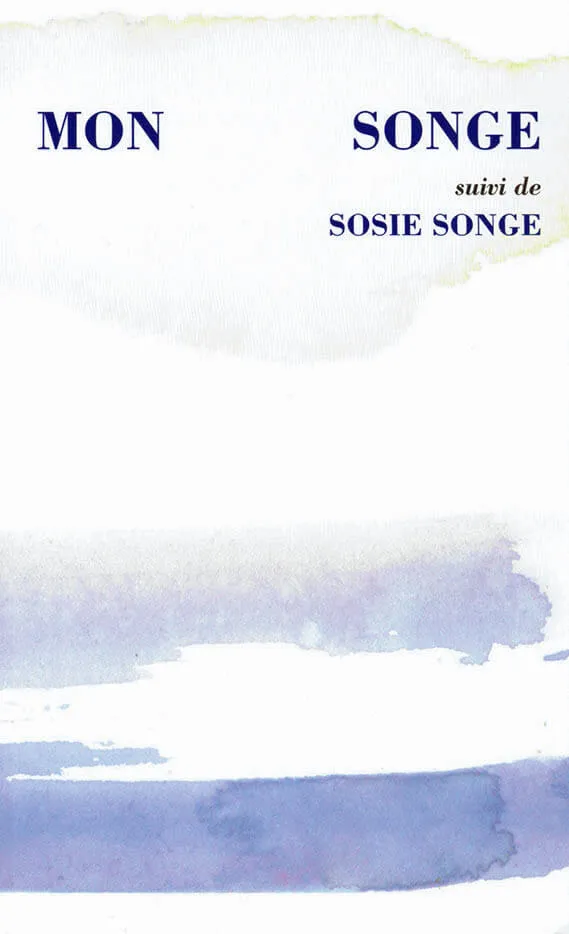
Time has fallen asleep in the afternoon sunshine
Mon Songe
For the project Time has fallen asleep in the afternoon sunshine a group of people/ performers memorize a book of their choice. Together they form a library collection consisting of living books. After years of learning by heart and reciting for readers, some of the books have now been written down from memory to create new editions, versions resulting from this process. This book is one of those books, chosen by one person, learned by heart and recited many times, and now written down again from memory. This edition is not a re-edition of the original text. It is a re-writing of the text after the process of reading, memorizing and reciting, with all the alterations that might have occured in the course of this process.
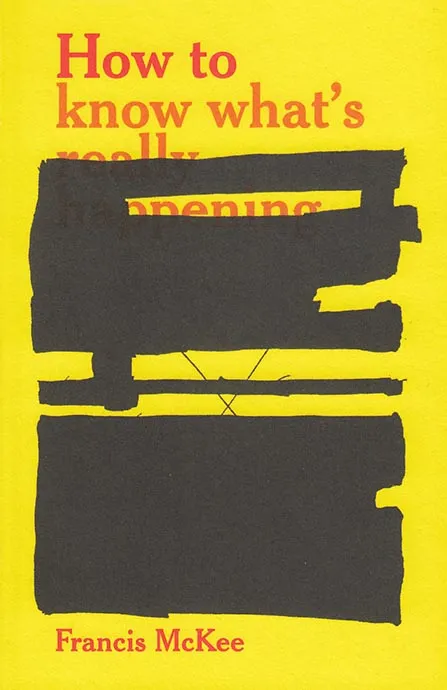
How To Know What's Really Happening
In this post-truth era, how does one navigate the endless information available and choose a viable narrative of reality? In How to Know What’s Really Happening Glasgow-based writer and curator Francis McKee looks at various techniques for determining verity, from those of spy agencies and whistle-blowers to mystics and scientists.
Francis McKee is an Irish writer, medical historian, and curator working in Glasgow where since 2006 he has been the director of the Centre for Contemporary Arts, and is a lecturer and research fellow at Glasgow School of Art. McKee has worked on the development of open-source ideologies and their practical application to art spaces.
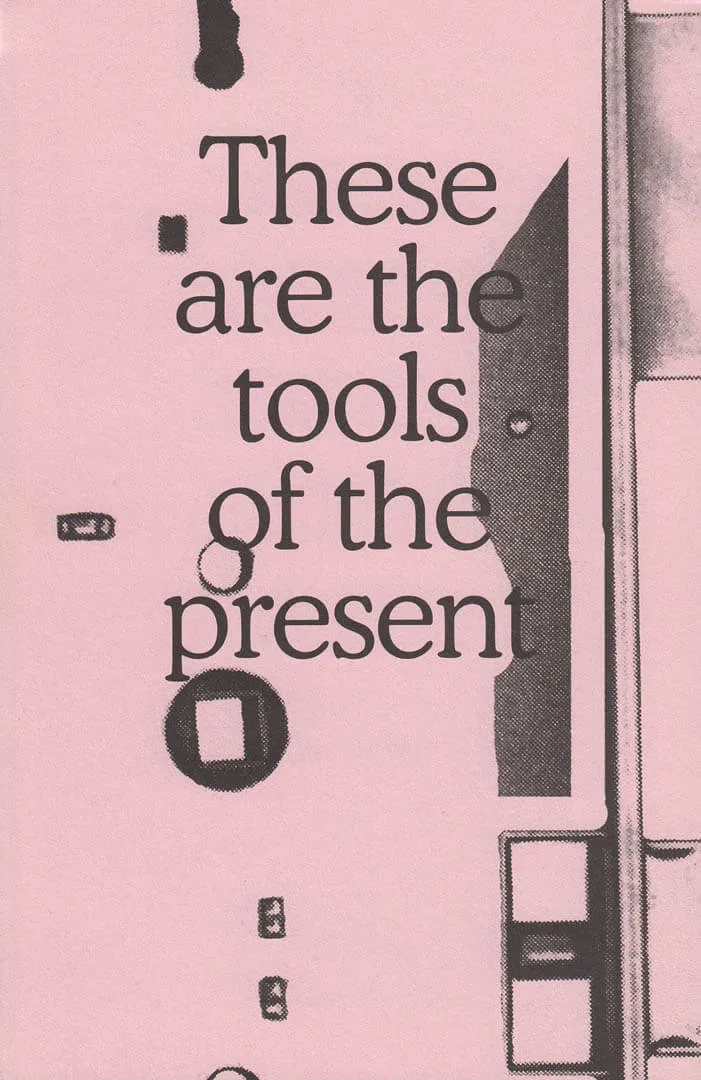
These are the tools of the present
Mai Abu ElDahab, November Paynter and 1 more
This publication comprises a series of interviews with contemporary artists, musicians, and writers who are in dialogue with Beirut and Cairo. While not purporting to be an overview of the art scenes in these cities, this book begins to draw a picture of how artists think about what it means to be active in the contexts of these cities. It offers insight into the circumstances that structured these artists’ stories, and the often accidental influences that have shaped how their practices have developed.
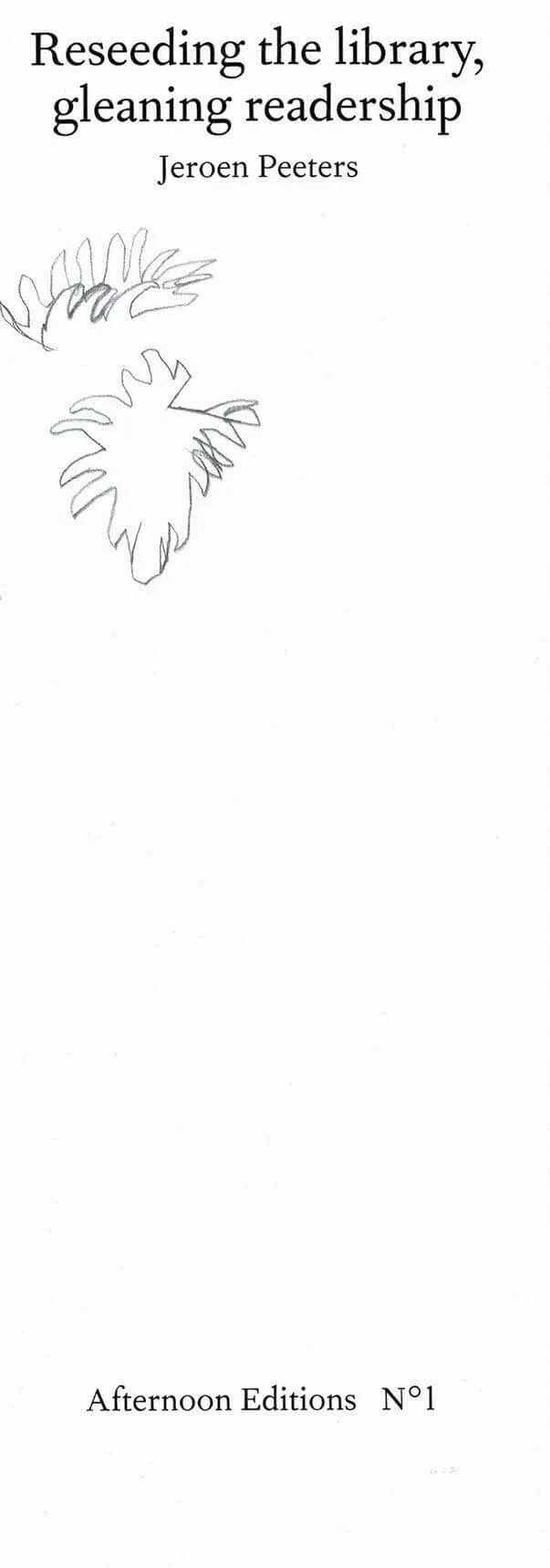
Reseeding the library, gleaning readership
Afternoon Editions no. 1: an essay by Jeroen Peeters titled Reseeding the library, gleaning readership. In May 2017, Time has fallen asleep in the afternoon sunshine settled during three weeks in the Ravenstein Gallery in Brussels as part of the Kunstenfestivaldesarts. Invited as a writer in residence, Jeroen Peeters visited the library of living books on a daily basis and recorded his observations by hand in a notebook, which formed the basis for Afternoon Edition #1. Reseeding the library, gleaning readership is an essay on the seed library, on the dispersion of literature through wind, water and animals, on biodiversity and commoning at the heart of readership. On the cover a drawing by Wouter Krokaert of a Philodendron Xanadu. Published May 2018.
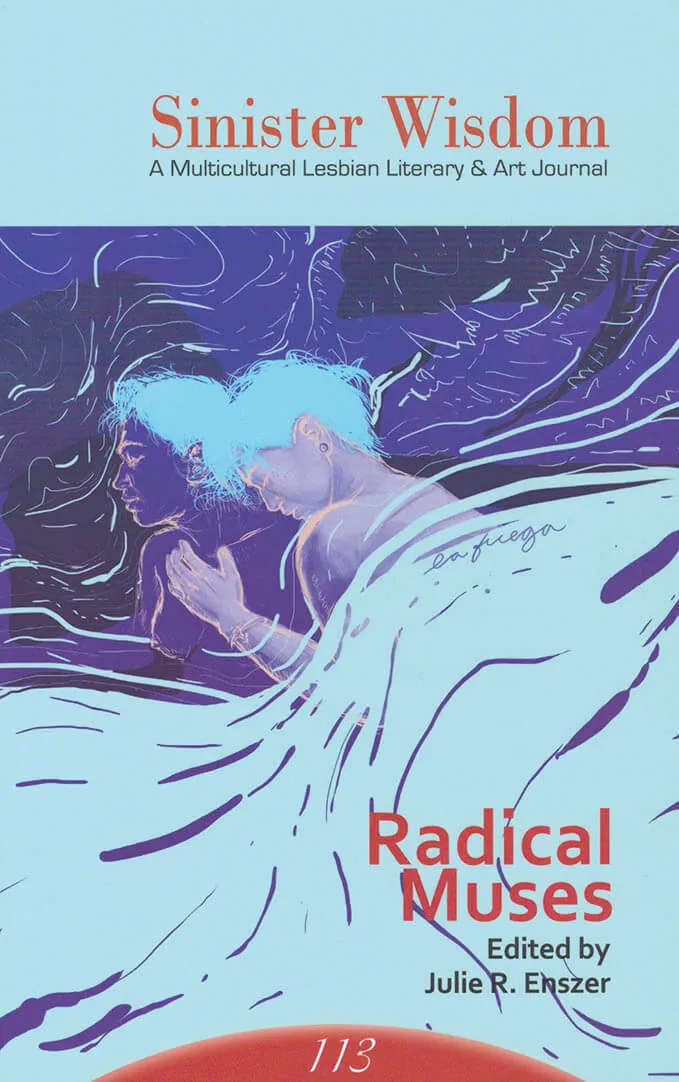
Radical Muses (Sinister Wisdom nr. 113)
Sinister Wisdom 113: Radical Muses features an eclectic array of contemporary poetry, prose, and art by lesbians from around the world, including new work by: Andrea Assaf, Tara Shea Burke, Cheryl Clarke, Marina Chirkova, Estela González, Barbara Haas, Nancy E. Lake, Vi Khi Nao, H. Ní Aódagaín and much more!
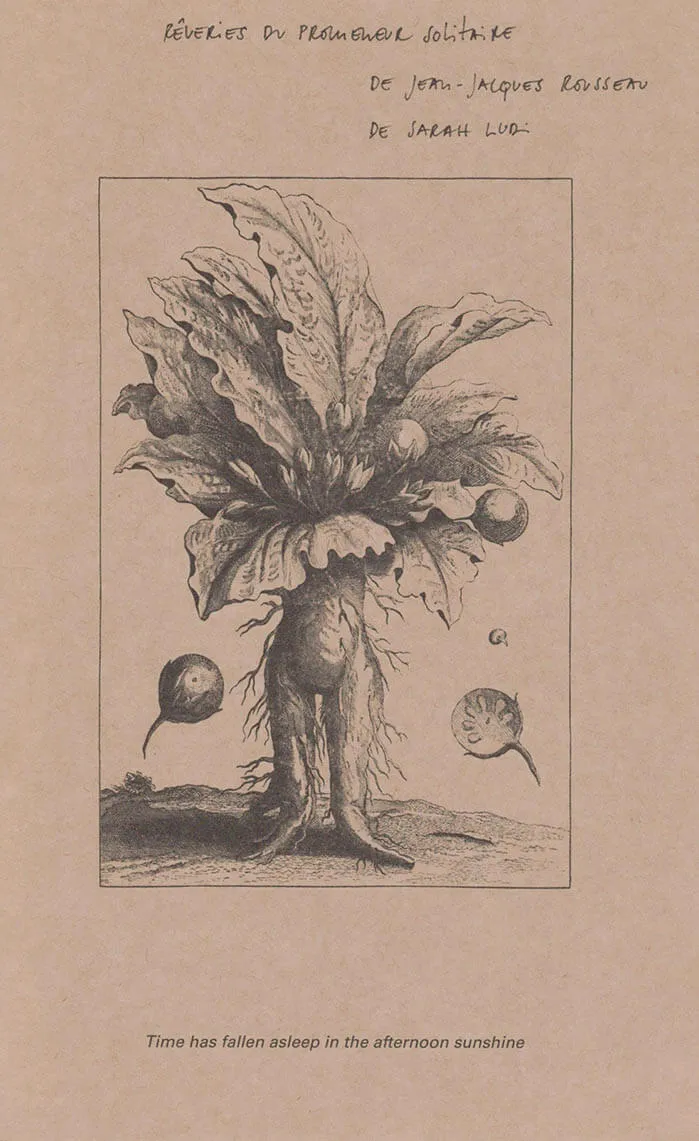
Time has fallen asleep in the afternoon sunshine
Rêveries du promeneur solitaire
For the project Time has fallen asleep in the afternoon sunshine a group of people/ performers memorize a book of their choice. Together they form a library collection consisting of living books. After years of learning by heart and reciting for readers, some of the books have now been written down from memory to create new editions, versions resulting from this process. This book is one of those books, chosen by one person, learned by heart and recited many times, and now written down again from memory. This edition is not a re-edition of the original text. It is a re-writing of the text after the process of reading, memorizing and reciting, with all the alterations that might have occured in the course of this process.