rile*books

Search books

Search books by title, author, publisher, keywords...

Explore

Categories
Visit
Collections
Publishers
Back in stock
Any books
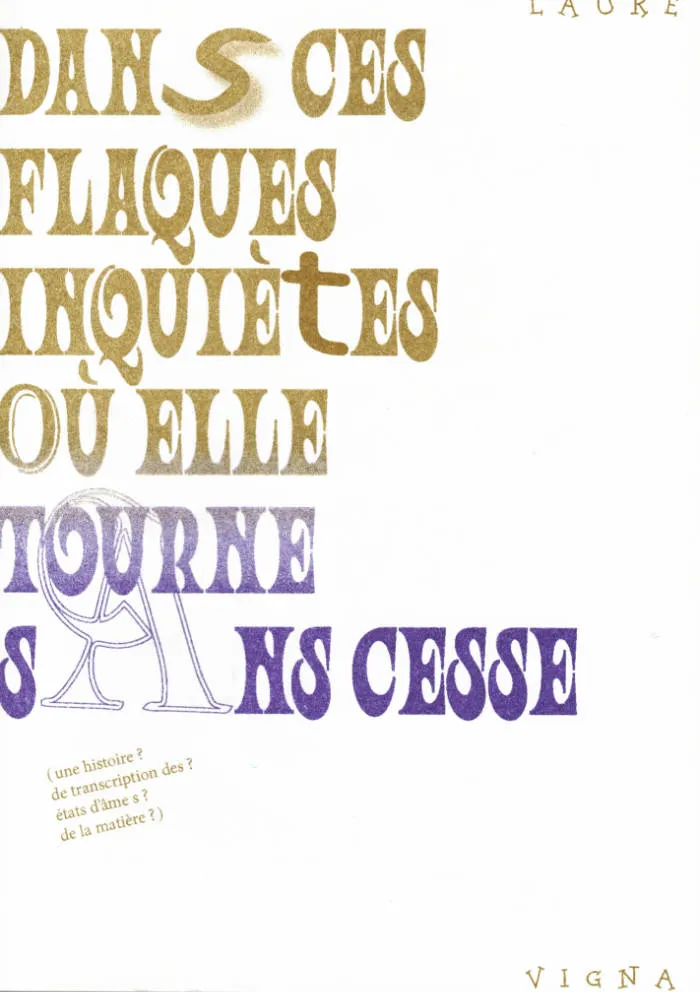
Cover of In These Worried Puddles / Dans ces flaques inquiètes

Tombolo Press

In These Worried Puddles / Dans ces flaques inquiètes

Laure Vigna

€14.00

This bilingual edition in two booklets (French/English) brings together short texts and narratives by Laure Vigna, accompanied by notes from news media and scientific articles. Several narrators, with more or less abstract identities alternately representing materials, sculptural forms, or the author, seem to speak under the effect of their emotional states.

Sharing the same spaces of action and words, they merge throughout the text, forming only one physical body at the end. In a collaborative effort between Laure Vigna and graphic designer Roxanne Maillet, the publication reveals research conducted on typography and letters as body, receptacles, and spaces.

Paperback ┊ Language: English, French

recommendations

Cover of Revue Phylactere n°2 - Oh là là !

immixition books

Revue Phylactere n°2 - Oh là là !

Roxanne Maillet, Auriane Preud'homme

Periodicals €25.00

Phylactère est une revue annuelle à voix multiples, née du désir d’explorer l’écriture de l’oralité et les possibilités de retranscription de performance, à travers des visions authentiques, subjectives et spontanées. Donnant la parole à des amateur·ice·s, artiste·s, designer·s et penseur·se·s, la revue Phylactère regroupe des écrits de transition, assumant tous les glissements entre un script, l’action réalisée et sa traduction, avec une attention extrême et aventureuse pour la manière dont les contextes, gestes, émotions et espaces sont mis en jeu lors de cette retranscription.

Initiée par Roxanne Maillet et Auriane Preud’homme à l’invitation de Camille Videcoq lors de la résidence Entrée Principale (Marseille), Phylactère conjugue pratique graphique et éditoriale et démarche curatoriale en intégrant au processus de publication l’organisation de différents événements. 

Pour son deuxième numéro, Phylactère prend pour titre l’onomatopée Oh là là !

Avec les contributions de : Anne Lise Le Gac, Benoît Le Boulicaut, Camille Videcoq, Cecil Serres, Claudia Pagès, Considered to be Allies (Margaux Parillaud & Mie Frederikke Fischer Christensen), Ghita Skali, Giuliana Zefferi, Lauren Tortil, Loreto Martínez Troncoso, Louise Hervé & Clovis Maillet, Mona Gérardin-Laverge, Nygel Panasco, pauline l. boulba, Sarah Browne, Susie Green (with Kim Coleman, Simon Bayliss & Rory Pilgrim), Tahnee, L’autre and Tiziana La Melia.

Conception graphique : Auriane Preud'homme et Roxanne Maillet.

Cover of VNOUJE 4

Rag Editions

VNOUJE 4

Cécile Bouffard, Roxanne Maillet and 1 more

Periodicals €20.00

4ème numéro de l'épopée lesbienne en épisodes par la collective Fusion, ce recueil d'aventures se lit dans n'importe quel ordre.

Cover of La Redoutable

La Mousse Éditions

La Redoutable

Roxanne Maillet

Zines €16.00

La Redoutable compile les archives lesbiennes de trois provenances distinctes mais complémentaires. Aux abords de l’ARCL (Archives Recherches Culture Lesbiennes) se rencontre Caroline Drieu, Roxanne Maillet et Suzette Robichon. Elles se racontent des mots imprimés sur des t-shirts et des gapettes. Ces slogans, fruits de détournements, plagiats et jeux de mots sont en plus d’être revendicateurs, des signes distinctifs pour un réseau de lesbiennes absolument occupées à incarner les attitudes qui les définissent. Ces viragos peuvent se connaître ou non, mais un jour, ielles se retrouveront certainement dans des jardins partagés, à des groupes de lecture, des barbecues ou des karaokés.

Cover of Poster Edition (bundle)

Self-Published

Poster Edition (bundle)

etaïnn zwer

4 poèmes-affiches, format A3, impriméx en risographie au studio Colorama (Berlin), sur papiers variés, tirage à 150 exemplaires

«GASOLINE, Apocalypse 1998», «the category is: phone sex», «zona nudista», «(fête) sentimental-e-s» : étés d'apocalypse, émojis banane, cruising transocéanique, SMS en short, sales coeurs, baraques à frissons et grand-huit sentimental... ces poèmes courent toustes ~ à genoux, à nu ou en solex ~ après la question du désir, après l'amour aussi, avec une tendre obsession

Design graphique signé Auriane Preud’homme, Enz@ Le Garrec, Roxanne Maillet & Martha Salimbeni, avec des dessins de Gaëlle Loth

Cover of Up Your Ass

Sternberg Press

Up Your Ass

Valerie Solanas

Valerie Solanas's rarely published, legendary play, Up Your Ass, explodes social and sexual mores and the hypocritical, patriarchal culture that produces them through her signature irreverence and wit, incisiveness and camp.

The play, whose full title is Up Your Ass Or From the Cradle to the Boat Or The Big Suck Or Up from the Slime, marches out a cast of screwy stereotypes: the unknowing john, the frothy career girl, the boring male narcissist, two catty drag queens, the sex-depraved housewife, and a pair of racialized pickup artists, among others. At the center is protagonist Bongi Perez—a thinly veiled Solanas—a sardonic, gender-bending hustler who escorts us through the back alleys of her street life. The fictionalized predecessor to SCUM Manifesto, the play shares the same grand, subversive, implicative language, equally spitting and winking, embracing the margins, the scum, and selling a trick along the way.

Valerie Solanas (1936-1988) is an American radical feminist intellectual, known for her SCUM Manifesto—a pamphlet with which she declares the power of women and imagines a political future through the margin—, and for having tried to assassinate Andy Warhol.

Edited by Leah Whitman-Salkin.
With a contribution by Paul B. Preciado.
Graphic design: Roxanne Maillet.

Cover of La locataire

Bierke Verlag

La locataire

Lucy McKenzie, Marie Canet

Essays €15.00

The Tenant is a monographic critical essay by Marie Canet. It is the first text to directly address the connections between McKenzie’s work, pornography, and special effects. The title refers to the way the artist moves through different periods and aesthetic spaces, appropriating their codes in order to construct new visual fictions. The book is infused with post-#MeToo feminist thinking, alternative uses of biography, reflections on the art world, and contemporary debates surrounding appropriation, embodiment, and the status of the artwork.

McKenzie and Canet worked with each other for over eight years, on projects like Atelier E.B: Passer-by catalogue, published on the occasion of the Fondation Galeries Lafayette exhibition, or the book Pervert or Detective, a conversation between Lucy McKenzie and artist Reba Maybury. This collaboration now culminated in an exhibition and a book: Plastic Newspaper (presented at CRAC Sète in March 2026) and Lucy McKenzie, The Tenant.

Texts by Marie Canet and Lucy McKenzie
Translations: Catherine Petit & Paul Buck (Marie Canet), Juliette Desorgues (Lucy McKenzie)

Published in connection with the exhibition Lucy McKenzie, Plastic Newspaper, at Crac Occitanie, Centre régional d‘art contemporain Occitanie/Pyrénées-Méditerranée à Sète, 21.03.-06.09.26

Cover of On Pillow Talk

ÇAVAQUOI PRODUCTIONS

On Pillow Talk

Deborah Birch

Poetry €5.00
On Pillow Talk, or, How I dance Solo While Logos Watches from Our Bed, Smoking a Cigarette
Cover of Le Chauffage — Issue #2

Le Chauffage

Le Chauffage — Issue #2

Francesca Percival, Felix Rapp and 1 more

Periodicals €20.00

Le Chauffage (french for “The Heater”) is an artist-run publication based in Brussels and Vancouver. It is conceived as a cross-continental, community oriented platform. Le Chauffage brings together the work and writing of artists / friends from different cities with the  intent to spark discussion and fuel casual forms of critical discourse.

The second issue of Le Chauffage contains photographs and texts, photographs of text, photographs as text and vice versa. Loosely thinking through the format of The Photo Essay celebrated by John Szarkowski in an eponymously titled exhibition at MoMA in 1965, this issue considers some of the artistic possibilities that can be found in such an archaic and historically male-dominated form. 

Many of the contributions that make up this second issue are not photo essays per se. But each one of them considers the printed page as a space in its own right. The magazine becomes an interior where words and images entertain a malleable and distinctly porous relationship. At times, it is also a space where artists and writers from different cities were invited to meet and collaborate. And since interest in other people is also an interest in yourself, it is always unclear who is really transforming who?

Contributions by: Bob Cain & Linda Miller, Moyra Davey, Laurie Kang, Niklas Taleb, Madeleine Paré & Diane Severin Nguyen, Josephine Pryde, Slow Reading Club, Ken Lum, Isaac Thomas, Vijai Maia Patchineelam, Artun Alaska Arasli & Graeme Wahn, Stephen Waddell, Maya Beaudry & Chloe Chignell, Lisa Robertson, groana melendez, Victoria Antoinette Megens and Will Holder.

Editors: Emile Rubino and Felix Rapp
Co-Editor: Francesca Percival
Design: Francesca Percival and Felix Rapp
Cover Design: Francesca Percival
Printed by: Cassochrome, Belgium
Edition of 350

Cover of Chile Chico et le quartier Versailles

Self-Published

Chile Chico et le quartier Versailles

Ema Tytgat

Chile Chico et le quartier Versailles, c'est une exploration qui inventorie, interroge et révèle les mémoires invisibles en listes et en collections. Une mémoire qui ne soffre pas en bloc, qui résiste, se fragmente, se transforme. A travers cette archive collaborative, nous avons voulu capter ces va-et-vient ď'un passé qui dialogue avec le présent, des images qui oscillent entre Vintime et le collectif. 

Le point de départ de cette fabrique visuelle, c'est lexil des Chilien.nes, débarqué.es dans les années 70, qui se tissent une nouvelle vie sur le sol de Neder-Over-Heembeek, dans le quartier Versailles à Bruxelles. Ces trajectoires, arrachées à un ailleurs, s'ancrent dans des espaces rêvés comme de transit pour devenir des lieux d 'appartenance, où lexil se mue et les racines finissent par se déployer. A ces récits se greffent d'autres histoires, d'autres trajectoires. Un quartier comme un carrefour, ou les individualités se rencontrent, où les vies se croisent et s'allient.