rile*books

Search books

Search books by title, author, publisher, keywords...

Explore

Categories
Visit
Collections
Publishers
Back in stock
Any books
Cover of Voyage, War, Exile: Three Essays

Litmus Press

Voyage, War, Exile: Three Essays

Etel Adnan

€17.00

Written between 1984 and 1995, this new edition collects three essays by Etel Adnan meditating on a life lived in motion: intellectual, geographic, linguistic and artistic perpetual motion. Published in honor of Adnan’s centennial (2025), these essays are a beacon and remain a piercing and profound model for reckoning with and surviving our times of war and exile.

Voyage, War, and Exile collects three essays by Etel Adnan that present a multilayered meditation on the author’s life within and without Beirut. Adnan reflects upon the intricacies of family, place, and language, asking what it means to be an Arab woman and writer in exile at the end of a century in which “Exile became the existential and metaphysical condition for every Arab.” At once deeply personal to the life of the author and yet ubiquitous in inquiry, Voyage, War, Exile pulls us into the shifting landscape of Lebanon and the United States in the 20th Century through a weaving of philosophical reflection and memory. This volume includes artwork by Simone Fattal.

Praise for Etel Adnan

The work of Etel Adnan—poet, painter, philosopher—is an interrogation of the human experience and a study in worldly engagement…Sorting through decades of memory, loss, and linguistic turns, we drift with her in a sea of thought and expansive meditation. —K.B. Thors, The Lambda Literary Review

Her poetry has the capacity to assemble and discern the ‘sides’ of the self as well as the literature and literary personalities which frame the self of her writing. —Matt Turner, Hyperallergic

Adnan’s receptivity is evident in her fine-tuned attention to detail, at the microscopic and cosmic level alike. Her lens shifts in scale and orientation, defamiliarizing the surroundings we thought we knew and re-introducing us to nature.—Noa Micaela Fields, Medium

Published in 2025 ┊ 104 pages ┊ Paperback ┊ Language: English

recommendations

Cover of That They Were at the Beach

Litmus Press

That They Were at the Beach

Leslie Scalapino

Poetry €16.00

For this collection of poems and prose, Leslie Scalapino has gathered four sequences into what she calls an “aeolotropic series.” The poems reflect each other like crystals and change like highly polished glass illuminated by a shifting light. They follow the mind from thought and observation to afterthought, reflection, and obsession.

Leslie Scalapino (1947-2010) is the author of thirty books of poetry, prose, inter-genre fiction, plays, and essays, including numerous collaborations with artists, writers, and dancers. Her long poem way (North Point Press, 1988) won the Poetry Center Award, the Lawrence Lipton Prize, and the American Book Award from the Before Columbus Foundation. Scalapino taught at the Naropa Institute, Bard College, Mills College, and UC San Diego. She was the editor and founder of O Books.

Cover of Sitt Marie Rose

Litmus Press

Sitt Marie Rose

Etel Adnan, Georgina Kleege

Fiction €17.00

Sitt Marie Rose is the story of a woman abducted by militiamen during the civil war in Lebanon. Already a classic of war literature, this extraordinary novel won the France-Pays Arabes award in Paris and has been translated into six languages. Sitt Marie Rose is part of Comparative Literature, World Literature, Women’s Studies and Middle East Studies curricula at more than thirty universities and colleges in the U.S.

Etel Adnan was born in Beirut, Lebanon in 1925. She is a celebrated writer, essayist, and playwright, and is the author of more than twenty books in all these disciplines. Her work as a whole is a faithful record of the times and places she has lived in Beirut, Paris, and in the San Francisco Bay Area. At least eighteen works by Adnan have been published in English. They include Sitt Marie Rose (Post-Apollo Press, 1982); The Arab Apocalypse (Post-Apollo Press, 1989); Sea and Fog (Nightboat Books, 2012), winner of the Lambda Literary Award for Lesbian Poetry and the California Book Award for Poetry; Premonition (Kelsey Street Press, 2014); Surge (Nightboat Books, 2018); Time (Nightboat Books, 2019), winner of the Griffin Poetry Prize and the Best Translated Book Award; and Shifting the Silence (Nightboat Books, 2020). In 2021, Litmus Press published a second edition of Journey to Mount Tamalpais (originally published by The Post-Apollo Press), which included nine new ink drawings by Adnan. Her paintings, described by New York Times art critic Roberta Smith as "stubbornly radiant abstractions," have been widely exhibited. Spanning media and genres, Adnan's writings have led to numerous collaborations with artists and musicians, including the French part of CIVIL warS, a multi-language opera by American stage director Robert Wilson, performed in Lyon and Bobigny in 1985. In 2014 she was named Chevalier des Arts et des Lettres, France's highest cultural honor, by the French Government. She died in Paris, in 2021.

Georgina Kleege is an internationally known writer and disability studies scholar. Her collection of personal essays, Sight Unseen (1999) is a classic in the field of disability studies. Kleege’s latest book, More Than Meets the Eye: What Blindness Brings to Art (2018) is concerned with blindness and visual art. Kleege joined the English department at the University of California, Berkeley in 2003 where in addition to teaching creative writing classes she teaches courses on representations of disability in literature, and disability memoir. Kleege is also the author of Home for the Summer (The Post-Apollo Press, 1989).

Cover of Another Room to Live In: 15 Contemporary Arab Poets

Litmus Press

Another Room to Live In: 15 Contemporary Arab Poets

Sarah Riggs, Omar Berrada

Anthology €26.00

Another Room to Live In is an archive of encounter: a multilingual conversation between fifteen poet-translators, connected through friendship, correspondence, and cross-diasporic gatherings. With work in English, Arabic, and French, the collection moves beyond both language and nation-state, investing instead in transcontinental dreamspaces. Here, translation practices collaboratively transform the poems and reflect the poets’ own experiences of “living” in multiple languages. Complicating any flat conception of identity, the poems presented here seek to revisit and challenge foundational narratives, to rework mythologies, and to do all this through a cross-generational process of translation as poetic communion.

Contributors include: Etel Adnan, Hoda Adra, Sinan Antoon, Mirene Arsanios, Omar Berrada, Sara Elkamel, Safaa Fathy, Soukaina Habiballah, Marilyn Hacker, Golan Haji, Kadhim Jihad Hassan, Pierre Joris, Mona Kareem, Souad Labbize, Rachida Madani, Alisha Mascarenhas, Iman Mersal, Aya Nabih, Sarah Riggs, Yasmine Seale, Cole Swensen, Habib Tengour, and Sam Wilder.

Cover of Murder

Litmus Press

Murder

Danielle Collobert, Nathanaël

Fiction €18.00

Murder is Danielle Collobert’s first novel. Originally published in 1964 by Éditions Gallimard while Collobert was living as a political exile in Italy, this prose work was written against the backdrop of the Algerian War. Uncompromising in its exposure of the calculated cruelty of the quotidian, Murder’s accusations have photographic precision, inculpating instants of habitual violence.

Born in Rostrenen in 1940, Danielle Collobert left Bretagne for Paris at the age of eighteen where she worked in an art gallery and self-published her first poems in a book entitled Chants des guerres (1961). Both of Collobert’s parents, and her aunt, who survived deportation to Ravensbrück, were members of the Résistance during World War II. Herself a supporter of Algerian independence, Collobert joined the FLN (the Algerian National Liberation Front), precipitating her exile in Italy, during which time she completed work on Meurtre, first published in 1964 by Éditions Gallimard with the unwavering support of Raymond Queneau. She worked for Révolution africaine, a short-lived journal created at the end of the Algerian war. Collobert’s extensive travels, to Czechoslovakia, Indonesia, Bolivia, Ecuador, Venezuela, Mexico, Spain, Greece, Egypt, etc., did not prevent her from becoming a member of the group formed around Jean-Pierre Faye and the journal, Change. Her other works include Dire I et II (1972), a radio play the following year, Polyphonie, aired by France Culture, Il donc (1976) and Survie (1978). Upon her return from a trip to New York, Danielle Collobert took her own life in a hotel in Paris on her thirty-eighth birthday. Her complete works, in two volumes, edited by Françoise Morvan, augmented by several unpublished texts, were published by P.O.L. in 2005. Collobert’s works available in English include In the Environs of a Film (Litmus Press, 2019), Notebooks, 1956-1978 (Litmus Press, 2003) and It Then (O Books, 1989).

Cover of In/Somnia

Post Apollo Press

In/Somnia

Etel Adnan

Poetry €12.00

In/somnia explores fissures within words as places where thought enters. Sleepless sleepers, we dream among ever more complex and hallucinatory realitites: `in/tense/in/season'—Rosmarie Waldrop.

Cover of Black Bedouin

1080 Press

Black Bedouin

Mohammed Zenia, Tenaya Nasser

Poetry €30.00

Black Bedouin, by Mohammed Zenia and Tenaya Nasser is a book of the IMMEDIATE — written immediately (in the span of five days, very literally at the printing press at 1080PRESS) in response to the current genocide against, and in solidarity with, the people of Sudan and in the context of immediate echoes in Palestine, Congo, Pakistan, and more — and throughout it all imbued with the immediacy that the global situation demands of us and our moral consciences. Black Bedouin rings in the creative immediacy of New York School all-night-writing-to-mimeograph-next-day with the political immediacy of a this-is-happening-right-now Crass single or Etel Adnan's incomparable (but here spiritually correlated) The Arab Apocalypse. In other words, Black Bedouin hits every star in a very cool and specific constellation. — Dave Morse

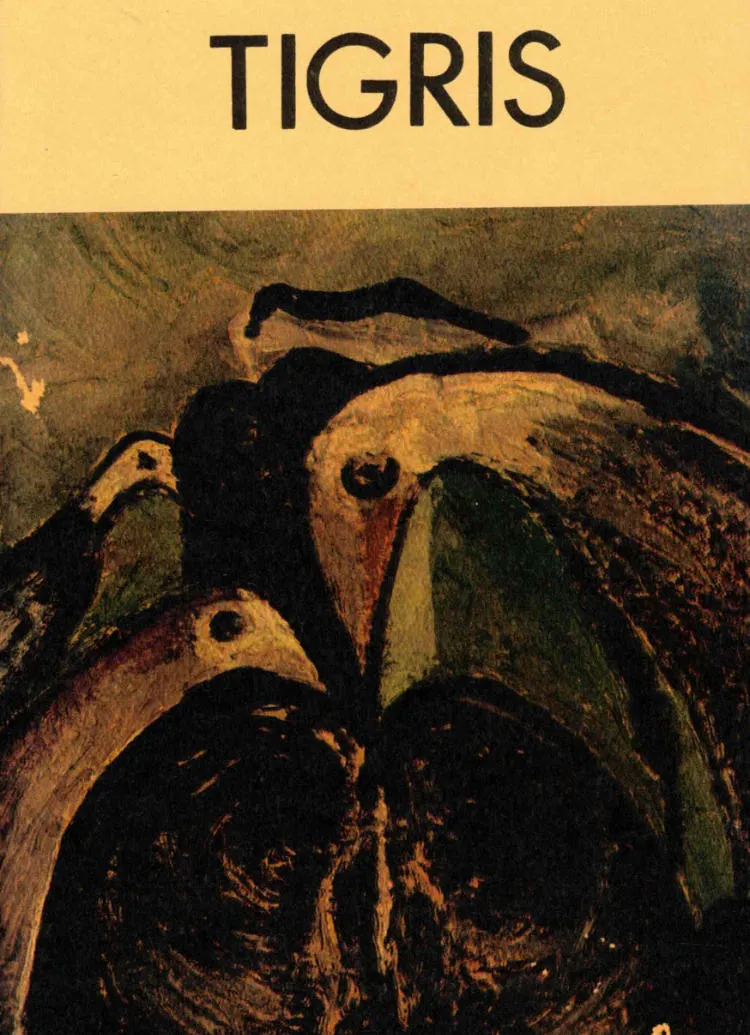
Cover of Tigris Vol. 1

CUNY Center for the Humanities

Tigris Vol. 1

Sargon Boulus

Poetry €16.00

In 1971, the great Iraqi poet Sargon Boulus (1944-2007) published a single issue of an English-language literary anthology that he called Tigris. The magazine—a whisper on the literary landscape that appeared three years after Boulus’s arrival in the US—brings together work by Boulus and several of his literary friends, in translation by Boulus and Etel Adnan.

Tigris was not an end in itself, but rather a temporary solution to the lifelong problem of how to devote oneself to poetry across different countries, eras, and styles: how to live poetry. Yet, in so doing, the small anthology includes significant work: Etel Adnan’s “Jebu,” translated by Adnan, and poetry by Boulus, Fouad Rifkah, Yusuf al-Khal, Mouayad al-Rawi, and Riadh Fakhouri, all in Boulus’s translations, as well as a work by Ankido, a “street-activist poet-café worker of importance to the Palestinian Liberation Movement.”

Cover of The Hungering Years

Host Publications

The Hungering Years

Summer Farah

Poetry €20.00

Utterly magnetic, Summer Farah’s debut poetry collection The Hungering Years is a rush of breathless song, voicing confessions so often left unsung amidst personal and collective crisis. “I am afraid of asking the right questions,” Farah admits. But through intimate conversations with fellow Arab-American writer and literary ancestor Etel Adnan, this work finds the courage to ask: What is art? An escape? A reflection? Another unhealthy attachment? Though the answers are elusive, what steps into the light is a collective of friends whose genuine care and companionship anchor these poems through their spiraling search. 

“I am always looking for Palestine, and yes, I am always looking for love,” these poems croon, holding so much of the world even as they trace an inheritance of displacement. The Hungering Years conjures startling landscapes where we may also experience what it is to be consumed by obsession, echoing with songs by Mitski, iconic scenes from Supernatural, and the sound of the Mediterranean Sea. But as Lena Khalaf Tuffaha writes in her introduction, Farah’s repetitions “are more than echo. They are a vernacular of this unspeakable era,” anchored in “questions that keep us reaching toward life,” and questions toward each other.

Building glass structures from her questions, Farah pushes their architecture almost to breaking. Then breaking, the spirit—luminous, actualized—reveals itself through the cracks. Through the landscapes of California, Palestine, and all of the distances in between, there emerges a new sense of devotion to what is possible which might thrust us, together, “off the edge, / in love, towards God.”

With an introduction by poet, essayist, and translator Lena Khalaf Tuffaha.

Summer Farah’s debut collection The Hungering Years bubbles with language, is desirous, sensitive, and hysterically (ferociously) human. “I” is I, is mother, is the guiding wisdom of Etel Adnan, is Palestine, is the work that writes Palestine into the future, is the epistolary thread of love that holds this daring young poet’s work together. “i am an enemy of dust i am an amalgamation of everyone i have ever loved …” writes Farah, enlisting us in this vital poetry against the death cult, lush with solidarity, teeming with the futurity we need. — Wendy Xu, author of The Past

What I most adore about Summer Farah's work, and what most comes alive in The Hungering Years is that there is no such thing as an unworthy affection, nothing unworthy of close and careful attention, nothing unworthy of being pressed up against the undeserving world and becoming something greater. This is a gift and a delight, and through that gift, these poems are richly and generously populated, and teeming with beauty. — Hanif Abdurraqib, author of There’s Always This Year

Summer Farah's words ease me, compel me, motivate me. Her work is agile and brilliant, her mind potent and illustrious—like air, a song, rhythmic and concise. These poems move me to my core, rupturing something deep inside of me about place, Palestine and Etel Adnan. "I memorize no language/but their voices," she writes as I memorize her words again and again, uttering gratitude that I get to be alive and read Summer's words. This book is both a spell and an oracle. — Fariha Róisín, author of Survival Takes a Wild Imagination

Cover of The Arab Apocalypse

Post Apollo Press

The Arab Apocalypse

Etel Adnan, Etel Adnan

Poetry €25.00

Translated from the French by the author.

“From time to time, there occurs what suspends time, revelation—at least for certain people, martyrs. But then the apocalypse, revelation, is withdrawn, occulted by the ‘apocalypse,’ the surpassing disaster, so that symptomatically apocalypse’s primary sense (from Greek apokalypsis, from apokalyptein to uncover, from apo- + kalyptein to cover) is occulted by its secondary meaning, and martyr’s primary sense, witness, is occulted by its secondary, vulgar meaning: ‘a person who suffers greatly or is killed because of their political or religious beliefs’… While the Arab ‘apocalypse’ as surpassing disaster leads to a withdrawal of Arabic tradition, the apocalypse as revelation leads to Arabic tradition’s vertiginous extension.” — from the Foreword by Jalal Toufic

Etel Adnan was born in Beirut, Lebanon in 1925. She is a celebrated writer, essayist, and playwright, and is the author of more than twenty books in all these disciplines. Her work as a whole is a faithful record of the times and places she has lived in Beirut, Paris, and in the San Francisco Bay Area. At least eighteen works by Adnan have been published in English. They include Sitt Marie Rose (Post-Apollo Press, 1982); The Arab Apocalypse (Post-Apollo Press, 1989); Sea and Fog (Nightboat Books, 2012), winner of the Lambda Literary Award for Lesbian Poetry and the California Book Award for Poetry; Premonition (Kelsey Street Press, 2014); Surge (Nightboat Books, 2018); Time (Nightboat Books, 2019), winner of the Griffin Poetry Prize and the Best Translated Book Award; and Shifting the Silence (Nightboat Books, 2020). In 2021, Litmus Press published a second edition of Journey to Mount Tamalpais (originally published by The Post-Apollo Press), which included nine new ink drawings by Adnan. Her paintings, described by New York Times art critic Roberta Smith as "stubbornly radiant abstractions," have been widely exhibited. Spanning media and genres, Adnan's writings have led to numerous collaborations with artists and musicians, including the French part of CIVIL warS, a multi-language opera by American stage director Robert Wilson, performed in Lyon and Bobigny in 1985.

Cover of Tripwire 16 - Performance/Writing

Tripwire Journal

Tripwire 16 - Performance/Writing

David Buuck, Kevin Killian

Poetry €18.00

A special issue focused on performance writing, with work by Tanya Lukin Linklater (with Michael Nardone), Jibade-Khalil Huffman & Simone White, Jean-Thomas Tremblay, Claudina Domingo (trans. Ryan Greene), Kim Rosenfield, Nathan Walker, Liz Knox, Rona Lorimer, Léo Richard, & Hector Uniacke, Mohamed A. Gawad & Dalia Neis, Mei-mei Berssenbrugge & Teddy Yoshikami, interviewed by Michelle N. Huang, Kyoo Lee and Jocelyn Saidenberg, Adriana Garriga-López, Gabrielle Civil, plus a Kevin Killian Tribute, with Eileen Myles * Scott Hewicker * Cliff Hengst * Karla Milosevich * Craig Goodman * Michelle Rollman * Anne McGuire * Wayne Smith * Tanya Hollis * Steve Orth * Lindsey Boldt * Maxe Crandall * Arnold J. Kemp * Carla Harryman, Lee Ann Brown & Tony Torn * Susan Gevirtz * Laynie Browne * Patrick Durgin * Norma Cole * Jo Giardini. & reviews: Jessica Lopez Lyman & Jocelyn E. Marshall on Gabrielle Civil, alex cruse on Merce Cunningham, Rob Stanton on Anne Boyer, Jack Chelgren on Miyó Vestrini, David Grundy on Stephen Jonas, Virginia Konchan on Sarah Vap.

Cover of Imperfect Solidarities

Floating Opera Press

Imperfect Solidarities

Aruna D'Souza

Essays €18.00

Art, empathy and political solidarity.

Can empathy deliver political change? Does art that elicits emotional identification with others take us where we need to go? In Imperfect Solidarities, writer and art historian Aruna D'Souza offers observations pulled from current events as well as contemporary art that suggest that a feeling of understanding or closeness based on emotion is an imperfect ground for solidarity. Empathy—and its correlate, love—is a distraction from the hard work that needs to be done to achieve justice. Rather, D'Souza contends, we need to imagine a form of political solidarity that is not based on empathy, but on the much more difficult obligation of care. When we can respect the unknowability of the other and still care for and with them, without translating ourselves into their terms, perhaps we will fare better at building political bridges.

Aruna D'Souza is a writer and critic based in New York. She is a regular contributor to The New York Times and 4Columns.org, where she is a member of the editorial advisory board. Her writing has also appeared in The Wall Street Journal, CNN.com, Bookforum, Frieze, Momus, and Art in America, among other places. Her book, Whitewalling: Art, Race, and Protest in 3 Acts (Badlands Unlimited), was named one of the best art books of 2018 by The New York Times. She is the recipient of the 2021 Rabkin Prize for art journalism and a 2019 Andy Warhol Foundation Art Writers Grant.

Cover of Family Picture

S*I*G

Family Picture

Tom Humphreys

Essays €6.00

An essay in the form of painting studies - including persons, dogs, a frog, a hoofed animal, fish, hare, trees and plants.