rile*books

Search books

Search books by title, author, publisher, keywords...

Cover of An Image of My Name Enters America: Essays

Graywolf Press

An Image of My Name Enters America: Essays

Lucy Ives

€20.00

What would you risk to know yourself? Which stories are you willing to follow to the bitter end, revise, or, possibly, begin all over? In this collection of five interrelated essays, Lucy Ives explores identity, national fantasy, and history. She examines events and records from her own life―a childhood obsession with My Little Pony, papers and notebooks from college, an unwitting inculcation into the myth of romantic love, and the birth of her son―to excavate larger aspects of the past that have been suppressed or ignored. With bracing insight and extraordinary range, she weaves new stories about herself, her family, our country, and our culture. She connects postmodern irony to eighteenth-century cults, Cold War musicals to a great uncle’s suicide to the settlement of the American West, museum period rooms to the origins of her last name to the Assyrian genocide, and the sci-fi novel The Three-Body Problem to the development of modern obstetrics. Here Ives retrieves shadowy sites of pain and fear and, with her boundless imagination, attentiveness, and wit, transforms them into narratives of repair and possibility.

Language: English

recommendations

Cover of The Slicks: On Sylvia Plath and Taylor Swift

Graywolf Press

The Slicks: On Sylvia Plath and Taylor Swift

Maggie Nelson

Essays €12.00

In The Slicks, Maggie Nelson positions culture-dominating pop superstar Taylor Swift and feminist cult icon Sylvia Plath as twin hosts of the female urge toward wanting hard, working hard, and pouring forth—and as twinned targets of patriarchy’s ancient urge to disparage, trivialize, and discipline creative work by women rooted in autobiography and abundance. 

A buoyant melding of popular culture and literary criticism, The Slicks is a captivating and unexpected assessment of two iconic female artists by one of the most revered and influential critics of her generation.

Cover of The Hormone of Darkness: A Playlist

Graywolf Press

The Hormone of Darkness: A Playlist

Tilsa Otta, Farid Matuk

Poetry €19.00

In Tilsa Otta’s The Hormone of Darkness, we find a queer, Latinx person who has lived through iterations of authoritarian rule, and who answers these conditions by creating poetry that doubles down on a life force that precedes and exceeds received notions of the poetic. Here poetry is bawdy, fabulist, and spiritual—in short, it is alive. Otta has created a heaven where readers can go after they die. 

Drawing from four volumes spanning Otta’s career, translator-poet Farid Matuk has curated a playlist we can dance and dream to, one that honors Otta’s drive toward liberation through both perreo in the club and transdimensional wandering among the stars.

We can go on like that forever
building paradise from our urges
out of our fetishes our loves our vices
How lucky
We’ll wait for you then
Don’t be too long
Bookmark the page
We’ll be Here
—From “The New Heaven”

Translated from the Spanish by Farid Matuk.

Cover of Regaining Unconsciousness: Poems

Graywolf Press

Regaining Unconsciousness: Poems

Harryette Mullen

Poetry €18.00

Harryette Mullen is one of contemporary poetry’s most influential voices, for her inventive language play, keen wit, formal experimentation, and pointed critique of American culture. In Regaining Unconsciousness, her first new collection in twelve years, Mullen confronts the imminent dangers of our present to sound an alarm for our future, to wake us out of our complicity and despondency: Can we, even still, find our way to our unconscious selves, beyond our capacity to harm, subdue, and consume? 

In eleven taut sections written in the eleventh hour of our collective being, these poems address climate change, corporate greed, racist violence, artificial intelligence, the pollution of our oceans, individualism at the cost of mutual wellness, and the consequences of not addressing these pressing issues. Mullen imagines, as we must, our apocalypse, and yet, in an astounding feat, she does so with playfulness and wry referentiality that make these poems surprisingly buoyant, funny, and readable. Our end may be inevitable, Mullen admits, but maybe we begin with gratitude.

Cover of The Argonauts

Graywolf Press

The Argonauts

Maggie Nelson

Autofiction €17.00

Maggie Nelson's The Argonauts is a genre-bending memoir, a work of autotheory offering fresh, fierce, and timely thinking about desire, identity, and the limitations and possibilities of love and language. It binds an account of Nelson's relationship with her partner and a journey to and through a pregnancy to a rigorous exploration of sexuality, gender, and family. An insistence on radical individual freedom and the value of caretaking becomes the rallying cry for this thoughtful, unabashed, uncompromising book.

Cover of The Rose

Graywolf Press

The Rose

Ariana Reines

Poetry €17.00

Drawing on the history of “romance” as the troubadours knew it and the titular flower’s ancient allegories for sexuality and mystery, Reines plunges into feminine archetypes to explore masculine pain: “I have always liked helpless / & terrible men because they break my mind.” In these poems, inherited ideologies of gender performance are replaced with bold vulnerability: paradoxes of power and surrender transmute the speaker’s understanding of suffering, desire, and the soul.

The voice in The Rose is wry and bare, approaching the connection between erotic love and spirituality with humor. Investigating war, maternity, violent sensuality, and the role of language in magical acts, Reines is unafraid to uncover the “secret / & terrible shovelings / Of love,” and the result is a bloody and pulsing, sexy and unabashed bloom.

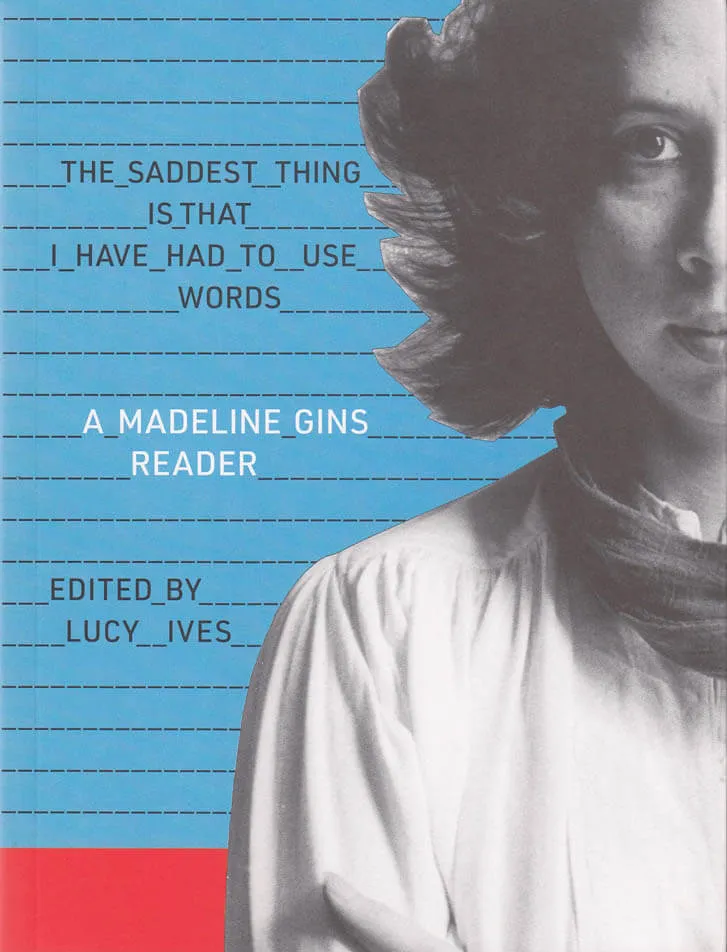
Cover of The Saddest Thing Is That I Have Had to Use Words: A Madeline Gins Reader

Siglio Press

The Saddest Thing Is That I Have Had to Use Words: A Madeline Gins Reader

Madeline Gins

Poetry €28.00

Poet, philosopher, speculative architect and transdisciplinary artist, Madeline Gins is well known for her collaborations with her husband, the artist Arakawa, on the experimental architectural project Reversible Destiny, in which they sought to arrest mortality by transforming the built environment. Yet, her own writings — in the form of poetry, essays, experimental prose and philosophical inquiries — represent her most visionary and transformative work. Like Gertrude Stein before her, Gins transfigures grammar and liberates words. Like her contemporaries in conceptual art, her writing is attuned to the energized, collaborative space between reader and page.

The Saddest Thing Is That I Have Had to Use Words: A Madeline Gins Reader is a revelatory anthology, edited and with an introduction by the writer and critic Lucy Ives. It brings never-before-published poems and essays together with a complete facsimile reproduction of Gins' 1969 masterpiece, WORD RAIN (or A Discursive Introduction to the Intimate Philosophical Investigations of G, R, E, T, A, G, A, R, B, O, It Says), along with substantial excerpts from her two later books What the President Will Say and Do!! (1984) and Helen Keller or Arakawa (1994). Long out of print or unpublished, Gins' poems and prose form a powerful corpus of experimental literature, one which is sure to upend existing narratives of American poetics at the close of the 20th century.

Edited by Lucy Ives. 

Cover of Spells: 21st Century Occult Poetry

Silver Press

Spells: 21st Century Occult Poetry

Sarah Shin, Rebecca Tamas

Poetry €17.00

Spells are poems; poetry is spelling.

Spell-poems take us into a realm where words can influence the universe.

Spells brings together over forty contemporary voices exploring the territory where justice, selfhood and the imagination meet the transformative power of the occult. These poems unmake the world around them, so that it might be remade anew.

Kaveh Akbar, Rachael Allen, Nuar Alsadir, Khairani Barokka, Emily Berry, A.K. Blakemore, Jen Calleja, Anthony V. Capildeo, Elinor Cleghorn, CAConrad, Nia Davies, Paige Emery, Livia Franchini, Alexis Pauline Gumbs, Will Harris, Caspar Heinemann, Lucy Ives, Rebecca May Johnson, Bhanu Kapil, Amy Key, Daisy Lafarge, Dorothea Lasky, Francesca Lisette, Canisia Lubrin, Karen McCarthy Woolf, Lucy Mercer, Hoa Nguyen, Precious Okoyomon, Rebecca Perry, Nat Raha, Nisha Ramayya, Ariana Reines, Sophie Robinson, Erica Scourti, Sarah Shin, Himali Singh Soin, Tai Shani, Rebecca Tamás, Bones Tan Jones, Dolly Turing, Jane Yeh, Flora Yin Wong

Introduced by So Mayer
Afterword by Sarah Shin

Cover of Glaring

Wendy's Subway

Glaring

Benjamin Krusling

Poetry €18.00

Glaring: a sustained look of anger, an obvious fact, a situation of such brightness and intensity that vision is obscured. In his debut book of poems, Benjamin Krusling is concerned with reading domination and violence and entering their psychotic motion, the better to do otherwise. Through the thicket of anti-blackness, militarism, surveillance, impoverishment, and interpersonal abuse and violence, Glaring investigates the things that haunt daily life and make love difficult, possible, necessary.

Benjamin Krusling's Glaring is the winner of our 2019 Open Reading Period, and was selected by guest judge Lucy Ives.

Cover of Constructing Worlds Otherwise

AK Press

Constructing Worlds Otherwise

Raúl Zibechi, George Ygarza Quispe

Non-fiction €18.00

A new collection from one of Latin America's most dynamic radical thinkers—in the tradition of Frantz Fanon and Eduardo Galeano.

Through a survey of the most marginalized voices across Latin America—feminists, the Indigenous, people of African descent, and inhabitants of urban favelas and rural towns—Zibechi introduces the Anglo world to a range of critical perspectives and new forms of struggle in Peru, Mexico, Brazil, Colombia, and Bolivia. His book contributes to global geographies of autonomous and anti-state thinking, including that of the revolutionaries in Rojava and Abdullah Öcalan, ideological theorist of Kurdish resistance, for a rich and dynamic survey of movements of nonstate power. Constructing Worlds Otherwise comes at a time when the global left—struggling to expand its vision in an era of climate chaos and rising authoritarianism—finds itself at an impasse, desperate to animate and renew its critical imaginary.

Cover of How to see palace pillars as if they were palm trees

Kayfa ta

How to see palace pillars as if they were palm trees

Hussein Nasseraddine

Essays €10.00

For so it happens that when the poets speak, objects appear closer to their own shadows. The poet's mouth fills up with horses and marble, and his verses start to shine like rivers. These rivers then turn back to flow through the very palace he is depicting. The poet's own words begin to weigh down on him, as though he were holding up a palace with his palms. Then he travels, and the palace is obliterated. Countries and nations change, and naught remains but what the poets had seen. Of what the poets had seen, naught remains but its image in anthologies. And when the libraries have been flooded or burned to the ground, nothing but the commentaries on those anthologies are left, and all that one finds in these commentaries is that which was appropriated and wrought a thousand times over. 

Hussein Nassereddine is a multidisciplinary artist. His work in installation, writing, video and performance originates from a practice around language that builds fragile monuments - some verbal, some sonic, some tactile - rooted in collective histories and resources of poetry, ruins, construction and image-making.

Translated from Arabic by Ben Koerber.

Cover of Prisoner of Love

New York Review of Books

Prisoner of Love

Jean Genet

Non-fiction €25.00

Starting in 1970, Jean Genet—petty thief, prostitute, modernist master—spent two years in the Palestinian refugee camps in Jordan. Always an outcast himself, Genet was drawn to this displaced people, an attraction that was to prove as complicated for him as it was enduring. Prisoner of Love, written some ten years later, when many of the men Genet had known had been killed, and he himself was dying, is a beautifully observed description of that time and those men as well as a reaffirmation of the author’s commitment not only to the Palestinian revolution but to rebellion itself. For Genet’s most overtly political book is also his most personal—the last step in the unrepentantly sacrilegious pilgrimage first recorded in The Thief’s Journal, and a searching meditation, packed with visions, ruses, and contradictions, on such life-and-death issues as the politics of the image and the seductive and treacherous character of identity. Genet’s final masterpiece is a lyrical and philosophical voyage to the bloody intersection of oppression, terror, and desire at the heart of the contemporary world.

Cover of The Essential Jill Johnston Reader

Duke University Press

The Essential Jill Johnston Reader

Jill Johnston, Clare Croft

Performance €28.00

Jill Johnston began the 1960s as an influential dance columnist for the Village Voice and by the start of the next decade she was known as a keen observer of postmodern art and lesbian feminist life who challenged how dance, art, and women can and should be seen. The Essential Jill Johnston Reader collects dozens of pieces of her writing from across her career. These writings—many of which appeared in the Village Voice and the New York Times—survey the breadth of her work, braiding together her thinking, writing, and activism.

From personal essays, travel writing, and artist profiles to dance and visual art reviews as well as her infamous series of columns for the Voice in which she came out as a lesbian, these pieces demonstrate the evolution of her philosophies and writing style. Illustrating how Johnston drew on lessons from dance to reconsider what it means to be a woman, this collection brings a fascinating and brilliant voice of American arts criticism, radical feminism, and gay liberation back to contemporary audiences.