Essays
Essays

On the Benefits of Friendship
Isabelle Graw reflects on the purposes and struggles of friendship in competitive social milieus.
By focusing on her own social milieu—the art world—Graw demonstrates how friendships are neither totally disinterested nor reduceable to their use. Written in the intimate form of a fictional diary, this book laments useful friendships while praising true friendship in all its forms. For Graw, friendship is an existential necessity—if only because it points to how we relate to and depend on others. Friendship, she finds, is as important as the air we breathe—with it, we are able to fully live.
"On the Benefits of Friendship strangely calls to mind the fictional schoolboy-diary format Robert Walser staged to deliver his first novel. Aware of its own performance while successfully assuming its desired voice, Graw's diaristic story is a clever vehicle for social critique of utility friendships."
— Stephanie LaCava, author of I Fear My Pain Interests You
"Isabelle Graw has written the Elective Affinities for the twenty-first century, as a feminist novel and a dysfunctional family portrait set in the contemporary art world."
— Violaine Huisman, author of The Book of Mother
Isabelle Graw is Professor for Art Theory and Art History at Staatliche Hochschule für Bildende Künste (Städelschule), Frankfurt am Main, where she co-founded the Institute of Art Criticism. She is an art critic and co-founder ofTexte zur Kunst in Berlin.

And Then Comes the Chorus
In the high-octane essay And Then Comes the Chorus, Jon Refsdal Moe pursues the imagination of theatre opened up by Alfred Jarry when he slipped an ‘r’ into a profanity as he exclaimed ‘Merdre!’ on stage. ‘What matters is that the words became flesh and that this flesh exploded right in the world’s face. What matters is that literature stood up at the Théâtre de l’Œuvre on December 10, 1896 and cried FUCK! and all hell broke loose and the world has never been the same since.’
Jon Refsdal Moe is a writer and dramaturg from Oslo. He has written two novels, one doctoral dissertation, several essays and a lot of criticism. He was artistic director of Black Box teater in Oslo from 2009 to 2016 and is now professor of dramaturgy at Stockholm University of the Arts.
Published by Varamo Press in the essay series Gestures
First edition November 2022
48 pages, 11.0 x 16.5 cm, sewn perfect binding
ISBN: 978-82-691492-8-9
Graphic design by Michaël Bussaer

After Institutions
The current crisis of museums and the future of Institutional Critique.
Faced with waning state support, declining revenue, and forced entrepreneurialism, museums have become a threatened public space. Simultaneously, they have assumed the role of institutional arbiter in issues of social justice and accountability. The canon of Institutional Critique has responded to the social embeddedness of art institutions by looking at the inner workings of such organizations. In After Institutions, Karen Archey expands the definition of Institutional Critique to develop a broader understanding of contemporary art's sociopolitical entanglements, looking beyond what cultural institutions were to what they are and what they might become.
Karen Archey is curator of contemporary art at the Stedelijk Museum Amsterdam. She is a 2015 Creative Capital | Warhol Foundation Arts Writers Grant recipient for short-form writing. Since joining the Stedelijk Museum in April 2017, Archey has organized solo exhibitions by artists Rineke Dijkstra, Stefan Tcherepnin, Catherine Christer Hennix, Steffani Jemison, Metahaven, Jeff Preiss, Charlie Prodger, and Hito Steyerl. She has written numerous catalogue essays and is a contributor to several art publications, including Artforum and Frieze.

كيف تلتئم – عن الأمومة وأشباحها - How to Mend: Motherhood and Its Ghosts
A highly personal and sensitive exploration of motherhood.
In How to Mend: On Motherhood and its Ghosts, Iman Mersal navigates a long and winding road, from the only surviving picture of the author has with her mother, to a deep search through what memory, photography, dreams and writing, a search of what is lost between the mainstream and more personal representations of motherhood and its struggles. How to mend the gap between the representation and the real, the photograph and its subject, the self and the other, the mother and her child.
"If I'd been more aware and someone had asked me about 'my mother's picture' I would have shown them the bird she'd stitched onto the canvas herself. It is not aesthetic vision or skill that summons my mother's presence in this canvas, but the slight punctum the bird gives me. I get nothing of this sort from our studio portrait. The bird's eyes are always looking at me, as though they belong to her. The bird: motionless, for whose sake my mother sat and stitched by the window where the light came in, each pinprick a symbolic laceration in the process of its embodiment: cuts by the hundred to make it whole."
Iman Mersal (born 1966 à Mit 'Adlan) is an Egyptian poet, writer, academic and translator. She works as an Associate professor of Arabic literature and Middle Eastern studies at the University of Alberta, Canada. An anthology of her works was translated into more than twenty languages and she has five poetry collections published.

Wound Building: Dispatches from the Latest Disasters in UK Poetry
Wound Building is a volume of essays, with digressions, on one group of contemporary poets active in a self-organizing political poetry scene in the UK, most of whom have little to no audience outside of the little magazines that they publish and the reading series they put on. The book is a front-line report on the rapid development of this poetry in the period between 2015 and 2020, with a particular focus on the relationship of poetry to violence and its representation. The poets discussed here write violent love poems and violent elegies as well as violent fantasies composed in stabs of violent verse and violet prose. The poems themselves comprise fantasies of killing David Cameron, dreams of being split open along a seam, basement songs, hundreds of pages of notes on working life in a privatized care home in Hove, East Sussex, a four-line slogan about the Cologne groping scandal of New Year 2016, variations on the Refugees Medical Phrasebook, a life wasted in a factory in Guangzhou, an autobiographical sci-fi internet fever dream, an anarchist elegy, and a refusal to argue. Ultimately, Hayward argues that the lessons this poetry teaches is never to write a "worthy" narrative when a fucked up collage will do. Rather than a cohesive "account" of a "school" of poets, or a "contribution" to the boring tittle-tattle of aesthetic debates over British poetry as an institution, Wound Building is a front-line report on the local disasters of a contemporary UK poetry caught in the grip of the historical cataclysm of capitalist culture.
Wound Building is further concerned with aesthetic problems related to Marxism, anarchism, contemporary trans politics, and class, though its "theoretical" preoccupations are subordinated to its desire to provide a ground-level view on the writing itself, its production, its intellectual aporia, and the ways it finds itself outstripped by the ongoing "march of events." The book will be of interest not only for those concerned with contemporary British political and experimental poetry, but also more generally for anyone who wishes to think carefully about what it means to make art about present-day history and its many horrible enormities.
The book's title is derived from the idea of sublime woundedness that subtends the context of the poets discussed here: the impressions of wounds opening up like LED-lit shopfronts in the night, in a parallel universe in which injury is intoxicatingly impersonal and structural, and which forms the environment in which the poems fight to absolutize the value of every last breath, or face into the reality of extravagantly violent wish fulfillment, or dissolve themselves in a search for new ways of professing love, or transform into a kind of expressionism of vomiting up medical-diagnostic categories found in abstract social labor, or pump their verses full of the convulsive rhythms of surprise and sudden relief, without any guarantee that this is the right thing to do or that anyone will even fucking hear. Wound Building does not historicize this state of affairs as much as it attempts to live alongside the immediacy of this work, in order to see what is still possible for poetry, and criticism, to make and do.

How to Mend: Motherhood and Its Ghosts
In How to Mend: On Motherhood and its Ghosts, Kayfa ta’s 4th monograph, Iman Mersal navigates a long and winding road, from the only surviving picture of the author has with her mother, to a deep search through what memory, photography, dreams and writing, a search of what is lost between the mainstream and more personal representations of motherhood and its struggles. How to mend the gap between the representation and the real, the photograph and its subject, the self and the other, the mother and her child.
Iman Mersal is an Egyptian poet and associate professor of Arabic Literature and Middle Eastern Studies in the University of Alberta, Canada.
Editors: Maha Maamoun and Ala Younis
Co-publishers: Kayfa ta and Sternberg Press
Design: Julie Peeters
Size: 9.6 x 14.8 cm

OEI #86/87 Publishing Practices, Publishing Poetics
Tobi Maier, Cecilia Grönberg and 1 more
Once more, an astonishing issue of OEI – a thrilling, compelling, stimulating feast of ideas regarding publishing and the book: the perfect big companion to read and hug in bed while the virus spreads outside.
Bringing together contributions from circa 130 publishing structures, publishing communities, magazines, small press endeavors, artists, poets, writers, editors, theoreticians, curators, scholars, and art bookstores, OEI # 86–87 reflects upon the challenges, pressures and possibilities of publishing and creating publics in different contexts and places in a time of far-reaching – economical, medial, political, social, technological – transformations.
The potential and the versatility of publishing open it to a diversity of practices and approaches in the arts, but as an eminently social form of art, a collective or micro-collective work with shared responsibilities, it is also a never-ending process of “crafting a variegated approach to how you create, publish, distribute, and build a social ecosystem around your efforts”, of trying to “build up and strengthen the community around these printed forms” (Temporary Services).
It is the conviction of OEI #86–87 that print has the power to play an important part in the construction of social spaces, of a social world. As Benjamin Thorel puts it in one of the essays in the issue, “conceiving of the dynamics of publishing as making publics as well as making things public is not a pun – insofar as the artists/publishers encompass, beyond the book itself, its possible ‘lives’, imagining the different spaces, and the different people, amongst whom a publication will circulate.” This is what Michael Warner has called “a public [as] poetic worldmaking”, implying “that all discourse or performance addressed to a public must characterize the world in which it attempts to circulate, projecting for that world a concrete and livable shape, and attempting to realize that world through address.”
This is also, as stressed by Annette Gilbert and others, what can make publishing such an active force, a force co-constituting texts and publications and publics. Indeed, with Michalis Pichler, it is tempting to say that in publishing as practice – perhaps more than in any other art field – “artists have been able to assert the aesthetic value of their own socio-politically informed concerns and to engage, often under precarious conditions, in cultural activities fully aligned with their political values.”
OEI #86–87 also includes sections on and with contemporary poetry from Canada; Fluxus publishing; Krister Brandt/Astrid Gogglesworth; Kalas på BORD (Öyvind Fahlström); Lars Fredrikson; Claude Royet-Journoud’s poetry magazines; Carl Einstein; Gail Scott; Ållebergshändelser; OEI #79: edit/publish/distribute!; “det offentligas försvinnande” and many many other things. [publisher’s note]
Design by Konst & Teknik

OEI #82-83 Art in the Age of Kleptomania
Tobi Maier, Cecilia Grönberg and 1 more
Aeron Bergman and Alejandra Salinas, co-editors at INCA Press (along with Irena Borić), are the guest-editors of this issue of OEI: it contains essays, artworks, and archival materials by 21 artists, theorists, writers, and artist-run spaces (mostly from the Americas).
The subject of the issue is art and neoliberalism, and it encompasses essays, images and other works by Dorothée Dupuis, Max Jorge Hindered Cruz, Luciano Concheiro, Yvonne Osei, Diego Bruno, John Riepenhoff, Suhail Malik, Good Weather, The Luminary, Bikini Wax, Beta-Local and more.

Pasts, Futures, and Aftermaths: Revisiting the Black Dada Reader
The sequel to Pendleton's acclaimed Black Dada Reader, compiling an anti-canon of radical experimentation and thought.
In 2011, artist Adam Pendleton (born 1984) assembled Black Dada Reader, a compendium of texts, documents and positions that elucidated a practice and ethos of Black Dada. Resembling a school course reader, the book was a spiral-bound series of photocopies and collages, originally intended only for personal reference, and eventually distributed informally to friends and colleagues. The contents - an unlikely mix of Hugo Ball, W.E.B. Du Bois, Adrian Piper, Gertrude Stein, Sun Ra, Stokely Carmichael, Gilles Deleuze -formed a kind of experimental canon, realized through what Pendleton calls radical juxtaposition. In 2017, Koenig Books published the Reader in a hardcover edition, with newly commissioned essays and additional writings by the artist. A decade later, Pendleton has composed another reader, building upon the constellation of writers, artists, filmmakers, philosophers and critics that emerged in the first volume.
Source texts by Sara Ahmed, Mikhail Bakhtin, Toni Cade Bambara, Amiri Baraka, Augusto de Campos, Hardoldo de Campos, and Décio Pignatari, Angela Davis, Gilles Deleuze, Julius Eastman, Adrienne Edwards, Clarice Lispector, Achille Mbembe, Philippe-Alain Michaud, Charles Mingus, Piet Mondrian, Leslie Scalapino, Leonard Schwartz and Michael Hardt, Juliana Spahr, Cecil Taylor and Malcolm X.

Can the Monster Speak?: Report to an Academy of Psychoanalysts
Paul Preciado's controversial 2019 lecture at the École de la Cause Freudienne annual conference, published in a definitive translation for the first time.
In November 2019, Paul Preciado was invited to speak in front of 3,500 psychoanalysts at the École de la Cause Freudienne's annual conference in Paris. Standing in front of the profession for whom he is a mentally ill person suffering from gender dysphoria, Preciado draws inspiration in his lecture from Kafka's Report to an Academy, in which a monkey tells an assembly of scientists that human subjectivity is a cage comparable to one made of metal bars.
Speaking from his own mutant cage, Preciado does not so much criticize the homophobia and transphobia of the founders of psychoanalysis as demonstrate the discipline's complicity with the ideology of sexual difference dating back to the colonial era, an ideology which is today rendered obsolete by technological advances allowing us to alter our bodies and procreate differently. Preciado calls for a radical transformation of psychological and psychoanalytic discourse and practices, arguing for a new epistemology capable of allowing for a multiplicity of living bodies without reducing the body to its sole heterosexual reproductive capability, and without legitimizing hetero-patriarchal and colonial violence.
Causing a veritable outcry among the assembly, Preciado was heckled and booed and unable to finish. The lecture, filmed on smartphones, was published online, where fragments were transcribed, translated, and published with no regard for exactitude. With this volume, Can the Monster Speak? is published in a definitive translation for the first time.

A Nazi Word for a Nazi Thing
An essay on art, bodies and fascism.
In an era where identity politics is being weaponised against the very people it has sought to make visible, how can we reclaim complexity?
In 1937 the Nazis staged an exhibition of seized modernist artworks. Named Entartete ‘Kunst’ – Degenerate ‘Art’ – it sought to define degeneracy, display it and destroy it.This act of violent appropriation is one episode in a long and ongoing history of the erasure of queer and non-normative cultures.
A Nazi Word for a Nazi Thing works against this erasure; it is a manifesto – a catalogue for an exhibition that could never take place. Drawing on work from dissident sexologist Magnus Hirschfeld to South African artist Zanele Muholi, as well as a century of queer cinema from Sergei Eisenstein to Pedro Almodóvar, So Mayer creates an archive of resistance.
‘This book is a small revolution that becomes a party that you won’t be leaving soon. I believe we’re living in a time of fresh erasures, systemic violences working that global pandemic to take some other bodies out. Looking so freshly at the history of queerness, sexual deviance and the long long coordinated erasures of colonialism, bigotry and transphobia the essential non binary nature of art opens up right here like the wildly singing flower it is and So Mayer’s compelling version makes sense, makes me listen.’
— Eileen Myles
‘A Nazi Word for a Nazi Thing is a reflective, creative walk through some of the worst – and best – people of the last hundred years, looking at the power of images and their relationship(s) with text. In a time of rising fascism, So Mayer highlights ways that artists have found strategies of resistance, and offers hope in historical analysis.’
— Juliet Jacques

Wages For Wages Against – Volume 1 – We are not where we need to be, but we ain't where we were
Ramaya Tegegne, Lili Reynaud-Dewar and 1 more
We are not where we need to be but, we ain't where we were is the first volume of a new series of publications by the collective Wages For Wages Against that reports on active research engaged within the artistic professions and institutions since 2017. Its aim is to question the underlying neoliberal logics in the contemporary art world, by orienting our object of study towards the struggles that impact it. With this publication, our hope is to put into practice various values specific to the campaign: the existence of a systematic and fair remuneration, a desire for transparency, the sharing of knowledge, and the visibilization of demands proper to the field of the visual arts and concomitant struggles. It is the result of militant experiences, at the convergence of our individual experiences and collective questionings.
With texts by Tiphanie Blanc, Antonella Corsani, Fanny Lallart, Lili Reynaud-Dewar, Ramaya Tegegne and an interview with Outrage Collectif.

Why Call it Labor? On Motherhood and Art Work
This publication comprises four essays and one conversation with contemporary artists and curators discussing their experience of becoming mothers as professionals in the arts, its reality and effects. While their reflections represent a similar strata of art worker in terms of background, class, and career trajectory, the impact of instruments of patriarchy on rendering maternity invisible that they describe is recognizable and insidious.
Contributions by Mai Abu ElDahab, Basma Alsharif, Lara Khaldi, Mary Jirmanus Saba, and Mirene Arsanios with Nikki Columbus.
Edited by Mai Abu ElDahab
Published by Mophradat and Archive Books
Text design layout by Valerie Arif
Arabic and English

Translation is a Mode = Translation is an Anti-neocolonial Mode
Don Mee Choi is the author of three books of poetry and hybrid essays, and an award-winning translator of contemporary Korean women’s poetry. In this pamphlet, Translation is a Mode=Translation is an Anti-neocolonial Mode, she explores translation and language in the context of US imperialism—through the eyes of a “foreigner;” a translator; a child in Timoka, the made-up city of Ingmar Bergman’s The Silence; a child from a neocolony.
This pamphlet is part of UDP’s 2020 Pamphlet Series: twenty commissioned essays on collective work, translation, performance, pedagogy, poetics, and small press publishing. Each offers a different approach to the pamphlet as a form of working in the present, an engagement at once sustained and ephemeral.

Undrowned: Black Feminist Lessons from Marine Mammals
Undrowned is a book-length meditation for social movements and our whole species based on the subversive and transformative guidance of marine mammals. Our aquatic cousins are queer, fierce, protective of each other, complex, shaped by conflict, and struggling to survive the extractive and militarized conditions our species has imposed on the ocean. Gumbs employs a brilliant mix of poetic sensibility and naturalist observation to show what they might teach us, producing not a specific agenda but an unfolding space for wondering and questioning. From the relationship between the endangered North Atlantic Right Whale and Gumbs's Shinnecock and enslaved ancestors to the ways echolocation changes our understandings of "vision" and visionary action, this is a masterful use of metaphor and natural models in the service of social justice.
With Foreword by adrienne maree brown
Alexis Pauline Gumbs is a poet, independent scholar, and activist. She is the author of Spill: Scenes of Black Feminist Fugitivity, M Archive: After the End of the World, and Dub: Finding Ceremony; coeditor of Revolutionary Mothering: Love on the Front Lines; and the founder of Brilliance Remastered, an online network and series of retreats and online intensives serving community accountable intellectuals and artists.

Schismatics
Schismatics consists of 10 short stories, in a fictitious way dealing with forgotten historical personas. Among them, artist Goda Palekaitė includes Mary Anning –– an amateur discoverer of dinosaurs, Emanuel Swedenborg –– a mystic who empirically explored the architecture of heaven, and Essad Bey –– a Jewish-Muslim writer and orientalist. Here their lives are revived and balance between the lines of history and story.
The book fuses elements of fiction, academic writing, and artistic research, and intertwines with rumors, forgeries, and inventions. Previously, its characters and narratives have already appeared in Palekaitė’s performances and installations, which are presented in the middle of this bilingual edition. In the introductory essay, Valerio Del Baglivo analyses the author’s exploration of facts and fiction, the mechanisms of knowledge production, and the trans-chronological perception of time. At the end of the book, Monika Lipšic ‘Riddle’ reflects on a ‘schismatic poetics’.
Goda Palekaitė is a contemporary artist and researcher whose work combines visual, literary, performative, and anthropological practices. Exploring the politics of historical narratives, the agency of dreams and collective imagination, and social conditions of creativity, her work evolves around long-term projects that manifest as performances, scenographies, installations, and texts. Her performances, solo and group shows are being presented internationally. In 2019 Goda Palekaitė received The Golden Stage Cross and the Young Artist’s Prize for her artistic contributions across disciplines.
Published September 2020

Salvage 8: Comrades, this is madness
The Salvage Editorial Collective on the Covid-19 crisis.
Including: ‘Mothering Against the World' by Sophie Lewis on ‘Momrades’, ‘The Bushes’ a new fiction by China Miéville, ‘Hookers and Other Angels’ photography from Juno Mac, ‘Prepared for the Worst’ by Richard Seymour on Disaster Nationalism, ‘Welfare State Populism and the “Left-Behind Left”’ by Kevin Ochieng Okoth, ‘A Glimmer of a Shell of a Husk’ by Maya Osborne; ‘The Phallic Road to Socialism’ by Sebastian Budgen; A newly translated interview with Daniel Guérin, ‘Nationalism After Coronavirus’ by Sivamohan Valluvan, ‘Striking in Striking Times: Capitalism’s Coronavirus Crisis’ by Gregor Gall, ‘Getting Dressed for a Pandemic’ by Camila Valle, ‘Out of the Iron Lung: A Miasma Theory of Coronavirus’ by Matthew Broomfield.
Poetry by Nisha Ramayya, this issue’s featured poet, and an interview with her conducted by Salvage poetry editor, Caitlín Doherty. Plus the return of the Salvage Editorial Collective perspectives pamphlet, and a postcard.
Salvage is a bi-annual journal of revolutionary arts and letters. Salvage is written by and for the desolated Left, by and for those sick of capitalism and its planetary death-drive, implacably opposed to the fascist reflux and all ‘national’ solutions to our crisis, committed to radical change, guarded against the encroachments of ‘woke’ capitalism and its sadistic dramaphagy, and impatient with the Left’s bad faith and bullshit.

An Apartment on Uranus
A “dissident of the gender-sex binary system” reflects on gender transitioning and political and cultural transitions in technoscientific capitalism.
Uranus, the frozen giant, is the coldest planet in the solar system as well as a deity in Greek mythology. It is also the inspiration for uranism, a concept coined by the writer Karl Heinrich Ulrich in 1864 to define the “third sex” and the rights of those who “love differently.” Following Ulrich, Paul B. Preciado dreams of an apartment on Uranus where he might live beyond existing power, gender and racial strictures invented by modernity. “My trans condition is a new form of uranism,” he writes. “I am not a man. I am not a woman. I am not heterosexual. I am not homosexual. I am not bisexual. I am a dissident of the gender-sex binary system. I am the multiplicity of the cosmos trapped in a binary political and epistemological system, shouting in front of you. I am a uranist confined inside the limits of technoscientific capitalism.”
This book recounts Preciado's transformation from Beatriz into Paul B., but it is not only an account of gender transitioning. Preciado also considers political, cultural, and sexual transition, reflecting on issues that range from the rise of neo-fascism in Europe to the technological appropriation of the uterus, from the harassment of trans children to the role museums might play in the cultural revolution to come.

Poetic Intention
This is the first English-language translation of Poetic Intention, Glissant’s classic meditation on poetry and art. In this wide-ranging book, Glissant discusses poets, including Stéphane Mallarmé and Saint-John Perse, and visual artists, such as the Surrealist painters Matta and Wilfredo Lam, arguing for the importance of the global position of art. He states that a poem, in its intention, must never deny the “way of the world.” Capacious, inventive, and unique, Glissant’s Poetic Intention creates a new landscape for understanding the relationship between aesthetics and politics.

Wretched Strangers
In response to surges of violent British nationalism and political paranoia around borders, and to related social and ethical crises, JT Welsch and Ágnes Lehóczky have assembled an anthology to mark the vital contribution of non-UK-born writers to this country’s poetry culture. Wretched Strangers brings together innovative writing from around the globe, celebrating the irreducible diversity such work brings to ‘British’ poetry. While documenting the challenges faced by writers from elsewhere, these pieces offer hopeful re-conceptions of ‘shared foreignness’ as Lila Matsumoto describes it, and the ‘peculiar state of exiled human,’ in Fawzi Karim’s words.
The book is published by Boiler House Press to commemorate the anniversary of the June 2016 EU Referendum and in solidarity through struggles ongoing and to come. Proceeds will be donated to charities fighting for the rights of refugees.
Alireza Abiz • Astrid Alben • Tim Atkins • Andre Bagoo • Veronica Barnsley • Khairani Barokka • Leire Barrera-Medrano • Katherine E. Bash • Áine Belton • Caroline Bergvall • Sujata Bhatt • Rachel Blau DuPlessis • Fióna Bolger • Ben Borek • Andrea Brady • Serena Braida • Wilson Bueno • James Byrne • Kimberly Campanello • J.R. Carpenter • Mary Jean Chan • che • Matthew Cheeseman • Iris Colomb • Giovanna Coppola • Anne Laure Coxam • Sara Crangle • Emily Critchley • Ailbhe Darcy • Nia Davies • Tim Dooley • Benjamin Dorey • Angelina D’Roza • Katherine Ebury • Dan Eltringham • Ruth Fainlight • Kit Fan • León Felipe • Alicia Fernández • Veronica Fibisan • Steven J Fowler • Livia Franchini • Ulli Freer • Anastasia Freygang • Kit Fryatt • Monika Genova • Geoff Gilbert • Peter Gizzi • Chris Gutkind • Cory Hanafin • Edmund Hardy • David Herd • Jeff Hilson • Áilbhe Hines • Alex Houen • Anthony Howell • Nasser Hussain • Zainab Ismail • Maria Jastrzębska • Lisa Jeschke • Evan Jones • Loma Sylvana Jones • Maria Kardel • Fawzi Karim • Kapka Kassabova • Özgecan Kesici • Mimi Khalvati • Robert Kiely • Michael Kindellan • Igor Klikovac • Ágnes Lehóczky • Éireann Lorsung • Patrick Loughnane • John McAuliffe • Aodán McCardle • Niall McDevitt • Luke McMullan • Christodoulos Makris • Ethel Maqeda • Lila Matsumoto • Luna Montenegro • Stephen Mooney • Ghazal Mosadeq • Erín Moure • Vivek Narayanan • Cristina Navazo-Eguía Newton • Alice Notley • Terry O’Connor • Wanda O’Connor • Gizem Okulu • Claire Orchard • Daniele Pantano • Astra Papachristodoulou • Fani Papageorgiou • Richard Parker • Sandeep Parmar • Albert Pellicer • Pascale Petit • Adam Piette • Jèssica Pujol Duran • Alonso Quesada • Ariadne Radi Cor • Nat Raha • Nisha Ramayya • Peter Robinson • William Rowe • Lisa Samuels • Jaya Savige • Ana Seferovic • Sophie Seita • Seni Seneviratne • Timea Sipos • Zoë Skoulding • Irene Solà • Samuel Solomon • Agnieszka Studzinska • James Sutherland-Smith • George Szirtes • Rebecca Tamás • Harriet Tarlo • Shirin Teifouri • Virna Teixeira • David Toms • Sara Torres • Kinga Toth • Claire Trévien • David Troupes • Arto Vaun • Juha Virtanen • J. T. Welsch • David Wheatley • Elżbieta Wójcik-Leese • Jennifer Wong • Isaac Xubín • Jane Yeh
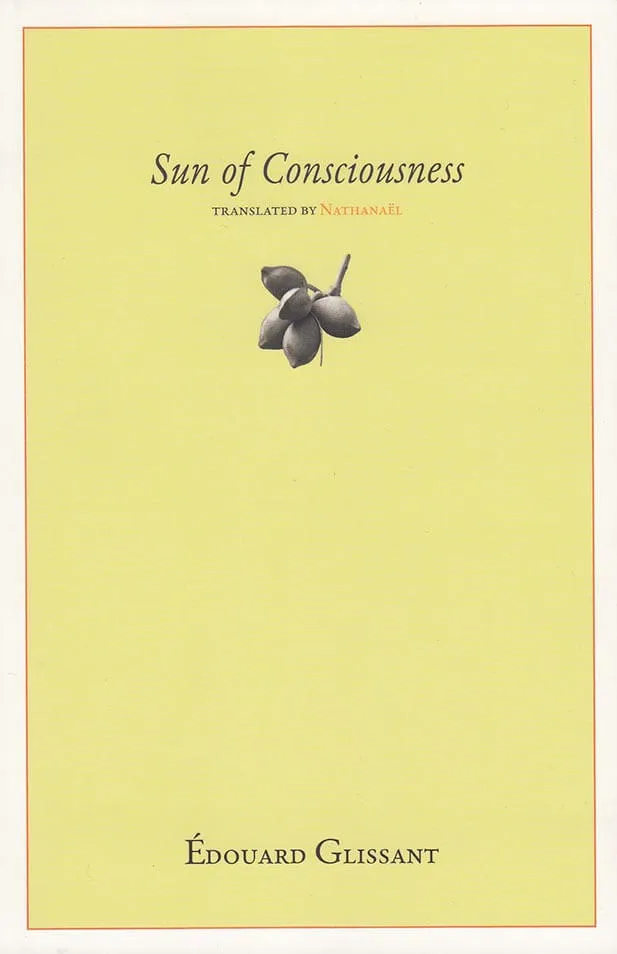
Sun of Consciousness
Soleil de la Conscience (Sun of Consciousness) was Martinican philosopher Édouard Glissant's first published work, and opened the Poétique (Poetics) strain of his oeuvre. This book-length essay, which is characterized by its exploratory, intimate character, announces Glissants concerns with créolisation (creolization), mondialité (worldliness, as against globalization), or opacité (opacity) and inscribes in this work a refusal of colonialism and of inverted exoticism. The sense of estrangement experienced by the author who arrives as a "foreigner" in a country to which he is bound by "the first page of his passport" is the author's principal preoccupation. By positioning himself as both different and same, Glissant opens a space for the writing of a(nother) history: that of the Caribbean.

The Carrier Bag Theory of Fiction
In The Carrier Bag Theory of Fiction, visionary author Ursula K. Le Guin tells the story of human origin by redefining technology as a cultural carrier bag rather than a weapon of domination.
Hacking the linear, progressive mode of the Techno-Heroic, the Carrier Bag Theory of human evolution proposes: ‘before the tool that forces energy outward, we made the tool that brings energy home.’ Prior to the preeminence of sticks, swords and the Hero’s killing tools, our ancestors’ greatest invention was the container: the basket of wild oats, the medicine bundle, the net made of your own hair, the home, the shrine, the place that contains whatever is sacred. The recipient, the holder, the story. The bag of stars.
This influential essay opens a portal to terra ignota, where the possibilities of human experience and knowledge can be discovered anew.

The Feminist Bookstore Movement
From the 1970s through the 1990s more than one hundred feminist bookstores built a transnational network that helped shape some of feminism's most complex conversations. Kristen Hogan traces the feminist bookstore movement's rise and eventual fall, restoring its radical work to public feminist memory. The bookwomen at the heart of this story—mostly lesbians and including women of color—measured their success not by profit, but by developing theories and practices of lesbian antiracism and feminist accountability.
At bookstores like BookWoman in Austin, the Toronto Women's Bookstore, and Old Wives' Tales in San Francisco, and in the essential Feminist Bookstore News, bookwomen changed people's lives and the world. In retelling their stories, Hogan not only shares the movement's tools with contemporary queer antiracist feminist activists and theorists, she gives us a vocabulary, strategy, and legacy for thinking through today's feminisms.

Vampyroteuthis Infernalis
Vilem Flusser, Rodrigo Maltez Novaes
Flusser introduces an infernal creature from the oceanic abysses, who slowly emerges, not from the oceans, but from man's own depths to gaze spitefully into his eyes and reflect back at his own existence.
Originally published only in German in 1987, this version has been edited and translated by Rodrigo Maltez Novaes, Ph.D. candidate at the European Graduate School, Saas-Fee, under the supervision of Prof. Dr. Siegfried Zielinski, from the original, unpublished and extended Brazilian-Portuguese version of the manuscript recently found at the Vilém Flusser Archive at the Universität der Kunst, Berlin. This edition is also accompanied by a selection of previously unpublished excerpts from Flusser's correspondence with Milton Vargas and Dora Ferreira da Silva, with whom he discussed the development of the present text.