Books
Books
in random order

Working Museum
"In Spring and All, William Carlos Williams figures imagination as the springing off point to greater connection with the world and its gentle motions. ‘It is spring,’ he writes: ‘life again begins to assume its normal appearance as of “today.” Only the imagination is undeceived.’ Embracing the haecceity of the everyday and allowing the imagination to make silent and surprising connections are ways to withhold the deceptiveness of relying on old habits of thinking and writing.
Ziddy Ibn Sharam’s Working Museum begins with another quotation from Spring and All: ‘There is not confusion – only difficulties’, and the sequence offers delicate, poetical examinations how the confusions and frustrations of interpersonal communication are beneficent difficulties to be embraced and considered in gentle depth. This is a gorgeous sequence of poems, offering generous, gracious and graceful glimpses of a family’s birthday pilgrimage to Amberley Museum and Heritage Centre in Sussex. Working Museum is a tour de force of delicate poetry of feelings and feeling through feelings in a world of wordless connections and contacts, navigating the liminal but intimately understood spaces between two brothers and their family. In these poems,
Sharam is trying to be still in language, as smiles, touches and profound intimacies are exchanged. Observing and being in his brother’s presence during this special time of spring, Sharam re-learns to experience, to become ‘plugged’ in, as he writes, to new ‘switchboards’ of sensation, thought and poetic possibility. The ‘old machines’ of mental expectation and habit are, in the presence of his other-sensing brother, found wanting for the appreciation of his ‘intellect just as it is’. Here, Sharam learns to ‘do things minimally’ and to revel in the ‘seismic proportions’ of the apparently mundane. Sharam and his readers are offered a space to share in a brother’s beautifully vivid world and are privileged to witness a profound, ‘beginning, // again." - Gareth Farmer

The Stone Door
The Stone Door is a surrealist allegory intertwining myth, mysticism, and romance. Written by Leonora Carrington after World War II, the novel follows a woman's symbolic journey through esoteric teachings, ancient lands, and dreamlike visions in pursuit of spiritual awakening and the unification of male and female forces. Both a metaphysical adventure and a tribute to Carrington's personal love story, it offers a visionary exploration of transformation and liberation.

Ezio Gribaudo - The Weight of the Concrete
Lilou Vidal, Tom Engels and 1 more
The Weight of the Concrete explores the legacy of the Turinese artist and publisher Ezio Gribaudo (1929–2022), examining his multifaceted oeuvre at the confluence of image and language. This publication, named after Il Peso del Concreto (1968)—a seminal work that featured Gribaudo’s early graphic creations alongside an anthology of concrete poetry edited by the poet Adriano Spatola (1941–88)—places Gribaudo’s work in conversation with approximately forty artists and poets from different generations, all of whom similarly engage with explorations of text, form, and visual expression.
Reflecting the editorial premise of Il Peso del Concreto, The Weight of the Concrete revisits the influential anthology, including archive material that documents its production, and reimagines it, pairing Gribaudo’s graphic work with a new selection of historical and contemporary concrete and experimental poetry.
At the heart of the volume is Gribaudo’s emblematic Logogrifi series, developed from the 1960s onward. The Logogrifi reveal his deep engagement with the art of bookmaking and fascination with industrial printing processes, relief matrices, typefaces, and language games.
In this new edition, the editors take the opportunity to revisit Gribaudo’s pioneering work, examining previously overlooked dimensions—gendered, geographical, and technological—and exploring contemporary associations beyond the original context. The book also includes essays that elucidate the poetic and political interplay between image, language, and materiality.
This publication is released following Ezio Gribaudo – The Weight of the Concrete, an exhibition held at the Grazer Kunstverein in Graz, Austria (2023–24), and at the Museion—Museum of Modern and Contemporary Art in Bolzano-Bozen, Italy (2024).
Edited by Tom Engels and Lilou Vidal
Published by Axis Axis and Grazer Kunstverein
Contributions by Anni Albers, Mirella Bentivoglio, Tomaso Binga, Irma Blank, Al Cartio, Paula Claire, CAConrad, Natalie Czech, Betty Danon, Constance DeJong, Mirtha Dermisache, Johanna Drucker, Bryana Fritz, Ilse Garnier, Liliane Giraudon, Susan Howe, Alison Knowles, Katalin Ladik, Liliane Lijn, Hanne Lippard, Sara Magenheimer, Françoise Mairey, Nadia Marcus, Giulia Niccolai, Alice Notley, Ewa Partum, sadé powell, N. H. Pritchard, Cia Rinne, Neide Dias de Sá, Giovanna Sandri, Mary Ellen Solt, Alice Theobald, Colleen Thibaudeau, Patrizia Vicinelli, Pascal Vonlanthen, Hannah Weiner, and Ruth Wolf-Rehfeldt
Essays by Alex Balgiu, Tom Engels, Nadia Marcus, Luca Lo Pinto, Mónica de la Torre, and Lilou Vidal

La Maison des Maladies
Unica Zürn, Ruth Henry and 1 more
Unica Zürn dans La maison des maladies raconte, par un ensemble de textes et dessins, un séjour en hôpital où elle est soignée d’une jaunisse. Elle y écrit et compose ce carnet où le regard qu’elle pose sur son propre corps, les lieux qu’elle habite et les personnages qu’elle rencontre, témoigne d’une sensibilité hors-norme qui tire à la fantaisie, voire au délire.
Pour la première fois en France, La maison des maladies est publié intégralement.
Le texte est traduit de l’allemand par Ruth Henry & Robert Valençay. Un après-propos de Mathilde Girard clôture le livre.

Better Do It Now before You Die Later: Sonny Simmons with Marc Chaloin
Though his years in the New York free-jazz scene of the sixties cemented his reputation as "one of the most forceful and convincing composers and soloists in his field," saxophonist Sonny Simmons (1933–2021) was nearly forgotten by the '80s, which found him broke, heavily dependent on drugs and alcohol, and separated from his wife and kids. "I played on the streets from 1980 to 1994, 365 days a year," Simmons tells jazz historian and biographer Marc Chaloin. "I would go to North Beach, and I'd sleep in the park. The word got around town that Sonny is a junkie, really strung out."
The resurrection of Simmons' career―upon the release of his critically acclaimed Ancient Ritual (Qwest Records) in 1994―has become a modern legend of the genre. In the last two decades of his musical career, Simmons broke through to a new echelon of recognition, joining the pantheon of great innovators and masters of the music. But to this day he remains an undersung figure. Here, in the first ever book dedicated to his life, Simmons recounts his childhood in the backwoods of Louisiana, his adolescence in the burgeoning Bay Area jazz scene and his star-studded life in New York playing alongside the greats.

Labour of Tongues
Labour of Tongues is a document of poetry that records, but saves nothing. It asks, how to stay with pain?
This archive is build out of two channels, two voices running parallel to one another. In one an elder speaks, in the other a knot of generational fabulation.
Here, the poem and flesh serve as ushers for pain. Through imitation and declaration this archive becomes a container for disorganised storytelling, disorder, grief, translation, the loss of language, and affection.
I do
nothing I need
no one
I loose my keys
they were on the door
outside

OEI #102–103 Photography on Edge
Cecilia Grönberg, Jonas J. Magnusson
Photography on Edge – 25 visual dossiers compiled and introduced by Geoffrey Batchen + ”Wanting more” – on and from the work of Australian artist Justine Varga + translations of a selection of Geoffrey Batchen’s essays into Swedish
”The published history of photography has long been motivated by a number of key principles: innovation and originality, authorship and nationality, chronology and medium specificity, technical excellence and aesthetic achievement. The folios [in OEI #102–103] offer an alternative way to regard this history. They comprise a series of repetitious fragments drawn more or less arbitrarily from across various photographic practices and genres. In every case, these folios present a photography on edge: tense, nervous, unsure of itself—at least when compared to the self-certainty we encounter in most histories of this medium.
A photography on edge is a photography that escapes the usual definitions. […] One thing is for sure: if they are to be included in future histories of photography, then we will need to set aside our prejudices and presumptions and learn to say what we see, and not just see what we already know how to say.”
— Geoffrey Batchen in Photography on Edge

Unconscious/Television
This book stems from the author’s discontents with Lacanian Psychoanalysis, by drawing from psychoanalysts like Félix Guattari and Sándor Ferenczi, as well as authors like Viveiro DeCastro, and Thomas Lamarre, to whom the book is dedicated.
As Lucas Ferraço Nassif elaborates on the possibility of a multiplicitous Unconscious, or rather, a mass of many Unconscious(es), he attempts here to fold the book itself into the text, to make the organisation of the physical book itself a part of the elaboration.
This 2nd Edition comes with a few editorial changes, and a slightly different design approach. It is being presented now with a suite of endorsements from a group of exciting writers and researchers, including Persis Bekkering, Thomas Lamarre, and Yuchen Li. Much of the first edition is preserved, and an extra text has been added, written by the editor as a part of the lecture at Ifilnova. There has been a focus on making this book more accessible, so we have reworked the design of this edition in Black & White.
The Unconscious is Semiotic, not Linguistic, and it only jumps out when you read between the lines. Do you remember, back in 1997, when 600 kids had epileptic shocks whilst watching Television—the Pokémon Shock? This might sound strange at first, but Lucas Ferraço Nassif theorises that, contrary to the claim that this was caused by oscillations of blue and red light alone, it could have been caused by microperceptions and intensities within narrative. As Porygon takes Ash and friends into the digital world, the immanence of unconscious assemblages drags viewers in, too.
Such is the haptic and imagetic nature of this book. Using several design and editorial strategies, and a particular mode of writing, the author attempts to elaborate on their work on the Unconscious by recreating a similar possibility—where book, language and reader collapse into a composition, an assemblage or a haecceity. Unconsciousness operates as the multiplanar compositions of Japanese Anime do, so this book has been organized accordingly—different texts, different temporalities, different voices—and like the Japanese concept of Ma (negative space), or even like CoreCore, something jumps out of the breaks, the gaps in between the layers, and therein lies, for this book, a departure point for elaborating on not just one, but many, Unconscious(es).

Magic Episodes and Other Synchronicities
Scott Burton, Eduardo Costa and 2 more
Their relationship is forged in charismatic, darting, and deep correspondence: dishy gossip, shop talk, and the auditioning of ideas and shaping of artistic practices."
—Nate Lippens
When Scott Burton (1939–1989) and Eduardo Costa (b. 1940) met in New York City in 1968, they developed a close friendship that lasted until Burton’s death. In letters from the 1970s, they gossiped and shared thoughts about the rapid changes taking place in the art world, queer life, and their work as writers and artists. Burton and Costa’s letters show a vibrant transnational queer artistic friendship and offer a new perspective on the struggle to establish conceptual, critical artistic practices in the Americas. As Costa moved from New York to Buenos Aires to Rio de Janeiro, he and Burton discussed the art communities of North and South America, including Costa’s friend Hélio Oiticica and the lasting influence of Marcel Duchamp. Both artists found the letters to be a source of emotional and intellectual nourishment—as will their readers.

Bodies of Extraction
Lydia Xynogala, Lorena Vicini and 1 more
What does it mean to drill deep and interfere with the configuration of tectonic plates? What does it mean to hollow out and alienate islandic undergrounds? How is wealth extracted and exploited from the ground, crumbled into fragments, transformed into matter, pieces of power, moved away to be represented elsewhere? Whose lungs and souls are capitalized upon and hidden under the suffocating dust in mining shafts? To whom do the surface of the land and its underground belong?
This book takes proto-industrial mining in the Aegean island of Serifos as an entry point for disclosing historical and contemporary consequences of politics of the soil through land extraction, and looks at how mineral evidence was historically produced, disseminated, and capitalized upon in the Aegean region and beyond.
Contents:
Mineral Travels:
Fragments of Geographies on the Move
by Lydia Xynogala
The Evil in the Surface
by Lorena Vicini
Consuming Land at Serifos
by Asli Özdoyuran
and David Bergé
Letter from Frikas Fortress
by Constantinos Speras
Iron Lungs
by Milica Ivic
Walking on Marble: Materialized Histories
by Anna Run Tryggvadottir

Moments Before The Wind
Moments Before the Wind is a heterogeneous collection of notes on scenography that offers a glimpse into the poetics and artistic practice of Jozef Wouters. These reflections on space, scenography, art making and institutional critique have developed over the years as they were written out loud in various contexts. Now settling on the page among built and unbuilt spaces, they’re an invitation to the reader to think along or against, and think up space for oneself. Edited by Jeroen Peeters; graphic design by Filiep Tacq.
Jozef Wouters is a scenographer and theatre maker based in Brussels, who develops work in collaboration with his Decoratelier. Decoratelier is also a workplace for set designers and artists, and provides room for cross-disciplinary ventures and social experiment.

Coups de putes
Faut-il cautionner la prostitution pour soutenir les travailleuses du sexe ? Faut-il pénaliser les clients ? La prostituée est-elle le symbole de l'oppression des femmes ? Juno Mac & Molly Smith posent un regard nouveau sur ces questions souvent conflictuelles. Elles rejettent l'alternative entre condamnation et glorification du travail du sexe, et étendent leur propos à des problématiques plus larges : les frontières, l'exploitation, le sexisme et la suprématie blanche. En délaissant les symboles passionnés et en examinant les effets concrets des différents régimes législatifs, elles démontrent que la lutte des travailleuses du sexe est d'une importance capitale pour le mouvement social.
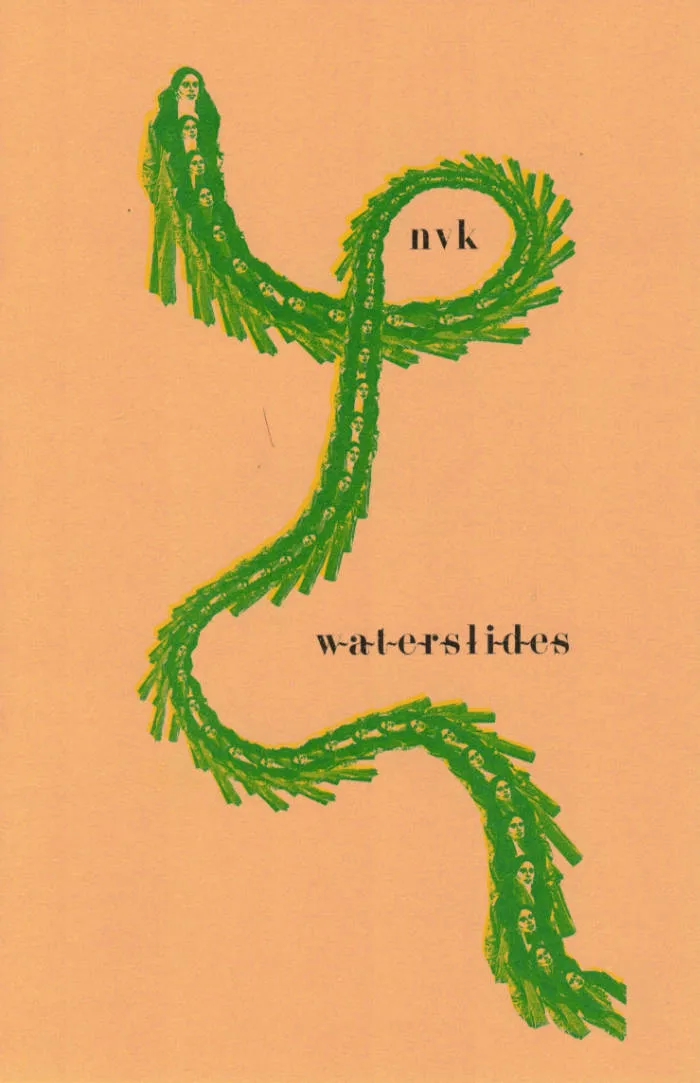
Waterslides
"Waterslides is a falling and plunging, short starts and stops aided by movement, until we splash, climb and plunge again. Each sliding is the same but different—with each descent new expectations and thoughts swirl, shifting focus and gaining new insights or blockages. Waterslides are brief moments of remembering, remembering as a present tense activity, one that happens as we think of it, projected on our now. The waterslide is the moment of past and present working in tandem, a movement of repeating, revisiting and remembering all at once.”
Written by nvk 2021-2023. Dedicated to Judi, MM & TNN.
A version of these poems was published as an audio work through Ignota Press’ The Mountain (2023) and included in a reading with James Loop on Montez Press Radio (2023). nvk would like to thank Jan Matthé, Stine Sampers and Michelangelo Miccolis for their patience & love.
This book was first presented at Kransen in Antwerp, May 6th 2023, with a performance by Sassy (costume by Rosa Schützendorf). Printed and bound at Risiko Press, Borgerhout. Cover image by nvk. Fonts: Adonis, Garamond Pro. Limited to 150 copies.
128x195mm, 16p., stapled, cover: green, yellow and black risoprint on 160gsm caramel paper, inside: black and blue riso on 120gsm Munken Pure paper.

Parapraxis 05: Economies
Like Freud’s prototypical baby, we struggle over whether to keep our body together or to give it away. We all live these scenes of bodily loss. Freud and Marx both sing harmoniously: what we give up, we give under duress. We are not easy with what we’ve been tasked with, but the task has been the same since birth, doubled in the name of emancipation: first, there’s nothing less than to survive alienation and exploitation, then there’s staying alive for one another’s sake. Perhaps the storied antagonism between Freud and Marx turns on the difficulty of holding these tasks together, balanced on the knife’s edge that separates self-interest from collective liberation.
Capitalism does not produce itself all alone, no matter its disciplines and political-economic constraints on the reproduction of society. If Marx taught us anything, it’s that capitalism produces its own gravediggers, the proletariat—“the unreason of reason,” he quipped, where the dominant social order encounters its unconscious element. Through the bad exchange of capitalism comes a gothic reversal, from preconscious life to premature death, where workers end up burying themselves instead of the system that provides the grave plot. That exchange is felt internally, in a rift that cleaves open the self. Freud, for his part, helps us describe how political economy hammers our lives into unreasonable and reasonable shapes, imaginary and real, as countless and heterogeneous as the individual faces in a collective mass. For each and for all, we bring psychoanalysis to bear on the political-economic problems we suffer in common.
King Ketamine. Beyond the vibecession. Austere Mothers. Sick at Work. Money, Feces, Babies, Gifts. Essays by Juliana Spahr, Peter Coviello, Nicolás Medina Mora, Jyoti Rao, and Hannah Proctor. Images of Red Vienna from Wilhelm Reich’s camera, dispatches from Lebanon, and more.

Crue
L’Île-de-France a été engloutie. Submergée par de l’eau liquide. C’est à peu près tout ce que l’on sait. Crue est un long poème construit sur un rythme ternaire, une suite de tercets libres entrecoupés de symboles typographiques étranges dont la signification exacte semble avoir été perdue dans l’inondation. Il y a dans le va-et-vient soutenu du texte comme dans celui de la mer, ses gestes répétés, toujours successifs, quelque chose de l’automation ; l’acceptation sans révolte d’une nouvelle nature sous-marine hybride, plus uniquement humaine, à la langue noyée, gorgée de néologismes, méthodique, néanmoins sentimentale. Car ici la cruauté sinistre de la nature fait écho aux émotions du narrateur. Le paysage-état d’âme est désolé, apocalyptique mais comme résigné, nu. Crue sonde les abysses de la civilisation et des comportements humains. Peut-être un des textes les plus personnels de Théo Robine-Langlois.

Steering The Craft
A Twenty-First-Century Guide to Sailing the Sea of Story.
With an introduction by Theo Downes-Le Guin, Karen Joy Fowler, Molly Gloss and Kelly Link.
Steering the Craft is Ursula K. Le Guin’s carrier bag of the tools of a writer’s craft: how – and why – to write. From the sound of language to tenses to point of view, Le Guin offers a comprehensive and generous guide to the fundamental components of narrative, illustrating her incisive analysis with examples from some of her favourite writers. Revised and updated for the twenty-first century, this handbook includes exercises that the writer can do alone or in a group.

Standpoint Autotheory – Writing Embodied Experiences and Relational Artistic Practices
Ana de Almeida, Mariel Rodríguez
In this anthology of essays, twelve artists explore radically self-reflexive research attitudes integrating embodied experiences within the production of theory.
Standpoint Autotheory encompasses a multitude of manifestations of radically self-reflexive research attitudes. It traces research based artistic practices through twelve contributions that propose a performative integration of the personal within the production of theory and explore the entanglements of subjectivity with criticality aimed at social transformation by questioning dominant epistemologies.
The positions assembled in the book are permeated by different modes of thinking and practice such as autoethnography, practices of the self, auto-historia teoría, standpoint theories, strong objectivity and situated knowledge, self-authority, narrativity and storytelling, radical positioning, performative philosophy, autofiction, thinking-feeling, and other methods that, through the interrogation of embodied experiences, illuminate the connections between the personal and the political, as well as the individual and the communal.
Edited by Ana de Almeida and Mariel Rodríguez.
Contributions by Ana de Almeida, andrea ancira, Cana Bilir-Meier, Nina Hoechtl, Olena Khoroshylova, Sanja Lasić, Mai Ling, Stephanie Misa, Lena Ditte Nissen, Mariel Rodríguez, Ruth Sonderegger, Elif Süsler-Rohringer, Verena Melgarejo Weinandt.

Risking the Self. Philosophy, Tai Chi and Psychedelics
A philosopher’s path towards embodiment through Tai Chi and psychedelics.
This book proposes different forms of embodiment that are not necessarily leading to production of subjectivity or territorialized identities but rather putting the “self” at risk allowing us to be emancipated from the mandatory illusion of self-realization. This can be facilitated by a daily commitment with a set of body altering practices that disjoint us from the ordinary accustomed experience of reality and provide us access to “other” layers of the real. These practices grant access to the primary control centers of the body that regulate frequencies of energy and consciousness in a deeper way and enable the body to unfold in different dimensional spaces of experience: rendering sensible the multi-layered energetic body.

Blank Stare
Blank Stare is the first publication in the CommonWealth series, published by Chillzone.
Compiled of graffiti written in the streets of Iran, combining the urgency of emotional expression amidst the political suffocation of people during the 2026 government-imposed internet blackout.

DMZ Colony
Woven from poems, prose, photographs, and drawings, Don Mee Choi's DMZ Colony is a tour de force of personal and political reckoning set over eight acts. Evincing the power of translation as a poetic device to navigate historical and linguistic borders, it explores Edward Said's notion of "the intertwined and overlapping histories" in regards to South Korea and the United States through innovative deployments of voice, story, and poetics. Like its sister book, Hardly War, it holds history accountable, its very presence a resistance to empire and a hope in humankind.

Elegies of the Earth
Ahmad Shamlou, Niloufar Talebi
A sweeping centennial edition of Iran’s iconic twentieth-century poet of liberty, whose work shaped modern Persian poetry. Known for his political engagement and deep humanism, and his pivotal role in Persian poetry’s modernist turn toward free verse, Ahmad Shamlou (1925–2000) crafted poems that carried both lyrical intimacy and cultural force. A central, defiant voice in Iran’s modern literary history, Shamlou championed the power of poetry as an instrument of liberation. His work, long suppressed in his homeland, remains urgent for readers everywhere confronting censorship, exile, and erasure. This bilingual edition honors Shamlou’s centennial with the most expansive selection of his poetry to date in English, encompassing his wide thematic range: from fierce protest to intimate love, mythic storytelling to existential reflection. Niloufar Talebi’s vibrant translations and deeply researched commentary shine new light on Shamlou’s legacy and his relevance today.

Biarritz
Written and edited in Biarritz, Borgerhout and Midsommarkransen, 2016—2021. Dedicated to Räffi, with much love. Another version of this text was published in Pfeil Magazin 10 (Montez Press, 2018); editor: Anja Dietmann, copy-editor: Stacy Skulnik. Epigraph from Numéro Deux (1975) by Anne-Marie Miéville and Jean-Luc Godard. Presented on Saturday February 5th 2022 at Kransen, Borgerhout.
128x201mm, 40p, staple bound. Riso-printed on Arcoprint Edizioni Avorio 90g and Clairefontaine Blue 210g. Design by Kaye–Matthé, typefaces: Tribute, Gillies Gothic Light. Printed by Risiko Press at Kransen, covers silkscreened at Afreux, bound by Drukkerijcollectief De Wrikker. Edition of around 200.

SABR N°02 - Un scorpion dans l’épicerie
« Jusqu’à ce soir-là, je ne me doute pas qu’il y a des scorpions en France. Dans mon esprit, tous les scorpions vivent en Algérie. Je ne sais pas exactement ce qu’est l’Algérie, je n’y suis jamais allée, mais je sais, grâce à ma mère, que je suis scorpion “du deuxième décan”. »
Lydia Amarouche est directrice éditoriale, autrice et curatrice. Son travail puise dans l'exploration de documents d'archives, une matière première qui lui permet en particulier d’aborder la question du passé et du présent colonial. En 2020, elle fonde Shed publishing, une maison d'édition indépendante publiant des essais de critique sociale et politique ainsi que de la littérature jeunesse.
SABR/Collection est une série de publications qui rassemble des œuvres littéraires de format court et de genres variés. Dirigée par Nesrine Salem, la collection souhaite mettre en avant les macro-réalités des auteur·ices choisi·es pour rendre visible le caractère intersectionnel des luttes.

Basta Now (Expanded Edition)
Basta Now - Women, Trans & Non-binary in Experimental Music is a non-academic essay by French poet, novelist and music enthusiast Fanny Chiarello. It’s also the first book to be published by Permanent Draft, an all-female record label and micro-press founded by Chiarello & musician Valentina Magaletti, dedicated to promoting contemporary female, non-binary and transgender artists.
Basta Now is essentially a huge (yet admittedly not definitive) overview of 3867 womxn in the global experimental sound & music scene. It’s been written in playful and compelling prose and stylishly presented with photos, illustrations, and discographies.
Now in its expanded edition, the book includes 80 more pages and an additional 1496 names than the first edition, extended lists and discographies, and updated chapters – especially Wild Things, All-Stars and Madame Bricolage. “This book has nothing against men, it’s just not about them” (Fanny Chiarello)