Books
Books
in random order

KAMERA CAHIER N° 5
Louise Crawford, Stéphan Guéneau
A special edition issue curated, designed and published by AVARIE, Paris and Labor Neunzehn, Berlin. It accompanies KAMERA SERIES, while it is an independent and valuable object to collect.
The central idea that informs and directs the booklets’ montage is the interplay between the concepts of addition and subtraction. This is achieved by unveiling a missing image in the screening or an unreleased second from an artist's film, expanded to 24 pages. Additionally, each booklet contains a piece directly removed from the show.
The editing establishes a dialogue between film frames and performed writings derived from texts, scripts, storyboards, and notes. The KAMERA exhibition is consequently extended into a physical space—the book—allowing for its widespread dissemination, complementing and contrasting with its potential online occurrence.
KAMERA SERIES is a screening program of experimental films, video art works and printed matter taking place in a former GDR building in Berlin.
75 numbered copies +
screenprinted newsprints’ fragment
24 pages / color plates
book size 21 x 14,5 cm
papers fedrigoni sirio rough pearl 210 and arena white rough 120

CUNY Center for the Humanities
Lost & Found: The CUNY Poetics Document Initiative, Series III
John Wieners, Lorine Niedecker and 3 more
Lost & Found: The CUNY Poetics Document Initiative publishes unexpected, genre-bending works by important 20th century writers. Unearthed from personal and institutional archives in the United States and abroad, these materials are edited by doctoral students at the Graduate Center, CUNY.
SERIES III is a collection of 8 chapbooks that authenticate Edward Dahlberg's claim that "There is more political energy in friendship than in ideology."
Langston Hughes & Nancy Cunard cement their personal relationship by penning notes across the ocean throughout the Spanish Civil War. After meeting at Black Mountain, John Wieners & Charles Olson remain in close correspondence until months before Olson's death. In "Old Father, Old Artificer," part lecture and part evocation of Charles Olson, Diane di Prima helps to establish how key figures in "New American Poetry" were processing their own past, while the breathless Olson lecture by Ed Dorn erodes the fictive dualism that pits poetic theory against practical action. In his letters, Michael Rumaker invites you to share his life, its radiant pursuit of love, "dirty realism," literature, and lasting community, and Joanne Kyger booms "communication is essential" in her Letters to & from. In Homemade Poems, a gift-book mailed to a friend in 1964, Lorine Niedecker insists that the handmade chapbook is the material continuation of the poems so carefully nestled in its pages.
Breaking up the monolith of the historical lens, Series III continues to track individuals as they tell their stories, cast their lifelines, and position themselves in relation to the times they lived in—and the times we live in—through intimate journals, letters, lectures, and friendships. Edited, annotated, and with accompanying essays, The London Review of Books calls this "a serious and worthy enterprise." Diane di Prima calls the series "a gold mine" and Joanne Kyger writes: "What a brilliant cast of characters. Just exactly what one (myself) would like to read."
SERIES III includes:
Lorine Niedecker: Homemade Poems (John Harkey, editor)
John Wieners & Charles Olson: Selected Correspondence (Parts I & II) (Michael Seth Stewart, editor)
Diane di Prima: Charles Olson Memorial Lecture (Ammiel Alcalay and Ana Božičević, editors)
Edward Dorn: The Olson Memorial Lectures (Lindsey Freer, editor)
Michael Rumaker: Selected Letters (Megan Paslawski, editor)
Letters to & from Joanne Kyger (Ammiel Alcalay and Joanne Kyger, editors)
Langston Hughes, Nancy Cunard & Louise Thompson: Poetry, Politics & Friendship in the Spanish Civil War (Anne Donlon, editor)

After Words: Visual and Experimental Poetry in Little Magazines and Small Presses, 1960–2025
This book offers a visual and thematic journey through avant-garde, concrete, visual, and experimental poetics as they appeared in ephemeral little magazines and small press publications from the 1960s onward. This book serves as an exhibition catalog for After Words: Visual and Experimental Poetry in Little Magazines and Small Presses, 1960–2025 from April 23rd to July 26, 2025, at The Grolier Club exhibition in New York City.
Small presses include: 7 Flowers Press, Agentzia, Anabasis, Asylum’s Press, Ayizan Press, Beach Books Texts & Documents, Beau Geste Press, blewointmentpress, Burning Press, C Press, Chax Press, Coach House Press, Edition Hansjörg Mayer, Edizioni Geiger, Expanded Media Editions, Fleye Press, Goliard Press, Grabhorn-Hoyem, Granary Books, Druckwerk, Hawk’s Well Press, Heiner Friedrich, The Hermetic Press, Hermetic Gallery, John Martin, Joseph Melzer Verlag, Kickshaws, Kontexts Publications, Letter Edged in Black Press, Luna Bisonte Productions, Membrane Press, Milano: East 128, New Wilderness Foundation, Nietzsche’s Brolly, Nova News, Open Book, Openings Press, PANic Press, Phenomenon Press, Poltroon Press, Renegade Press, Roaring Fork Press, Scorribanda Productions, Seedorn Verlag, Seripress, Siglio Press, Station Hill, Tarasque Press, Tetrad Press, Visual Poetry Workshop National Poetry Society of London, Wild Hawthorn Press, and Xexoxial Editions.
Little magazines include: “before your very eyes!”, A: An Envelope Magazine of Visual Poetry, Abracadabra, Alcheringa, Anti-Isolation, Approches, AQ, Assembling, Blank Tape, Bulletin From Nothing, Cenizas, Diagonal Cero, E pod, Fruit Cup, Ganglia, Geiger, Gnaoua, Industrial Sabotage, Interstate, Journeyman, Kaldron, Klacto 23, Kontakte, Kontexts, Kroklok, L=A=N=G=U=A=G=E, Libellus, Life Begins with Love, Lines, Lost and Found Times, Lost Paper, Mini, New Wilderness Letter, Pages, Poor.Old.Tired.Horse., Rawz, Revue OU, Rhinozeros, Sammelband Futura, Schmuck, Shi Shi: Concrete & Visual Poetry, Signal, Soft Need, Sondern, Spanish Fleye, Stereo Headphones, Taproot Reviews, The Acts: The Shelf Life, The Difficulties, The Improbable, The Insect Trust Gazette, The Marrahwanna Quarterly, The San Francisco Earthquake, The Subtle Journal of Raw Coinage, Toothpick Lisbon & the Orcas Islands, Unarmed: Adventurous Poetry Journal, UNI/vers(;), WhiteWalls, Xerolage, and xtant.

Steering The Craft
A Twenty-First-Century Guide to Sailing the Sea of Story.
With an introduction by Theo Downes-Le Guin, Karen Joy Fowler, Molly Gloss and Kelly Link.
Steering the Craft is Ursula K. Le Guin’s carrier bag of the tools of a writer’s craft: how – and why – to write. From the sound of language to tenses to point of view, Le Guin offers a comprehensive and generous guide to the fundamental components of narrative, illustrating her incisive analysis with examples from some of her favourite writers. Revised and updated for the twenty-first century, this handbook includes exercises that the writer can do alone or in a group.

Thievery and Songs
Publication accompanying the exhibition Gernot Wieland (08.02.-05.07.2020).
One can summarize Gernot Wieland and his work as an intertwining of the man, the artist, and the artwork. With Gernot, we experience in his artwork and in his presence more of a quiet, constant fascination with what is around him and what has affected or influenced or indeed shaped him sinde his childhood. These impressions - whether quirky memories or indeed tragic experiences and the non-stop grappliing with what has happened - arise in his artwork or in his conversation, whether directly or not. Alongside self-analysis and presentation through his artwork is an analysis of societal norms and indeed repressed aspects of society as it expresses itself, even violently, in hegemonic structures - in the classroom and upon children, for example. From his sketches or film narratives we catch a powerful glimpse upon a concentration of trauma, repression, and guilt placed upon his generation, an Austrian condition manifesting itself in obscene and absurd ways.

Agitated Air: Poems After Ibn Arabi
Born in Murcia in 1165, Ibn Arabi was a prolific Muslim philosopher and poet. He travelled extensively before settling in Damascus, where he died in 1240. Tarjuman al-Ashwaq, or The Interpreter of Desires, is a cycle of sixty-one Arabic poems. They speak of loss and bewilderment, a spiritual and sensual yearning for the divine, and a hunger for communion in which near and far collapse.
Agitated Air is a correspondence in poems between Istanbul and Cape Town, following the wake of The Interpreter of Desires. Collaborating at a distance, Yasmine Seale and Robin Moger work in close counterpoint, making separate translations of each poem, exchanging them, then writing new poems in response to what they receive. The process continues until they are exhausted, and then a new chain begins.
Translated and re-translated, these poems fray and eddy and, their themes of intimacy across distance made various, sing back and forth, circling and never landing. Absence and approach, knowing and unknowing, failure and repetition: Ibn Arabi’s cycle of ecstatic love shimmers with turbulence. Seale and Moger move into and against these contending drifts, finding in the play of dissatisfaction and endurance a prompt for new poetry.

Time has fallen asleep in the afternoon sunshine
Appendix #2 - How to organize a library
Mette Edvardsen, Léa Poiré and 1 more
The Appendixes #1–4 is an editorial series by Mette Edvardsen, Léa Poiré and Victoria Pérez Royo that developed out of the project Time has fallen asleep in the afternoon sunshine. For a two-year residency at Les Laboratoires d’Aubervilliers* (2022–23), they came together as a small work group, shaping the work process, hosting presentation formats and making this publication series on paper as four cahiers.
The cahiers comprise a collection of commissioned texts and contributions created for this context, selected documents and traces from work sessions and encounters organized during their residency, texts read together and republished for this occasion, a collection of references, notes in progress, unfinished thoughts and loose fragments – on paper, between pages.
The Appendixes are organized around four themes: (1) The gesture of writing, (2) How to organize a library, (3) Orality and (4) Translation. In addition to being published on paper, the editorial series also consisted of other formats of presentations, exchanges and meetings organized as workshops, fieldwork, performances, conferences, collective readings and oral publications, taking place during their residency at Les Laboratoires d’Aubervilliers and in the vicinity.

Yellow Songs 1: Voiced-Voiceless
Fifty years after the fall of Saigon, Dao Strom’s Yellow Songs vibrates with the ramifications and ripples of Empire. Each of the four Yellow Songs books reckons with the intimate consequences of the colonial project, reconfiguring them into complex and lucid, literal and figurative songs of selfhood. Embodied, critical, wholehearted, collective, personal, genre-defying—Yellow Songs renders the brute force of history with tender precision. Art book quality printing in full color with felt paper inserts.
Yellow Songs 1: Voiced-Voiceless unearths, unwinds, un-bodies the violence of stigma, reclaiming the ventriloquized voice of David Bowie's "China Girl” through a lyric-critical essaying (assaying) of cultural tropes, racialized and gendered power plays, and memory.

Being a Chair. Essays on Choreographic Poetry
Imagine words approaching a dance eyes closed or sleepwalking, words adrift beyond what can be envisioned beforehand, prompting writer and reader alike into a zone where time multiplies, where bodies grow footnotes and paper skin, savour the taste of language, attune their ears to the wavelength of blue. In a string of brief essays on her practice of writing choreographic poetry and scores, Janne-Camilla Lyster offers reflections on time, memory and the senses, on translation, punctuation and rhythm, on mistakes and crevasses, on the impossible and yet other things. What does it take to enter another form of existence, say, a chair?
Janne-Camilla Lyster is a writer, dancer and choreographer. She has published poetry, novels, essays and plays.

Americón
Nico Vela Page’s Americón is a collection of poems in Spanglish that weaves a space for the queer, trans body to know the land, and itself, as extensions of each other. The land is the desert of Northern New Mexico, the forgotten Pan-American Highway, the space between our thighs, the quaking cordillera of Chile, the moans of elk, and the ripe fruit waiting to be picked. Through archive, attention, and erotic ecopoetics, Page’s debut collection of poems extends far across the page, the gender binary, language, and the Americas to find out who we are by asking where we are.

Paradis catalogue
Contributions by: Nicole-Antonia Spagnola, Georgia Sagri, John Kelsey, Matthew Pang, Cathy Wilkes, Sarah Rapson, Nick Irvin, Gene Beery, Anne Dressen, Anne Pontégnie, Jacqueline Mesmaeker, Sara Deraedt, Anne Rorimer, Kari Rittenbach, Olga Balema, Maria Nordman, Louise Lawler, Julie Ault, Martin Beck, Adrian Morris, Matt Browning, John Miller, Envers Hadzijaj, Enzo Shalom, Bedros Yeretzian, Morag Keil, Helmut Draxler, Gianna Surangkanjanajai, Steve Cannon, Rae Armentrout, Zoe Hitzig, Pierre Guyotat, Lola Sinreich, Fanny Howe, Hélène Fauquet, Marie Angeletti, Richard Hawkins, Andy Robert, Alexander García Düttmann, Daniel Horn, El Hadji Sy, Henrik Olesen, Aurélien Potier, Richard John Jones, Stéphane Barbier Bouvet, Nora Schultz, Peter Fend, Megan Francis Sullivan, Jill Johnston, Sturtevant, Tonio Kröner, Bernard Bazile, Pierre Bal-Blanc, Jérome Pantalacci, Gérard Traquandi, Gladys Clover, Maria Wutz, Jimmie Durham, Richard Sides, Camilla Wills, Michael Callies, Steven Warwick, Matthew Langan-Peck, Dan Graham, Nina Könnemann, Hans Christian Dany, Valérie Knoll, Win McCarthy, Eleanor Ivory Weber, Anna Rubin, Heji Shin, Michèle Graf & Selina Grüter, Inka Meißner, Simone Forti, Morgan O’Hara, Angharad Williams, Ye Xe, Lily van der Stokker, Yuki Kimura, Peter Wächtler, Eva Steinmetz, Michael Van den Abeele, Marc Kokopeli, Bradley Kronz, Robert Grosvenor, Samuel Jeffery, Charlotte Houette, Adam Martin, Wade Guyton, Chloe Truong-Jones.
Edited by Marie Angeletti with Gianmaria Andreetta and Camilla Wills.

Secrèt
Mystique des rues vides et peu éclatantes des banlieues pavillonnaires, ce court poème en prose interpelle par sa langue sombre. Dans une parodie de messe noire – beigeasse comme le crépis des façades –, Théo Robine-Langlois dépeint le monde mystérieux des maisons individuelles, du repli sur soi démonique, et des vieilles qui marmonnent entre leurs gencives au retour du marché, le panier plein de gros sel et de radis noirs en guise d'hostie. Les mots occitans qui ponctuent le texte comme des conjurations en accroissent l’escur.

The Poeticians

Understanding Molecular Typography
Molecular typography is the study of the chemical and physical underpinnings of letters. All characters are formed from seven basic atomic building blocks, known as typtoms. These typtoms come together in various combinations and configurations to form letters, numbers, and punctuation. Typtoms are not just theoretical tools for exploring the anatomy of type, but actual particles. Letters are molecules.
H.F. Henderson’s work, Understanding Molecular Typography, originally published in 1992, was a seminal work in the field. By condensing information pulled from nearly forty years of publications from the top molecular typographic scientists, Henderson made the science approachable to the everyday American for the first time. Part primer, part field guide, it lays out the basic principles, followed by detailed diagrams of the molecular formation of letters, numbers, and punctuation. A conclusion sums up the field of molecular typography to date, and a comprehensive bibliography provides valuable reference for the reader looking to learn more.
With the demise of the field of molecular typography as a whole in the mid-to-late ‘90s, (perhaps even due to its increased popularity brought on by Henderson’s work), Understanding Molecular Typography ran out of print, and has long since been forgotten. Peculiar as it may be, molecular typography is nevertheless a science worthy of being brought back to mainstream attention, if for no other reason than demonstrating humanity’s frequent scientific misconceptions throughout history. This reprint edition, with a new introduction by Woody Leslie, seeks to do just that.
"Until Henderson's incredible analysis, no one had created a conceptual framework sophisticated enough to do the analytic work in graphical physics that the alphabet required if it was to be fully understood. True, some of the Russian futurists, like Ilia Zdanevich, in their examinations of the properties of language, had begun to grasp the vague outlines of a modern scientific approach to molecular components, to the formation of compounds, and their behavior as chemical substances, within the structure of poetics. But Henderson's research was comprehensive and the results nothing short of astonishing." —Johanna Drucker

The Third Body
In The Third Body, the poet, novelist, feminist critic, and theorist Hélène Cixous interweaves a loose narrative line with anecdotes, autobiography, lyricism, myth, dream, fantasy, philosophical insights, and intertextual citations of and conversations with other authors and thinkers. Cixous evokes the relationship of the female narrator and her lover, a relationship of alternating presences and absences, separations and rejoinings. This relationship assumes protean forms within a complex web of writing, creating a third body out of the entwined bodies of the narrator and her lover.
Hélène Cixous is a professor emerita of literature and founder of the Centre d'études feminines, Paris VIII. Her numerous books include Stigmata, Three Steps on the Ladder of Writing, The Newly Born Woman, The Laugh of the Medusa, and Manhattan: Letters from Prehistory. In 2000, a collection in Cixous' name was created at the Bibliothèque nationale de France.

The Book of Na
In The Book of Na, translation acts at the edge of perception. Tracing across projects in film, video, and performance, Na Mira reflects on the violent fragmentation of bodies while refusing the containment of geographic and corporeal borders. In 1977, a name is cut at an immigration office. This gap turns into an intergenerational score for becoming heat, hexagram, hologram. Using oracular and glitching technologies, Mira witnesses what escapes data: doppelgängers, dreams, endangered tigers, tesseracts, A. Turiyasangitananda Coltrane's stairs, Theresa Hak Kyung Cha in a theater, Korean shamanism, frozen ligaments, wildfires, borderlands, subatomic particles, and pink. Syncing to a clock with neither face nor hands, Mira’s hauntological permutations in time, death, and relation travel outside the symbolic order and draw energy from the void.
Na Mira’s autobody rites have been presented at sites including Seoul Museum of Art; Museum of Contemporary Art, Los Angeles; Portland Institute of Contemporary Art; Participant Inc., New York; and Whitney Museum of American Art, New York. She earned an MFA from the University of California, Los Angeles. She grew up between the US and East Asia and teaches outside.

The Sense of Brown
The Sense of Brown is José Esteban Muñoz's treatise on brownness and being as well as his most direct address to queer Latinx studies. In this book, which he was completing at the time of his death, Muñoz examines the work of playwrights Ricardo Bracho and Nilo Cruz, artists Nao Bustamante, Isaac Julien, and Tania Bruguera, and singer José Feliciano, among others, arguing for a sense of brownness that is not fixed within the racial and national contours of Latinidad.
This sense of brown is not about the individualized brown subject; rather, it demonstrates that for brown peoples, being exists within what Muñoz calls the brown commons—a lifeworld, queer ecology, and form of collectivity. In analyzing minoritarian affect, ethnicity as a structure of feeling, and brown feelings as they emerge in, through, and beside art and performance, Muñoz illustrates how the sense of brown serves as the basis for other ways of knowing and being in the world.

CUNY Center for the Humanities
Algeria: Capital Algiers
Algeria, Capital: Algiers by Anna Gréki is co-published by Pinsapo Press and CUNY Lost & Found, translated by Marine Cornuet, and introduced by Ammiel Alcalay.
Anna Gréki (1931-1966) was an Algerian poet of French descent. A member of the Algerian Communist Party, she was arrested and imprisoned for her participation in the Algerian liberation struggle in Algiers, in 1957. Algérie, capitale Alger, a collection of poems written during Gréki's imprisonment, was published in 1963 in a French and Arabic bilingual edition. Algeria, Capital: Algiers makes this work available to English readers for the first time.
"Anna Gréki was a particularly inconvenient pied noir—not loyal enough for the French colonists and too compromised for the Algerian nationalists—and so she was shunted to the margins of Algerian literary history. Nevertheless, it’s time she takes her place at the center of that narrative, and these accomplished translations constitute a necessary English-language introduction to this secret garden of Maghrebi poetry. Gréki’s poetry is electrified by the heady heights of the war of liberation, but arguably it finds its truest expression in her paeans to the wild hills and impregnable peaks of the Aurès mountains, where she was born and where she found a sense of peace which otherwise eluded her in her brief life." —André Naffis-Sahely
“Nothing happens here but everything burns.” From the prison where she was tortured by French authorities in 1950s Algeria, Anna Greki stays in touch, feverishly, with “this world of vulnerable flesh.” Addressed to her friends and comrades in struggle, to the land and the leaves and the birds, these poems defy “the war, this male ax,” invoking the future with “a trust so total / I can almost touch it.” Marine Cornuet’s translation deftly conveys Greki’s intimate language of the senses, to “transcribe with words what is done without them.” —Omar Berrada
"How fitting that a bilingual edition of Anna Gréki’s poems should be published now: a French poet born in Algeria, anti-colonialist (imprisoned for that) as Algeria battled for independence, writing in French, like Kateb Yacine, to show her freedom from French hegemony, but also her freedom as a woman writer to forge a transcendent and engaged poetics." —Marilyn Hacker

Smoke Drifts
Nadia Anjuman, Diana Arterian and 1 more
Afghan poet Nadia Anjuman (1980-2005) drew on the lineage of Persian and Sufi writing and her life under Taliban rule, attending to love, oppression, myth, and devotion through lyrics that both embrace and resist tradition. Anjuman grew up in the Herat, Afghanistan, a city known for centuries for its poetry. While the Taliban was in power, Anjuman met with other women in what appeared to be a needlepoint school, one of the few sanctioned pastimes for women, to secretly discuss literature and poetry. After the fall of the Taliban, Anjuman was finally able to attend university. She wrote and published a celebrated volume of poetry and was set to publish another before her early death due to domestic violence. Selections from both of Anjuman’s collections are presented here for the first time in English.

The New Sentience. Reimagining Animal Poetry
As our treatment of nonhuman animals is increasingly implicated in planetary crises—from climate change to global pandemics to unprecedented rates of biodiversity loss and species extinction—it’s clear that an urgent reconsideration of our relationship to other animals is not only necessary but overdue.
How we write about animals, how we represent them in our poems and stories, doesn’t simply reflect how we relate to them in the world; it also shapes how we treat them. Any cultural shift in how we conceive of other animals requires a shift in how we read and write about them. The New Sentience seeks to help catalyze this shift by ushering in a new kind of animal poetry, what editors Ashley Capps and Allison Titus dub “kinpoetics.” Whereas animals in Western poetry have disproportionately functioned as symbols, the poems in this anthology foreground a meaningful awareness of animal sentience and subjectivity, depicting other animals as individuals with dynamic selfhood, personalities, and emotional lives.
Stylistically wide-ranging, the poets featured here, among them Wendell Berry, Lucille Clifton, E. E. Cummings, Mary Oliver, Ross Gay, and Margaret Atwood, apply scrutinous lyrical attention to the animal experience in such surprising and illuminating ways that the reader can’t avoid an earnest reexamination of what humans owe our more-than-human kin. With humility, empathy, and curiosity, the work in this anthology reaffirms the vital connections between humans, animals, and the natural world. This pioneering book will impel readers to a deeper understanding of the lives of the creatures that share our planet and will inspire poets and writers to a more compassionate, meaningful engagement with animal subjects and lives.
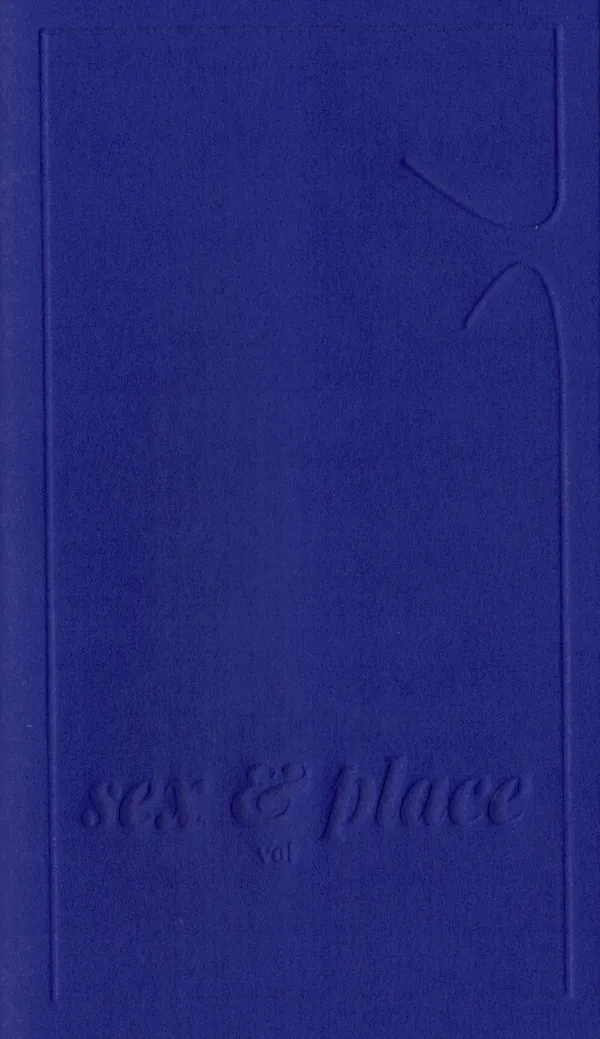
sex and place vol 1
Adriano Wilfert Jensen, Andrea Zavala Folache
sex and place is a series of workshops and publications exploring score-based and semi-anonymous writing as a tool for articulating shared concerns.
Vol. 1 ‘preliminiaries’ is written by Andrea Zavala Folache and Adriano Wilfert Jensen. In the midst of (learning) child care, (unlearning) performance and (experimenting with) sex, the publication interweaves three registers of writing as analogies and interruptions of each other.
The ‘sex and place’ series is part Domestic Anarchism, a project devoted to coalition-building beyond biological, chosen, or national conceptions of family. Dance serves as a set of tools and knowledge that can be applied beyond “the spectacle” to collectively study, write, and move.
Andrea Zavala Folache and Adriano Wilfert Jensen are choreographers and they co-parent three-year-old Penélope Cleo. Andrea and Adriano use dance and choreography to think about the distribution of care and solidarity beyond ‘the family’, and in turn consider how such a distribution could inform their dance practice. Inevitably themes like sex, economy, gender, and class get activated. But also notions such as prefiguration, anarchism, clitoridian* thinking, zones of non-domination and coalition building. They see dance as a knowledge that can be applied to different practices. Some of these include: co-habitations, score based writing and dancing, self-organised study groups and publications, workshops and dance performances.

Catflap Issue 05
catflap is the annual publication of new queer writing from Outburst Arts, a hot mix of open call submissions, curated interviews and smart queer writing with a disco heart.

Cough Drop Circus
Josheph Dunkerley, Holly Miles
This collection of 20 poems by young poets Holly Miles and Joseph Dunkerley sheds a glimpse into the bizarre journey of two isolated souls in a time of global crisis. Read along in this 24 page zine as they chart their unique perspectives of the worldwide COVID-19 pandemic!

Selected Writings of Gertrude Stein
This collection, a retrospective exhibit of the work of a woman who created a unique place for herself in the world of letters, contains a sample of practically every period and every manner in Gertrude Stein’s career. It includes The Autobiography of Alice B. Toklas in its entirety; selected passages from The Making of Americans; "Melanctha"from Three Lives; portraits of the painters Cezanne, Matisse, and Picasso; Tender Buttons; the opera Four Saints in Three Acts; and poem, plays, lectures, articles, sketches, and a generous portion of her famous book on the Occupation of France, Wars I Have Seen.