Books
Books
in random order

Howdunnit 2 - Panorama
Merle Kröger, Rubaica Jaliwala
Navina Sundaram is sitting in the editing room in Hamburg. She has managed to reduce the complexity of the Kemal Altun case to the required 2 minutes and 40 seconds for the political magazine; a journalistic feat considering the legal terminology and the international political situation, which must be presented in simple terms. She places her interview with the judge at the back. The audience therefore first gets an impression of perhaps the best-known deportation prisoner of the republic on trial here. The phone rings. I imagine she is displeased about the disturbance. It’s the day of the broadcast; the report still needs to be approved. It rings again. She answers. Peter Boultwood is on the phone and says, “Did you hear? Kemal jumped out of the window in the courtroom. He’s dead.”
Merle Kröger lives in Berlin where she works as a novelist, screenwriter and dramaturg. She was a member of the Berlin film collective dog film (1992–1999) and founded pong lm in 2001. Kröger is the co-author of Philip Scheffner’s internationally awarded films Revision (2012), Havarie (2016) and Europe (2022). Kröger has published five novels to date, including Grenzfall (2012), Havarie/ Collision (2015) and Die Experten/ The Experts (2021). Her novels have received numerous awards, including Best Crime Novel of the Year, the Radio Bremen Prize for Crime Fiction and the German Crime Fiction Prize.
Translated by Rubaica Jaliwala

Archive Dora Diamant #06
A collection of photographs from the archives of the icon of underground and alternative Parisian nights Dora Diamant.
A self-taught photographer, Dora Diamant has left thousands of photos. The Dora Diamant Association, custodian of this archive, and Éditions L'Amazone have joined forces to bring them to life by devoting a series of publications to them. Each volume of the Dora Diamant Archive was created by a different person and is the result of a subjective selection and arrangement specific to its author.
Figurehead of the Parisian underground and queer nights, photographer, DJ, multimedia and polymorphic artist, Dora Diamant was the daughter of Pascal Doury.
Selected by Leopold Duchemin.

Tongue Ring: Issue 01
Aodhan Madden, Claire Star Finch
Oh oh this is the first issue of Tongue Ring, a journal of experimental writing in English & French, with original contributions and translations of texts* by Ariana Reines*, CAConrad*, Camille Kingué, Kaur Alia Ahmed*, Rafael Moreno, Taos Bertrand, and Théo Robine-Langlois*.
Vous voyez, c’est ça mon genre. Je ne sais pas ce que c’est.
Mais c’est mon genre. J’ai cet esprit en moi—qui est très ému
par la féminité. Je pourrais me mettre à pleurer. Je veux poser
mon manteau par terre pour la laisser marcher dessus
—Ariana Reines
Premier numéro de la nouvelle revue fantastique et bilingue (FR + EN) d’écriture expérimentale Tongue Ring, avec des contributions originales ainsi que des traductions* de textes de Ariana Reines*, CAConrad*, Camille Kingué, Kaur Alia Ahmed*, Rafael Moreno, Taos Bertrand, and Théo Robine-Langlois*.

Amalgamemnon
History and literature seem to be losing ground to the brave new world of electronic media and technology, and battle lines are being drawn between the humanities and technology, the first world and the third world, women and men. Narrator Mira Enketei erases those boundaries in her punning monologue, blurring the texts of Herodotus with the callers to a talk-radio program, and blending contemporary history with ancient: fairy-tale and literal/invented people (the kidnappers of capitalism, a girl-warrior from Somalia, a pop singer, a political writer), connected by an elaborate mock-genealogy stretching back to the Greek gods, move in and out of each other's stories. The narrator sometimes sees herself as Cassandra, condemned by Apollo to prophesy but never to be believed, enslaved by Agamemnon after the fall of Troy. Brooke-Rose amalgamates ancient literature with modern crises to produce a powerful novel about the future of culture.
Christine Frances Evelyn Brooke-Rose was a British writer and literary critic, known principally for her later, experimental novels.

Delirious Verse
Andrea di Serego Alighieri, Amelia Rosselli and 1 more
Delirious Verse presents the first English translation of a talk given by the Italian poet Amelia Rosselli in the early 1980s, in which she read aloud from and expanded upon her seminal essay “Metrical Spaces.” Drawing on intensive literary and musical studies, and shaped by her trilingual upbringing as a refugee from fascist Italy, Rosselli conceptualizes a new kind of poetic form: a graphic-prosodic “time-space” capable of containing “all possible imaginable rhythms.”
The book includes a new translation of “Metrical Spaces” by Jennifer Scappettone and an afterword by Andrea di Serego Alighieri.
Edited and translated by Andrea di Serego Alighieri and Phil Baber.

BUTT 38
Slide into spring with our mega-stimulating 38th issue.
Hop in the jacuzzi with Italiano chart-topper Mahmood. Read the hustling tell-all with Ashland Mines aka deejay Bobby Beethovan. Zip to queer futures with internet-doll sensation @StarAmerasu. Go behind-the-scenes of some of the biggest French content creators with photographer @RaphaelChatelain. There’s hairy art from China, trans love affairs, cottaging evidence for court, d*ck arrangements, ladyboy activism, and so much more.
Plus, a back section of smutty poetry submitted to us by our talented readers, and a visit to our favorite local cruise bar on BUTT’s 25th anniversary. At 152 pages, it’s sure to satisfy size queens all around the world.

Sforzando - Pastels 2020 - 2022
At midday, March 17th, 2020, Macron’s government decided to place France in suspended animation. Total confinement. The first in a series of strict debilitating lockdowns to combat the spiralling Covid-19 pandemic. This first confinement lasted 55 days. It ended on 11th May 2020. The first part of a dramatic trilogy.
One month in, in April 2020, David West picked up a box of pastels that used to belong to his mother. He had had them for many years but never used them. New to the medium, locked in his Paris studio, he sets himself to the task. Naturally, violence ensues. Folk horror. Animals are disembowelled. Faceless sexualised female bodies perform. Screaming faces educate. Covered figures stand motionless. Shadows. Hooded beings populate. Stabbing, scratching, fading, softening, sforzando. Crescendo. Schadenfreude.
Occasional respite comes when West ventures outside - andante - but the externalised screaming pushes him back in. Hagazussa. Ghosts from West’s past, real and unreal, appear and disappear, figures and shapes, compositional arcs, a slimy snaking emerald hand parts the waves for colour to gush forth a new language verde fosforescente, worm purple, rosa shocking, vermillion, cobalt, ultra-black.
This book reproduces a small selection of some 300 works, in chronological order, in an attempt to document time, evolution, revolt, epiphany and joy. Joy in colour, horror, form, symphony, and finally, West’s visions of a new utopia. Marcato. Decrescendo.
Softcover (21cm x 29.7cm)
100 Pages
50 copies
Signed and numbered by David West

Grab Bag
Cult novelist Dennis Cooper launches the third title of Little House on the Bowery, the Akashic series he is editing and promoting.
Grab Bag is comprised of two interrelated novels, Dark Rides and Wish Book, from one of Canada’s most important young writers. Both books are set in the same small rural city, in different eras (1950s, 1930s), each characterized by McCormack’s spare and elliptical prose.

BFTK #6: Tentative — Incomplete — Inconsistent
Andrew Walsh‐Lister, Matthew Stuart
This instalment of Bricks from the Kiln doubles as issue #6 of the journal and as an exhibition catalogue for the thematic show ‘BFTK#6: Tentative — Incomplete — Inconsistent: A Catalogue of the Disappeared, Destroyed, Lost or Otherwise Inaccessible’. Presenting objects, artworks, artefacts, models, events and animals that no-longer — or never did — exist in physical form, the exhibition explores themes of death, destruction and reincarnation, examining persisting interests in notions of ephemerality and permanence, memory and record, preservation and erasure, creation and reconstruction.
How do we remember and memorialise? How is space given to the unrecorded? How do we experience the out of reach, concealed, unseen, undiscovered? How can the dematerialised be materialised again, through the mediation of writing, image and sound?
THE ALMOST HORSE
Helen Marten
(inside front / back cover)
‘STILL IN ALL HEARTS, IN ALL BELLIES, IN ALL TOES’:
A BELATED REVIEW OF FESTIVAL DE FORT BOYARD
Matthew Stuart & Andrew Walsh-Lister
(pp.6–8)
EDDYSTONE
Rachael Allen
(pp.11–18)
TO MAKE THE STONE STONY
Emily LaBarge
(pp.21–26)
WHEREFORE AM I NOW?
Lucy Mercer
(pp.29–40)
WESTON: THE TOWN THAT WAS, AND THEN WASN’T
Crystal Bennes
(pp.43–52)
NOTES TO ACCOMPANY VIOLENT INNOCENCE (2019)
Will Harris
(pp.55–64)
GHOST, POCKETS, TRACES, NECESSARY CLOUDS
Matthew Stuart
(pp.66–69)
CONNECTIVITY OF TOUCHING
Ali Na & Mindy Seu in conversation
(pp.71–76)
PEARL
Rose Higham-Stainton
(pp.79–84)
NOTES FROM NEW MEXICO
Jennifer Hodgson
(pp.87–98)
THE MOOG OF AHMEDABAD
Paul Purgas
(pp.101–108)
IN WHICH DECIBELLA ESCAPES AUDITION
Sarah Hayden
(pp.111–122)
D.C.B.: A PARTIAL RETROSPECTIVE
Juliet Jacques
(pp.125–136)
PINBALL REMAINS: ON THE PINBALL ISSUE OF THE SITUATIONIST TIMES
Ellef Prestsæter
(pp.139–150)
TOMB III – CADMIUM (2021)
Gilbert Again
(pp.152–154)
NON-DESCRIPT ANIMAL
David Hering
(pp.157–161)
Cover & Bookmark artwork by Helen Marten

Glass, Irony & God
Known as a remarkable classicist, Anne Carson weaves contemporary and ancient poetic strands with stunning style in Glass, Irony and God. This collection includes: "The Glass Essay," a powerful poem about the end of a love affair, told in the context of Carson's reading of the Bronte sisters; "Book of Isaiah," a poem evoking the deeply primitive feel of ancient Judaism; and "The Fall of Rome," about her trip to "find" Rome and her struggle to overcome feelings of a terrible alienation there.
Anne Carson was born in Canada and teaches ancient Greek for a living.

Untitled
Sasha Phyars-Burgess’ first monograph, Untitled. Spanning three bodies of work, this 200-plus page monograph includes poems by Ser Alida and Aurora Masum-Javed, a conversation between Sasha Phyars-Burgess, Juliana Huxtable and Carolyn Lazard, and essay by Bill Gaskins. Designed by Studio Lin.
As recipient of the second annual Capricious Photo Award, Sasha is a vital, emerging voice in contemporary photography, engaging the charged line between documentary and fine art. Her work ranges from affecting studies on diaspora, family and place to revolving social phenomenons in which energy, beauty and power meet.
The second annual jury panel was helmed by Capricious Founder and Publisher Sophie Mörner and Associate Publisher Anika Sabin alongside Lauren Cornell, Katherine Hubbard, JOFF, Matt Keegan, Guadalupe Rosales, Ka-Man Tse, and Lyndsy Welgos.

Le Sacrifice comme acte poétique
Angélica Liddell, Christilla Vasserot
Mise en scène, écriture – pièces de théâtre, poésie, récits, journaux – et présence sur scène : tout est lié chez Angélica Liddell. L’art et la vie, la fiction et la biographie, la création poétique et la réflexion théorique entretiennent les uns avec les autres des liens évidents et complexes. Ce volume inclut une série de textes qui, depuis une perspective théorique, éclairent en partie la pratique théâtrale de leur auteur, contribuant à la construction d’une poétique toujours inachevée, basée sur une expérience vitale.
Dans cet essai recueillant douze conférences et entretiens, Angélica Liddell évoque la création artistique ainsi que son processus dramaturgique très organique et très violent car « la violence poétique est nécessaire pour combattre la violence réelle ».
-
Direction, writing—plays, poetry, stories, journals—and stage presence: everything is interconnected in Angélica Liddell’s work. Art and life, fiction and biography, poetic creation and theoretical reflection maintain obvious yet complex connections with one another. This volume includes a series of texts that, from a theoretical perspective, shed light on the author’s theatrical practice, contributing to the construction of an ever-unfinished poetics rooted in lived experience.
In this essay, which brings together twelve lectures and interviews, Angélica Liddell discusses artistic creation as well as her highly organic and violent dramaturgical process, for “poetic violence is necessary to combat real violence.”

Publiek Park
Jef Declercq, Anna Laganovska and 2 more
The third Publiek Park publication – Walking Guide – combines essays, archival fragments, and artistic voices to trace both the exhibition route at Plantentuin Meise and the historical path that led from the creation of the Jardin Botanique in the heart of Brussels to its relocation outside the city. Following the logic of a quilt, layering different perspectives, textures, and timelines, the book connects artistic narratives with history and reflections on urban gardens, public space, and botanical imaginaries. Just like the exhibition, the publication offers not merely a portrait of a place, but a reflection on the multiplicity that defines it.
Alongside documentation of the exhibition and contributions from the participating artists, this year’s Walking Guide features writings by Nikolaos Akritidis, Denis Diagre-Vanderpelen, Koen Es, Lana Jones, François Makanga, Noam Youngrak Son, and Jean Watt. The two parks are portrayed in photographs by Michiel de Cleene, with book design by Victor Verhelst and Corbin Mahieu bringing all of these elements together.
This publication is made with the generous support of Plantentuin Meise and all partners.

Survival Takes a Wild Imagination: Poems
In the powerful follow up to her critically acclaimed debut collection, poet and activist Fariha Róisín is writing, praying, clawing, and scratching her way out of the grips of generational trauma on the search for the freedom her mother never received and the kindness she couldn’t give.
This collection of poetry asks a kaleidoscope of Who is my family? My father? How do I love a mother no longer here? Can I see myself? What does it mean to be Bangladeshi? What is a border? Innately hopeful and resolutely strong, Fariha's voice turns to the optimism and beauty inherent in rebuilding the self, and in turn, the world that the self moves through. Ubiquitous to the human experience, Survival Takes a Wild Imagination is an illuminating breath of fresh air from a powerful poetic voice.

The New Sentience. Reimagining Animal Poetry
As our treatment of nonhuman animals is increasingly implicated in planetary crises—from climate change to global pandemics to unprecedented rates of biodiversity loss and species extinction—it’s clear that an urgent reconsideration of our relationship to other animals is not only necessary but overdue.
How we write about animals, how we represent them in our poems and stories, doesn’t simply reflect how we relate to them in the world; it also shapes how we treat them. Any cultural shift in how we conceive of other animals requires a shift in how we read and write about them. The New Sentience seeks to help catalyze this shift by ushering in a new kind of animal poetry, what editors Ashley Capps and Allison Titus dub “kinpoetics.” Whereas animals in Western poetry have disproportionately functioned as symbols, the poems in this anthology foreground a meaningful awareness of animal sentience and subjectivity, depicting other animals as individuals with dynamic selfhood, personalities, and emotional lives.
Stylistically wide-ranging, the poets featured here, among them Wendell Berry, Lucille Clifton, E. E. Cummings, Mary Oliver, Ross Gay, and Margaret Atwood, apply scrutinous lyrical attention to the animal experience in such surprising and illuminating ways that the reader can’t avoid an earnest reexamination of what humans owe our more-than-human kin. With humility, empathy, and curiosity, the work in this anthology reaffirms the vital connections between humans, animals, and the natural world. This pioneering book will impel readers to a deeper understanding of the lives of the creatures that share our planet and will inspire poets and writers to a more compassionate, meaningful engagement with animal subjects and lives.
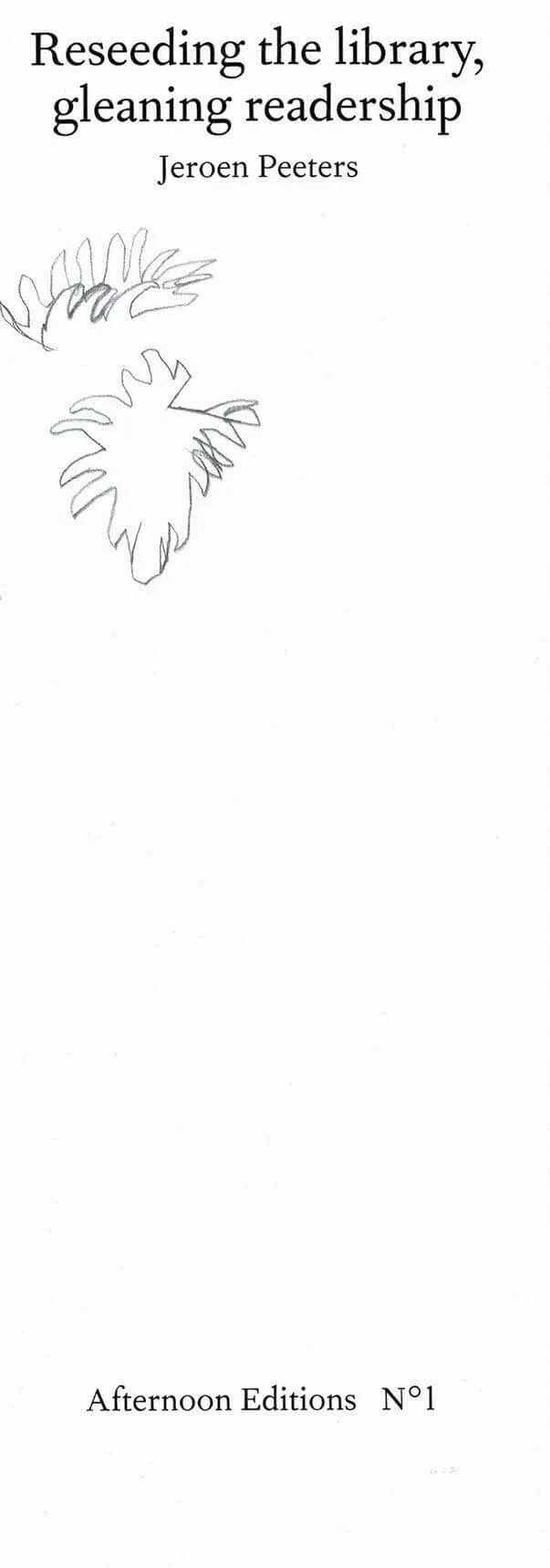
Reseeding the library, gleaning readership
Afternoon Editions no. 1: an essay by Jeroen Peeters titled Reseeding the library, gleaning readership. In May 2017, Time has fallen asleep in the afternoon sunshine settled during three weeks in the Ravenstein Gallery in Brussels as part of the Kunstenfestivaldesarts. Invited as a writer in residence, Jeroen Peeters visited the library of living books on a daily basis and recorded his observations by hand in a notebook, which formed the basis for Afternoon Edition #1. Reseeding the library, gleaning readership is an essay on the seed library, on the dispersion of literature through wind, water and animals, on biodiversity and commoning at the heart of readership. On the cover a drawing by Wouter Krokaert of a Philodendron Xanadu. Published May 2018.

Hopelessness
"The brilliant Verity Spott has a new book out, called Hopelessness and published by the 87 Press. The work defies categorisation: Verity is a poet, and this book is certainly poetry, but large parts are in prose form and towards the end it even takes on the structure of an absurdist play. There seems to be a loose narrative, and even recurring character voices, so I’m tempted to call it a short experimental novel, in the vein of Kenneth Patchen’s The Journal Of Albion Moonlight (a personal favourite). Ultimately though I’d just call it a book; one full of words that are profound, moving, silly, sad, challenging and beautiful in equal measure. Even though it’s still a boldly experimental piece, in some ways Hopelessness feels like the most accessible thing Verity’s done. Without wanting to sound condescending, it’s also the most mature. You don’t get much more universal than death, love and loss, and these seem to be the main themes explored here. Another is language itself, the way it defines and limits our experience, and the way that we’re constantly at the mercy of words and phrases as they’re deployed by the authorities, the media, and eventually our own thought processes. Dissenting voices continually talk over one another throughout Hopelessness, often sampled from outside sources, or parodies thereof: Sappho, MR James, traditional hymns and folk songs, Hollywood movies, talk radio, tabloid newspapers, dreams and demagogues. Through it all there’s a painful lesson about how loss can make us bitter and hard, and how by refusing to move forward we become empty caricatures mouthing meaningless clichés to wound and hurt. But grief and loss can also teach us about love, if we let them, and there is so much grief and love in this book. Verity continually rearranges reality (that is, language) as if searching desperately for a way out, but in the end, as always, there is just life, love, and death. Hopelessness is a bravura performance, wholeheartedly recommended." — Ben Graham
Verity Spott is a poet from Brighton. Verity is the author of several books including Hopelessness (the 87 Press), Click Away Close Door Say (Contraband Books), We Will Bury You (Veer Books) and Poems of Sappho (in translation, Face Press). From 2018 to 2019 Verity was Poet in Residence at the University of Surrey. Verity teaches poetry in Brighton with The Creative Writing Programme and (alongside Kat Addis) with the Hollingdean Wednesdays project where they hold a poetry reading and writing group in Hollingdean Community Centre. Verity's poems have been translated into Greek, Spanish, Portuguese, Dutch and German and their book Hopelessness has been translated into French and published by Même pas l'hiver. Verity plays cello in the improvised tune duo Benzo Fury and the free jazz trio In Threads. Since 2006 Verity has run the monthly poetry, performance and music event Horseplay.

this simulation sux
Jr Ting Ding, DeForrest Brown Jr.
this simulation sux is a collection of speculative essays and personal observations commissioned by global cultural institutions and local counterculture zines between February 2020 and April 2021.
"During the moment of pause brought on by the initial lockdown, we chose to write as a form of self care and mediated therapy; writing, for us, is a way to process, orient, and grasp for a moment of clarity in the ever changing media and cultural landscape. In this informational era, in which our attention is in very high demand, the amount of content we are expected to consume is endless. Beset with political unrest, economic uncertainty, and waning emotional bandwidth, we have become datapoints in the vast and saturated marketplace presented to us as “society.”
[...]
Flânerie, the French term describing the act of walking and observing, became a part of our daily ritual; we lapped the outer edges of the island of Manhattan and exploring various neighborhoods during the peak of the pandemic. The images presented on this book’s jacket were captured on these walks, documenting the absurdities of everyday life in this fraying simulation. Personal, anecdotal narratives of an imagined reality are represented through the images, which are placed alongside our speculative observations derived from historical data.
We hope that these writings can provide others with prose and information that can be applied like an antidotal balm to treat our communal ailment of future shock."
—Ting Ding 丁汀 & DeForrest Brown, Jr.

Play-White
The racist term "play-white" comes from the apartheid era, when it connoted a black or mixed race person who lived as a white person: “So and so is a play-white.” South African artist Bianca Baldi draws from studies of biomimicry and her own family history, as well as literary precedents—such as Nella Larsen’s novel Passing (1929)—to reflect on racial passing and the instability of racial identities. Play-White alternates between layers of visualization and moments of discretion in order to explore questions of presence and evasion beyond their representation in black and white.
With contributions by Bianca Baldi, Mika Conradie, Shoniqua Roach, Amy Watson, and others; design by Katharina Tauer & Wolfgang Hückel in collaboration with K. Verlag.
Published 2021

Slow Mania
Nazareth Hassan’s devastatingly brilliant Slow mania is a powerful document of senses and sense-making where estrangement and ugliness meets longing and beauty. The artist begins with a photographic sequence: two white-blue sky panels; a shattered glass storefront window; a street gutter clutching leaves, smashed straw sleeves and plastic lids; then snow holding a disassembled red stained chest of drawers. These are the writer’s plinths where form as waste is configured: “smoggy breath thru burnt-edged holes tracking acid mucous inside your home.” Slow mania provokes through enumerative structures, for instance, “screening bodies” who keep a sex club’s gates open only to some: “…197 mmm maybe lemme think / 151 yes / 162 yes / 197 ok yes, but keep your shirt on.” The poet deftly folds human intimacy into interspecies metaphor: “The rat torso twitches in agreement. Across / the street, the flies continue to starve,” where “…you’re lost in your own hole: what did you find?” Hassan attends to this painful search, bearing witness to the disturbingly exultant, offering a radical state of being, in and out of which the stunning and timely Slow mania lives and thrives. — Ronaldo V. Wilson
Slow mania is resistance to resolution, it’s pointillistic magic, it’s Seurat in Bed-Stuy: the tighter you zoom, the more undifferentiated beauty you encounter. It’s kinky (the kinked-up curls of somebody’s greased-up chops). It’s tender (bruised and brown, like the overripe fruit that haunts your summer kitchen waiting to be crumbled into a crumble). The colors are blurry, the edges are soft, the stakes are high, and everything—everything!—shimmers in the space between life and afterlife. Hassan’s gaze is a hot summer steam that sneaks into the skinniest, stinkiest crevices; the grimiest seams, the most miraculous cracks. Breathe into the abyss, that’s the invitation. Take it in, let it in. Be a wit(h)ness to every single being. — Steffani Jemison
This amazing book reads like a synesthetic performance, the only thing missing is the smell of sweat, of streets, of loss. A book of choreographed pages, scores, movements, image blur, hand-scribbles. The bleak, unsparing texts hidden among the materials turn out to be the record of sudden eruptions, violent street scenes, pick-up scenes, unclear dialogues, insults, self-debasing verbal injuries on repeat. The performers are racialized, sexualized, anonymized “persons,” “meats,” numbers, lovers, passers-by, all caught up in these dangerous yet desperately emotional and triggering dances at the limit. It will leave you raw, spaced-out, both roused and alarmed as though coming out of an intoxicating show, and wanting more. — Caroline Bergvall

OEI #102–103 Photography on Edge
Cecilia Grönberg, Jonas J. Magnusson
Photography on Edge – 25 visual dossiers compiled and introduced by Geoffrey Batchen + ”Wanting more” – on and from the work of Australian artist Justine Varga + translations of a selection of Geoffrey Batchen’s essays into Swedish
”The published history of photography has long been motivated by a number of key principles: innovation and originality, authorship and nationality, chronology and medium specificity, technical excellence and aesthetic achievement. The folios [in OEI #102–103] offer an alternative way to regard this history. They comprise a series of repetitious fragments drawn more or less arbitrarily from across various photographic practices and genres. In every case, these folios present a photography on edge: tense, nervous, unsure of itself—at least when compared to the self-certainty we encounter in most histories of this medium.
A photography on edge is a photography that escapes the usual definitions. […] One thing is for sure: if they are to be included in future histories of photography, then we will need to set aside our prejudices and presumptions and learn to say what we see, and not just see what we already know how to say.”
— Geoffrey Batchen in Photography on Edge

I Love Shopping
Chickens have a collective soul. Heaven is full of the skateboarders you kissed in middle school. If the algorithm is its own hell, Lauren Cook, author of the critically (and uncritically) acclaimed Sex Goblin, stands in front of it fully armored. I Love Shopping invites its readers to inhabit a world just like ours, reflected through a big, benevolent funhouse mirror.
First published in a limited edition, this is the first trade edition of the cult classic.

Blade Pitch Control Unit
Blade Pitch Control Unit is a gathering of Sean Bonney’s work in poetry between 2000-2005. It collects together all the work from his previous pamphlets that he still feels is valid, plus a number of previously unpublished pieces.
The presentation of this work in a single volume makes clear the scope of his project as a psychogeographic/historical exploration of the possibilities of political verse that would seek to obliterate the pitfalls of simple protest or the expression of easily assimilable opinions.
The work moves from psychogeographical registerings of Greenwich and the Isle of Dogs at the time of the Millennium Dome, through excavations of the ghosts of millennial heresies still present in contemporary London, and into a charting of the effects of official mendacity on the psyche of any individual citizen who knows that all private experience is collective.
The events of recent history play a major role, sometimes obliquely, sometimes less so, but Bonney refuses to allow his voice to be merely an outraged commentary on contemporary woes. Instead, he presents a poetry that makes clear that the protestor is also culpable, but equally a poetry that understands that only through a registering of this position can a way out be found.
For Bonney, a poem is typically a highly rhythmic (or arrhythmic) object that seeks through maximum density to communicate a dialectical relationship with the cosmos, and to explore the faultlines of official history and urbanism through which possibilities of liberation can be traced.

Better Do It Now before You Die Later: Sonny Simmons with Marc Chaloin
Though his years in the New York free-jazz scene of the sixties cemented his reputation as "one of the most forceful and convincing composers and soloists in his field," saxophonist Sonny Simmons (1933–2021) was nearly forgotten by the '80s, which found him broke, heavily dependent on drugs and alcohol, and separated from his wife and kids. "I played on the streets from 1980 to 1994, 365 days a year," Simmons tells jazz historian and biographer Marc Chaloin. "I would go to North Beach, and I'd sleep in the park. The word got around town that Sonny is a junkie, really strung out."
The resurrection of Simmons' career―upon the release of his critically acclaimed Ancient Ritual (Qwest Records) in 1994―has become a modern legend of the genre. In the last two decades of his musical career, Simmons broke through to a new echelon of recognition, joining the pantheon of great innovators and masters of the music. But to this day he remains an undersung figure. Here, in the first ever book dedicated to his life, Simmons recounts his childhood in the backwoods of Louisiana, his adolescence in the burgeoning Bay Area jazz scene and his star-studded life in New York playing alongside the greats.