Books
Books
in random order

Tar Hollow Trans: Essays
"I've lived a completely ordinary life, so much that I don't know how to write a transgender or queer or Appalachian story, because I don't feel like I've lived one.... Though, in searching for ways to write myself in my stories, maybe I can find power in this ordinariness."
Raised in southeast Ohio, Stacy Jane Grover would not describe her upbringing as "Appalachian." Appalachia existed farther afield—more rural, more country than the landscape of her hometown.
Grover returned to the places of her childhood to reconcile her identity and experience with the culture and the people who had raised her. She began to reflect on her memories and discovered that group identities like Appalachian and transgender are linked by more than just the stinging brand of social otherness.
In Tar Hollow Trans, Grover explores her transgender experience through common Appalachian cultural traditions. In "Dead Furrows," a death vigil and funeral leads to an investigation of Appalachian funerary rituals and their failure to help Grover cope with the grief of being denied her transness. "Homeplace" threads family interactions with farm animals and Grover's coming out journey, illuminating the disturbing parallels between the American Veterinary Association's guidelines for ethical euthanasia and the World Professional Association for Transgender Health's guidelines for transgender care.
Together, her essays write transgender experience into broader cultural narratives beyond transition and interrogate the failures of concepts such as memory, metaphor, heritage, and tradition. Tar Hollow Trans investigates the ways the labels of transgender and Appalachian have been created and understood and reckons with the ways the ever-becoming transgender self, like a stigmatized region, can find new spaces of growth.

Exocapitalism – Economies with absolutely no limits
Roberto Alonso Trillo, Marek Poliks
A rigorous and mind-blowing account of the dynamics of capitalism today through an in-depth exposition of software, speculative finance, and the highest scales of arbitrage.
At the centre of Marek Poliks and Roberto Alonso Trillo's argument is the idea that capital does not belong to humans, it belongs to—and is governed by—itself. Traditional economic theory struggles to keep up with the rapid rate of acceleration, and this book steps in to address this:
"The critical orthodoxy is slowing; it's tired, it's not especially good at the internet, it's probably never manned a Starbucks counter or an anonymous cubicle. Its younger adepts—though digitally native—are chronically underemployed, unavailable, drowning in the student debt (or student opportunity cost) required for entry into the critical apparatus. Few have any patience for the numbing slop-speak of the LinkedIn economy, the libertarian enclave of forex and HFT and memecoins, the quarter-zip depravity of employment at the charnel houses of McKinsey or Deloitte or Accenture, the blazingly random mood-swings of venture capital that lubricate all of the above. This impatience is—in the parlance of the above—a blocker: it means that the critical apparatus underestimates the power of the software economy, struggles to articulate the morphological density of digitally-realized capitalism, comprehensively ignores the functional death of labor, and doesn't understand scale."
Introduction by Charles Mudede.
Afterword by Alex Quicho.
"A masterpiece... Nick Land for adults."
— 0nty

Biography of a Fiction
Biography of a Fiction collects poems written between 2020 to 2025. These poems were written in a diaristic way, mostly in short form, while working on larger pieces, some of which also collected here or elsewhere. What started, seemingly, as notes on reproductive desire, gender, and sexuality soon matured into a meditation on the role of fiction in the exercise of writing (and idealizing) a biography, including the thorny aspect of artistic license and the uses of one’s own life and of others.

Pearls from Their Mouth
This book is built of stories and provocations—like the birth of a pearl, it transforms that which irritates, layer by layer.
Through speculative fiction and critical essays, Pear Nuallak explores what happens when messy, desiring bodies collide with the hard edge of power. The world’s neat categories are unmade and rewritten, revealing that racial capitalism’s myths are just as much fantasies as Thai bird princesses and transgender magic.
Moving playfully across folktale, horror, satire and critique, Nuallak examines how different beings are formed politically, bodily and emotionally. We discover interdimensional fungi resisting colonisation, queer monsters living on Hampstead Heath, and a mysterious canal running through the ruins of capitalism into interstitial realms. We test the borders of queer diasporic nationalism and take apart the racially melancholic memoir. In this fiery yet delicate collection, we aren’t bound by truth, but flow with it into new worlds.
Pear Nuallak is a visual artist and writer from London. They run community art workshops and co-organise a queer social hub with the Black Cap Community Benefit Society. Their writing has been published in The Dark and Interfictions. Pearls from Their Mouth is their first book.

Insula
Insula est un roman d’anticipation aussi intime que spéculatif qui mêle autofiction, confession intime, esthétique queer, jeu vidéo, et une formidable vision apocalyptique du monde contemporain. Insula (île, en latin), c’est d’abord le nom d’un jeu clandestin de réalité augmentée d’un nouveau genre : il suffit d’ingérer une pilule stupéfiante et illégale pour accéder à la simulation. Théo, le narrateur, en apprend l’existence lors d’une fête de cruising queer, au sommet d’un immeuble désaffecté du centre de Londres, dans une atmosphère d’apocalypse. Un garçon s’effondre à ses pieds quelques minutes après avoir consommé la substance, et pleure des larmes de sperme. Mais Théo doit tout interrompre pour se rendre au chevet de son père mourant, dans un hôpital parisien. C’est le moment de la dernière nuit, du dernier souffle et des derniers aveux. Le mot insula revient, cette fois dans la bouche des médecins, pour désigner une partie flottante du cerveau ravagée par la maladie, comme une île qu’on a dans la tête. Alors que les médias annoncent la disparition de plusieurs personnes qui auraient pris une pilule d’insula, l’étau se resserre sur Théo qui se résout à son tour à prendre un cachet prohibé avec l’intuition que les avatars ne sont que des fantômes, et qu’il pourra ainsi retrouver son père dans l’autre monde.
Ce roman aux accents dantesques (vision d’un enfer digital qui n’est que le double du monde réel), entre vertige technologique et exploration du désir, est marqué par la pensée critique du réel et la pop culture (Final Fantasy, Kanye West). Il ouvre un univers parallèle pour raconter l’histoire d’une traversée intime, convoquer des époques, des territoires et des identités multiples, dans une seule et même histoire qui navigue entre témoignage et fantasme. Dystopie, histoire d’amour et de fantômes, enquête et cauchemar, Insula est un portail entre plusieurs dimensions, le vrai et le faux, le réel et le digital, la vie et la mort.

Tuesday or September or the End
During a residency on Fire Island, artist and writer Hannah Black decided to tackle a highly daunting project: the 2020 novel.
The result of her efforts, Tuesday of September or the End, is a slim, playful work of speculative fiction. Written in the aftermath of the early months of the pandemic and the uprisings of summer 2020, the novel explores the ruptures of the year with a satirical sci-fi bent. Black chronicles the lives of two characters, Bird and Dog, as they contend with rapidly changing political possibilities during the pandemic while the run of Moley Salamanders (i.e. Bernie Sanders) concludes and aliens finally invade earth. Through a galvanic vision of how the riots of 2020 might have turned revolutionary, Black offers a meditation on collective life. This crucial novel invites readers to consider who we are—and, by extension, what we are here for—when our normal referents are muted, deleted and upended.
Hannah Black (born 1981) is a New York-based visual artist, critic and writer from Manchester, England. Her work spans video, text and performance and draws from communist, feminist and Afro-pessimist theory. She is the author of Life (2017, with Juliana Huxtable) and Dark Pool Party (2016). Black is represented by the gallery Arcadia Missa in London and Isabella Bortolozzi in Berlin.

Paradis catalogue
Contributions by: Nicole-Antonia Spagnola, Georgia Sagri, John Kelsey, Matthew Pang, Cathy Wilkes, Sarah Rapson, Nick Irvin, Gene Beery, Anne Dressen, Anne Pontégnie, Jacqueline Mesmaeker, Sara Deraedt, Anne Rorimer, Kari Rittenbach, Olga Balema, Maria Nordman, Louise Lawler, Julie Ault, Martin Beck, Adrian Morris, Matt Browning, John Miller, Envers Hadzijaj, Enzo Shalom, Bedros Yeretzian, Morag Keil, Helmut Draxler, Gianna Surangkanjanajai, Steve Cannon, Rae Armentrout, Zoe Hitzig, Pierre Guyotat, Lola Sinreich, Fanny Howe, Hélène Fauquet, Marie Angeletti, Richard Hawkins, Andy Robert, Alexander García Düttmann, Daniel Horn, El Hadji Sy, Henrik Olesen, Aurélien Potier, Richard John Jones, Stéphane Barbier Bouvet, Nora Schultz, Peter Fend, Megan Francis Sullivan, Jill Johnston, Sturtevant, Tonio Kröner, Bernard Bazile, Pierre Bal-Blanc, Jérome Pantalacci, Gérard Traquandi, Gladys Clover, Maria Wutz, Jimmie Durham, Richard Sides, Camilla Wills, Michael Callies, Steven Warwick, Matthew Langan-Peck, Dan Graham, Nina Könnemann, Hans Christian Dany, Valérie Knoll, Win McCarthy, Eleanor Ivory Weber, Anna Rubin, Heji Shin, Michèle Graf & Selina Grüter, Inka Meißner, Simone Forti, Morgan O’Hara, Angharad Williams, Ye Xe, Lily van der Stokker, Yuki Kimura, Peter Wächtler, Eva Steinmetz, Michael Van den Abeele, Marc Kokopeli, Bradley Kronz, Robert Grosvenor, Samuel Jeffery, Charlotte Houette, Adam Martin, Wade Guyton, Chloe Truong-Jones.
Edited by Marie Angeletti with Gianmaria Andreetta and Camilla Wills.

Girl With a Bullet
Ukrainian poet Anna Malihon’s English-language debut gathers daring, resilient, open-eyed poems written before and after Russia’s full-scale invasion. The difficult fates voiced by the protagonists of Malihon’s poems intertwine with her own experience, weaving an alarming but beautiful world where the young grow old and love is met with war. This world, at first shocking, holds the reader in suspension, compelling a desire to rethink and reread. With deft allegory and startling metaphor, Malihon crafts a poetry that seeks to influence the course of events, to reroute history.

Ethical Portraits: In Search Of Representational Justice
Ethical Portraits investigates the representation of the incarcerated in the U.S. criminal justice system. Through interviews, creative non-fiction, and cultural theory, Hatty Nestor deconstructs a range of different prison portraiture.
Prisons systematically dehumanise the imprisoned. Visualised through mugshots and surveillance recordings, the incarcerated lose control of their own image and identity. The criminal justice system in the United States does not only carry out so-called justice in ways that compound inequality, it also minimises the possibility for empathetic encounters with those who are most marginalised. It is therefore urgent to understand how prisoners are portrayed by the carceral state and how this might be countered or recuperated. How can understanding the visual representation of prisoners help us confront the invisible forms of power in the American prison system? Ethical Portraits investigates the representation of the incarcerated in the United States criminal justice system, and the state's failure to represent those incarcerated humanely.
Through wide-ranging interviews and creative nonfiction, Hatty Nestor deconstructs the different roles of prison portraiture, such as in courtroom sketches, DNA profiling, and the incarceration of Chelsea Manning. Includes a foreword by Jackie Wang.
Hatty Nestor is a cultural critic and writer, published in Frieze, The Times Literary Supplement, The White Review and many other publications. She is currently completing a PhD at Birkbeck, University of London.

À perte de mère – Sur les routes atlantiques de l'esclavage
Saidiya Hartman traces the history of the Atlantic slave trade by recounting a journey she took along a slave route in Ghana. Following the trail of captives from the hinterland to the Atlantic coast, she reckons with the blank slate of her own genealogy and vividly dramatizes the effects of slavery on three centuries of African and African American history.
Saidiya Hartman, professor of English and comparative literature at Columbia University, is a scholar of African American literature and cultural history.
Preface by Maboula Soumahoro.
Translated from the English (American) by Maboula Soumahoro (original title: Lose Your Mother. A Journey Along The Atlantic Slave Route, Farrar, Straus and Giroux, 2007).

Oslo National Academy of the Arts
Segunda Vez: How Masotta Was Repeated
Publication documenting the research made by Dora García for a video project on Oscar Masotta, pioneer of Lacanian psychoanalysis in Latin America and influential art critic.
It features a selection of Masotta's writings as well as contextual essays on his work.Segunda Vez is an art research project centered on the figure of Oscar Masotta (Buenos Aires, 1930, Barcelona, 1979), an author of groundbreaking texts about the Happening, art, and dematerialization, a pioneer of Lacanian psychoanalysis in the Spanish-speaking world, and a happenista. The project has yielded a full-length and four medium-length films by Dora García, two Cahiers documenting the research, and this book. Segunda Vez: How Masotta Was Repeated offers a selection of Masotta's writings, including his early study of Argentinean author Roberto Arlt, as well as texts that contextualize Masotta's thought and broaden the reach of his reflections on the intersections between performance and psychoanalysis, art and politics.
Edited by Emiliano Battista.
Texts by Dora García, Oscar Masotta, Roberto Bolaño, Jorge Jinkis, Inés Katzenstein, Ana Longoni, Emiliano Battista, Aaron Schuster, Julio Cortázar.
English edition
13,5 x 21 cm (hardcover)
320 pages (color & b/w ill.)

Immediacy: Or, the Style of Too Late Capitalism
Why speed, flow, and direct expression now dominate cultural style.
Contemporary cultural style boosts transparency and instantaneity. These are values absorbed from our current economic conditions of "disintermediation": cutting out the middleman. Like Uber, but for art. Immediacy names this style to make sense of what we lose when the contradictions of twenty-first-century capitalism demand that aesthetics negate mediation. Surging realness as an aesthetic program synchs with the economic imperative to intensify circulation when production stagnates. "Flow" is the ultimate twenty-first-century buzzword, but speedy circulation grinds art down to the nub. And the bad news is that political turmoil and social challenges require more mediation. Collective will, inspiring ideas, and deliberate construction are the only way out, but our dominant style forgoes them.
Considering original streaming TV, popular literature, artworld trends, and academic theories, Immediacy explains the recent obsession with immersion and today's intolerance of representation, and points to alternative forms in photography, TV, novels, and constructive theory that prioritize distance, impersonality, and big ideas instead.

Writing in Space, 1973–2019
Writing in Space, 1973-2019 gathers the writings of conceptual artist Lorraine O'Grady, who for over forty years has investigated the complicated relationship between text and image.
A firsthand account of O'Grady's wide-ranging practice, this volume contains statements, scripts, and previously unpublished notes charting the development of her performance work and conceptual photography; her art and music criticism that appeared in the Village Voice and Artforum; critical and theoretical essays on art and culture, including her classic "Olympia's Maid"; and interviews in which O'Grady maps, expands, and complicates the intellectual terrain of her work. She examines issues ranging from black female subjectivity to diaspora and race and representation in contemporary art, exploring both their personal and their institutional implications.
O'Grady's writings—introduced in this collection by critic and curator Aruna D'Souza—offer a unique window into her artistic and intellectual evolution while consistently plumbing the political possibilities of art.
Edited by Aruna D'Souza

Biarritz
Written and edited in Biarritz, Borgerhout and Midsommarkransen, 2016—2021. Dedicated to Räffi, with much love. Another version of this text was published in Pfeil Magazin 10 (Montez Press, 2018); editor: Anja Dietmann, copy-editor: Stacy Skulnik. Epigraph from Numéro Deux (1975) by Anne-Marie Miéville and Jean-Luc Godard. Presented on Saturday February 5th 2022 at Kransen, Borgerhout.
128x201mm, 40p, staple bound. Riso-printed on Arcoprint Edizioni Avorio 90g and Clairefontaine Blue 210g. Design by Kaye–Matthé, typefaces: Tribute, Gillies Gothic Light. Printed by Risiko Press at Kransen, covers silkscreened at Afreux, bound by Drukkerijcollectief De Wrikker. Edition of around 200.

one long continuous line or a thought that dissolves into the distance
A short text or a long line written by Mette Edvardsen for Etcetera magazine (June 2018) on an invitation to elaborate on her approach to text, writing and speech from a choreographic point of view. Held by a cardboard cover, the text is here published on its own as a very slim book.

Quantum Listening
What is the difference between hearing and listening? Does sound have consciousness? Can you imagine listening beyond the edge of your own imagination?
In response to the anti-war movements of the 1960s, pioneering musician and composer Pauline Oliveros began to expand the way she made music, experimenting with meditation, movement and activism in her compositions. Fascinated by the role that sound and consciousness play in our daily lives, Oliveros developed a series of Sonic Meditations that would eventually lead to the creation of Deep Listening – a practice for healing and transformation open to all, rooted in her musicianship.
Quantum Listening is a manifesto for listening as activism. Through simple yet profound exercises, Oliveros shows how Deep Listening is the foundation for a radically transformed social matrix: one in which compassion and peace form the basis for our actions in the world.
This timely edition brings Oliveros’ futuristic vision – blending technology and spirituality – together with a new Foreword and Introduction by Laurie Anderson and IONE.

Simurgh Self-Help
The 2025 Ringier annual report (artist's book).
Since 1998, Ringier, the Swiss-based global media company, has traditionally commissioned an artist to design its annual report. Publisher Michael Ringier and curator Beatrix Ruf initiated this series as a means of reinforcing the links between art and the activities of the company.
For the 2025 edition, Slavs and Tatars' Simurgh Self-Help revisits Marcel Broodthaers' seminal work Musée d'Art Moderne: Département des Aigles (1968–1972), replacing or "translating" the eagle—a symbol of power and empire that is used to challenge our understanding of authority and value—with the Simurgh, a mythical bird found across the Turkic-Persianate world. Whilst the eagle is often associated with nation-states and masculinity, the Simurgh is decidedly transnational, metaphysical, and flamboyant, if not gender-fluid.
Much like the collective's geographic remit—between the former Berlin Wall and the Great Wall of China—this publication attempts to shift our focus elsewhere, eastwards, to regions which too often fall through the cracks of historiography and art history. If modern and contemporary art institutions in Broodthaers' time were largely situated between the Rhineland and Northeast United States, the multipolarity of today's art world is a fait accompli: with biennials in Uzbekistan and museums in Kazakhstan, amongst others, rivalling the traditional centers of power.
Once too a sacred bird—accompanying Zeus, for example—the eagle has, over the past two millennia, undergone a thorough profanation: a brawny, secular flex of nationalism. It would be remiss not to see the parallels in the world of media: print itself and the act of reading, once an activity for the few and anointed, has undergone a similar dynamic of democratization over the past several centuries and, especially in recent years with the internet, a vulgarization which would make medieval Church elders wag their shriveled fingers at us in an I-told-you-so meme meant for the ages. This profanation has challenged the very institution of media and the narratives it disseminates, much as important works of institutional critique challenged contemporary art in the 1970s and beyond—akin to Slavs and Tatars' genre-bending mix of high and low, East and West, sacred and profane does today.
Slavs and Tatars' (founded 2006) extensive publishing activity—some 15 books in 20 years—has treated subjects as diverse as alphabet politics, Uighur literary culture, political satire in the Muslim world, and German anti-Enlightenment thinkers. Alongside sculptures, textile works, installations, sound pieces, and even a brick-and-mortar Pickle Bar in Berlin, the collective's books have cleared new paths for contemporary discourse via a wholly idiosyncratic form of knowledge production that draws on popular culture, spiritual and esoteric traditions, oral histories, modern myths, as well as scholarly research.
Slavs and Tatars is a faction of polemics and intimacies devoted to an area east of the former Berlin Wall and west of the Great Wall of China known as Eurasia. The collective's work spans several media, disciplines, and a broad spectrum of cultural registers (high and low) focusing on an oft-forgotten sphere of influence between Slavs, Caucasians and Central Asians.
Slavs and Tatars has published Kidnapping Mountains (Book Works, 2009), a celebration of complexity in the Caucasus, Love Me, Love Me Not: Changed Names (onestar press, 2010) and are currently preparing solo engagements at Vienna's Secession, Museum of Modern Art, New York and Künstlerhaus Stuttgart.

Coups de putes
Faut-il cautionner la prostitution pour soutenir les travailleuses du sexe ? Faut-il pénaliser les clients ? La prostituée est-elle le symbole de l'oppression des femmes ? Juno Mac & Molly Smith posent un regard nouveau sur ces questions souvent conflictuelles. Elles rejettent l'alternative entre condamnation et glorification du travail du sexe, et étendent leur propos à des problématiques plus larges : les frontières, l'exploitation, le sexisme et la suprématie blanche. En délaissant les symboles passionnés et en examinant les effets concrets des différents régimes législatifs, elles démontrent que la lutte des travailleuses du sexe est d'une importance capitale pour le mouvement social.

Plastic: A Poem
Set during a single twelve-hour night shift in an injection molding factory, plastic is a book-length poem exploring the life of the industrial worker turned poet.
Bringing together memoir, ekphrasis, and satire, plastic is based on Matthew Rice’s experience working in a plastic molding factory for ten years. Illustrating alienated twenty-first-century Irish labor in poetic form, plastic engages with the inflictions and implications of a “post-industrial,” “post-Troubles” society, all while weaving in depictions of factory work from literature, film, and the visual arts.
Time-stamped to highlight the claustrophobia of the worker’s experience, Rice meditates on masculinity, sectarianism, and intergenerational trauma. But at its core is a poem about feeling a calling while being submerged in the world of menial labor—making plastic airplane parts by night, making poetry by day.
Invoking the brevity of Seamus Heaney, plastic is an expansive and imaginative poem that offers the working class a grace, dignity, and truth not often found in contemporary literature.
MATTHEW RICE was born in Belfast. He holds an MA in poetry from Queen’s University Belfast and is currently undertaking a PhD at the Seamus Heaney Centre at Queen’s. His debut collection, The Last Weather Observer, was published in 2021 to critical acclaim, highly commended for the Forward Prize for Best First Collection, and included in the Arts Council of Northern Ireland’s top ten books of the year.

Glove Money
A hymn to perversity, a lyric pledge to desire and risk, Glove Money pages through the canon to “seed its sugar in your dreams.”
In this joyful and irreverent exploration of the role of poet-as lover, Sophia Dahlin plays Sappho, O’Hara, romantics and troubadours, assembling a self seaworthy of romance. With humor and a light touch, Glove Money dismisses bioessentialist gatekeeping and expands the lesbian imaginary.
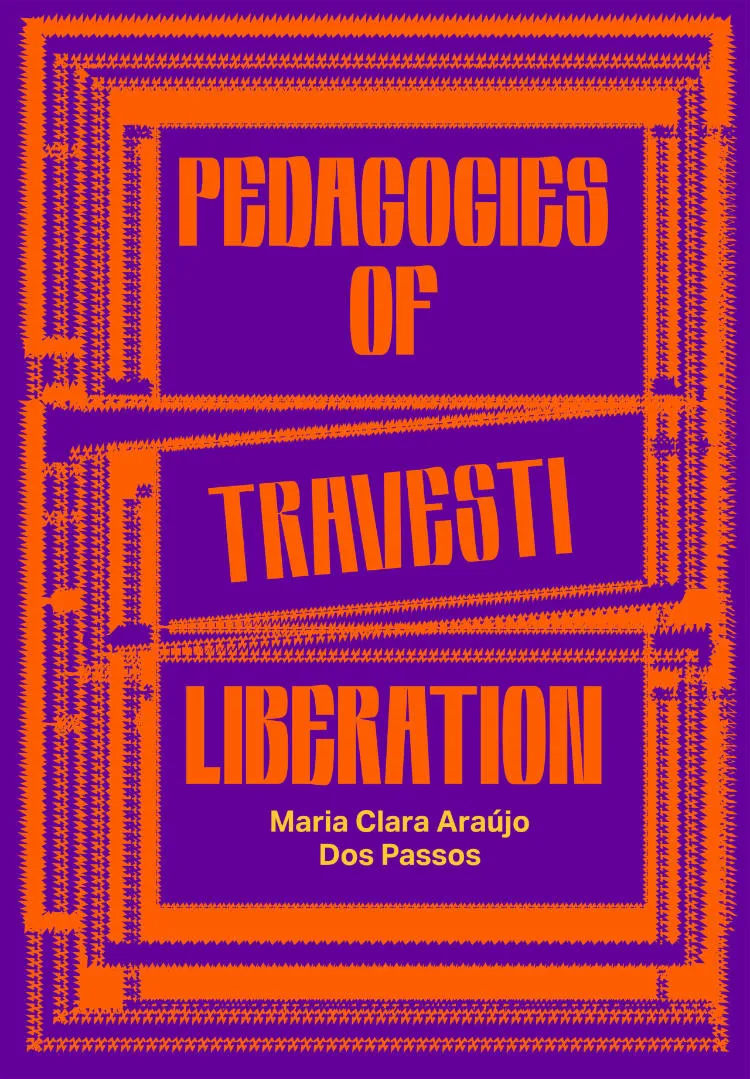
Pedagogies of Travesti Liberation
Maria Clara Araújo dos Passos, Natália Affonso
Maria Clara Araújo dos Passos examines the interplay of education, identity, and liberation in Brazil's travesti community.
In Pedagogies of Travesti Liberation, Maria Clara Araújo dos Passos critiques traditional pedagogical frameworks that marginalize gender nonconforming narratives and highlights the effects of systemic discrimination on travestis' psychosocial well-being. The book advocates for inclusive educational practices and emphasizes the need for affirmative curricula.
Newly translated from Portuguese, this work contributes towards connecting political struggles globally and navigating the complexities of translation—particularly of the term "travesti"—across various geographical and political contexts, featuring a conversation between Araújo dos Passos and translator Natália Affonso.
Maria Clara Araújo dos Passos (born 1996 in Recife) is a Brazilian Afro-transfeminist educator and sociologist, and an activist for LGBT rights.

Sick issue 7
Writing on navigating the workplace as an ambulatory wheelchair user, how sex work can be a means of survival, re-imagining 'Christina's World', the boundaries of our bodies, an interview with Caren Beilin, poetry, artwork, book recommendations, and much more.
Essays, features, poetry, art, interviews & more from Laura Baliman, Caren Beilin, Amy Berkowitz, Leah M. Bowie, Kaitlin D'Avella, Lindsy Davis, Katherine DeCoste, Yining Fang, Emily Freeman, Maria Gray, Bec Mackenzie, Ariana Martinez, Chloe McGreal, Ryann McKinney, Iyla Owens, Emily Pinkerton, Marin Scarlett, Maya-Gawonii Shabazz-Saleh, Anna Stiles, Maeve Sweeney, & J Min Wang.
SICK is an independent, thoughtful magazine exploring illness and disability, founded & edited by Olivia Spring and designed by Kaiya Waerea. Founded in Norwich, UK in 2019, we are currently based in Maine, USA and London, UK. We typically publish one issue per year.

Água Viva
In Água Viva Clarice Lispector aims to 'capture the present'. Her direct, confessional and unfiltered meditations on everything from life and time to perfume and sleep are strange and hypnotic in their emotional power and have been a huge influence on many artists and writers, including one Brazilian musician who read it one hundred and eleven times. Despite its apparent spontaneity, this is a masterly work of art, which rearranges language and plays in the gaps between reality and fiction.
Clarice Lispector (December 10, 1920 – December 9, 1977) was a Brazilian writer acclaimed internationally for her innovative novels and short stories. Born to a Jewish family in Podolia in Western Ukraine, as an infant she moved to Brazil with her family, amidst the disasters engulfing her native land following the First World War.

I Love Shopping
Chickens have a collective soul. Heaven is full of the skateboarders you kissed in middle school. If the algorithm is its own hell, Lauren Cook, author of the critically (and uncritically) acclaimed Sex Goblin, stands in front of it fully armored. I Love Shopping invites its readers to inhabit a world just like ours, reflected through a big, benevolent funhouse mirror.
First published in a limited edition, this is the first trade edition of the cult classic.