rile*books

Search books

Search books by title, author, publisher, keywords...

Explore

Categories
Visit
Collections
Publishers
Back in stock
Any books
Cover of On Breathing

Peninsula Press

On Breathing

Jamieson Webster

€18.00

A beautiful, expansive essay about care, dependence, and what it means to breathe in an age of environmental catastrophe. 

A few moments after birth we begin to use our lungs for the first time. From then on, we must continue breathing for as long as we are alive. And although this mostly happens unconsciously, in a society plagued by anxiety, climate change, environmental racism, and illness, there are more and more instances that ‘teach us about the privilege that is breathing.’

Why do we so easily forget the air that we breathe in common? What does it mean to breathe when the environment that sustains life now threatens it? And how can life continue to flourish under conditions that are increasingly toxic?

To approach these questions, Jamieson Webster draws on psychoanalytic theory and reflects on her own experiences as an asthmatic teenager, a deep-sea diver, a palliative psychologist during covid, a psychoanalyst attentive to the somatic, and a new mother. The result is a compassionate and timely exploration of air and breathing as a way to undo the pervasive myth of the individual by considering our dependence on invisible systems, on one another, and the way we have violently neglected this important aspect of life.

Published in 2026 ┊ 255 pages ┊ Language: English

recommendations

Cover of Bad Language

Peninsula Press

Bad Language

So Mayer

Essays €20.00

There is no such thing as a safe word. 

In Bad Language, So Mayer blends memoir and manifesto as they explore the politics of speech, while looking at how language has been used – and abused – in their own life. What is the relationship between language and sexual violence? And how can we ‘make ourselves up’ in language when words themselves are encoded by a dominant culture that insists we see ourselves as powerless listeners rather than active speakers? 

Examining the semantic traps of their multi-lingual childhood – and taking in texts from the Torah to Grimms’ Fairytales, from protest bust cards to the works of Ursula K. Le Guin – Mayer asks who gets to speak, and who is forced into silence. Bad Language calls out the harm that words can do, while searching for crafty ways through which we can collectively reclaim language for protest and pleasure. 

‘Mayer’s writing is generous, astute and sincere; in Bad Language, they choose their words carefully, using incantation and spell to distil a complex argument – the transformative power of language lay in its ability to shape sense perception. For Mayer, the task of ‘making ourselves up’ is another way of asking, what kind of world do we want to live in?’ – Lola Olufemi

SO MAYER is a writer, editor, bookseller and organiser. Truth & Dare, their first collection of speculative fiction, was longlisted for the Republic of Consciousness and Edge Hill Short Story prizes. With Sarah Shin, they co-edited Ursula K. Le Guin, Space Crone, winner of the 2024 Locus Award for non-fiction. Bad Language is their second book for Peninsula, after A Nazi Word for a Nazi Thing.

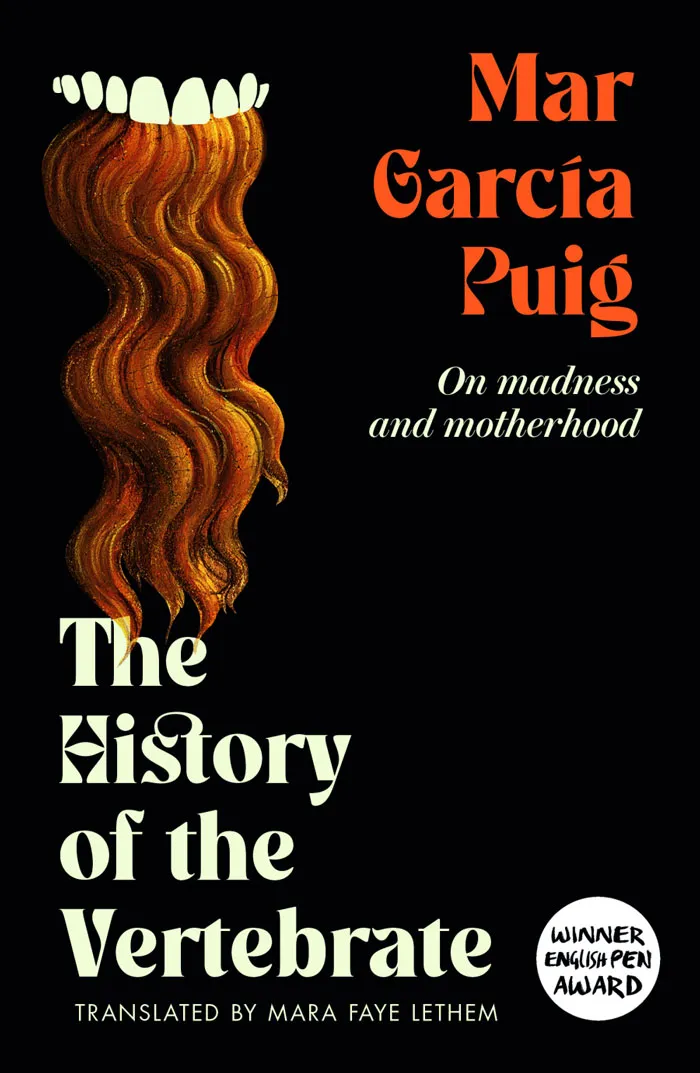
Cover of The History of the Vertebrate

Peninsula Press

The History of the Vertebrate

Mar García Puig, Mara Faye Lethem

‘On 20 December 2015 I became a mother and I went mad.’ 

On a single day, Mar García Puig gives birth to twins and becomes elected to the Spanish Parliament as a member of the insurgent left-wing party Podemos. What might have been the best day of her life becomes the start of a terrifying ordeal; García Puig’s grip on reality begins to slip as she grapples with uncertainty, the weight of expectation, and misogyny in both of her new roles. 

In defiance of a culture that tells her the problem lies within, García Puig chooses to look outwards, examining the imbrication of madness and motherhood across centuries of science, myth, and politics while dissecting the ways in which women have been pathologized and banished from public life. 

At once intimate and epic, The History of the Vertebrate is a searing account of postpartum madness. Moving between memory, culture, and the history of medicine, García Puig transforms her experience into a story about the countless women who have felt that sanity was leaving them, and about the patriarchal forces that have silenced them. 

MAR GARCÍA PUIG is an editor and author. From 2015 to 2023 she was a member of the Spanish Congress of Deputies for Podemos, where she served on the Culture Committee and the Equality Committee. Her books include The History of the Vertebrate and This Thing of Darkness.

Cover of A Nazi Word for a Nazi Thing

Peninsula Press

A Nazi Word for a Nazi Thing

So Mayer

Essays €12.00

An essay on art, bodies and fascism.

In an era where identity politics is being weaponised against the very people it has sought to make visible, how can we reclaim complexity?

In 1937 the Nazis staged an exhibition of seized modernist artworks. Named Entartete ‘Kunst’ – Degenerate ‘Art’ – it sought to define degeneracy, display it and destroy it.This act of violent appropriation is one episode in a long and ongoing history of the erasure of queer and non-normative cultures.

A Nazi Word for a Nazi Thing works against this erasure; it is a manifesto – a catalogue for an exhibition that could never take place. Drawing on work from dissident sexologist Magnus Hirschfeld to South African artist Zanele Muholi, as well as a century of queer cinema from Sergei Eisenstein to Pedro Almodóvar, So Mayer creates an archive of resistance.

‘This book is a small revolution that becomes a party that you won’t be leaving soon. I believe we’re living in a time of fresh erasures, systemic violences working that global pandemic to take some other bodies out. Looking so freshly at the history of queerness, sexual deviance and the long long coordinated erasures of colonialism, bigotry and transphobia the essential non binary nature of art opens up right here like the wildly singing flower it is and So Mayer’s compelling version makes sense, makes me listen.’
Eileen Myles

‘A Nazi Word for a Nazi Thing is a reflective, creative walk through some of the worst – and best – people of the last hundred years, looking at the power of images and their relationship(s) with text. In a time of rising fascism, So Mayer highlights ways that artists have found strategies of resistance, and offers hope in historical analysis.’
Juliet Jacques

Cover of Weird Fucks

Peninsula Press

Weird Fucks

Lynne Tillman

Fiction €17.00

A brilliant novella from a legendary figure in American fiction.

A young woman drifts through dimly lit bars and rented rooms, reporting from the erogenous zones of New York and Europe. Encountering increasingly bizarre sexual situations, she turns her curious, comic, and fierce eye onto the contemporary world of sex and desire.

The men of this world evade and simper, they prey, preen, and fall hopelessly in love. In the narrator’s deadpan portraits, we see young women indulging their freedom through hope and disappointment, and young men wearing various guises of masculinity.

This novella surprises with unlikely fucks, disturbing fucks, outlandish fucks, and some truly weird fucks – all written with the smart, elegant, and tough style which could only be that of Lynne Tillman.

Cover of Dominique: The Case of an Adolescent

Divided Publishing

Dominique: The Case of an Adolescent

Françoise Dolto

Non-fiction €17.00

"Dolto’s Dominique is the only case I’ve found that rivals Freud, and brings us up to date, replete with questions of incestuous trauma, repressed sexualities, autism and cognitive disability, and a profound sense for the contradictions of polite society and histories of colonial and racist violence. I love this child and encountering Dolto’s otherworldly voice as an analyst." — Jamieson Webster

While the child psychoanalyst Françoise Dolto stands alongside Jacques Lacan as a leading light of the Other French School, she has been little translated and remains curiously unknown in the English-speaking world. First published in 1971, Dominique: The Case of an Adolescent is frank and close to the clinical experience. A masterpiece of the genre, it is at once a granular psychological portrait of a troubled adolescent and his familial inheritance, and a historical case study, set in the France of the 1960s, of the of the relationship between subjectivity, nationality, and time and space.

With a foreword by Michael Ryzner-Basiewicz

Translated by Ivan Kats, revised by Lionel and Sharmini Bailly

Cover image by Mike Kelley, Untitled 1975

Françoise Dolto (born 6 November 1908, Paris) was a psychoanalyst and paediatrician. Alongside private practice at her home, where she saw adults and children, Dolto practised in four institutions where she saw only children patients: the Polyclinique Ney, the Centre Claude Bernard, the Hôpital Trousseau and the Centre Etienne Marcel. From 1967 to 1969, Dolto answered adult and child listeners of the French radio station Europe No. 1, live and anonymously under the name ‘Docteur X’. The programme enjoyed excellent ratings, but Dolto found dialogue to be hindered by the demands of live broadcasting and advertising. In 1976, she agreed to return to radio with Lorsque l’enfant paraît on France Inter, on the condition that she replied to listeners’ letters, which enabled her to go into depth. The programme was a huge success, and would make her a household name. In 1978 Dolto retired as an adult psychoanalyst: her fame had become such that it distorted the therapeutic relationship with patients. She now devoted herself to prevention, training of young analysts, group and individual supervision, publications, conferences and radio and television broadcasts. She also continued her work with children in the care of the Aide Sociale à l’Enfance, some of whom she received at her home until the end of her life. In 1979, along with a small team, she founded the Maison Verte, a place for early-years socialisation welcoming children from ages zero to four along with their caregivers, for sessions of play and talk. This model spread throughout France and Europe, to Russia, Armenia and Latin America. Dolto is the author of more than a dozen books, and several essays, interviews and seminars. In English, her books have been translated as Psychoanalysis and Pediatrics (Routeledge, 2013) and The Unconscious Body Image (Routledge, 2022). Françoise Dolto died on 25 August 1988 in Paris.

Cover of Parapraxis 06: Resistance

Parapraxis

Parapraxis 06: Resistance

Essays €25.00

In 1911, Sigmund Freud addressed his followers gathered at Nuremberg, where he restated the import of his practice: “the task of psychoanalysis lies not at all in the discovering of complexes, but in the dissolving of resistances.” A formal antipode to political resistance, psychoanalytic resistance dams up desire and obstructs traumatic knowledge. It is conservative, allergic to change, and aims for the kind of frictionless normativity against which the unconscious drives rail. Meanwhile, we associate political resistance with change itself, with a blockade that pushes for revolution—rather than a blockage that censors its very possibility. If we read Freud as urging his followers to help their patients move through their resistance, psychoanalysis is a project on the side of material and political reality by bringing patients out of isolation and into social struggles. However, psychoanalysis is often glossed in reverse: as a project of isolated relief for the stubborn individual.

Should psychoanalysis only succeed at rendering patients compliant in their cure? Is psychoanalysis a tool for nullifying political resistance? If so, Freud’s edict for the aim of psychoanalysis is now but an epitaph. It would be easy, then, to give up the ghost, to let psychoanalysis go. But why should psychoanalysis retreat from collective symptoms back into the consulting room for individual treatment—away from strikes, riots, and uprisings, and toward complacency and normativity, if not quite literally marriage and babies? Why should the clinic not dare to be in and of the world?

Feeling restless. Hunger tactics. Laughing in the face of fascism. Breaking through. Diagnosing revolution. Madness in the Maghreb. Essays by Fady Joudah, Jamieson Webster, Dylan Saba, Yasmin El-Rifae, Ussama Makdisi, Mary Turfah, Hannah Proctor, and more.

In Memory of Joshua Clover (1962-2025).

Cover of Spike #88 – Spirituality

Spike Magazine

Spike #88 – Spirituality

Periodicals €20.00

For our Summer 2026 issue, amid the latest revival of SPIRITUALITY in culture, Spike asked: what are people reaching for beyond what can be measured? The answers are eclectic, emphatic, and most of all personal: Johanna Hedva’s essay about the human voice’s part in the divine; portraits of mystic artists Lee “Scratch” Perry, Natasha Tontey, and Santiago Yahuarcani by Isis Semaj-Hall, Riar Rizaldi, and Miguel A. López; Jamieson Webster’s psychoanalytic look at Renaissance painting’s body of Christ; a spiritual history of perfumes by Élisabeth de Feydeau; Patrick McGraw’s soulful reading of America’s (perhaps) greatest living author, Joy Williams; queries of Gen Z’s search for God by Lamorna Ash, the disappearance of atheism by Steven Phillips-Horst, and a new form of contemplation by Aodhan Madden; and LIFEMAXXING recommendations to purge the soul, sometimes devilishly. Plus, some backpage words of wisdom from Tea Hačić-Vlahović: “Devotion and humiliation are holy.” 

Cover of After Institutions

Floating Opera Press

After Institutions

Karen Archey

Essays €17.00

The current crisis of museums and the future of Institutional Critique.

Faced with waning state support, declining revenue, and forced entrepreneurialism, museums have become a threatened public space. Simultaneously, they have assumed the role of institutional arbiter in issues of social justice and accountability. The canon of Institutional Critique has responded to the social embeddedness of art institutions by looking at the inner workings of such organizations. In After Institutions, Karen Archey expands the definition of Institutional Critique to develop a broader understanding of contemporary art's sociopolitical entanglements, looking beyond what cultural institutions were to what they are and what they might become.

Karen Archey is curator of contemporary art at the Stedelijk Museum Amsterdam. She is a 2015 Creative Capital | Warhol Foundation Arts Writers Grant recipient for short-form writing. Since joining the Stedelijk Museum in April 2017, Archey has organized solo exhibitions by artists Rineke Dijkstra, Stefan Tcherepnin, Catherine Christer Hennix, Steffani Jemison, Metahaven, Jeff Preiss, Charlie Prodger, and Hito Steyerl. She has written numerous catalogue essays and is a contributor to several art publications, including Artforum and Frieze.

Cover of Grandma’s Story

Silver Press

Grandma’s Story

Trinh T. Minh-ha

Essays €11.00

‘May my story be beautiful and unwind like a long thread . . .’, she recites as she begins her story. 

The storyteller is the living memory of her time: at once an oracle, weaver, healer, warrior, witch, protectress, teacher and great mother. Her powers are to do with passing on – not only the stories but transmission itself: ‘what grandma began, granddaughter completes and passes on to be further completed.’

In contrast to the idea that a story is ‘just a story’, pioneering postcolonial feminist theorist and filmmaker Trinh T. Minh-ha recodes ideas about truth and fantasy to tell a different story about power, civilisation, history, medicine and magic. Grandma’s Story shows how creative speech is connected to women’s powers of enchantment, drawing upon and speaking with storytellers including Theresa Hak Kyung Cha, Clarice Lispector, Maxine Hong Kingston, Leslie Marmon Silko and Zora Neale Hurston – all who may be known as ‘she who breaks open the spell’. 

The story as a cure and a protection is at once musical, historical, poetical, ethical, educational, magical, and religious.

Cover of Five Devours

Vibrational Semantics

Five Devours

Holly Pester

Essays €8.00

‘Five Devours’ is a short essay in five parts about need and food as a part of speech, about speech’s relationship to nourishment and hunger; the currency between eating and speaking, expending and consuming.

12 pages
150 x 200mm
risograph printed 
edition of 150

Cover of Post-Nationalism

Berggruen Press

Post-Nationalism

Rosi Braidotti

Essays €6.50

Why is post-nationalism so difficult to accept? Why is it that everyone still clings to ideas about their nations and cultures that limit exchange and construction? Why is it that Europe, the post-national project par excellence, is still facing a deficit in commitment compared to national and even local commitments?

In this riveting essay, Rosi Braidotti tackles these questions through a renewed examination of the social imaginary underlying how people understand their communities, cultures and nations. Europeans in particular need to become Europeans just as we became French, Italian or German in the past.

In the contemporary geopolitical context — war, the rise of authoritarian right-wing politics, the return of illiberal, neofascist political movements spreading a climate of gloom and crisis — the unfinished task of becoming post-national has acquired new urgency. The way to make it possible might lie in a renewal of love and solidarity, creative energy and affirmative ethics.

Rosi Braidotti is a philosopher and feminist theorist. A distinguished university professor emerita at Utrecht University and honorary professor at RMIT University, her work is discussed all around the world. She has authored more than 20 books. Her last book in English is Posthuman Feminism (Polity, 2022).

Cover of Semi-Nomadic Debt-Ridden Bedouins

Lenz Press

Semi-Nomadic Debt-Ridden Bedouins

Basma al-Sharif

Essays €35.00

Semi-Nomadic Debt-Ridden Bedouins offers an in-depth look at nearly two decades of artistic output by the Palestinian artist and filmmaker Basma al-Sharif. Retracing her practice from recent works back to her earliest experiments, the book provides an original overview of how her visual language and conceptual concerns have evolved over time.

Basma al-Sharif's films and installations navigate the unstable terrains of displacement, colonialism, and representation—often shaped by the ongoing reality of the occupation of Palestine. Through a rich selection of images and curatorial essays, the monograph highlights the layered political and cinematic frameworks within which her works are embedded.

Also included are two newly commissioned literary contributions: a fictional piece by Karim Kattan that resonates with the themes of place and estrangement, and a conversation between al-Sharif and the artist Diego Marcon, in which they reflect on shared affinities, artistic processes, and their long-standing dialogue. Blurring the personal and the political, the real and the imagined, Semi-Nomadic Debt-Ridden Bedouins captures the complexity and urgency of al-Sharif's artistic journey.

Texts by Basma al-Sharif, Karim Kattan, Diego Marcon, et al.

Basma al-Sharif (born 1983 in Koweit) is a Palestinian artist working in cinema and installation. She developed her practice nomadically between the Middle East, Europe, and North America and is currently based in Berlin. Her practice looks at cyclical political conflicts and confronts the legacy of colonialism through satirical, immersive, and lyrical works.