rile*books

Search books

Search books by title, author, publisher, keywords...

Cover of And then it got legs: Notes on dance dramaturgy

Varamo Press

And then it got legs: Notes on dance dramaturgy

Jeroen Peeters

€18.00

Drawing on his experience in the field of contemporary dance, Jeroen Peeters discusses principles, methods and practices that contribute to an understanding of dramaturgy as an experimental, collaborative practice and a material form of thinking.

Written from practice, this book reflects a particular history of collaboration and conversation with dance-makers such as Martin Nachbar, Meg Stuart, Vera Mantero, Sabina Holzer, Lisa Nelson, Jennifer Lacey, Chrysa Parkinson, deufert + plischke, Eleanor Bauer, Philipp Gehmacher and many others.

Phantasmal archaeology, unfolding material, literal and physical reading, crafting method, articulating process, witnessing and performing not-knowing, naming and ritual destruction, conceptual landscapes, symbolic waste, internal fictions and foreign objects – they may all play a role in creation and in exploring the unfamiliar in pursuit of making sense.

And then it got legs is an invitation to think along or against, to discuss those ideas with others or explore them in the studio, and eventually to imagine and devise one’s own methods of research, observation, reflection and creation.

Published in 2022 ┊ 168 pages ┊ Language: English

recommendations

Cover of Being a Chair. Essays on Choreographic Poetry

Varamo Press

Being a Chair. Essays on Choreographic Poetry

Janne-Camilla Lyster

Essays €12.00

Imagine words approaching a dance eyes closed or sleepwalking, words adrift beyond what can be envisioned beforehand, prompting writer and reader alike into a zone where time multiplies, where bodies grow footnotes and paper skin, savour the taste of language, attune their ears to the wavelength of blue. In a string of brief essays on her practice of writing choreographic poetry and scores, Janne-Camilla Lyster offers reflections on time, memory and the senses, on translation, punctuation and rhythm, on mistakes and crevasses, on the impossible and yet other things. What does it take to enter another form of existence, say, a chair?

Janne-Camilla Lyster is a writer, dancer and choreographer. She has published poetry, novels, essays and plays.

Cover of Wrap, History and Syncope

Varamo Press

Wrap, History and Syncope

Isabel de Naverán

Non-fiction €12.00

18 July 1936, Bayonne. After hearing the news of the Fascist uprising, the Spanish dancer and bailaora Antonia Mercé y Luque, known as La Argentina, suffers a syncope and dies in fateful synchrony with the Second Republic. History, and the artist’s body, have been seized and broken by the event.

In close dialogue with images and historical documents, Isabel de Naverán pursues the reverberations of that shock and how it resonates with collective pain and artistic translations (by Federico García Lorca, Gertrude Stein, Kazuo Ohno and others). How does history affect and move through bodies? How do living bodies carry and pass on cultural legacy and collective memory? What do these complex movements reveal about the present? Wrap, History and Syncope is an affective journey that invites the reader into tracing and revisiting other bodies, to ultimately dance their difference and multiplicity for oneself.

Isabel de Naverán is a writer and researcher. Concern with the passage and use of time is the backbone of her work, which focuses on bodily transmission and the examination of the concept of historical time by way of ephemeral and fugitive practices. She holds a PhD in art from the University of the Basque Country.  

Translation from Spanish: Toni Crabb
Graphic design: Michaël Bussaer

Cover of Fields

Varamo Press

Fields

Julien Bruneau

Fiction €18.00

As a stretch of land cultivated for crops to grow, a field evokes sensuous associations of smells, turned soil, exposure to weather. In a sense, fields ground our entire sedentary civilization and the cultures it gave rise to. At the same time, the field is where bodies fall in battle, the site that hosts the perishing of things.

Interweaving strands of autobiography with mythological and cultural tropes, Julien Bruneau explores the field as a metaphor rich with meaning and possibility. How do we inhabit fields and their furrows? How in turn do their history and imagination traverse us? As if it were a dance on the page, Fields invites the reader to encounter, think and feel our entanglement with space and places.

Julien Bruneau is an artist working with dance, presence, drawing and writing. His interest lies in the dynamic interplay between interiority and the collective.

Cover of Writing Dance

Varamo Press

Writing Dance

Jonathan Burrows

‘Human beings embody whatever they meet, and it’s all there when you work whether you want it there or not.’ Practice is like the dust that accumulates, and revisiting fragments of essays and talks on choreography Jonathan Burrows ended up embracing the haphazard and the mess, moments of unfocus and focus, harnessing them in pithy formulations and scores, adding room and punctuation and line breaks in the process so readers can hear the rhythm as he writes his dance on writing dance.

Jonathan Burrows is a choreographer, who has worked for many years in collaboration with the composer Matteo Fargion, with whom he continues to create and perform work. He is the author of A Choreographer’s Handbook (Routledge, 2010) and is currently an Associate Professor at the Centre for Dance Research, Coventry University.

Published by Varamo Press in the essay series Gestures
Graphic design by Michaël Bussaer

Cover of Compromised by Magic

Varamo Press

Compromised by Magic

Augusto Corrieri

Enchanted €12.00

Being together in the dark awaiting a film or play, we’re actually readying ourselves for a threshold experience, for something else to appear: ‘We catch a glimpse of how the possible and the impossible are in fact threaded together, always have been.’ In these essays on the intersection of theatre, ecology, magic and darkness, Augusto Corrieri unearths forms of knowledge and attention repressed by Western modernity. How can we explore particular modes of attending to worldly things, he wonders, ‘modes of attending that value impossibility, multiplicity, drift, impermanence and dislocation, that hold dear the importance of the un-seen, the un-extracted, the un-consumed. There are things not meant for human eyes.’

Augusto Corrieri is an artist and writer. In his work he deconstructs the apparatus of theatre, inviting spectators to reflect on questions of spectacle and ecology in the twenty-first century. He presents sleight-of-hand magic performances under the pseudonym Vincent Gambini. www.vincentgambini.com

Cover of Let's Not Get Used to This Place – Works 2008-2023

Damaged Goods

Let's Not Get Used to This Place – Works 2008-2023

Meg Stuart

Performance €45.00

Edited by Astrid Kaminski, Jeroen Versteele, Julie De Meester. A personal and intimate look behind the scenes of Meg Stuart's creative process over more than a decade. 

Since the early nineties, Meg Stuart, and her dance company Damaged Goods, based in Brussels, have produced a remarkable and audacious body of choreographic work. In 2010, Damaged Goods published Are we here yet?, which spans the first twenty years of Meg Stuart's career. In the follow-up book Let's not get used to this place, the choreographer looks back on more than a decade of works through reflections, interviews, scores, and notes on the practice of creating, performing, teaching and living dance. These are mixed with reports, essays and poetry by collaborators and other observers, photos, performance texts and archive material. The book's title, gleaned from one of Stuart's recent video works, ties together these multifarious sources in a desire to discard tried and tested strategies, explore new contexts, and transgress the edge of what we (do not) know. 
Let's not get used to this place gives a sense of the plentitude of motions, inspirations and personalities that energize Meg Stuart's creative cosmos. It offers a personal and intimate look behind the scenes of the creative process, and expands this to include the world around it. As a journey through her more recent career, an inspiring manual and a work of art in its own right, it has a wide appeal to an international base of artists, students and peers, and to anyone who is interested in performance.

Contributions by Jean-Marc Adolphe, Preethi Athreya, Mariana Tengner Barros, Sandra Blatterer, Esther Boldt, Márcio Kerber Canabarro, Varinia Canto Vila, Descha Daemgen, Jorge De Hoyos, Igor Dobricic, Brendan Dougherty, Doris Dziersk, Tim Etchells, Moriah Evans, Thomas F. DeFrantz, Jule Flierl, Alain Franco, Davis Freeman, Ami Garmon, Philipp Gehmacher, Jared Gradinger, Ezra Green, Claudia Hill, Maija Hirvanen, Elise Misao Hunchuck, Astrid Kaminski, Kiraṇ Kumār, Göksu Kunak, André Lepecki & Eleonora Fabiano, Jean-Paul Lespagnard, Marc Lohr, Matthias Mohr, Anne-Françoise Moyson, Anja Müller, Kotomi Nishiwaki, Jeroen Peeters, Alejandro Penagos, Léa Poiré, Leyla Postalcıoğlu, Ana Rocha, Tian Rotteveel, Hahn Rowe, Isabela Fernandes Santana, Maria F. Scaroni, Bernd M. Scherer, Kerstin Schroth, Gerald Siegmund, Charlotte Simon, Mieko Suzuki, Claire Vivianne Sobottke, Poorna Swami, Meg Stuart, Margarita Tsomou, Kristof Van Boven, Elke Van Campenhout, Myriam Van Imschoot, Jeroen Versteele, Doug Weiss, Stefanie Wenner, Jozef Wouters, John Zwaenepoel.

Cover of Bookmarks of sorts

Afternoon Editions

Bookmarks of sorts

Jeroen Peeters

Afternoon Editions no. 5: a collection of found papers annotated by Jeroen Peeters, titled Bookmarks of sorts. During several years Jeroen Peeters collected notes left by readers in library books: faded reader tickets, scraps with notes, a shopping list, train tickets and other little papers used as bookmarks. He noted each time the date and the book in which they were found. Afterwards he wrote commentaries to this collection, an essay on alternative reading practices, marginalia and extra-illustration, on the exchange between readers and the imaginary community lingering in all those library books.

Cover of Reseeding the library, gleaning readership

Afternoon Editions

Reseeding the library, gleaning readership

Jeroen Peeters

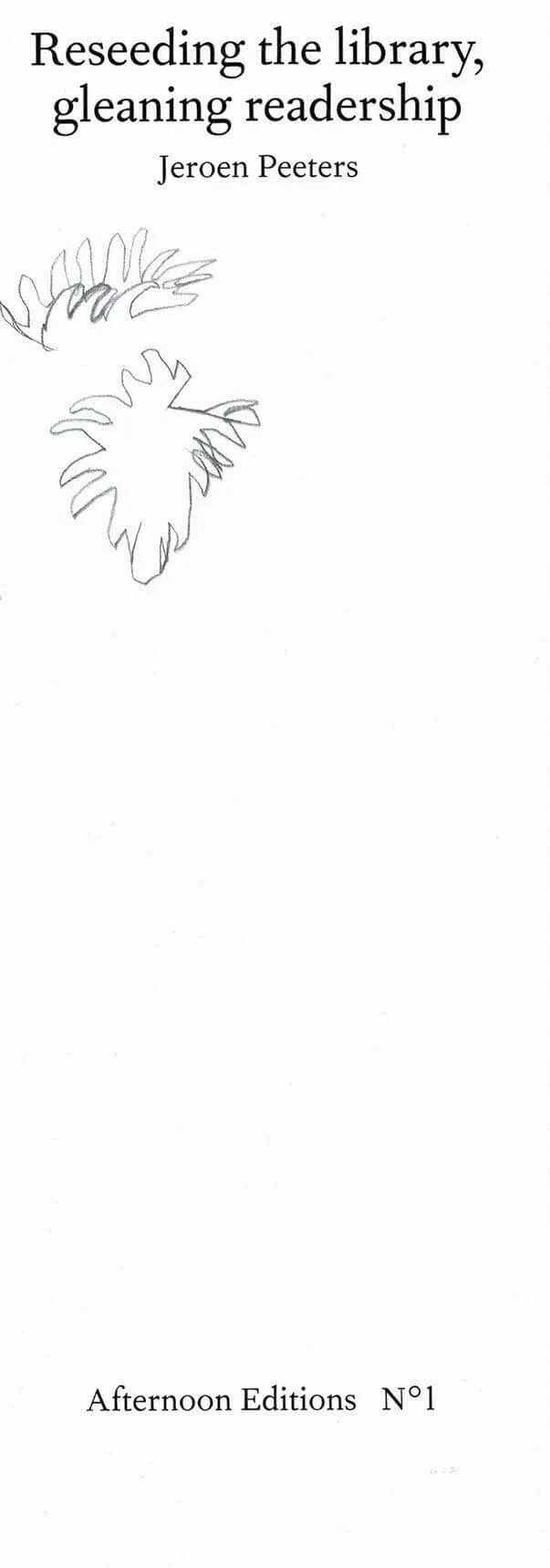
Afternoon Editions no. 1: an essay by Jeroen Peeters titled Reseeding the library, gleaning readership. In May 2017, Time has fallen asleep in the afternoon sunshine settled during three weeks in the Ravenstein Gallery in Brussels as part of the Kunstenfestivaldesarts. Invited as a writer in residence, Jeroen Peeters visited the library of living books on a daily basis and recorded his observations by hand in a notebook, which formed the basis for Afternoon Edition #1. Reseeding the library, gleaning readership is an essay on the seed library, on the dispersion of literature through wind, water and animals, on biodiversity and commoning at the heart of readership. On the cover a drawing by Wouter Krokaert of a Philodendron Xanadu. Published May 2018.